

Bankformulieren

Ferdi Enquête Voorbeeld Dat Aangepast Mag Worden
Ferdi Enquête voorbeeld dat aangepast mag worden.
Ga naar categorie:Bankformulieren
KYC Formulier
Een KYC-formulier (Know Your Client) wordt door banken en andere financiële instellingen gebruikt om informatie over de identiteit en het adres van hun klanten te verzamelen. Met deze template voor een KYC-formulier kan je organisatie deze informatie en ondertekende verklaringen naadloos online verzamelen. Je kunt de formuliertemplate eenvoudig op je behoeften afstemmen om de gewenste informatie te verzamelen. Als je klaar bent, kun je het formulier online delen of persoonlijk door klanten laten invullen. Je kunt alle ingediende formulieren bekijken via je beveiligde Jotform-account dat met een 256-bits SSL-verbinding is beschermd en aan de vereisten voor AVG- en CCPA-compliance voldoet.Je kunt deze template voor een KYC-formulier volledig op je behoeften afstemmen door vragen en het logo van je bedrijf toe te voegen en de lettertypen en kleuren aan te passen. Door onze drag-and-drop formulierbouwer te gebruiken, kun je de template binnen slechts enkele minuten personaliseren. Daarnaast kun je uit meer dan 100 gratis integraties kiezen om ingevulde formulieren automatisch met andere apps, zoals Google Drive, Dropbox of Box te synchroniseren. Als je bij een financiële instelling werkt, kun je dit gratis KYC-formulier gebruiken om klantinformatie en ondertekende verklaringen eenvoudig online te verzamelen.
Ga naar categorie:Bankformulieren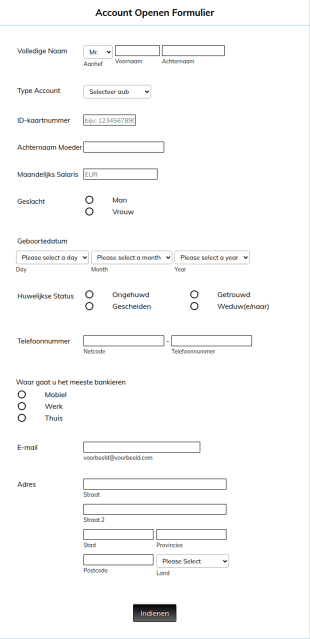
Account Openen Formulier
Een Account Openen Formulier wordt ingevuld door iemand die een rekening opent bij een bank, kredietunie of andere financiële instelling. Het voorziet de bank van belangrijke details zoals contactinformatie, maandsalaris, huisadres, en meer, zodat zij alle informatie hebben om een nieuwe bankrekening aan te maken. In plaats van dat klanten een papieren formulier invullen dat vervolgens gescand en geüpload moet worden naar uw computersysteem, kunt u dit gratis online Account Openen Formuliersjabloon gebruiken om snel de informatie te verzamelen die u nodig hebt. Het is een eenvoudige manier om onnodige papierwerk te voorkomen, uw administratie te organiseren en het intakeproces voor uw klanten te verbeteren. Om de efficiëntie van uw bank te maximaliseren, moet u deze Account Openen Formuliersjabloon enkel aanpassen aan uw behoeften. U hoeft alleen maar extra informatievelden toe te voegen, een veld voor het uploaden van bestanden op te nemen voor ondersteunende documenten, of te integreren met een van onze meer dan 100 nuttige toepassingen om de productiviteit verder te verhogen. Waarom zou u uw formulier niet koppelen aan een CRM systeem als HubSpot of Salesforce om het toe te voegen aan uw huidige database met contactpersonen? Hoe u uw sjabloon ook aanpast, u kunt uw workflow stroomlijnen en tijd en geld besparen door het klantintakeproces van uw bank online te nemen met een gratis openingsformulier voor accounts.
Ga naar categorie:Bankformulieren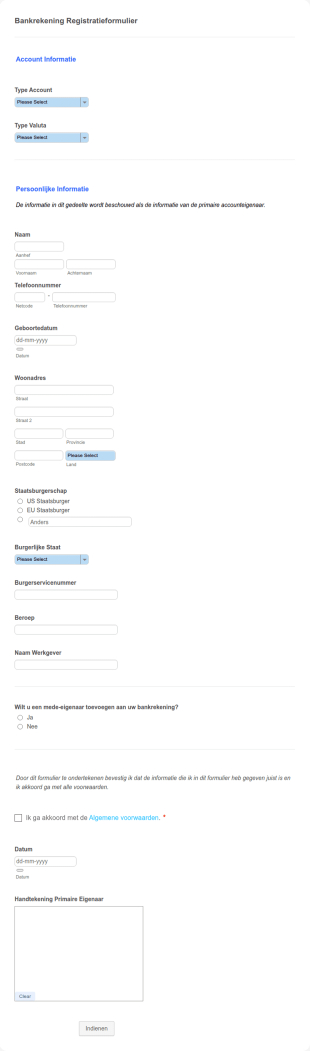
Bankrekening Registratieformulier
Een Bankrekening Registratieformulier wordt gebruikt om de gegevens te verzamelen die nodig zijn voor het openen van een nieuwe bankrekening voor een klant. Neem uw bank of financiële instelling mee naar de 21e eeuw door online bankrekeningregistraties te verwerken met ons gratis Bankrekening Registratieformulier! U kunt alle informatie verzamelen die nodig is om een nieuwe account te openen, zoals contactgegevens, burgerlijke staat, staatsburgerschap en meer. Alle inzendingen worden veilig online opgeslagen en beschermd met 256-bits SSL, GDPR-compliantie, CCPA-compliantie en PCI-compliantie. Voeg het logo van uw financiële instelling toe voor een professioneel tintje met onze Formulier Bouwer. En het aanpassen van het Bankrekening Registratieformulier hoeft daar niet meer bij te blijven: U kunt lettertypen en kleuren wijzigen, handige widgets toevoegen en een veld voor het uploaden van bestanden toevoegen om ondersteunende documenten tegelijkertijd te verzamelen. Om handmatige gegevensinvoer te beperken en de efficiëntie te maximaliseren, synchroniseert u automatisch inzendingen met apps van derden, zoals Google Drive, Airtable, Slack of Trello, met ons scala aan krachtige integraties.
Ga naar categorie:Bankformulieren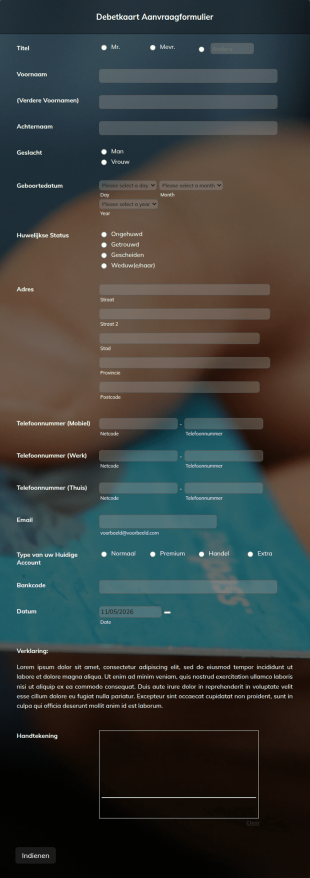
Debetkaart Aanvraagformulier
Met een debetkaart kunnen gebruikers betalen met plastic in plaats van contant geld, met geld van hun eigen rekening. Of u nu werkt voor een bank of een kredietunie met traditionele betaalkaarten, of een bedrijf dat herlaadbare en prepaid betaalkaarten aanbiedt, ons gratis Aanvraagformulier Debetkaart zal naadloos online applicaties accepteren en uw debetcard-distributieproces stroomlijnen. Klanten kunnen hun persoonlijke gegevens vermelden, selecteren welk type account ze willen openen, en hun handtekening geven, en dat alles in één keer. Inzendingen worden naar je beveiligde Jotform account gestuurd, waar je elke aanvraag eenvoudig kunt bekijken en organiseren. Pas het Aanvraagformulier Debetkaart aan uw instelling aan met onze gebruiksvriendelijke Formulier Bouwer. U kunt meer formuliervelden toevoegen, het sjabloonontwerp wijzigen en zelfs uw logo uploaden zonder enige codering. Als uw toepassing extra documenten vereist, voegt u gewoon een veld voor het uploaden van bestanden toe waarmee clients bestanden rechtstreeks vanaf hun bureaublad of mobiele apparaat kunnen slepen en neerzetten! Voor nog meer efficiëntie kunt u het formulier integreren met apps van derden die uw bedrijf al gebruikt om automatisch inzendingen naar deze accounts te sturen, zoals Google Drive, Dropbox, Slack en Airtable. Door het aanvraagproces voor zowel personeel als klanten te vereenvoudigen, is uw aangepaste aanvraagformulier voor betaalkaarten de perfecte manier om uw betaalkaartprogramma te verbeteren en het lidmaatschap te vergroten.
Ga naar categorie:BankformulierenOver Bankformulieren
Banking Forms are specialized digital forms designed to facilitate various financial operations within the banking industry. These forms serve as crucial components for managing transactions, customer onboarding, loan applications, and numerous other financial services. In real-world workflows, Banking Forms streamline processes such as account opening, customer inquiries, and compliance procedures, ensuring that data is captured accurately and securely. By digitizing these workflows, banks can enhance customer experiences and improve operational efficiency significantly.
Probeer vandaag nog een van onze gratis online bankformuliersjablonen!
Why Use Banking Forms?
- Banking Forms are essential for ensuring the accuracy of financial data, as they minimize human errors associated with manual data entry. By automating entries, banks can maintain high levels of precision in their records, which is crucial for audits and regulatory compliance.
- Speed is a significant advantage of using Banking Forms, as they enable rapid processing of financial transactions and customer requests. This efficiency not only improves customer satisfaction but also boosts the overall productivity of banking operations.
- Professional data handling is achieved through Banking Forms by providing a secure and organized method for data collection and management. This ensures that sensitive financial information is protected and easily retrievable for authorized personnel.
- Banking Forms facilitate seamless integration with other banking systems, allowing for real-time data synchronization and improved workflow automation. This integration capability enhances the operational fluidity of banking institutions.
- Customizable templates in Banking Forms allow banks to adapt quickly to changing regulatory requirements and market conditions. This flexibility ensures that banks remain compliant and responsive to industry shifts.
Common Problems Solved by Banking Forms
- One of the primary issues addressed by Banking Forms is the reduction of paperwork. Traditional banking processes often involve copious amounts of paperwork, which can be cumbersome and prone to misplacement. Digital forms eliminate this by providing a reliable digital storage solution.
- Manual data entry is another significant pain point in the banking industry, often leading to errors and inefficiencies. Banking Forms automate this process, ensuring that data is entered accurately and swiftly.
- Lost data is a critical concern, especially in financial transactions where every piece of information is vital. Banking Forms ensure that all data is securely stored and easily accessible, reducing the risk of data loss.
- Compliance management can be complex and time-consuming. Banking Forms simplify this process by automating compliance checks and ensuring that all necessary information is collected and stored according to regulatory standards.
Matching Use Cases to Features
- For customer onboarding, the Drag-and-Drop Form Builder enables banks to create personalized and intuitive forms that streamline the onboarding process, enhancing the customer experience.
- The use of Conditional Logic in Banking Forms allows for dynamic form behavior, adjusting questions based on previous answers. This feature is ideal for loan application forms where different pathways are needed based on customer responses.
- With 30+ Payment Gateways like Stripe and PayPal, Banking Forms facilitate seamless online transactions, making it easy for customers to make payments directly through the forms.
- Electronic Signatures (Jotform Sign) feature is crucial for contract and document approvals, allowing customers to sign documents digitally, thereby speeding up the processing time and reducing the need for in-person visits.
- The PDF Editor (Automated PDF Generation) is beneficial for creating professional, downloadable copies of submitted forms, which can be used for customer records or compliance documentation.
- Secure Data Management through Jotform Tables ensures that all collected data is stored securely, providing banking professionals with peace of mind regarding data protection and organization.
- Approval Workflows streamline the internal review process by automating the flow of form submissions to the relevant departments, ensuring timely actions and decisions.
How to Create a Banking Form
- Browse the Template List for a Bankings template or start from a blank form.
- Afdelingen voor bedrijfscommunicatie
- Zorgt voor tijdige aanvulling van voorraad en voorkomt verlies
Top Use Cases for Banking Forms
- For Managers: Managers can leverage Banking Forms to gain real-time insights into financial operations and customer interactions. By utilizing Jotform's reporting features, they can analyze trends and make informed decisions that enhance operational efficiency. The centralized data management also ensures that all managerial decisions are based on accurate and up-to-date information.
- For Teams: Banking teams benefit from forms that streamline communication and data sharing. With Jotform's integration capabilities, team members can collaborate seamlessly, ensuring that all departments are aligned and working towards common goals. The automation of routine tasks allows teams to focus on more strategic initiatives, improving overall productivity.
- For Customers: Customers experience a smoother banking process with the use of digital Banking Forms. These forms reduce the need for physical branch visits, enabling customers to complete transactions, applications, and inquiries online at their convenience. The ease of use and accessibility of these forms greatly enhance customer satisfaction and loyalty.
Summarizing Banking Forms
Banking Forms are indispensable in transforming how banks handle data, interact with customers, and manage operations. By digitizing and automating various banking processes, these forms help institutions enhance accuracy, speed, and professionalism in their services. Jotform's online form builder provides the necessary tools to customize and manage these forms efficiently, ensuring that banks can meet both their operational goals and customer expectations. As the banking industry continues to evolve, these forms play a crucial role in maintaining competitive advantage and regulatory compliance.
Veelgestelde vragen
1. Wat is een bankformuliertemplate?
Ja, Jotform biedt een gratis abonnement waarmee gebruikers bankformulieren kunnen maken en gebruiken. Er gelden echter enkele limieten voor het aantal inzendingen en functies. Dit is ideaal voor kleinschalige projecten of om het systeem eerst uit te proberen.
2. Waarom zijn digitale bankformulieren belangrijk voor financiële instellingen?
Digitale bankformulieren verminderen papierwerk, minimaliseren fouten, versnellen verwerkingstijden en verbeteren de gegevensbeveiliging, waardoor bankactiviteiten efficiënter en klantvriendelijker worden.
3. Welke informatie is doorgaans vereist in een bankformulier?
Veelvoorkomende velden zijn onder andere persoonlijke identificatie, contactgegevens, financiële informatie, arbeidsverleden, documentuploads en autorisatiehandtekeningen, afhankelijk van het doel van het formulier.
4. Zijn er verschillende soorten bankformulieren?
Ja, er zijn verschillende soorten, waaronder formulieren voor het openen van een account, leningaanvragen, KYC/AML-complianceformulieren, verzoeken voor bankoverschrijvingen en klanttevredenheidsenquêtes.
5) Kan ik deze formulieren op mobiele apparaten gebruiken?
Ja, de formulieren van Jotform zijn volledig responsief en kunnen op elk mobiel apparaat worden geopend en ingevuld. Dit zorgt voor optimale flexibiliteit en gebruiksvriendelijkheid voor zowel gebruikers als klanten.
6. Hoe helpen bankformulieren bij naleving van regelgeving?
Bankformulieren kunnen worden aangepast om alle benodigde informatie en documentatie te verzamelen die vereist is voor KYC, AML en andere regelgevingsnormen, wat helpt bij compliance en auditgereedheid.
Is de informatie die via bankformulieren wordt ingediend veilig?
Ja, Jotform maakt SSL-versleuteling mogelijk en helpt bij compliance met gegevensbeschermingsnormen zoals GDPR en PCI DSS om ervoor te zorgen dat gevoelige financiële gegevens veilig worden bewaard.
8. Kunnen bankformulieren met andere financiële software worden geïntegreerd?
Absoluut. Je kunt Jotform met CRM-systemen, betalingsgateways en tools voor documentbeheer integreren om naadloze gegevensoverdracht en workflowautomatisering mogelijk te maken.