If there was a tool that could slash your company’s time to hire by as much as 75 percent, would you use it?
That’s what happened when leaders at Chipotle integrated AI-powered recruitment software into the company’s hiring process. Dubbed “Ava Cado,” it helped reduce the time between application and offer acceptance by more than seven days. For a company that hires upwards of 9,000 people per year, that’s more than a benefit — it’s an essential for doing business.
Lack of time is one of the major obstacles HR professionals face when hiring. Even if your business hires only a small fraction of Chipotle’s number yearly, the process of screening candidates, fact-checking resumes, arranging interviews, and onboarding new employees can eat up the majority of hours in a workday. These tasks simply aren’t the best use of your skilled HR team’s time.
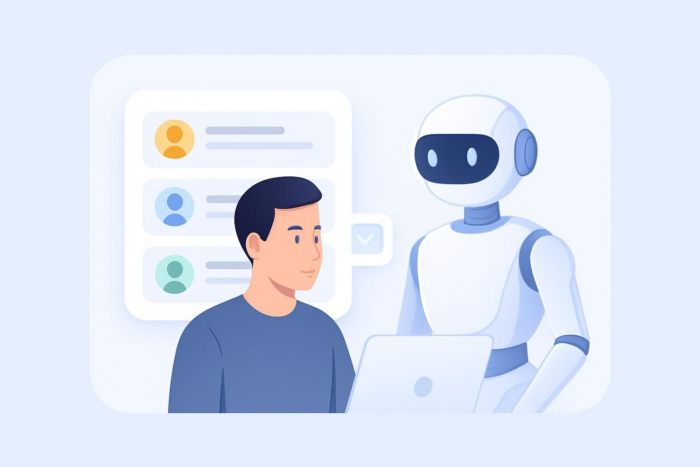
AI can do these and other routine administrative tasks faster and more efficiently than people, streamlining the entire hiring workflow. Plus, incorporating artificial intelligence into your process helps you reduce human biases in hiring as well.
Before you start researching AI tools, however, be aware there are some challenges associated with using the technology. This article aims to give you a full picture of AI in HR recruitment, covering five benefits and five challenges of AI adoption. It also offers up some solutions to help you navigate those challenges and make your implementation a success.
5 key benefits of AI in recruitment
1. Faster resume screening
On average, it takes an HR professional more than 20 minutes to review a resume; But AI can review and rank candidates 10 times faster by searching for keywords that match the job description and evaluating applicants based on certain criteria as defined by you. That means your HR team could have a short list of suitable candidates in hours rather than weeks — even with thousands of applicants.
2. Reduced hiring bias
Whether it’s done consciously or not, people can sometimes carry over biases into resume reviews. This can result in favoring certain candidates over others and creating a less diverse pool of talent. AI helps minimize discrimination by focusing solely on skills and experience. It can also be used to summarize and anonymize résumés so that human recruiters see only each applicant’s relevant job-related information rather than personal information during the review phase.
3. Better candidate experience
One of the biggest recruitment challenges is providing a positive candidate experience. Candidates form their first impressions of your organization during this phase, so you want it to be smooth. Human recruiters may not be able to pull this off if they’re juggling large numbers of roles and applicants simultaneously. But AI chatbots can help keep applicants engaged by providing real-time updates on the status of the hiring process, offering interviewees tips on how to prepare, and sending onboarding documents in a timely manner.
4. Improved job matching
Evaluating thousands of resumes manually is a tedious process, one that can easily overwhelm HR practitioners despite their best intentions. Not only does AI never tire of the job, it also does the job better in most cases. It analyzes the trends, experiences, and skills of candidate profiles to identify applicants who are the best fit for a role. It can also use predictive analytics to determine which candidates are likely to perform well in certain roles.
5. Lower costs & time to hire
Hiring someone is a costly endeavor, which is why it pays to get it right the first time. Much of the expense comes in the form of “hidden” costs, including the salaries and time of HR workers, fees and wait times for background checks, and the decreased efficiency of departments with unfilled positions. Using artificial intelligence in hiring can help reduce these recruitment costs by up to 30 percent, particularly by freeing up HR workers, automating background checks, and shortening time-to-hire cycles.
5 challenges (& solutions) in AI-based hiring
1. AI hiring bias
AI can minimize bias in the hiring process, but only if it is programmed and trained properly. If the AI is trained on data from just one group or if developers introduce their own biases into the algorithms, AI can actually reinforce discrimination instead.
Solution: Train your AI tool using data from multiple groups and locations. Also, audit your AI regularly to make sure it doesn’t unfairly exclude or discriminate against certain groups.
Can AI remove bias from hiring?
AI isn’t likely to completely eliminate bias from hiring, but it can help reduce it. For example, while humans always bring some amount of subjectivity to resume reviews, AI can look at applications based solely on performance, without any reference to names, genders, ages, and more. Many organizations are seeing good results with AI in hiring, but human oversight is key to preventing unintended discrimination.
2. Lack of transparency
AI hiring tools often operate as “black boxes,” making it unclear how decisions are really made. Additionally, many organizations don’t disclose their use of AI to applicants at the outset, which can lead to confusion and frustration.
Solution: Choose AI systems with explainable algorithms that provide transparent decision reports. Also, inform candidates how you’re using AI in the hiring process, even as early as the job posting stage.
3. Data privacy concerns
AI tools collect and process large volumes of sensitive personal information for candidates, opening up the possibility of data breaches. AI platforms are not always clear about their security measures or level of compliance with data privacy laws.
Solution: Make sure to choose a tool that is compliant with GDPR, CCPA, and any other relevant regulations.
4. Overreliance on AI
Some HR teams may depend too heavily on AI, significantly reducing the role of humans in their hiring decisions. As a result, these organizations could overlook some excellent potential candidates. This approach also risks being perceived as impersonal, which may turn some candidates off.
Solution: The most successful recruitment strategies don’t rely solely on AI. Leave the final hiring decisions to people, and your organization will keep the human touch that makes it a distinctive, welcoming place to work.
5. Soft skills & culture fit assessment
AI struggles when it comes to evaluating personality, communication style, and cultural fit. Without human intervention, this means you’re making hiring choices without considering important aspects like temperament, cultural fit, and team dynamics. Whether you’re hiring interns, full-time employees, or contractors, all of these elements are key to a successful hire.
Solution: Use AI for technical and competency screening but always conduct human-led interviews too.
Hire smarter and faster with Jotform AI Agents
Here’s a recruitment idea: If you’re looking for a simple yet effective way to add AI into your recruitment process, try Jotform’s intelligent AI tools. They’re incredibly easy to use, fit seamlessly into your workflow, and can handle a wide range of hiring-related tasks.
For example, the Jotform AI Resume Screener helps you automate candidate screening. Simply enter the job details and upload resumes, and Jotform’s AI will review and rank applicants, quickly identifying top talent — no coding required. Leveraging powerful natural language processing, Jotform AI learns to refine candidate matching. As a result, you’ll save hours on resume reviews and get instant insights that will help you find the best match for open positions.
You can also use Jotform AI to answer applicants’ questions, communicate with top candidates and schedule interviews, and create dynamic job application forms, ensuring timely, branded interactions from beginning to end.
Explore our full menu of Jotform Human Resources AI Agents, all of which simplify the application and hiring process. Here are just a few examples of agents that can guide and assist applicants:
With Jotform intelligent AI, you can reduce your time to hire, enhance the candidate experience, and empower your HR team to choose prospects that will help your organization grow. There’s no better way to get started with AI-based hiring!
What’s next for recruitment and AI?
AI cannot — and should not — replace the human touch in recruiting, but it will likely continue to take on an even broader supporting role for HR professionals.
One of AI’s strengths is analyzing data to make accurate and reliable predictions. This capability is already being used in other fields, but it can also be applied in recruiting to create predictive hiring models. With the help of AI, you’ll soon be able to create a short list of candidates based on things like likelihood of success in the role or probability of accepting a job offer.
Another trend on the horizon is AI-powered diversity hiring. AI can be used to detect and prevent biased hiring patterns. For example, it can alert you if a particular demographic group is underrepresented in the candidate pool, so you can work to correct the imbalance.
Finally, conversational AI is increasingly being used in the early interview stage. While humans should always interview candidates at some point, AI can be helpful in filtering out candidates from first-round interviews. AI voice and video analysis can provide insights that human interviewers might overlook. But beware: Many candidates find AI interviews unsettling, especially if they aren’t informed in advance.
So what will be the role of recruiters in an increasingly AI-driven world? Rather than being bogged down by administrative tasks, recruiters will have more freedom to actively engage with prospective talent and take time to build relationships that could benefit an organization. With the right combination of AI-based hiring tools and skilled HR practitioners, organizations are more likely to find the right candidates faster.
This guide is for anyone involved in hiring who wants faster, fairer recruiting and a better candidate experience, including HR managers, recruiters, talent acquisition leads, hiring managers, small business owners, and HR coordinators.





































Send Comment: