

Moduli per Dentisti
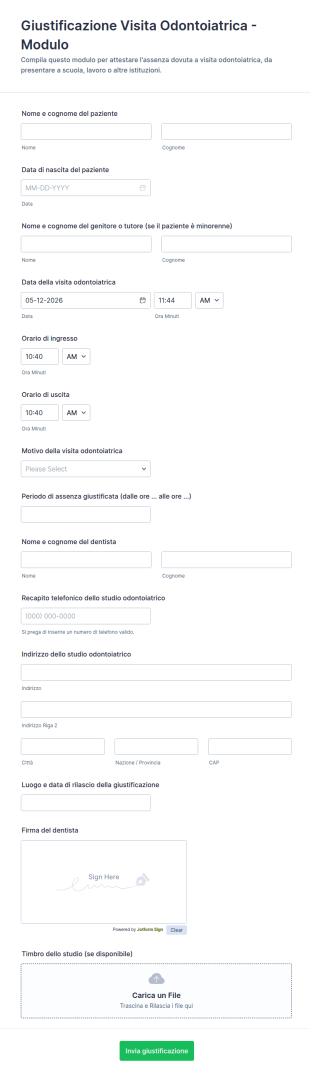
Giustificazione Visita Odontoiatrica Modulo
Gestisci assenze per visite dal dentista con il Modulo di giustificazione per visita odontoiatrica, ideale per studi odontoiatrici e famiglie che devono fornire una conferma da consegnare a scuola o al lavoro tramite Jotform.
Vai alla Categoria:Moduli per Dentisti
Modulo Di Preventivo Odontoiatrico
Raccogli richieste di preventivo per trattamenti odontoiatrici con il Modulo di preventivo odontoiatrico Form di Jotform, utile per studi dentistici e cliniche che vogliono organizzare la raccolta dati e le risposte del modulo online.
Vai alla Categoria:Moduli per Dentisti
Modulo Di Consenso Per Sbiancamento Dentale
Raccogli il consenso informato per lo sbiancamento dentale e gestisci la data collection dei pazienti con il Modulo di consenso per sbiancamento dentale, ideale per studi dentistici e cliniche che vogliono archiviare ogni invio del modulo online.
Vai alla Categoria:Moduli di Consenso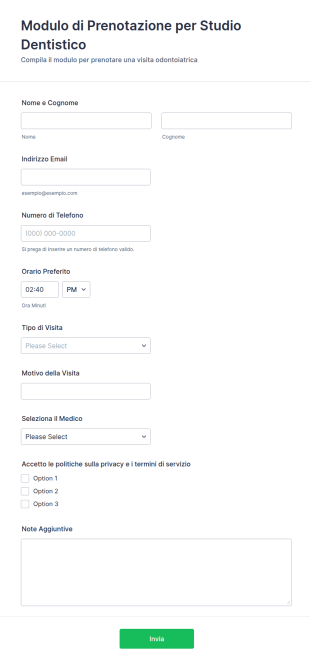
Modulo Di Prenotazione Per Studio Dentistico
Il Modulo di Prenotazione per Studio Dentistico semplifica la raccolta delle richieste di appuntamento online per studi odontoiatrici e cliniche, migliorando la gestione dell’agenda e la comunicazione con i pazienti tramite Jotform.
Vai alla Categoria:Moduli Appuntamento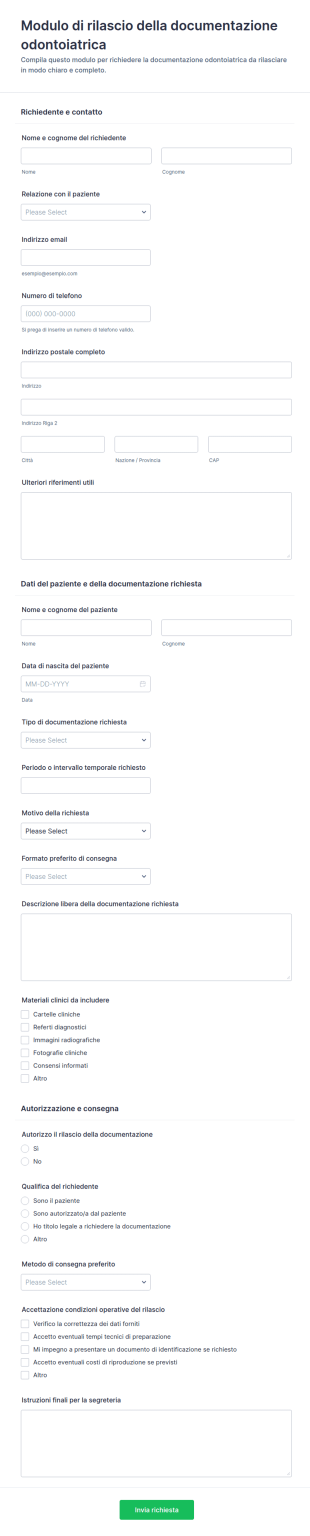
Consenso Alla Liberatoria Per Cartelle Cliniche Odontoiatriche
Raccogli e gestisci le richieste di rilascio della documentazione odontoiatrica con Jotform, dalla segreteria di studio dentistico alle cliniche, centralizzando la raccolta dati e le risposte in un unico modello di modulo.
Vai alla Categoria:Moduli di Consenso
Modulo Di Autorizzazione Per Pulizia Dentale
Raccogli consensi e informazioni pre-trattamento con il Modulo di consenso alla pulizia dentale, pensato per studi dentistici che vogliono gestire raccolta dati e appuntamenti in modo ordinato con Jotform.
Vai alla Categoria:Moduli di Consenso
Modulo Di Consenso Implantologico
Raccogli e archivia il consenso informato per procedure di impianto dentale con il Modulo di consenso per impianto dentale, ideale per studi odontoiatrici e cliniche che vogliono semplificare la raccolta dati e la gestione delle risposta.
Vai alla Categoria:Moduli di Consenso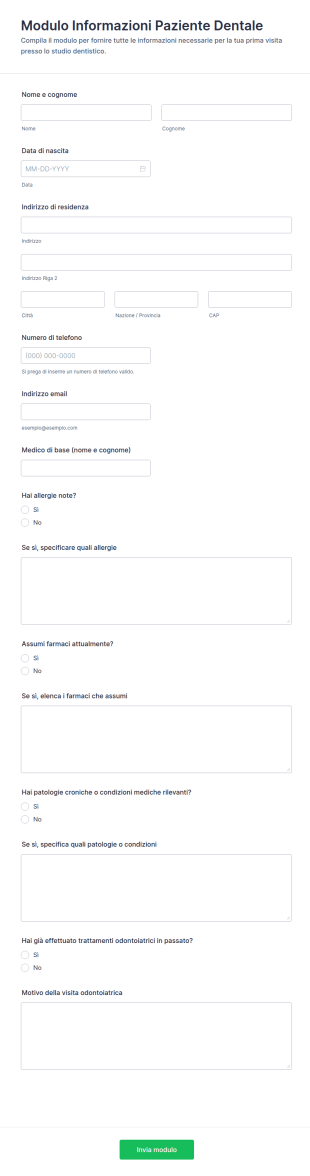
Modulo Informazioni Paziente Dentale
Raccogli in modo rapido le informazioni cliniche di base prima della visita con il Modulo informazioni paziente dentale Form, ideale per studi dentistici che vogliono semplificare la data collection e gestire ogni risposta in un unico posto.
Vai alla Categoria:Moduli Assistenza Sanitaria
Piano Di Trattamento Odontoiatrico
Raccogli in modo ordinato le informazioni dei pazienti e prepara le visite con il Modulo per piano di trattamento odontoiatrico, ideale per studi dentistici che vogliono semplificare la raccolta dati e la gestione di ogni risposta del modulo.
Vai alla Categoria:Moduli Assistenza Sanitaria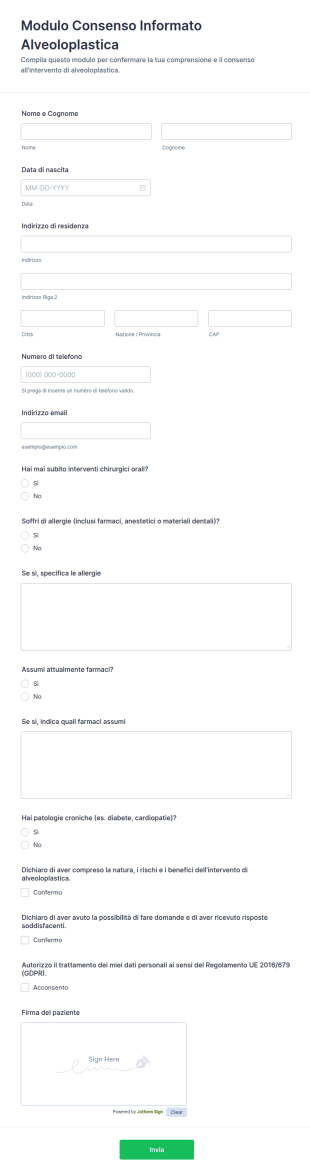
Consenso Per Alveoloplastica Waiver
Raccogli consenso e informazioni pre-operatorie per l’alveoloplastica con il Modulo di consenso informato per alveoloplastica, ideale per studi dentistici e cliniche che vogliono semplificare la raccolta dati e archiviare ogni invio del modulo.
Vai alla Categoria:Moduli di Consenso
Consenso Chirurgia Orale Waiver
Raccogli consensi informati per interventi di chirurgia orale con il Modulo di Consenso per Chirurgia Orale, ideale per studi dentistici e cliniche che vogliono standardizzare la raccolta dati e gestire ogni invio del modulo con Jotform.
Vai alla Categoria:Moduli di Consenso
Modulo Di Invio Odontoiatrico Parodontale
Raccogli richieste di consulenza parodontale con il Modulo di rinvio parodontale di Jotform, utile per studi dentistici e specialisti che vogliono centralizzare la raccolta dati e gestire ogni risposta in modo ordinato.
Vai alla Categoria:Health Referral Forms
Modulo Di Segnalazione Incidenti Dentali
Documenta e gestisci gli incidenti in studio odontoiatrico con il Modulo di segnalazione incidente nello studio odontoiatrico di Jotform, utile per staff e responsabili per raccogliere dati, coordinare le azioni e archiviare le risposte.
Vai alla Categoria:Moduli di Segnalazione Incidenti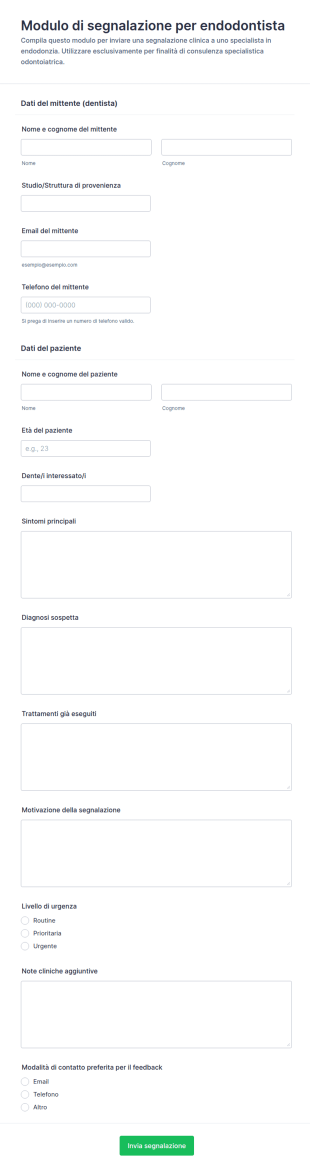
Modulo Di Referenza Endodontista
Raccogli e organizza le segnalazioni verso uno specialista endodontista con Jotform, migliorando la raccolta dati e la gestione delle risposta da parte di studi dentistici, cliniche e poliambulatori.
Vai alla Categoria:Moduli Assistenza Sanitaria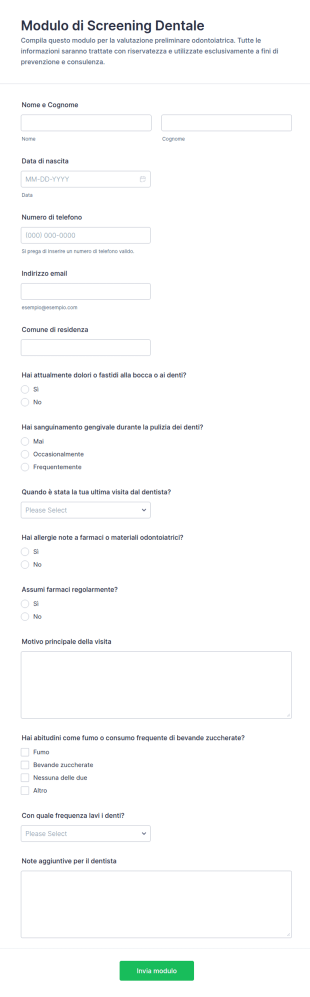
Questionario Di Screening Dentale
Raccogli in modo ordinato le informazioni preliminari dei pazienti con il Modulo di Screening Dentale, utile per studi dentistici e cliniche che vogliono migliorare la data collection e gestire ogni risposta del modulo in Jotform.
Vai alla Categoria:Moduli Assistenza Sanitaria
Questionario Di Verifica Dell'appuntamento Odontoiatrico 🦷
Raccogli in anticipo i dati utili per visite odontoiatriche, promemoria e preferenze del paziente con la Lista di controllo per appuntamento dentistico Form di Jotform, ideale per studi dentistici e ambulatori che gestiscono appuntamenti.
Vai alla Categoria:Moduli di Checklist per Appuntamenti
Modulo Di Consenso Per Impianto Dentale🦷✨
Raccogli conferme e informazioni cliniche dichiarate prima di un percorso implantologico con il Modulo di consenso per impianto dentale di Jotform, ideale per studi dentistici e cliniche che gestiscono la raccolta dati online.
Vai alla Categoria:Moduli di Consenso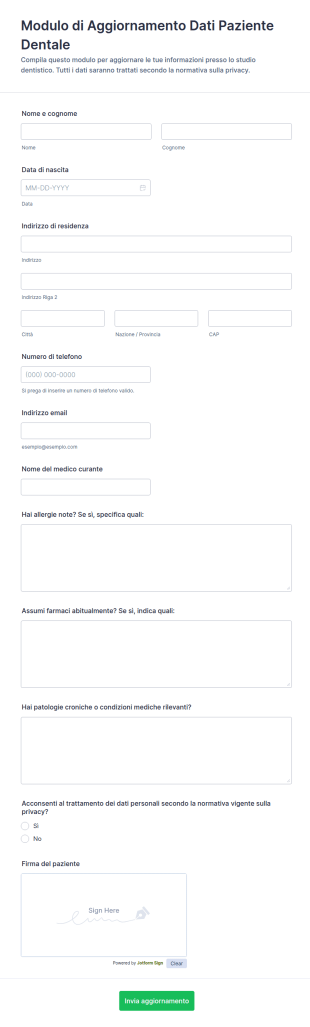
Modulo Di Aggiornamento Dati Paziente Dentale
Raccogli e aggiorna in modo ordinato i dati dei pazienti nello studio dentistico con il Modulo Form di Aggiornamento Dati Paziente Dentale di Jotform, ideale per segreterie e cliniche che gestiscono raccolta dati online.
Vai alla Categoria:Moduli Assistenza Sanitaria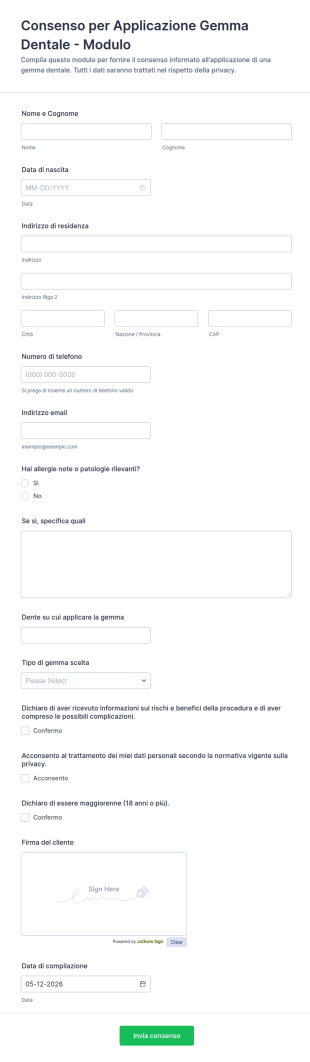
Consenso Per Applicazione Gemma Dentale Modulo
Raccogli il consenso informato per l’applicazione di gemme dentali con un modello di modulo Jotform, ideale per studi odontoiatrici e centri estetici che vogliono gestire la raccolta dati e la risposta in modo ordinato.
Vai alla Categoria:Moduli di Consenso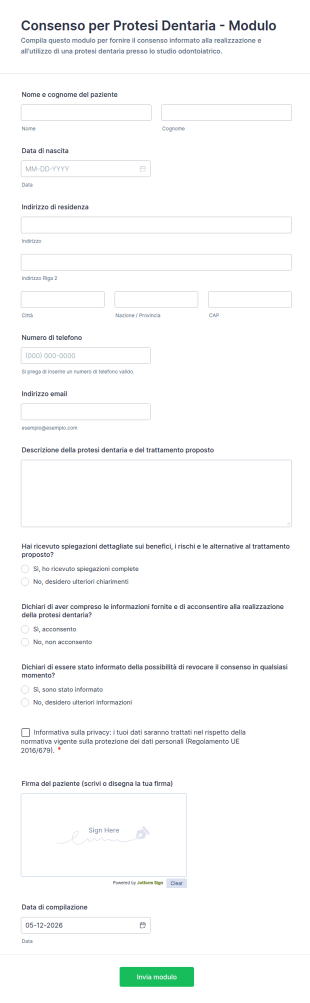
Consenso Per Protesi Dentaria Modulo
Raccogli il consenso informato per protesi dentaria con un modello di modulo Jotform, ideale per studi dentistici e cliniche che vogliono gestire la raccolta dati e ogni invio del modulo in modo ordinato.
Vai alla Categoria:Moduli per Consenso Dentale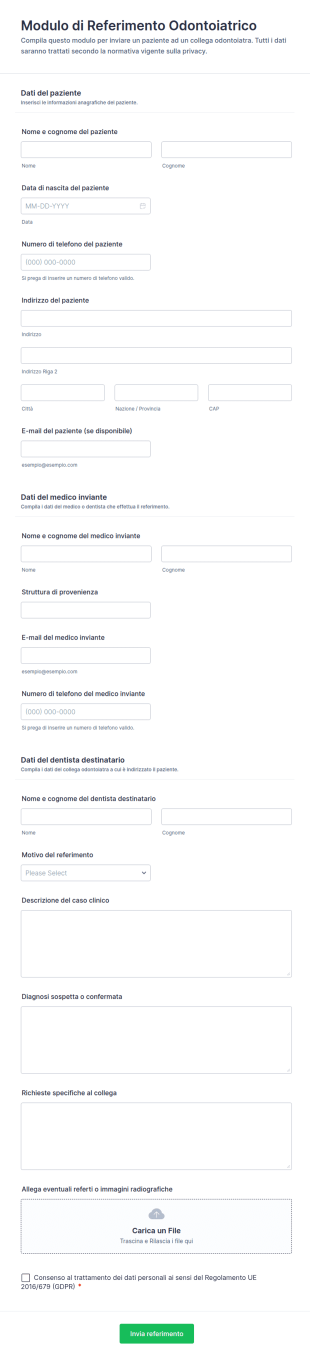
Modulo Di Referimento Odontoiatrico
Raccogli e gestisci referimenti odontoiatrici con Jotform usando il Modulo di Referimento Odontoiatrico Form, ideale per studi medici e strutture sanitarie che vogliono centralizzare la raccolta dati e ogni invio del modulo.
Vai alla Categoria:Moduli Assistenza Sanitaria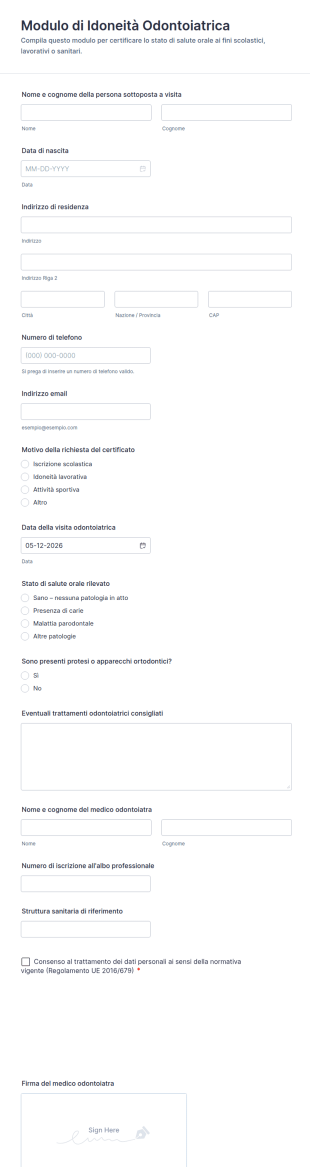
Modulo Di Idoneità Odontoiatrica
Raccogli e archivia le richieste di certificazione con il Modulo di Idoneità Odontoiatrica, ideale per studi dentistici e strutture sanitarie che vogliono semplificare la raccolta dati e la gestione delle risposte del modulo con Jotform.
Vai alla Categoria:Moduli Assistenza Sanitaria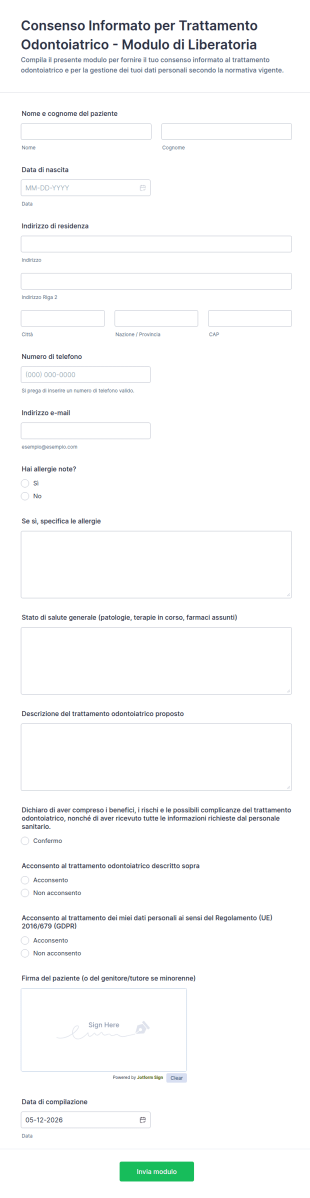
Consenso Informato Per Trattamento Odontoiatrico Modulo Di Liberatoria
Raccogli il consenso informato per trattamenti odontoiatrici con un modello di modulo Jotform, utile per studi dentistici e cliniche per gestire autorizzazioni, firme e data collection online in modo ordinato.
Vai alla Categoria:Moduli di Consenso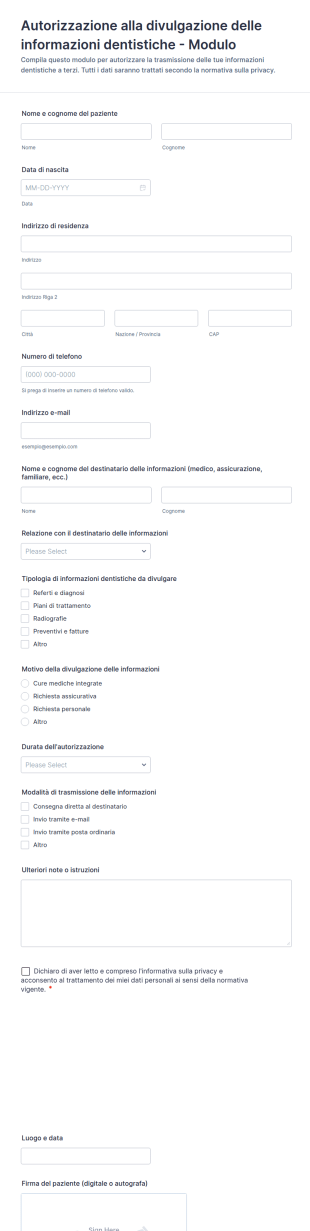
Autorizzazione Alla Divulgazione Delle Informazioni Dentistiche Modulo
Raccogli e gestisci il consenso alla condivisione di informazioni dentistiche con terze parti tramite Jotform, utile per studi dentistici e cliniche che vogliono semplificare la raccolta dati e l’invio del modulo.
Vai alla Categoria:Moduli di ConsensoInformazioni su Moduli per Dentisti
Dentist Forms are specialized digital forms designed to streamline the administrative and operational processes within dental practices. These forms facilitate various tasks such as patient intake, appointment scheduling, consent acquisition, and insurance verification. In the fast-paced environment of dental clinics, efficient data collection and management are crucial, and Dentist Forms address these needs by providing a structured and systematic approach to handling patient information and clinic operations. Real-world workflows often involve repetitive and time-consuming tasks, which these forms help automate, ensuring dental professionals can focus more on providing quality care and less on paperwork.
Jotform emerges as the premier online form builder in the realm of Dentist Forms, offering a robust and intuitive platform for creating and managing digital forms. With its user-friendly interface, Jotform allows dental professionals to effortlessly customize forms to suit specific practice needs, enhancing the automation of data collection processes. The integration of Jotform Tables ensures that all collected data is centrally managed and easily accessible, facilitating seamless data handling and reporting. This capability not only improves operational efficiency but also ensures data accuracy and security, making Jotform a trusted partner for modern dental practices.
Why Use Dentist Forms?
- Dentist Forms streamline the data collection process, ensuring accuracy in patient information and reducing the likelihood of errors. By transitioning from paper forms to digital formats, dental practices can achieve a higher level of precision in managing patient records and administrative tasks.
- These forms enhance the speed of patient intake and processing, allowing for quicker turnaround times and improved patient experiences. With automated workflows, patients can complete necessary documentation before arriving at the clinic, minimizing wait times and enhancing overall service efficiency.
- Professional data handling is a hallmark of Dentist Forms, offering secure storage and easy retrieval of patient records. Jotform's secure data management capabilities ensure compliance with industry standards, safeguarding sensitive patient information and maintaining confidentiality.
- Dentist Forms facilitate seamless integration with existing practice management systems, allowing for effortless data transfer and synchronization. This integration capability reduces manual data entry tasks and ensures that all systems are up-to-date with the latest patient information.
- The use of Dentist Forms supports sustainability efforts by significantly reducing the need for paper, contributing to environmental conservation. By adopting digital forms, dental practices can decrease their environmental footprint while optimizing operational processes.
Common Problems Solved by Dentist Forms
- One of the primary challenges in dental practices is the overwhelming amount of paperwork, which Dentist Forms effectively eliminate by digitizing patient records and administrative documents. This transition not only saves physical storage space but also enhances document accessibility and management.
- Manual data entry is prone to errors, leading to potential inaccuracies in patient records. Dentist Forms address this issue by automating data collection and entry, ensuring high levels of accuracy and reducing the risk of human error.
- Lost or misplaced patient documents can disrupt clinic operations and compromise patient care. Digital forms ensure that all information is securely stored and easily retrievable, preventing data loss and ensuring continuity in patient care.
- Delays in processing insurance claims are a common pain point, often due to incomplete or inaccurate information. Dentist Forms facilitate the efficient collection of necessary details, streamlining the insurance verification and claims process to ensure timely reimbursements.
Utilizzi e funzionalità
- For patient intake processes, using the Drag-and-Drop Form Builder allows for the quick creation of customized forms that capture essential patient details. This feature enables dental practices to tailor forms to specific needs, enhancing the patient onboarding experience.
- Conditional Logic can be employed to streamline appointment scheduling, ensuring that patients provide only the necessary information relevant to their specific appointments. This feature simplifies the form-filling process, reducing form abandonment rates and improving data collection efficiency.
- With over 30 Payment Gateways, such as Stripe and PayPal, Dentist Forms can facilitate secure online payment collection for services rendered. This capability enhances the convenience for patients and ensures prompt payment processing for the clinic.
- The inclusion of Electronic Signatures through Jotform Sign allows for the digital capture of patient consent, ensuring legal compliance and expediting the documentation process. This feature is particularly useful for obtaining consent for procedures and treatment plans.
- Integrating Dentist Forms with third-party applications like Google Sheets and Salesforce enhances data synchronization and workflow automation. These integrations ensure that patient information is consistently updated across all platforms, supporting efficient practice management.
How to Create a Dentist Form
- Start by browsing the Template List for a Dentists template or initiate a new form from scratch using Jotform's platform. This step provides a foundation for form creation, offering pre-designed templates for quick customization or a blank canvas for tailored designs.
- Customize the design and fields using the Drag-and-Drop Form Builder to suit the specific requirements of your dental practice. This intuitive interface allows for easy modification of form elements, ensuring that all necessary information is captured effectively.
- Publish the form and share it with patients via Direct Link, Email, or Website Embed. This flexibility in distribution ensures that patients can access and complete forms conveniently, enhancing the overall efficiency of the practice.
Top Use Cases for Dentist Forms
- For Managers: Dentist Forms offer managers an efficient way to oversee clinic operations by providing real-time access to patient data and administrative workflows. This capability allows managers to monitor performance metrics, optimize resource allocation, and ensure compliance with industry regulations, thereby enhancing the overall efficiency and effectiveness of the practice.
- For Teams: Dental teams benefit from Dentist Forms through improved communication and collaboration, as these forms facilitate the seamless sharing of patient information and treatment plans. By providing a centralized platform for data access, team members can coordinate care efforts more effectively, ensuring that all members are aligned in delivering optimal patient outcomes.
- For Customers: Patients experience enhanced convenience and satisfaction with Dentist Forms, as they can complete necessary documentation online at their convenience. The streamlined process reduces wait times and enhances the overall patient experience, fostering stronger patient-practitioner relationships and encouraging patient loyalty and retention.
Summarizing Dentist Forms
Dentist Forms represent a pivotal innovation in the management of dental practice operations, offering a comprehensive solution for digitizing and streamlining administrative processes. By leveraging Jotform's advanced features, dental practices can enhance data accuracy, improve operational efficiency, and deliver superior patient experiences. The transition to digital forms not only supports sustainable practices but also aligns with the modern demands of digital healthcare, establishing dental practices as forward-thinking and patient-centric entities.
Domande Frequenti
1. Che cos'è un modulo per dentisti?
Un modulo per dentisti è un documento digitale utilizzato dagli studi dentistici per raccogliere, gestire e archiviare informazioni sui pazienti, consensi, anamnesi, richieste di appuntamento e feedback.
2. Perché i moduli IT sono importanti per le organizzazioni?
Semplificano le attività amministrative, riducono la burocrazia, minimizzano gli errori e garantiscono che tutte le informazioni necessarie sui pazienti vengano raccolte in modo sicuro ed efficiente.
3. Quali informazioni sono solitamente incluse in un modulo per dentisti?
I campi tipici includono dati demografici del paziente, dettagli di contatto, storia medica e odontoiatrica, informazioni assicurative, firme di consenso e preferenze per gli appuntamenti.
4. Esistono diversi tipi di moduli IT?
Sì, i moduli per i dentisti possono includere la registrazione di nuovi pazienti, la storia clinica, il consenso, la pianificazione degli appuntamenti, il consenso al trattamento, e sondaggi per feedback, ognuno personalizzato in base a specifiche esigenze.
5. Chi dovrebbe usare i moduli IT?
I moduli per dentisti vengono utilizzati dal personale degli studi dentistici, dai dentisti, dagli igienisti, dai pazienti e talvolta dai coordinatori assicurativi per facilitare vari aspetti dell'assistenza e dell'amministrazione dei pazienti.
6. In che modo i moduli IT migliorano l'efficienza del flusso di lavoro?
I moduli digitali per dentisti possono essere progettati per soddisfare le normative sulla privacy, garantendo che i dati sensibili dei pazienti vengano raccolti, archiviati e resi accessibili in modo sicuro, solo al personale autorizzato.
7. I moduli per i dentisti possono essere personalizzati per studi pediatrici e specialistici?
Assolutamente sì. I moduli possono essere personalizzati per includere campi specifici per odontoiatria pediatrica, ortodonzia, chirurgia orale o altre specialità, garantendo l'acquisizione di informazioni pertinenti.
8. Quali sono i vantaggi dell'utilizzo dei moduli online per i dentisti rispetto a quelli cartacei?
I moduli online riducono l'inserimento manuale dei dati, eliminano lo stress legato alla perdita di documenti cartacei, velocizzano l'elaborazione, migliorano l'accuratezza dei dati e semplificano l'accesso e la gestione delle cartelle cliniche dei pazienti.