

Moduli per Funzionari di Polizia
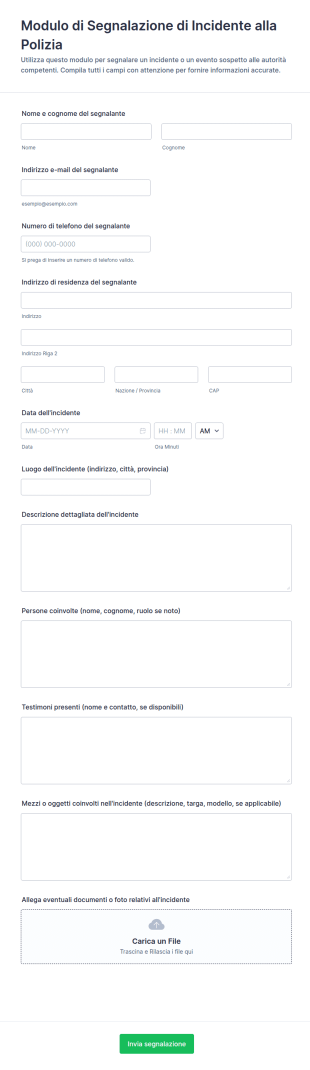
Modulo Di Segnalazione Di Incidente Alla Polizia
Raccogli e organizza segnalazioni di incidenti da inviare alle autorità con il Modulo di Segnalazione di Incidente alla Polizia di Jotform, utile per cittadini, aziende e strutture che vogliono gestire la raccolta dati in modo chiaro.
Vai alla Categoria:Moduli di Segnalazione Incidenti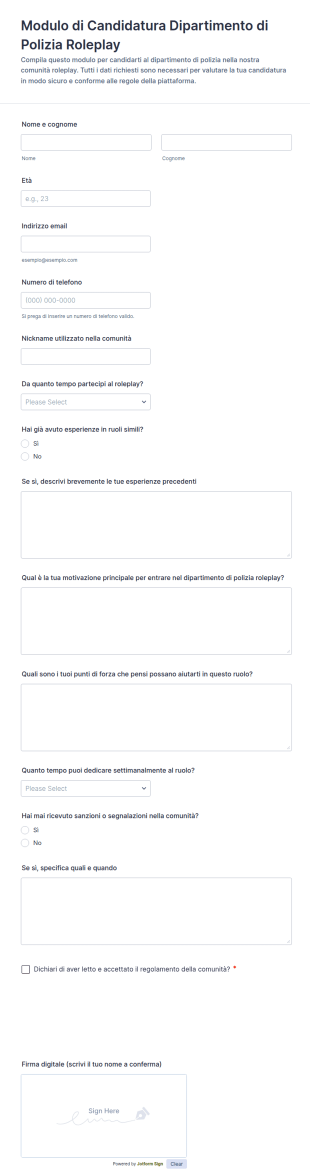
Candidatura Per Ruolo Di Polizia Form
Gestisci le candidature per un dipartimento di polizia roleplay con un modulo pronto all’uso, utile a staff e moderatori per raccogliere dati e valutare motivazioni, disponibilità e adesione al regolamento con Jotform.
Vai alla Categoria:Moduli di Domanda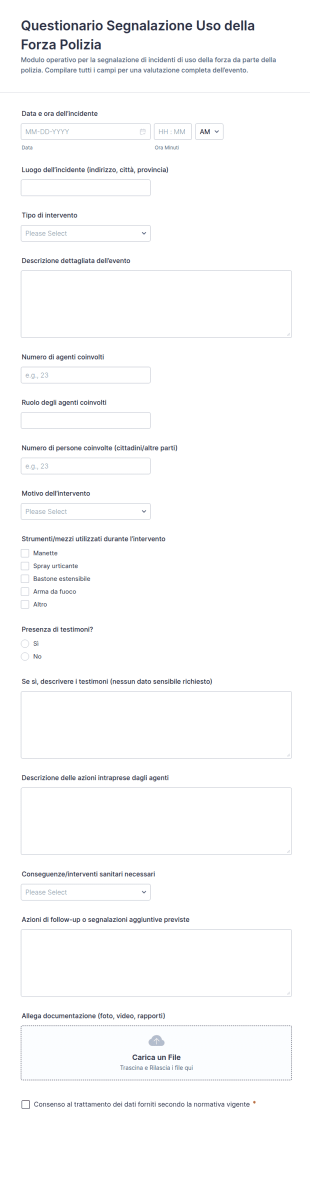
Segnalazione Uso Della Forza Da Parte Della Polizia
Raccogli e organizza segnalazioni sull’uso della forza durante interventi di polizia con il Questionario per Segnalazione Uso della Forza della Polizia Modulo, ideale per enti pubblici, associazioni e attività di monitoraggio.
Vai alla Categoria:Template Questionario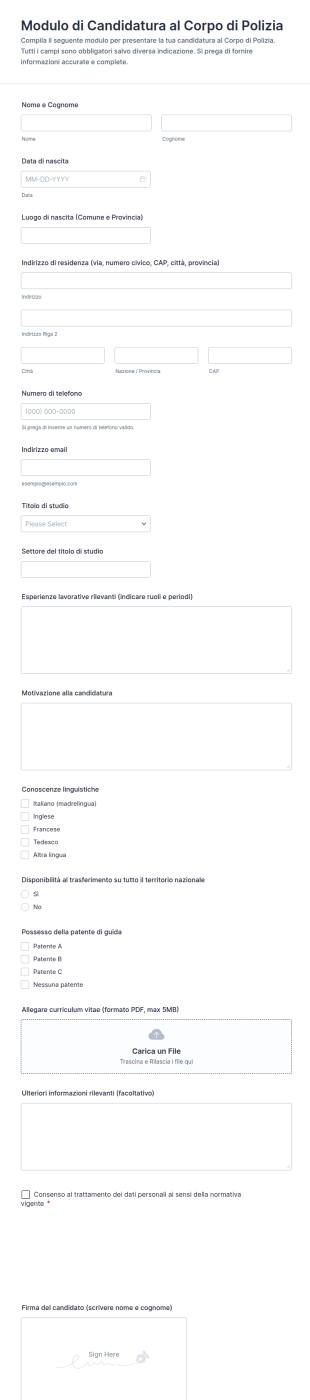
Modulo Di Candidatura Per La Polizia
Raccogli candidature per concorsi e selezioni del Corpo di Polizia con il Modulo di Candidatura al Corpo di Polizia di Jotform, utile per gestire la raccolta dati e le risposte in modo uniforme e tracciabile.
Vai alla Categoria:Moduli di Domanda
Questionario Sanitario Per Uso Interno Della Polizia Form
Raccogli informazioni sanitarie interne e recapiti del personale con il Questionario Sanitario per Uso Interno della Polizia Form di Jotform, ideale per uffici amministrativi e reparti che gestiscono raccolta dati online.
Vai alla Categoria:Template Questionario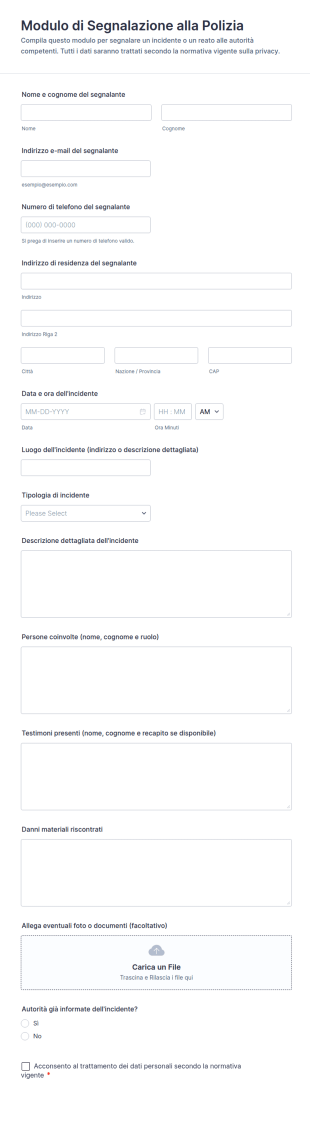
Modulo Di Segnalazione Alla Polizia
Raccogli e organizza segnalazioni di incidenti con il Modulo di Segnalazione alla Polizia, utile per cittadini e organizzazioni che vogliono gestire la raccolta dati e le risposte in modo chiaro e tracciabile con Jotform.
Vai alla Categoria:Moduli di Segnalazione IncidentiInformazioni sui Moduli per Funzionari di Polizia
Police Officer Forms are specialized digital forms designed to assist law enforcement agencies in managing a myriad of operational tasks. These forms streamline the collection and processing of crucial information, such as incident reports, witness statements, and evidence logs, thereby enhancing the efficiency of police operations. In real-world workflows, Police Officer Forms are utilized for tasks such as documenting crime scenes, reporting traffic violations, and managing personnel records. By leveraging these forms, police departments can significantly reduce the time spent on paperwork, allowing officers to focus more on fieldwork and community engagement, thus improving overall public safety.
Jotform stands out as the premier online form builder for creating Police Officer Forms, offering an intuitive, web-based Drag-and-Drop Form Builder that simplifies the customization process. With Jotform, law enforcement agencies can automate data collection, ensuring that information is accurately captured and easily accessible. The platform's ability to centralize data management through Jotform Tables further enhances the operational efficiency of police departments, allowing for seamless tracking and analysis of collected data. This integration not only aids in reducing administrative burdens but also facilitates better decision-making processes within the law enforcement sector.
Why Use Police Officer Forms?
- Police Officer Forms enhance data accuracy by eliminating the need for manual entry, thereby reducing the risk of human error. This is particularly crucial in law enforcement where precise data is vital for investigations and legal processes.
- The speed of data collection is significantly improved with digital forms, allowing officers to quickly gather and submit information directly from the field. This rapid input capability ensures timely reporting and response, which is essential in dynamic policing environments.
- Jotform's Police Officer Forms offer professional data handling features, such as secure data storage and management, which are pivotal in maintaining the confidentiality and integrity of sensitive information.
- The use of these forms streamlines administrative processes by automating routine tasks, freeing up valuable time for officers to focus on more critical duties. Automation also reduces the workload on support staff, optimizing department resources.
- With the ability to easily customize forms, departments can ensure that their specific data collection needs are met, providing flexibility to adapt to various operational requirements and legal standards.
Common Problems Solved by Police Officer Forms
- Traditional paperwork is time-consuming and prone to errors, but by using Police Officer Forms, departments can transition to a more efficient and accurate digital system. This shift not only saves time but also minimizes the potential for mistakes.
- Manual data entry often leads to data loss or misplacement, which can have serious consequences in law enforcement. Police Officer Forms help mitigate these risks by securely storing information in a digital format, ensuring it is always retrievable and intact.
- The cumbersome nature of processing and organizing paper documents can delay critical decision-making. Digital forms streamline this process, enabling quicker access to necessary data and facilitating faster, informed decisions.
- Coordinating data across various departments can be challenging with paper-based systems. Jotform's integration capabilities allow for seamless data sharing and collaboration, ensuring that all stakeholders have access to the most up-to-date information.
- Inconsistent data formats can hinder analysis and reporting. Police Officer Forms standardize data collection, making it easier to compile, analyze, and generate reports that are crucial for strategic planning and operational reviews.
Utilizzi e funzionalità
- Incident reporting is a vital use case that benefits from Jotform's Drag-and-Drop Form Builder, allowing officers to quickly design forms tailored to specific report types, ensuring comprehensive data capture.
- The Conditional Logic feature enables dynamic form responses based on user input, perfect for tailoring questions in witness statements or evidence collection, thus enhancing data relevance and efficiency.
- Utilizing Electronic Signatures (Jotform Sign) ensures that all necessary approvals and confirmations are digitally secured, essential for maintaining the legal validity of forms like arrest warrants and affidavits.
- For departments needing to process fines or fees, the integration with 30+ Payment Gateways such as Stripe and PayPal allows for seamless, direct payment collection through the forms.
- The PDF Editor feature supports automated PDF generation, transforming form submissions into professionally formatted documents that are ready for archiving or sharing with judicial entities.
- Jotform’s Approval Workflows facilitate the routing of completed forms through necessary review and approval processes, streamlining administrative procedures and ensuring compliance with departmental protocols.
- Offline Data Collection with Jotform Mobile Forms allows officers to gather information without an internet connection, crucial for operations in remote areas or during fieldwork.
How to Create a Police Officer Form
- Start by browsing the Template List for a Police Officers template or initiate the process from a blank form to tailor it to your department’s specific needs.
- Customize the design and fields using the Drag-and-Drop Form Builder, ensuring that all necessary information is captured clearly and efficiently.
- Once the form is ready, publish and share it through Direct Link, Email, or Website Embed, making it easily accessible to all intended users.
Top Use Cases for Police Officer Forms
- For Managers: Police Officer Forms empower managers by providing them with tools to oversee departmental operations effectively. They can utilize forms for performance evaluations, incident tracking, and resource allocation, ensuring that all processes are documented and managed efficiently. -This centralized approach to data collection and management facilitates strategic decision-making and enhances operational oversight.
- For Teams: Teams benefit from these forms by having a streamlined method for collaboration and communication. By using standardized forms for reporting incidents or coordinating activities, team members can ensure consistency and clarity in the information shared. This not only improves internal communication but also boosts overall team productivity and cohesion.
- For Customers: Citizens and community members interact with police services more efficiently through well-designed forms. Whether reporting a crime or providing feedback, these forms enhance the user experience by being straightforward and accessible, thereby fostering better community relations and trust in law enforcement processes.
Summarizing Police Officer Forms
Police Officer Forms are integral to modernizing law enforcement operations, offering a robust solution for data collection, management, and analysis. By transitioning to digital forms, police departments can significantly reduce administrative burdens, improve data accuracy, and ensure efficient information flow across various operational areas. Jotform's comprehensive features, such as secure data handling, easy customization, and seamless integration capabilities, make it an ideal platform for creating and deploying these forms, ultimately enhancing the overall effectiveness of law enforcement activities.
Domande Frequenti
1. Cos'è un modulo per le forze dell'ordine?
Un modulo per le forze dell'ordine è un documento digitale o cartaceo utilizzato dal personale delle forze dell'ordine per registrare informazioni relative a incidenti, pattugliamenti, attrezzature, reclami e altre attività operative.
2. Perché i moduli IT sono importanti per le organizzazioni?
Garantiscono una raccolta dati accurata e standardizzata, supportano la conformità ai requisiti legali e dipartimentali, e aiutano a mantenere registri organizzati per indagini e audit.
3. Quali informazioni sono tipicamente incluse in un modulo per le forze dell'ordine?
Campi comuni includono data e ora, luogo, parti coinvolte, descrizione degli eventi, dettagli dell'ufficiale, firme e prove di supporto come foto o file.
4. Esistono diversi tipi di moduli IT?
Sì, ce ne sono molti tipi, inclusi rapporti di incidente, dichiarazioni dei testimoni, registri di pattuglia, liste di controllo delle attrezzature e moduli di reclamo, ciascuno adattato a specifici compiti delle forze dell'ordine.
5. Chi dovrebbe usare i moduli IT?
Questi moduli sono utilizzati da agenti di polizia, detective, personale amministrativo, supervisori e talvolta dai cittadini per inviare reclami o segnalazioni.
6. In che modo i moduli IT migliorano l'efficienza del flusso di lavoro?
Essi forniscono un registro chiaro e tracciabile delle azioni intraprese, delle decisioni prese e delle informazioni raccolte, che supporta la trasparenza e la responsabilità all'interno delle forze dell'ordine.
7. I moduli per ufficiali di polizia sono sicuri e privati?
Quando creati e gestiti con Jotform, i moduli beneficiano di robuste funzionalità di sicurezza, inclusi la crittografia dei dati, l'archiviazione sicura e la conformità alle normative sulla privacy.
8. I moduli per agenti di polizia possono essere personalizzati per diversi dipartimenti o paesi?
Certamente. Jotform consente la completa personalizzazione dei campi del modulo, del design e dei flussi di lavoro per soddisfare i requisiti unici di qualsiasi dipartimento o giurisdizione.