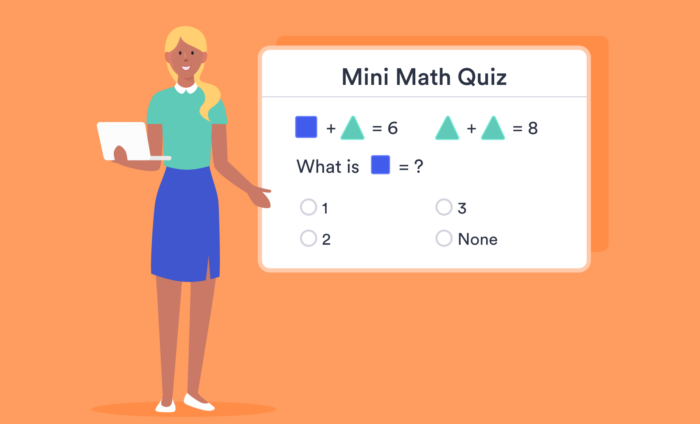
Quiz vs test vs exam at a glance
- A quiz is the shortest, most common, and most casual form of evaluation.
- A test is the standard evaluation technique used to determine grades in both high school and college classes.
- An exam is a tool to measure a student’s mastery of the course content, but it has weightier consequences.
If you’ve ever stared at a syllabus or an onboarding schedule and wondered whether “quiz,” “test,” and “exam” are just three interchangeable words for the same thing, you’re not alone.
Anyone responsible for evaluating learning — a fifth-grade teacher, a university professor, or an HR manager building out a new-hire training track — has run into this mix-up.
And it’s not just semantics. Choosing the wrong evaluation format can mean you’re measuring the wrong thing entirely: testing recall when you meant to test retention or grading a lengthy, high-stakes exam when a quick, low-pressure check-in would’ve told you more.
So, what’s the difference? Here’s the short version:
- A quiz is a quick, informal check-in on a single concept.
- A test is a more formal, structured evaluation of a broader chunk of material.
- And an exam is the heavyweight — comprehensive, high-stakes, and often used to determine a final grade, certification, or course outcome.
Understanding the difference between quiz and test formats (and where exams fit in) helps you pick the right tool for the job — whether you’re running a classroom, a lecture hall, or a corporate training program.
What is a quiz?
Use when: You need a fast pulse check on a single lesson or concept, right after teaching it.
A quiz is the lightest-touch evaluation tool in your kit. It’s brief, informal, and low-stakes, designed to check whether someone has grasped a single concept or a single lesson — not an entire unit.
Quizzes work well as a pulse check: Did the reading land? Did the training video actually stick? They’re also incredibly easy to build, which is exactly why they show up so often in classrooms, onboarding flows, and corporate learning modules.
Knowing when to use a quiz comes down to timing and stakes. You should use one immediately after new material is introduced, and when the goal is reinforcement rather than judgment.
With Jotform’s dedicated Quiz App, educators can instantly turn any standard web form into an interactive, self-grading quiz that displays results to the test-taker right away — no manual grading required and no waiting around for feedback that arrives too late to be useful.
What is a test?
Use when: You’re evaluating an entire unit, module, or block of training content.
A test is a formal, medium-stakes evaluation that covers more ground than a quiz — typically an entire unit, module, or training section rather than a single lesson.
Where a quiz asks, “Did you get today’s lesson?” a test asks, “Can you apply everything from the last few weeks?” That broader scope means tests usually carry more weight in a final grade or performance review, and they call for more structure: clear instructions, consistent scoring, and often a defined time limit.
Because tests cover more material and matter more to the outcome, they require more robust configurations than a quiz does. Jotform’s free online test maker supports secure testing with custom time limits, saving progress for later, and compiling detailed visual analytics — so instead of just collecting answers, you can actually see where a class or a cohort is struggling.
What is an exam?
Use when: You need a comprehensive, high-stakes measure of overall mastery.
An exam sits at the top of the academic and professional hierarchy: the most formal, most comprehensive, and highest-stakes assessment type.
Final exams, licensing exams, certification exams — these carry real consequences, whether that’s a course grade, a professional credential, or a compliance sign-off. Exams also typically pull from the full scope of material covered, sometimes spanning an entire semester or an entire training curriculum.
Given the stakes, exams tend to need more sophisticated logic than a standard quiz or test. Jotform’s robust form builder handles comprehensive exams with ease, using conditional logic to tailor question paths based on a test-taker’s previous answers, and generating direct PDF output for administrative records. This makes it particularly useful for HR teams and academic institutions that need a clean paper trail.
Test vs quiz vs exam: What’s the difference?
Here’s a side-by-side breakdown to help you quickly identify which format fits your specific evaluation goal. A quick test vs quiz comparison usually comes down to one question: How much material am I actually covering right now? Thinking through exam vs test vs quiz this way makes the decision much less abstract.
| Quiz | Test | Exam | |
|---|---|---|---|
|
Purpose |
Reinforce a single concept |
Evaluate a unit or module |
Measure overall mastery |
|
Scope |
One lesson or topic |
Several lessons or a full unit |
Full course or curriculum |
|
Stakes |
Low |
Medium |
High |
|
Average length |
Frequent (daily or weekly) |
Occasional (end of unit) |
Rare (midterm or final) |
|
Grading weight |
Minimal or ungraded |
Moderate |
Significant |
At a glance, the pattern is pretty simple: As the scope of material grows, so do the stakes, the length, and the weight that the score carries.
Formative vs summative assessments in educational theory
Behind these three formats sits a bit of teaching theory worth understanding, because it explains why the formats exist in the first place. Assessments generally fall into two buckets: formative and summative.
- Formative assessments (quizzes, mainly) happen throughout the learning process, not at the end of it. Their job is to give both the learner and the instructor real-time feedback on what’s sticking and what isn’t. A quiz is a classic formative tool: fast, low-stakes, and focused on active retrieval, which research consistently shows helps long-term retention far more than passive review does.
- Summative assessments (tests and exams) happen at the end of a learning period and are designed to evaluate cumulative mastery. They’re the final judgment on how well someone learned the material, and they typically carry real weight toward a grade, credential, or performance outcome.
A balanced learning strategy leans on both. Frequent quizzes build the habit of active retrieval and catch misunderstandings early, while a test or exam at the end reliably tracks whether that knowledge actually stuck. Understanding the formative vs summative assessment distinction is really the foundation for everything above — it’s the “why” behind the quiz-test-exam hierarchy.
Easily build quizzes and tests with Jotform
Once you know which evaluation format fits your goal, the next question is how to actually build it — and this is where Jotform can help. As an online quiz maker and full-featured assessment platform, Jotform goes well beyond basic form tools — giving educators, trainers, and HR teams the flexibility to build interactive, engaging assessments without writing a single line of code.
Build your next quiz or test with a 50 percent discount
Instead of grading papers manually, you can easily build self-grading, interactive quizzes and comprehensive tests on Jotform. Educators get a 50 percent discount on paid plans, dropping the Bronze tier from $34 to just $17 per month (billed annually). Upgrading from the free plan unlocks higher response limits, advanced analytics, and access to over 7,000 education form templates.
A few features make Jotform especially useful for thinking through quizzes, tests, and exams:
- Jotform AI: Generate full sets of questions, answer choices, and even entire assessments in seconds with a free AI quiz generator built right into the platform. This is a serious time-saver when you’re building out online quizzes and assignments from scratch.
- No-code test maker: Build secure, professional assessments with drag-and-drop simplicity — no development team required and no learning curve steep enough to slow you down.
- Self-grading automation: Skip the manual grading pile entirely. Jotform scores quizzes and tests automatically and immediately, surfacing results the moment a test-taker hits “submit.”
- Visual analytics and reports: See performance trends across a class, a cohort, or a whole department, so you can spot gaps before they become bigger problems.
- E-signature for tests and attendance: Use Jotform Sign to collect verified signatures on tests, attendance sheets, or academic integrity agreements — handy for anything that needs an audit trail.
Jotform AI also powers the platform’s broader library, including over 2,000 quiz templates and over 400 education app templates ready to customize for your subject, grade level, or training program.
Whether you’re a K-12 teacher who needs to prepare online classroom quizzes for tomorrow morning, a university professor building out homework and midterms, or an HR manager standardizing onboarding assessments across departments, Jotform for Education covers the full range of education form templates you’re likely to need.
Jotform consistently ranks among the best online testing tools available today, and it’s a genuinely simple way to make your own quiz app without touching code. Combined with the growing field of AI quiz generators reshaping how instructors and trainers approach assessment, Jotform reflects where educational technology is headed: faster to build, easier to grade, and far more responsive to how people actually learn. Give it a try for free today.
This article is for K-12 teachers, university professors, corporate trainers, and HR managers who want to evaluate student or employee performance but aren’t sure which format yields the most accurate data.




























Send Comment:
4 Comments:
February 22, 2024
Thanks
November 19, 2023
May I give a quiz exam
June 5, 2023
To help me in exam
May 9, 2023
thank you