

Moduli per Commercialisti
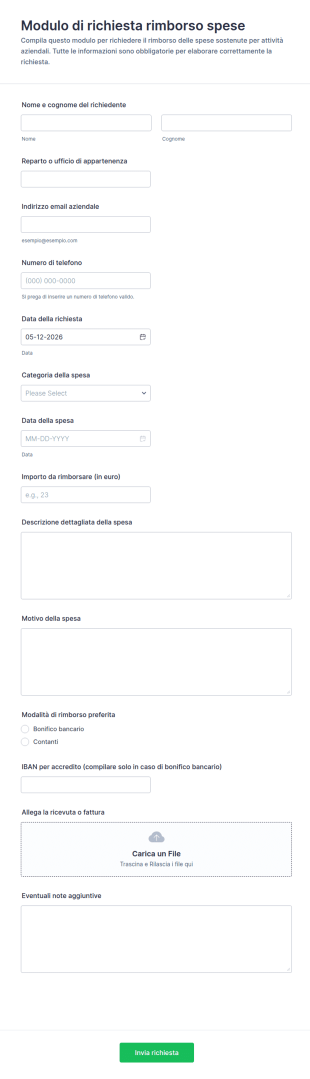
Modulo Di Richiesta Rimborso Spese
Gestisci richieste interne di rimborso con il Modulo di richiesta rimborso spese, un modello di modulo tra i Form Templates di Jotform utile per aziende e uffici amministrativi che vogliono velocizzare la raccolta dati e gli invii del modulo.
Vai alla Categoria:Moduli di Accettazione dei Rimborsi Spese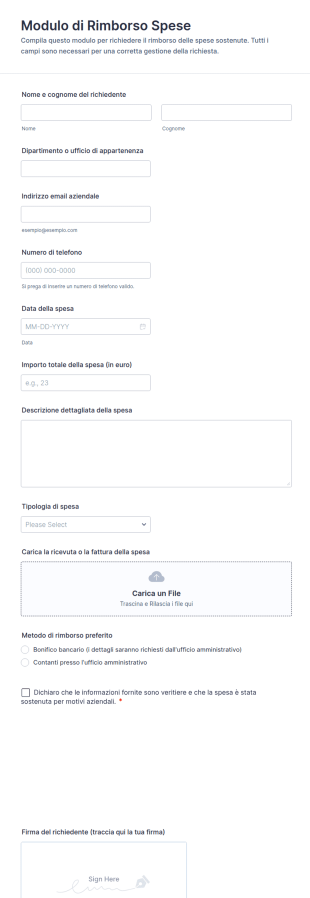
Modulo Di Rimborso Spese
Gestisci richieste di rimborso aziendale con il Modulo di Rimborso Spese Form, utile per raccogliere dati e documenti in un unico punto e semplificare la revisione da parte di amministrazione e contabilità.
Vai alla Categoria:Moduli di Accettazione dei Rimborsi Spese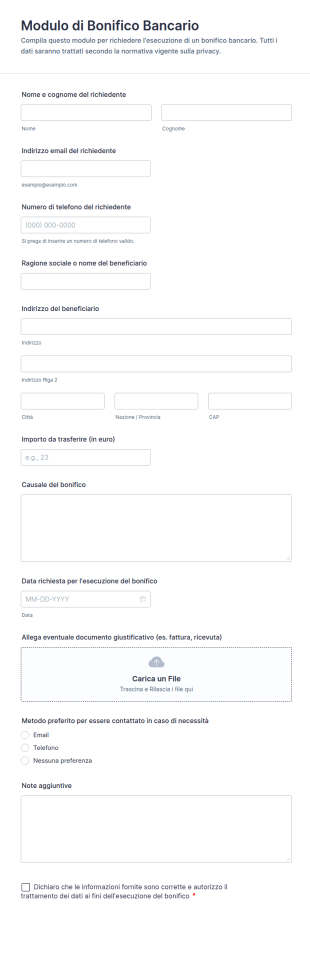
Modulo Di Bonifico Bancario
Gestisci richieste di bonifico con il Modulo di richiesta bonifico bancario di Jotform, utile per amministrazione, associazioni e piccole imprese che vogliono centralizzare la raccolta dati e monitorare ogni invio del modulo.
Vai alla Categoria:Moduli di Pagamento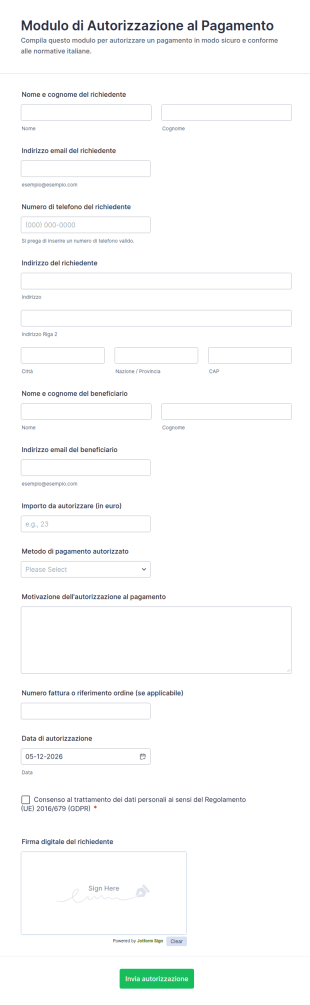
Modulo Di Autorizzazione Al Pagamento
Raccogli autorizzazioni di pagamento con il Modulo di Autorizzazione al Pagamento, ideale per aziende e associazioni che vogliono gestire richieste interne e documentare la raccolta dati con Jotform.
Vai alla Categoria:Moduli di Pagamento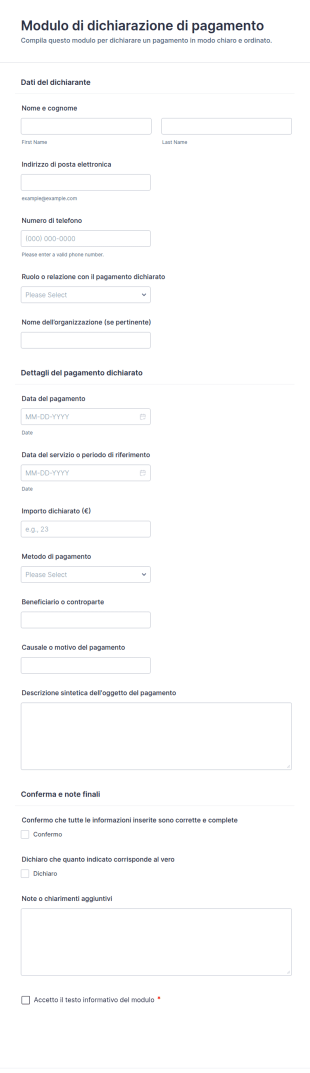
Modulo Di Dichiarazione Di Pagamento
Raccogli dichiarazioni di pagamento in modo chiaro con il Modulo di dichiarazione di pagamento Form di Jotform, utile per amministrazione, associazioni e studi professionali che gestiscono data collection e archiviazione delle risposte.
Vai alla Categoria:Moduli di Pagamento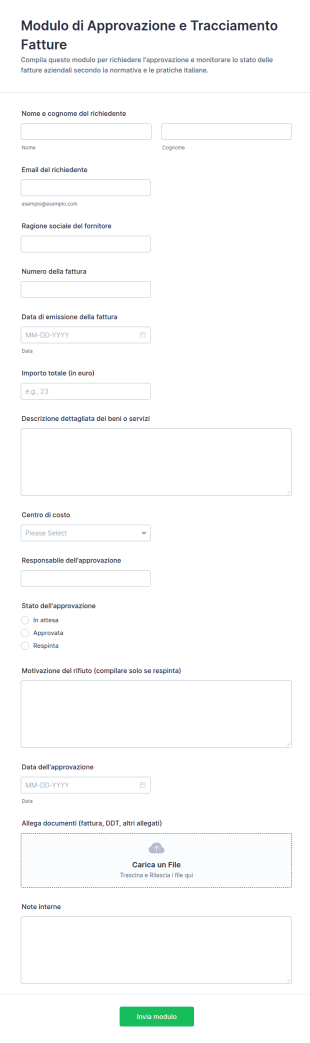
Modulo Di Approvazione E Tracciamento Fatture
Gestisci approvazioni e tracciamento delle fatture con il Modulo di approvazione e tracciamento fatture di Jotform, utile per contabilità e amministrazione per organizzare la raccolta dati e ogni risposta in un unico flusso.
Vai alla Categoria:Moduli di Approvazione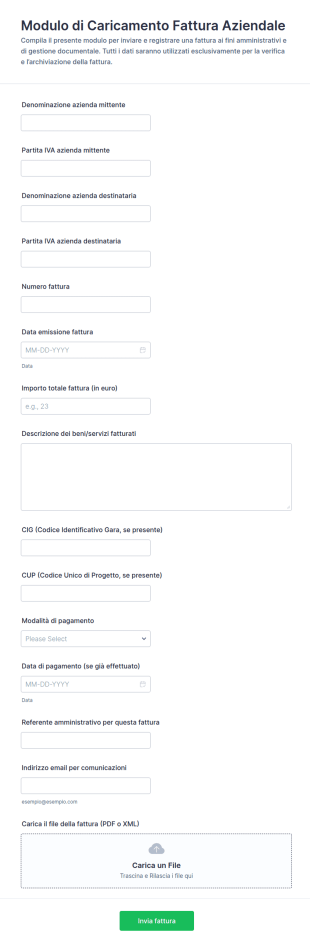
Modulo Di Caricamento Fatture
Raccogli e archivia fatture aziendali con Jotform usando il Modulo di Caricamento Fattura Aziendale, utile per uffici amministrativi e studi di contabilità che vogliono velocizzare la raccolta dati e gestire ogni invio del modulo.
Vai alla Categoria:Caricamento Documenti
Checklist Per La Dichiarazione Dei Redditi
Raccogli e organizza i documenti necessari alla dichiarazione con Checklist dichiarazione dei redditi Form, ideale per studi professionali, CAF e contribuenti che vogliono prepararsi prima di inviare informazioni.
Vai alla Categoria:Moduli Liste di Controllo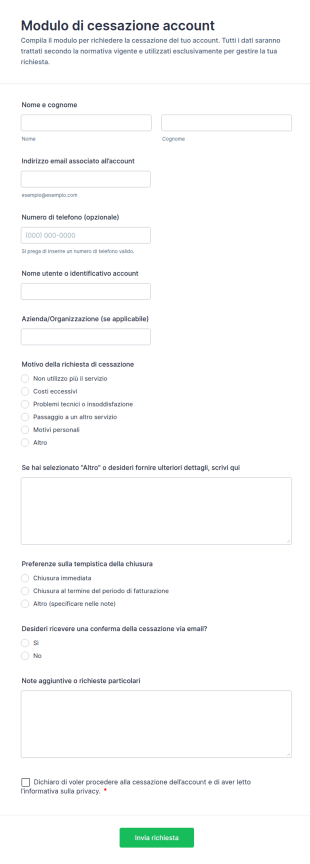
Modulo Di Disdetta Dell'Account
Gestisci le richieste di chiusura con il Modulo di cessazione account Form di Jotform, utile per aziende e organizzazioni che vogliono raccogliere dati, registrare motivazioni e confermare la cessazione in modo tracciabile.
Vai alla Categoria:Moduli di Disdetta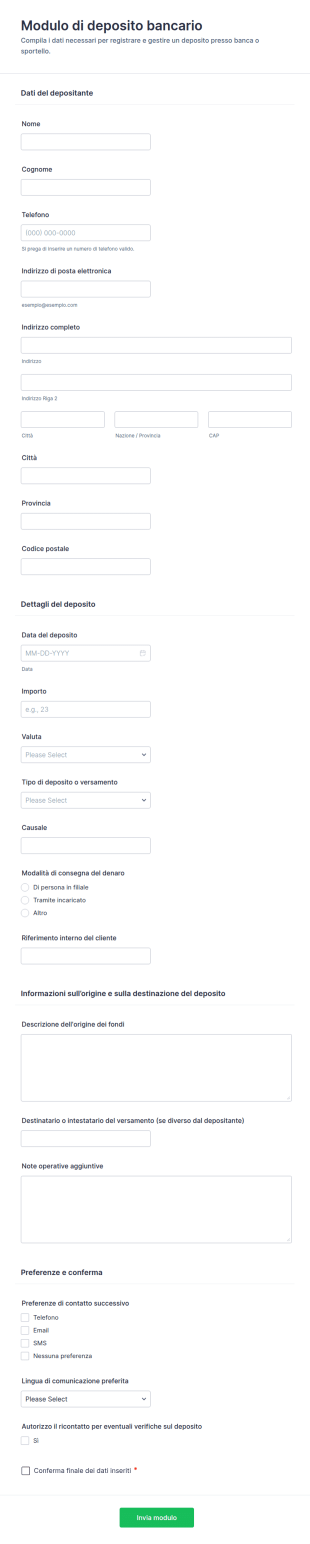
Modulo Di Deposito Bancario
Il Modulo di deposito bancario supporta banche e aziende nella raccolta dati online sui versamenti, migliorando tracciabilità e gestione delle risposte con Jotform e un modello di modulo personalizzabile.
Vai alla Categoria:Moduli Banking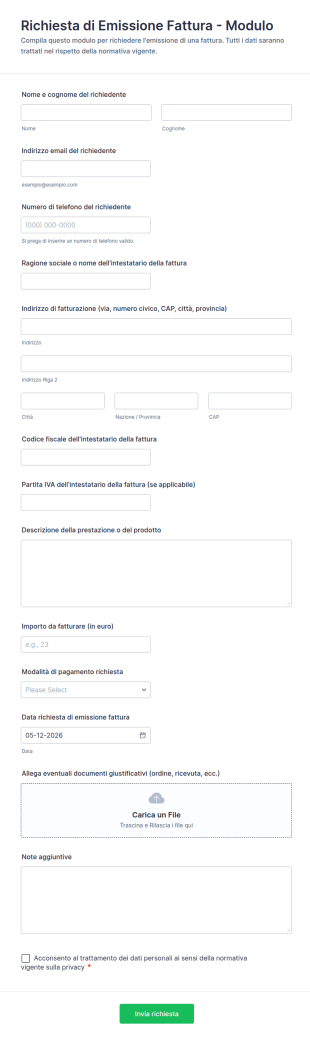
Richiesta Di Emissione Fattura Modulo
Raccogli richieste di emissione fattura con il Modulo di richiesta emissione fattura, utile per aziende e professionisti che vogliono velocizzare la raccolta dati e gestire ogni invio del modulo in modo ordinato con Jotform.
Vai alla Categoria:Moduli per Commercialisti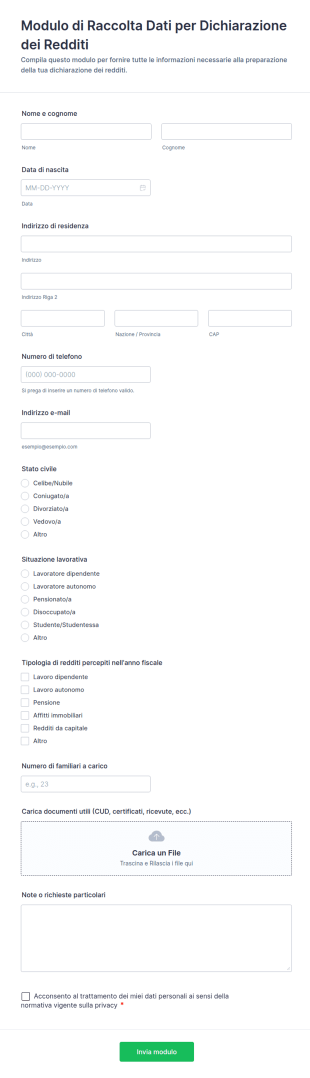
Modulo Di Raccolta Dati Per Dichiarazione Dei Redditi
Raccogli informazioni e documenti per la dichiarazione dei redditi con un modello di modulo Jotform, utile a commercialisti e CAF per velocizzare la raccolta dati e gestire ogni invio del modulo in modo ordinato.
Vai alla Categoria:Moduli Fiscali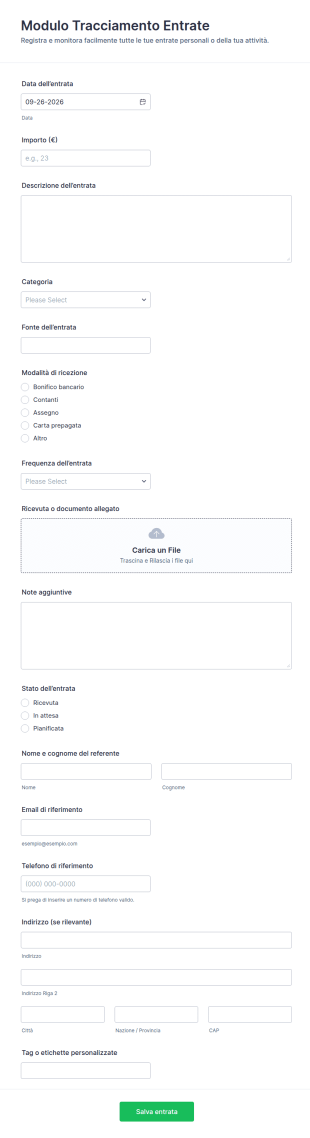
Modulo Di Tracciamento Entrate
Raccogli e organizza le entrate personali o della tua attività con il Modulo di Tracciamento Entrate, utile per monitorare incassi e tenere uno storico affidabile tramite raccolta dati online in Jotform.
Vai alla Categoria:Moduli Tracciamento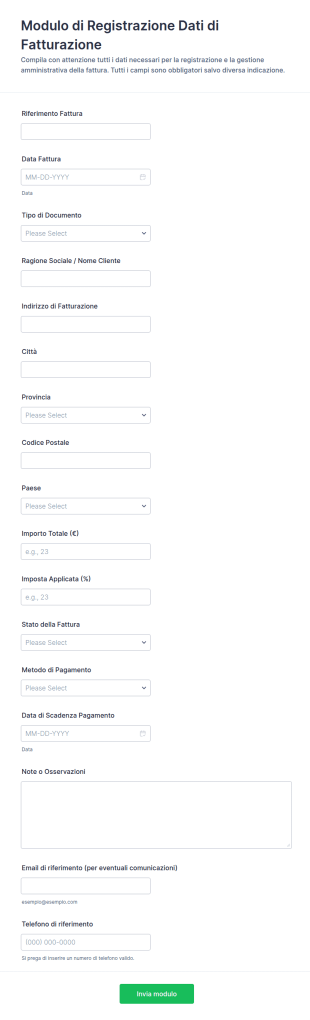
Modulo Di Registrazione Fattura
Raccogli e organizza dati di fatturazione, importi e scadenze con il Modulo di Registrazione Dati di Fatturazione, ideale per aziende, professionisti e uffici amministrativi che vogliono semplificare la raccolta dati con Jotform.
Vai alla Categoria:Moduli per Commercialisti
Pianificazione Delle Fonti Di Reddito Form
Raccogli e organizza informazioni su entrate e obiettivi economici con il Modulo di pianificazione delle fonti di reddito, utile per consulenti e privati che vogliono gestire la raccolta dati e ogni risposta del modulo in modo ordinato.
Vai alla Categoria:Moduli per Commercialisti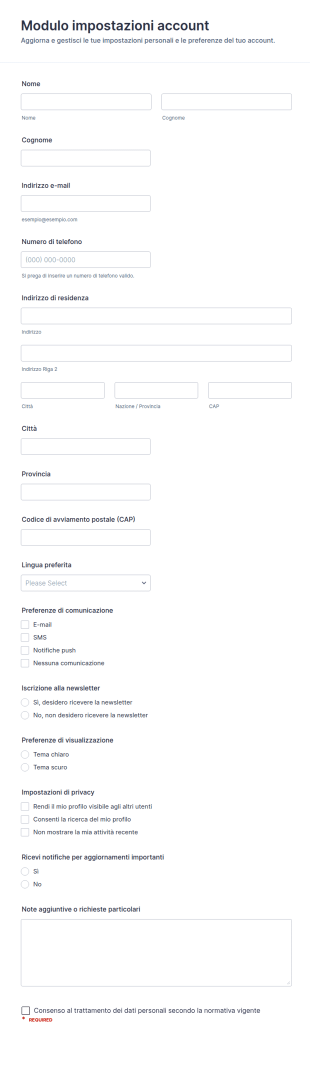
Impostazioni Account Form
Gestisci aggiornamenti di profilo e preferenze utente con il Modulo impostazioni account di Jotform, utile per aree riservate, portali clienti e servizi in abbonamento che richiedono raccolta dati e organizzazione delle risposte.
Vai alla Categoria:Moduli IT
Modulo Di Inserimento Spese E Tempo
Raccogli ore lavorate e note spese per commesse e trasferte con il Modulo di rilevazione tempi e spese di Jotform, utile per consulenti, agenzie e reparti amministrativi che gestiscono consuntivi e rendicontazioni.
Vai alla Categoria:Modulo Registrazione Spese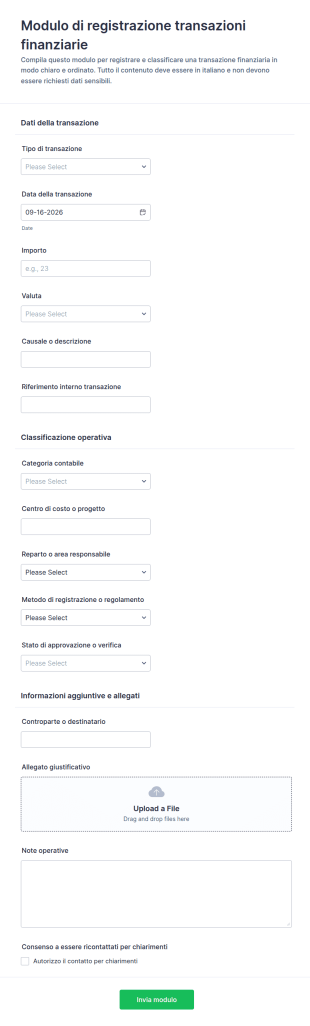
Modulo Di Inserimento Transazioni Finanziarie
Registra e classifica movimenti in entrata e in uscita con il Modulo di registrazione delle transazioni finanziarie, utile per amministrazione, contabilità e controllo di gestione, e raccogli risposte del modulo online con Jotform.
Vai alla Categoria:Moduli per Commercialisti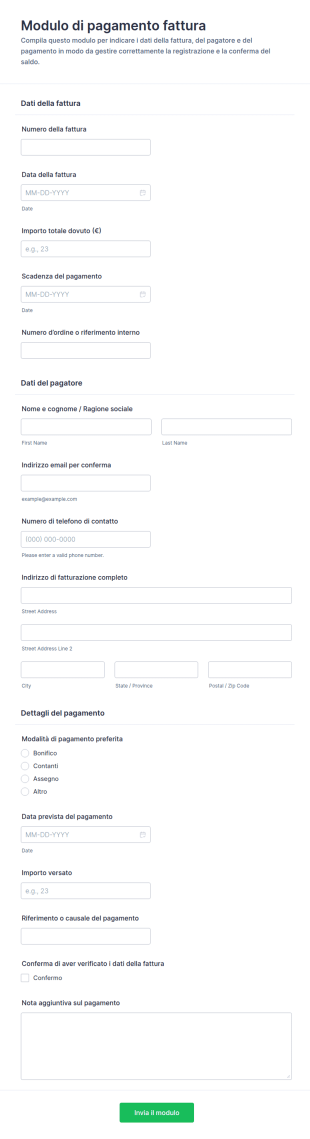
Modulo Di Pagamento Fattura
Raccogli e registra pagamenti di fatture con il Modulo di pagamento fattura di Jotform, utile per attività e professionisti che vogliono semplificare la raccolta dati e centralizzare ogni risposta in un unico flusso.
Vai alla Categoria:Moduli di Pagamento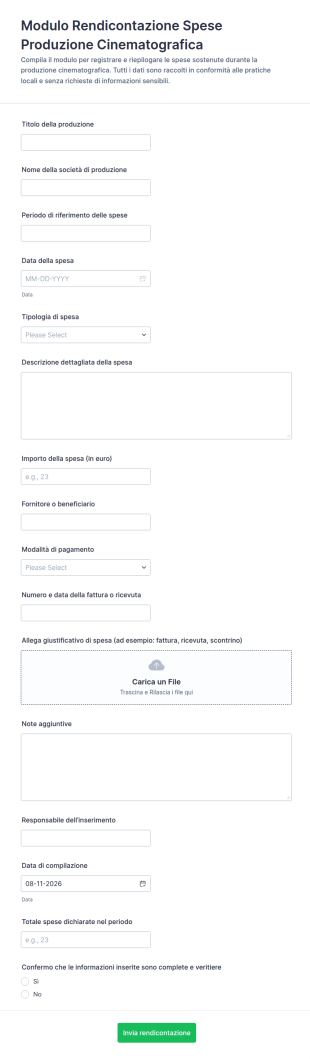
Rendiconto Spese Di Produzione Film Form
Raccogli e organizza le rendicontazioni delle spese di produzione cinematografica con un modulo di modulo Jotform, utile a case di produzione e reparti amministrativi per centralizzare la raccolta dati e le risposte.
Vai alla Categoria:Modulo Registrazione Spese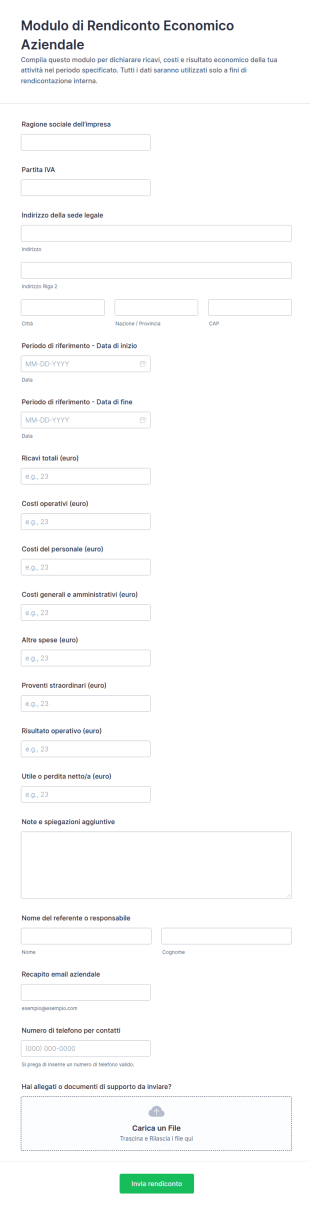
Rendiconto Profitti E Perdite Form
Raccogli ricavi, costi e risultati economici in un unico Modulo di Rendiconto Economico Aziendale, ideale per imprese e studi che vogliono semplificare la raccolta dati e organizzare le risposte con Jotform.
Vai alla Categoria:Moduli di Segnalazione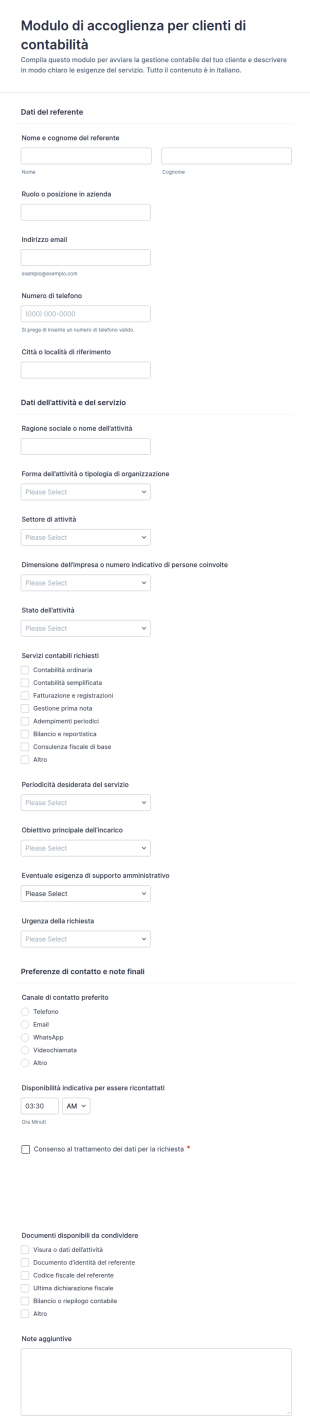
Modulo Di Acquisizione Clienti Contabili
Raccogli le richieste di nuovi clienti per servizi contabili con il Modulo di accoglienza per clienti di contabilità di Jotform e organizza la raccolta dati, le priorità e i contatti in un unico modulo online.
Vai alla Categoria:Moduli per Commercialisti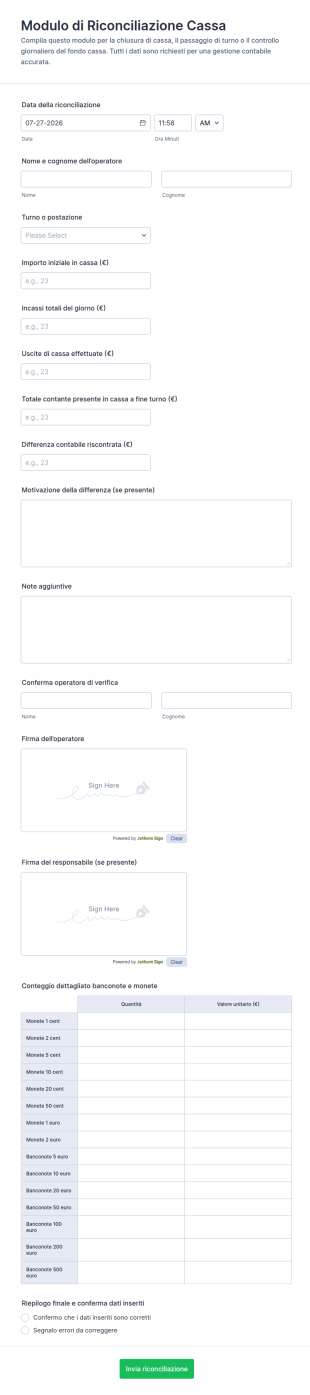
Riconciliazione Cassa Form
Raccogli e archivia le chiusure di cassa per turno o giornata con il Modulo di Riconciliazione Cassa di Jotform, ideale per negozi e locali che vogliono una raccolta dati ordinata e verificabile.
Vai alla Categoria:Moduli per Commercialisti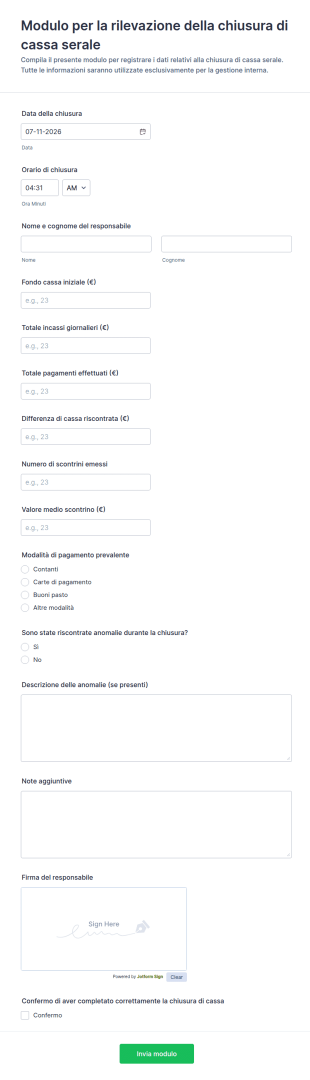
Rendiconto Cassa Serale Checklist
Raccogli e archivia i dati della chiusura di cassa serale con il Modulo per la rilevazione della chiusura di cassa serale di Jotform, ideale per negozi e locali che vogliono controlli interni più ordinati e rapidi.
Vai alla Categoria:Moduli per CommercialistiInformazioni su Moduli per Commercialisti
Accountant Forms are specialized digital forms designed to streamline the operations of accounting professionals by automating and simplifying various data collection tasks. These forms cater to a wide range of accounting activities, from client onboarding and financial reporting to tax documentation and invoicing. By leveraging Accountant Forms, professionals in the accounting industry can efficiently manage client data, track financial transactions, and ensure compliance with regulatory requirements. This digital transformation not only enhances productivity but also minimizes the risk of errors commonly associated with manual data entry and paperwork-heavy processes.
Jotform stands out as the premier online form builder for creating and managing Accountant Forms, offering unparalleled ease of use and customization. With Jotform’s intuitive drag-and-drop interface, accountants can effortlessly tailor forms to meet specific needs, enabling the seamless automation of data collection processes. The integration with Jotform Tables allows for centralized data management, providing a secure and organized platform to store, analyze, and retrieve financial information. This holistic approach ensures that accounting professionals can focus on delivering high-quality services to their clients while maintaining accuracy and efficiency in their workflows.
Why Use Accountant Forms?
- Accountant Forms are essential for ensuring the accuracy of financial data, as they eliminate the common errors associated with manual entry. By automating data collection, accountants can reduce the chances of discrepancies and ensure that financial records are precise and reliable.
- The speed at which Accountant Forms can process data is a significant advantage for busy professionals. These forms streamline workflows, allowing accountants to quickly gather and analyze information, ultimately saving time and increasing productivity.
- Professional data handling is a hallmark of Accountant Forms, as they provide a structured framework for capturing and organizing financial information. This ensures that all data is systematically stored and easily accessible, facilitating efficient audits and reviews.
- With the integration of electronic signatures via Jotform Sign, accountants can enhance the security and authenticity of documents. This feature allows clients to sign forms digitally, ensuring that all transactions and agreements are legally binding and verifiable.
- Accountant Forms can be easily customized to fit the specific needs of various clients and projects. This flexibility enables accountants to adapt forms to different scenarios, whether it's for tax documentation, invoicing, or financial reporting.
Common Problems Solved by Accountant Forms
- One of the primary challenges faced by accountants is dealing with excessive paperwork, which can be cumbersome and prone to errors. Accountant Forms digitize these documents, reducing the need for physical storage and making information retrieval more efficient.
- Manual data entry is time-consuming and often leads to human errors, affecting the accuracy of financial records. Accountant Forms solve this issue by automating data entry processes, ensuring that information is captured accurately and consistently.
- Lost or misplaced data is a significant concern in the accounting industry, especially during audits or compliance checks. Using Accountant Forms ensures that all data is securely stored and easily retrievable, minimizing the risk of data loss.
- Keeping track of client communications and approvals can be difficult with traditional methods. Accountant Forms streamline this process through features like conditional logic and automated email notifications, ensuring that all necessary approvals are obtained and documented.
- Accountants often deal with complex calculations and data analysis, which can be challenging to perform manually. These forms can be equipped with built-in calculations and integrations with third-party applications, simplifying complex financial analyses and reporting.
Utilizzi e funzionalità
- For client onboarding, the drag-and-drop form builder allows accountants to tailor forms to capture all necessary client information efficiently. This customization ensures a seamless onboarding process that is both comprehensive and user-friendly.
- Conditional logic is particularly useful for tax documentation, as it allows forms to dynamically adjust based on user input. This feature ensures that clients are only presented with relevant questions, simplifying the data collection process and reducing confusion.
- The availability of 30+ payment gateways, including Stripe and PayPal, facilitates the collection of payments directly through forms. This feature is crucial for invoicing and billing, allowing accountants to streamline financial transactions and improve cash flow management.
- Jotform’s PDF Editor enables the automatic generation of professional PDF documents from form submissions. This is especially beneficial for financial reporting, as it allows accountants to easily create and share polished reports with clients and stakeholders.
- Secure data management is a priority for accountants, and Jotform Tables provides a robust solution for storing and organizing sensitive information. This feature ensures that all client and financial data is protected and complies with industry regulations.
- The report builder feature enables accountants to create detailed reports and visualizations from collected data. This supports decision-making processes by providing clear insights into financial performance and trends.
- Approval workflows streamline internal processes by automating the approval of documents and transactions. This feature ensures that all necessary checks are completed efficiently, reducing bottlenecks and enhancing accountability.
How to Create a Accountant Form
- Start by browsing the Template List for an Accountants template or initiate the process from a blank form. This step allows you to either leverage pre-designed templates or create a form tailored to specific accounting needs from scratch.
- Customize the design and fields using the drag-and-drop form builder. This intuitive tool enables you to add, remove, or modify fields effortlessly, ensuring that the form aligns perfectly with your operational requirements.
- Publish and share the form via Direct Link, Email, or Website Embed. This flexibility ensures that clients and colleagues can access the form through multiple channels, facilitating seamless communication and data collection.
Top Use Cases for Accountant Forms
- For Managers: Accountant Forms are invaluable for managers seeking to oversee financial operations and ensure compliance with internal and external regulations. By using these forms, managers can streamline the approval processes, track financial data in real-time, and generate comprehensive reports on financial performance. This centralized approach not only enhances transparency but also empowers managers to make informed decisions that drive organizational success.
- For Teams: Accounting teams benefit from the collaborative features of Accountant Forms, which facilitate efficient data sharing and communication. These forms enable team members to collect, analyze, and report on financial data collaboratively, ensuring that all team members are aligned and informed. The integration with third-party applications further enhances team productivity by automating routine tasks and reducing the time spent on manual data entry.
- For Customers: For clients, Accountant Forms offer a seamless and user-friendly way to submit necessary financial information and documents. These forms can be customized to guide clients through complex processes, such as tax filings or financial disclosures, ensuring that all required information is captured accurately. The use of electronic signatures also provides clients with a secure method to authorize transactions and agreements, building trust and confidence in the accounting services provided.
Summarizing Accountant Forms
Accountant Forms play a crucial role in modernizing the workflow of accounting professionals by digitizing data collection and streamlining financial processes. They enhance accuracy and efficiency, reduce the risk of errors, and provide a structured approach to data management. With Jotform’s online form builder, accountants can easily create and customize these forms to suit their specific needs, ensuring that financial data is collected and managed effectively. By integrating advanced features such as electronic signatures, payment gateways, and approval workflows, Jotform empowers accountants to deliver high-quality services while maintaining compliance and security.
Domande Frequenti
1. Che cos'è un modulo per contabilità?
Un modulo per contabilità è un documento digitale utilizzato dai professionisti contabili per raccogliere, organizzare e gestire le informazioni finanziarie provenienti da clienti o team interni. Questi moduli possono coprire una vasta gamma di attività, tra cui l'onboarding, il monitoraggio delle spese, la fatturazione e la preparazione delle dichiarazioni dei redditi.
2. Perché i moduli IT sono importanti per le organizzazioni?
I moduli contabili semplificano la raccolta dati, riducono gli errori manuali e garantiscono che tutte le informazioni necessarie vengano raccolte in modo efficiente. Contribuiscono a mantenere la conformità, migliorare la comunicazione con i clienti e supportare un reporting finanziario accurato.
3. Quali informazioni vengono solitamente raccolte con i moduli per contabilità?
A seconda del caso d'uso, i moduli per contabilità possono raccogliere dati personali e aziendali, dati finanziari, ricevute, numeri di partita IVA, informazioni di pagamento e firme digitali.
4. Esistono diversi tipi di moduli IT?
Sì, ne esistono di vari tipi, tra cui moduli di acquisizione clienti, moduli di invio delle spese, moduli di fatturazione, moduli fiscali, moduli di busta paga e checklist di controllo, ognuno personalizzato per specifiche attività contabili.
5. Chi dovrebbe usare i moduli IT?
I moduli per contabili sono adatti a contabili indipendenti, studi di contabilità, consulenti finanziari, titolari di piccole imprese e dipartimenti di finanza aziendale.
6. In che modo i moduli IT migliorano l'efficienza del flusso di lavoro?
I moduli digitali per contabilità possono essere progettati per includere caselle di controllo del consenso, campi di caricamento file sicuri e archiviazione di dati crittografati, aiutando i professionisti a rispettare le normative sulla privacy e a proteggere le informazioni sensibili dei clienti.
7. I moduli per contabilità possono essere integrati con i software di contabilità?
Sì, molti moduli per contabilità possono essere integrati con le più diffuse piattaforme di contabilità e gateway di pagamento, consentendo un trasferimento dati agevole e una migliore automazione del flusso di lavoro.
8. Quali misure a protezione della privacy è opportuno prendere in considerazione quando si utilizzano moduli per contabilità?
È importante utilizzare piattaforme sicure come Jotform, che offrono crittografia, controlli di accesso e conformità agli standard di protezione dei dati per salvaguardare le informazioni dei clienti e mantenere la riservatezza.