
Every time you gain a new customer, your team takes on more manual work: more tickets, more data entry, more hours. And the feeling that you’re winning slowly starts to turn into the opposite. You no longer have time to complete all your tasks, there’s no space to onboard new hires, and you’re stuck in reactive mode. Over time, longer response times and inconsistent service quality will have customers looking for alternatives.
But if you’re using Salesforce as the base for your work, you’re already sitting on the solution. You can build AI agents via the Agentforce platform to autonomously handle support tickets, qualify leads, and run daily operations using your organization’s data. While Agentforce can’t replace you or your team, it will free up your time for strategic improvements that actually retain customers.
What is Agentforce?
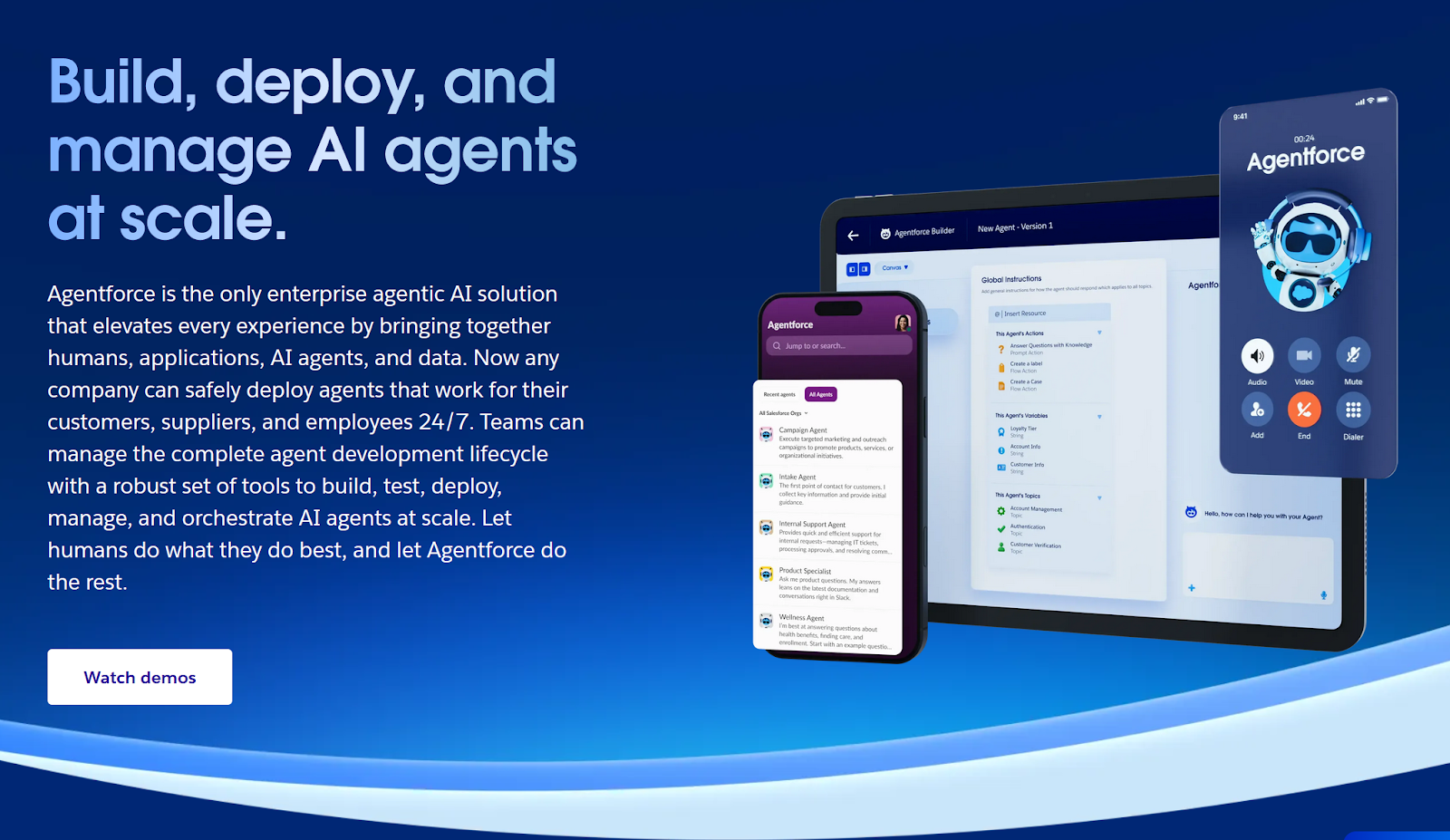
Agentforce — Salesforce’s AI agent builder platform — helps teams automate their workflows. Powered by Einstein AI and the Atlas Reasoning Engine, Agentforce agents can answer questions over a chat interface or they can take action, like updating case priorities, routing tickets, or creating follow-up tasks. This is particularly valuable when you want to combine information retrieval with task automation. And while connecting your data requires some technical configuration, the agent builder itself is a no-code interface.
Why use Agentforce?
Agentforce helps teams complete more tasks without adding new members by automating repetitive workflows, such as support ticket triage, lead qualification, and quote generation, directly within Salesforce. Unlike external AI platforms that add integration overhead, Agentforce works natively on top of your customer relationship management (CRM) system data, with enterprise-grade security controls. This leads to higher productivity, consistent service quality, and more time spent on high-value, strategic tasks.
Agentforce solves five core scaling challenges:
- Tool and data fragmentation — With Agentforce, there’s no need to subscribe to external platforms that don’t talk to Salesforce or that require expensive or complex middleware to connect.
- Manual multistep workflows — AI agents handle end-to-end workflows for repetitive processes like case order tracking updates or FAQs, escalating work that requires human judgment to you.
- Inconsistent execution — Guided actions and governed prompts ensure outputs stay compliant and on-brand, whether they’re facing customers or supporting internal teams. Agentforce helps your newest employee and your most experienced one deliver the same quality.
- Context hunting — Your AI agents tap directly into Data Cloud to surface the right information instantly. No more digging through documents, emails, and past records to find what you need before you can act.
- AI security concerns — The Einstein Trust Layer provides enterprise-grade data protection, so you can scale AI confidently without exposing sensitive information.
Now that you understand what Agentforce can do, let’s take a closer look at the AI agents in practice. Here are 10 Agentforce industry use cases from early adopters like Pandora, Siemens, and Salesforce itself.
10 real-world Agentforce use cases
1. Resolving 75%+ of support issues across 1.7M visitors
The Salesforce Help site receives over 60 million visits every year, with requests ranging from password resets to developer support. Before Agentforce, the company’s Einstein Bot could pull up training resources but couldn’t adapt to troubleshooting scenarios: The bot understood and matched the topic but not to the actual challenges the user was facing. This meant that most requests were still escalated to the human support team, consuming more resources and increasing wait times.
In an effort to tackle these concerns, Salesforce deployed an Agentforce AI concierge, available in seven languages, ready to handle customer questions. Built on top of Data 360, it used RAG (retrieval-augmented generation) to access data in the platform, including case histories, product purchases, knowledge articles, and product documentation from over 740,000 articles.
When a customer asked about account-specific details like API limits, Agentforce instantly pulled their entitlements and usage history instead of simply returning knowledge base search results. And when the answer wasn’t that linear, it could escalate to human support within the same chat window, automatically summarizing the conversation thus far so the customer didn’t have to repeat everything.
Agentforce now solves 76 percent of customer inquiries by itself, handling over 1.7 million conversations to date, with a 65 percent reduction in response time. Beyond customer satisfaction, it has also freed up Salesforce support teams to focus on the 1.3 million complex tickets passed on by the AI concierge.
Pro Tip
Jotform AI Agents can help you replicate Salesforce’s support concierge. Starting with the Customer Support AI Agent template, train the AI on your knowledge base and URLs, then add ticket-creation actions via Zendesk or Freshdesk so escalations happen seamlessly inside the same chat.
2. Automating 200K annual fan inquiries and data-driven matchup analysis
The United Football League (UFL) faced a massive operational challenge: 20 service representatives handling approximately 200,000 fan inquiries annually across eight teams during a compressed 12-week season. Half an hour before kickoff, service reps would inevitably be flooded with repetitive questions about gate times, parking passes, and bag policies, overwhelming them in transactional work.
The UFL deployed Dash, a fan-facing Agentforce assistant accessible via their mobile app, to provide instant answers to common game-day questions. Using a RAG framework to pull answers to common questions, it also logged all conversations for later analysis. For example, if 150 fans in St. Louis requested to open the gates earlier, the league could present that objective data to stadium partners rather than relying on hearsay.
Beyond the customer support use case, UFL also integrated an agent with live sports data via the SportsRadar API, logging stats such as rushing, touchdowns, passing yards, and running speed. This was an internal tool: Based on the available data, the football operations group could ask questions such as “Which defense has the advantage this week?” and get an answer based on the latest stats and historical data, which helped improve TV and social media content quality.
The benefits have been twofold. Agentforce now automates 80 percent of all fan questions on game days, helping the 20-person UFL team shift from a reactive support stance to proactive activities like handling group sales and premium suite bookings. For broadcasters and content teams, it helps distill the season’s key moments into insights they can share with their audience, increasing engagement and relevance.
Pro Tip
With Jotform AI Agents, you can handle high-volume FAQs by setting up one of hundreds of AI Agent templates and training it with your data. The agent can also send API requests to gather or act on external systems, letting your external and internal users access the information they want conversationally.
3. Turning hours of quote-building into minutes of conversation
Sales reps can spend hours building quotes and diving into spreadsheets and product catalogs, while navigating multiple approval rounds. The clicks only multiply: adding products, applying discounts, verifying pricing rules. The back-and-forth between reps and managers drags out the sales cycle and puts deals at risk for getting snapped up by more agile competitors.
Agentforce transforms the process into a conversational workflow built on Revenue Cloud and Sales Cloud. Sales teams can configure a quoting agent with predefined pricing rules, discount structures, and product catalog data. When building a new deal, reps simply open the chat interface and enter a prompt like “Create a business quote for this opportunity starting next month for six months with a 15 percent discount.” They can keep refining it with extra prompts if needed. The AI agent then pulls real-time data from product catalogs, applies pricing rules, checks discount thresholds, and flags any approvals needed, in mere seconds. It even drafts the email and attaches the quote as a PDF.
Salesforce, managing thousands of SKUs with complex pricing models, used Agentforce to reduce the clicks required to generate a quote by 87 percent, cutting turnaround time from hours to minutes. Automated pricing rules eliminated human error and ensured policy compliance, while approval workflows accelerated deal progression. This freed sales reps from manual data entry, helping them spend more time selling and strengthening customer relationships.
Pro Tip
Using Jotform AI Agents, you can set up a Price Quote AI Chatbot with your product, service, and quoting guidelines. You can expose this agent internally to help your team or externally to generate quotes for your clients. If any quotes exceed discount thresholds or preset conditions, you can escalate the request to managers automatically via Jotform Workflows.
4. Building an agent to migrate 1M+ telecom customers to new plans
How do you migrate over one million prepaid telecom customers from a complex legacy product portfolio to seven simplified plans? Traditional channels weren’t an option: In-store visits and phone support would have created massive wait times, while the existing confusing digital experience was already causing customers to abandon the site or switch carriers.
One New Zealand (One NZ) needed a self-service solution that could handle volume without losing personalization. Using Agentforce, it built One Assistant, an AI agent that could handle the entire migration journey in four steps:
- Step 1: Authentication & data retrieval — Customers received targeted SMS and email campaigns with private portal links. Clicking the link spurred One Assistant to request a one-time password to authenticate each SIM against Communications Cloud, replacing manual verification steps.
- Step 2: Personalized plan presentation — Agentforce pulled real-time account data (current balances, add-ons, and usage patterns) directly from Communications Cloud. It displayed the customer’s existing plan alongside seven simplified options tailored to their needs.
- Step 3: Intelligent Q&A — Using vector search against knowledge articles in Data 360, the AI agent answered customer questions instantly (e.g., “Will I lose my unused account refills?”) with accurate responses that upheld policy.
- Step 4: Autonomous execution — When customers selected a new plan, Agentforce executed the conversion automatically via Communications Cloud APIs. If balances were insufficient, it warned customers and directed them to links where they could refill their accounts. Guardrails prevented incomplete transactions, and complex cases escalated to human agents.
Built and deployed in just five weeks, One Assistant now provides 24-7 service to hundreds of thousands of customers targeted in the initial pilot. The touchless, end-to-end process requires no manual verification, freeing support teams to focus on complex cases while scaling toward the full prepaid customer base of over one million users.
Pro Tip
To replicate this process in Jotform, gather data by converting your forms into smart AI Agents. Then use Jotform Workflows to connect and update your systems with new plan information and Jotform Tables as a database to save migration tracking data from old plans to new plans.
5. 100% follow-up in minutes, converting 2% of previously ignored opportunities
Siemens received 2,800 inbound leads weekly from software downloads and trade conferences, but they all arrived unqualified. With no context around budget, authority, needs, or timeline, the sales team had no way to discern low-quality leads from high-value ones quickly. As a result, the sheer volume meant that many messages were left untouched, resulting in low conversion rates and missed opportunities.
Using Agentforce, Siemens deployed a multi-agent orchestration system to qualify inbound leads and ensure 100 percent response rates within minutes:
- The first agent sent a personalized email based on a dynamic template whenever the user registered for a webinar or filled out a form. If the lead didn’t respond within three days, it sent two reminder nudges. Additionally, it assigned a unique public key to the lead so it could be tracked across the multi-agent system.
- The second agent tracked landing page visits by tracking the public key. When the lead was on the page, it opened a chat interface and asked questions to qualify them. Leads with more than two answers that met the criteria were marked with “qualified” in Sales Cloud, triggering assignment rules, so the appropriate rep could take over.
Now, Siemens responds to 100 percent of leads within minutes, compared with previous response times measured in days. It qualifies over 12,000 business-to-business (B2B) leads every month with an expected 2 percent conversion rate from previously ignored opportunities. Its two-agent solution was built in just two weeks using Agentforce’s no-code Agent Builder, with several more months of testing to meet certain quality standards before deployment.
This represents one of the most impactful Agentforce success stories in B2B lead management.
Pro Tip
Start with a Jotform Lead Generation AI Agents, then connect it to Jotform Workflows to score leads and sync with your CRM, keeping data updated as the chat evolves.
6. Troubleshooting broken ovens, resolving one in four autonomously
When a dishwasher breaks down before a holiday meal, customers can quickly lose trust in the brand. GE Appliances’ support team used to have to navigate scattered documents — including product specifications, warranty details, and PDF manuals — often spending weeks hunting for answers to customers’ questions and risking their growing frustration.
Then they built a service agent with Agentforce in Service Cloud. Customers could now log into the support portal and describe their problem, like an oven that won’t heat. The agent verifies the appliance model, pulls troubleshooting steps from Service Cloud, and walks them through the fix in a chat interface. For time-sensitive issues, the agent checks business hours and escalates to a live rep, making sure that there’s always an answer.
Built in just seven weeks, the service agent achieved a 25 percent resolution rate, and GE Appliances expects this rate to climb as it expands topics, actions, and support channels.
Pro Tip
Train your Jotform AI Agent with product manuals, troubleshooting steps, and technician notes, no matter where they’re saved. Publish the agent to your customer support portal to automate repetitive steps, and configure escalation for cases where the user can’t find the solution.
7. Deflecting 60% of cases without losing brand storytelling
Even though Pandora’s customer service team had 500–600 specialists ready to help, peak holiday demand overwhelmed their capacity. With every rep manually responding to each request, from product help to “Where’s my order?” questions, the pace and transactional nature of the interactions failed to match the brand’s warm, personalized service approach.
In response, Pandora used Agentforce to build a customer service agent named Clara. Specialized to automate routine requests like order tracking and FAQs about jewelry care and storage, Clara used friendly, conversational language instead of rigid chatbot responses. For order tracking, Clara connected with Pandora’s internal systems housed in Salesforce and IBM to find the status based on a tracking number or email address. And if the request exceeded the agent’s capabilities, it escalated the case seamlessly to a human representative.
Clara now deflects 60 percent of cases while maintaining Pandora’s brand voice, driving a 10 percent boost in net promoter score, indicating that customers are more satisfied with agent-first service.
Pro Tip
Create an AI agent persona in Jotform AI Agents to define how they interact with customers. Set the tone of voice with a prompt, adjust response length for brevity or chattiness, and set clear rules to tell AI what to do during a conversation. These settings are all available in the Train tab.
8. Activating immediate real-world features via chat
Customers with electric vehicles (EVs) want to optimize costs by charging during off-peak hours, but activating these features usually requires navigating complex app settings or contacting support. For ENGIE’s support team, manually enabling smart charging created friction and diverted human agents from higher-value tasks.
Now, when a customer mentions owning an EV while chatting in the ENGIE mobile app, Agentforce can automatically activate smart charging options in the electrical company’s infrastructure. Once activated, customers can simply plug in their vehicle, setting a departure time and target battery level, and the system will automatically charge at the most cost-effective times based on their energy contract. All of this can be done without interacting with a support team, sending an on-site technician, or adjusting devices at the customer’s home.
This conversational activation is part of Agentforce’s broader impact: 1,200+ daily conversations, 83 percent accuracy, and 71 percent autonomous resolution. ENGIE’s example demonstrates how AI agents can interact with critical infrastructure such as electricity delivery devices, highlighting growing trust in the technology.
Pro Tip
Jotform AI Agents can send a request to any reachable HTTP/REST endpoint with the Send API Request action. You can then configure these systems to act based on the request, whether that’s updating a record on a database or unlocking a door in a smart building.
9. Saving 11 hours per week while managing 4,700 personalized onboarding journeys
In each academic session, DeVry University needs to onboard 4,700 students over eight weeks. This administrative burden is heightened by manual work, as the staff has to move lists between learning management systems, student community platforms, and Marketing Cloud. Moving lists alone takes 11 hours per week. And since data updates quickly during this time, advisors may act on outdated data and contact a student about a task that has already been completed.
DeVry first used Salesforce’s Data 360 platform to bring all these systems together, building unified profiles for each student and course curriculum. Now, the entire onboarding journey is automated via Marketing Cloud, sending personalized emails inviting students to explore the portal, access orientation, and preview courses.
With unified data in place, Agentforce provides 24-7 support to prospective DeVryPro students, answering questions about courses and enrollment, with over 150 chats handled so far. The university is also deploying Agentforce for current students through the portal, particularly targeting adult learners who need help during evening hours.
This setup sent 250,000 emails automatically, leading to a 227 basis-point increase in new student orientation completion rates. Advisors now work with real-time data, empowering them to provide more relevant answers and guidance. These combined efficiency gains have contributed to keeping DeVry tuition flat for six consecutive years for the university’s 32,000 students.
Pro Tip
Guide students with Jotform’s Education AI Agents, combining them with Jotform Workflows to build multistep email sequences, reminders, and status updates.
10. Saving $57K in two months by automating 75% of employee support cases
Salesforce’s internal IT team, Techforce, handled 25,000 support tickets per month from employees, with requests ranging from password resets to laptop replacements. The original Einstein chatbot helped with basic troubleshooting, but it wasn’t enough: Employees were still facing wait times of 27 to 30 hours.
Techforce deployed Agentforce directly in the company’s internal Slack channels, powered by over 6,000 knowledge articles from its portal. When an employee reached out for help, the request automatically routed via the support agent, creating a new case. Employees could ask questions about the issues they were facing, and Agentforce looked through all the connected data to offer accurate responses, even if the employee made a typo with a product or system name.
In just the first two months, Agentforce resolved 9,500 support requests on its own, generating $57,000 in cost savings. The agent currently handles 40 percent of all IT support cases with 74 percent accuracy. By the end of 2025, Techforce projects that Agentforce will resolve 75 percent of cases autonomously, with projected savings reaching $1.4 million annually.
Pro Tip
Set up an IT Helpdesk Support AI Agent with Jotform AI Agents, automating initial ticket collection, triage, and routing for IT issues, as well as providing answers to frequently asked questions.
Meet Jotform Salesforce Agent
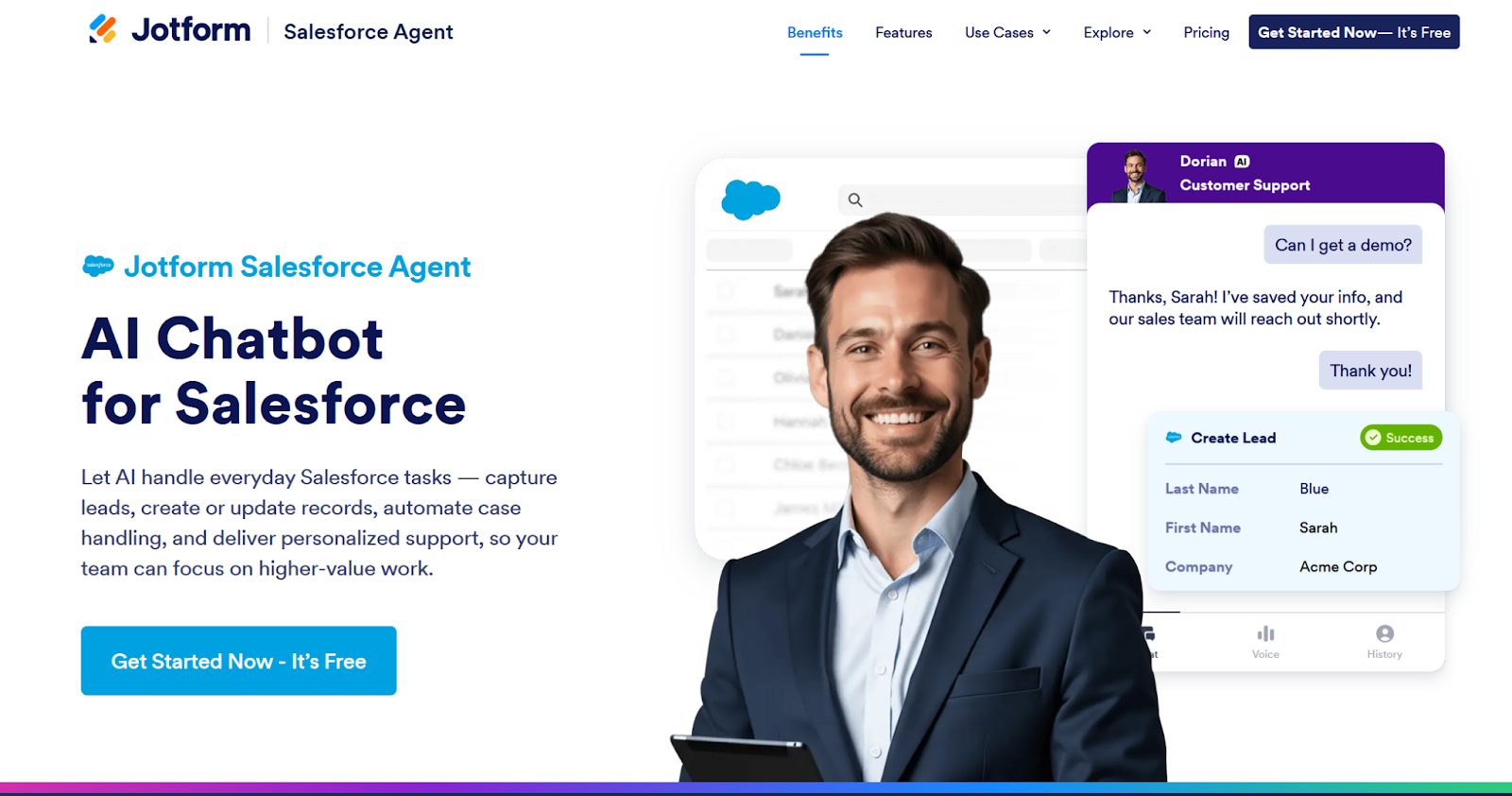
While the previous examples showcase what’s possible within Salesforce’s native ecosystem, some teams need even faster deployment or have different channel requirements (or are even exploring Salesforce alternatives for a CRM more aligned with their needs).
If that describes you, the Jotform Salesforce Agent is a powerful no-code alternative that lets you implement AI agents in just minutes across the web, WhatsApp, Instagram, and voice channels. The platform connects directly to your Salesforce data, automatically creating, updating, and managing records as conversations happen. For a real-world example of these kinds of workflows in action, see how architectural audio company Sonance improved customer communication with Jotform and Salesforce in this case study.
Teams can embed AI agents into websites or customer portals, then monitor real-time insights into every interaction. This visibility helps identify bottlenecks, reduce manual errors, and improve response efficiency without technical overhead.
The Jotform Salesforce Agent is part of Jotform’s AI Agents product suite, and its reach extends beyond Salesforce data. You can use the agent to pull knowledge from Zendesk, YouTube, or custom uploads, while its actions can connect to Shopify product listings, Google Calendar for appointments, or any tool via API integration.
Jotform users can apply the Salesforce Agent to the same scenarios explored throughout this article:
- Qualifying leads and routing opportunities to sales teams
- Managing support cases from creation through resolution
- Tracking orders and sending delivery updates
- Scheduling and rescheduling appointments
- Answering frequently asked questions with instant access to knowledge bases
- Providing employee HR support on internal processes and policies
The key advantages of Jotform are deployment speed and channel flexibility. What might take weeks or months to configure in a traditional setup can go live in minutes, with the same AI assistant accessible wherever your customers or employees prefer to interact, whether that’s your website, messaging apps, or phone support lines.
Making the most of Agentforce
The pattern emerging across these 10 Agentforce case studies is clear: Start with high-volume, repetitive workflows that don’t require complex judgment calls. Remove the work that’s preventing your team from focusing on retention, relationship-building, and strategic improvements. Map out your current bottlenecks to find these workflows, and use Agentforce to automate the most painful one.
As you implement, be sure your Salesforce data stays clean and accessible, because that’s your source of truth. Define clear escalation paths so your agent knows when to hand off to humans, and monitor accuracy rates closely in the first few months. This is not an overnight process. You’ll need to change agent configurations, knowledge bases, and connected actions to improve its performance.
Over time, you’ll start evolving to more complex multi-agent frameworks, achieving even higher levels of automation. This is where your human teams and machine systems begin to work together seamlessly, increasing operational efficiency and service quality for your customers.
FAQs about Agentforce use cases
Agentforce takes the pressure off your customer support team by being available 24-7 to handle common cases without human intervention, such as making appointment changes. Working across chat, email, and other portals, it can deflect up to 75 percent of repetitive tickets. Since Agentforce can connect to your systems and take action, it can also process refunds, change order details, and escalate anything outside its scope.
Yes, Agentforce is built explicitly for high-volume environments. It handles repetitive tickets on its own, manages traffic spikes without needing more staff, and comes with monitoring tools so you can adjust and improve it over time.
Yes, Agentforce works with both live chat and phone support. It connects to your website, messaging apps, and major phone systems like Amazon Connect and Five9. All interactions are managed in one place through Service Cloud.
This article is for Salesforce admins, support operations managers, and service team leads who want to explore real-world Agentforce use cases to improve customer service efficiency, automate workflows, and maximize their investment in the Salesforce ecosystem.








Send Comment: