
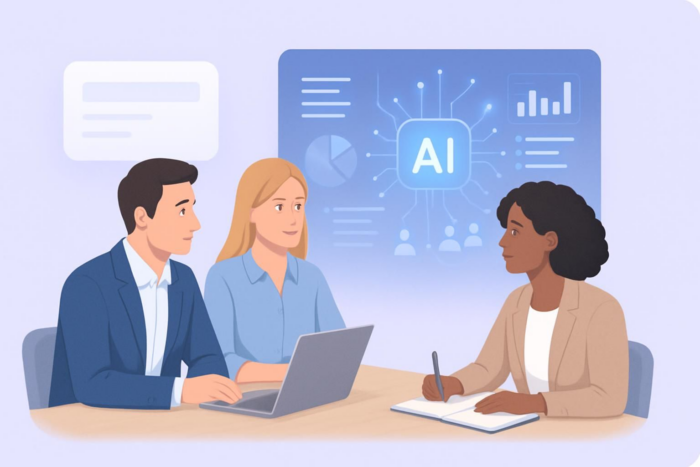
AI in business helps organizations automate tasks, improve decision-making, and scale operations more efficiently. However, it also comes with challenges such as data privacy risks, high implementation costs, and the need for human oversight, making it important to balance efficiency gains with ethical and operational considerations.
AI is permeating business operations at almost every level. An AI tool exists for every job, from automating menial tasks to handling more complex work such as marketing, personalization, and customer interactions. When implemented correctly, these tools can revolutionize business operations. However, these benefits come with challenges.
AI’s ability to eliminate busywork is great, but when users don’t think critically or question AI’s defaults, problems can arise. It’s often easier for users to accept AI’s suggestions without making the effort to improve them. Ultimately, users tend to fall into one of two camps:
- Some use AI to amplify their thinking, test their ideas, and iterate faster.
- Others become button-pushers overly reliant on surface-level output.
The first group will thrive. The second may plateau or be replaced. That’s why having a balanced understanding of AI’s capabilities is important.
Build faster with Jotform AIDescribe what you need, and let Jotform AI build it for you instantly.
Get Started Now
Pros of AI in business
When used well, AI solves real problems. It speeds things up, keeps operations humming, and helps teams focus on what matters.
Here’s what AI is already doing well and why so many businesses are jumping on board.
Increased efficiency and automation
Let’s be honest: Nobody misses the endless busywork of sorting emails, tagging support tickets, or entering line after line of data into a spreadsheet. That’s where AI shines. It takes on tedious, repetitive tasks so you can focus on solving problems, building a strategy, or just getting home on time.
AI doesn’t just save time; it keeps things running smoothly and consistently, 24-7, across departments. It doesn’t take breaks and it won’t experience burnout.
What this looks like in real life:
- AI chatbots like Zendesk and Intercom instantly handle order tracking, password resets, and basic questions without human intervention.
- Finance tools like QuickBooks and Xero automatically categorize expenses, flag anomalies, and reconcile accounts in the background.
- Jotform’s Small Business AI Agents transform dry forms into chat-like conversations that guide users through appointment scheduling, service requests, and feedback collection. No coding required.
The beauty here isn’t just speed. It’s also scale. AI lets you handle more without hiring more people and keeps things consistent even as your business grows.
Data-driven decision-making
Sometimes gut instinct is helpful, but it gets you only so far. AI gives businesses clarity. It can sift through mountains of data in seconds, spot patterns you may miss on your own, and turn raw numbers into decisions that move the needle.
The real power? Connecting the dots. AI helps teams understand what’s working and where the opportunities are hiding. Whether you’re refining a marketing campaign or adjusting hiring strategies, AI gives you the insight to act with confidence.
Real-world examples of AI turning data into direction:
- Marketing teams use Google Analytics 4 or HubSpot’s AI-powered insights to track user behavior, test messaging, and predict which campaigns will convert before spending the budget.
- HR departments use AI to identify which candidates are most likely to succeed, forecast turnover, and build stronger teams with less trial and error.
- AI dashboards give execs a live pulse on key metrics, such as sales, inventory, and customer churn, helping them make decisions faster.
In short, AI lets you see what’s happening and helps you decide what to do next.
Cost savings over time
Manual work gets expensive, especially when it involves repetitive tasks, long hours, and occasional human error. AI flips the equation. By automating routine processes and reducing mistakes, it helps businesses save money.
It’s not always about cutting jobs. It’s also about redirecting time, energy, and budget toward things that grow the business: less time spent on admin, more time spent on sales, innovation, and service improvements.
How it plays out in the real world:
- Customer service bots step in to handle basic issues at scale, which reduces the need to staff call centers around the clock.
- Manufacturing companies use AI-driven quality control systems to spot defects early, reducing product waste and rework costs.
- Jotform’s Business Registration AI Agents help government agencies and service providers automate complex registration processes, which cuts down on manual data entry, paperwork errors, and processing times.
Those savings add up and free up resources to deliver more value with less overhead.
Improved customer experience
No one likes waiting on hold or clicking through endless menus to find help. That’s where AI steps in. Rather than replacing the human connection, AI tools make it faster and more personalized.
From smart product suggestions to instant support, AI helps businesses create tailored experiences, even when they’re serving thousands of people at once.
How AI makes life better for your customers:
- E-commerce platforms use AI to recommend products based on what users have viewed, bought, or hovered over, leading to more relevant shopping experiences (and more sales).
- AI chatbots resolve everyday issues instantly, such as tracking orders and resetting passwords, and escalate complex cases to the right team.
- Jotform’s Customer Service & Support AI Agents deliver personalized, brand-aligned support that adapts to customer needs in real time.
When support is fast and personalized, customers feel valued. And that’s what keeps them coming back.
Competitive advantage
In business, speed and adaptability are everything. Companies that embrace AI tend to make smart decisions faster and quickly adapt customer experiences to align with shifting trends.
AI also unlocks entirely new ways of working. It allows companies to reimagine what’s possible, from creating hyper-personalized offerings to automating R&D workflows, and bring those ideas to market ahead of the competition.
What this looks like in action:
- Startups use AI to offer personalized services at scale, giving them enterprise-level impact without the enterprise-level head count.
- Large companies deploy AI in their R&D departments to test ideas faster, reduce time to market, and respond more quickly to market shifts.
- Businesses that fully integrate AI into daily workflows gain the flexibility to adapt fast, whether it’s tweaking a product, shifting strategy, or scaling operations with less friction.
The takeaway? AI is a catalyst for staying relevant and staying ahead.
Cons of AI in business
Of course, it’s not all upside. For every efficiency gain, there’s a trade-off to consider. AI can be expensive, disruptive, and risky if used carelessly.
Let’s take a closer look at where AI can fall short and what businesses need to watch out for as they adopt these tools.
High implementation costs
AI isn’t always plug and play. The software and the people needed to run it may require a high up-front investment, especially for small businesses.
Big companies may have the budget and IT teams to make AI work. However, smaller teams often struggle with the cost of tools, training, and setup. Even no-code platforms require time and know-how to customize and manage. It’s not magic. It’s infrastructure.
Real-world challenges:
- Enterprise projects can stall or go over budget due to unexpected complexity.
- Even free tools can collect dust if teams aren’t trained or don’t see the value.
Job displacement and workforce impact
AI can boost productivity, but it can also make certain jobs obsolete. When tasks are automated, roles change, and not everyone has the skills (or support) to adapt quickly.
This trend hits hardest in industries such as manufacturing, customer service, and admin support, where automation can replace entire functions. Even in knowledge work, AI is taking over tasks such as writing reports and analyzing data.
The key challenge for businesses? Making sure their employees are empowered to evolve along with AI
Real-world challenges:
- Data entry and back-office roles are often first in line for automation, with few transition paths in place.
- There’s often a lag in reskilling efforts, especially in small or resource-strapped organizations.
Data privacy and security concerns
AI runs on data. The more it knows, the smarter it gets. But that also means businesses are collecting, storing, and processing sensitive information at a much larger scale.
Without strong security and clear data governance, AI can open the door to data vulnerabilities.
Real-world challenges:
- Regulatory pressure is rising, especially with laws such as GDPR and CCPA requiring clear data usage policies and consent.
- Small businesses using third-party AI tools don’t always know where data is stored or how it’s being used.
Bias and ethical issues in AI
AI isn’t neutral. It learns from the data it’s given. If that data reflects bias, the AI tool can reinforce and amplify biased results.
That’s a big problem in areas such as hiring, lending, law enforcement, and healthcare, where biased decisions can affect real lives. Ethical AI use starts by prioritizing quality data and oversight, which is still a work in progress for many organizations.
Real-world challenges:
- Hiring algorithms have been shown to favor certain applicants or penalize candidates based on zip code or education gaps.
- Retail and finance companies have faced criticism for AI systems that unintentionally discriminate in pricing or credit approvals.
Dependence on technology and maintenance challenges
The more you rely on AI, the more you need it to work perfectly. AI systems require regular updates, retraining, and oversight to stay accurate and useful.
And if a key system goes down or outputs something incorrectly, businesses can get stuck without a backup plan. Overreliance also risks weakening human judgment, especially when teams stop questioning the tools.
Real-world challenges
- Recommendation engines can start showing irrelevant or inaccurate content if not updated with fresh data.
- Small teams often lack the technical resources to monitor and maintain AI tools over time, leading to “set it and forget it” problems.
AI isn’t magic, but it can be a game changer
AI is transforming the way businesses operate, in everything from personalized customer experiences to hands-off form automation. But like any powerful tool, AI comes with challenges: up-front costs, data risks, ethical concerns, and the need to reskill teams as roles evolve.
The key is balance. Businesses that approach AI thoughtfully, as a partner and not a replacement, will be better positioned to innovate, grow, and stay ahead of the curve.
At Jotform, we’re building AI tools designed to empower, not overwhelm. Our AI Agents help you get more done without losing the human touch.
Explore Jotform’s AI solutions to see how you can integrate automation into your workflows on your own terms.
This article is for business leaders, managers, and teams evaluating how AI fits into their day-to-day operations. It’s especially useful for decision-makers, marketers, operations, and customer experience professionals who want a realistic, balanced view of AI’s benefits and risks, and for anyone looking to adopt AI thoughtfully, without overhyping its potential or overlooking its limitations.
















































































Send Comment: