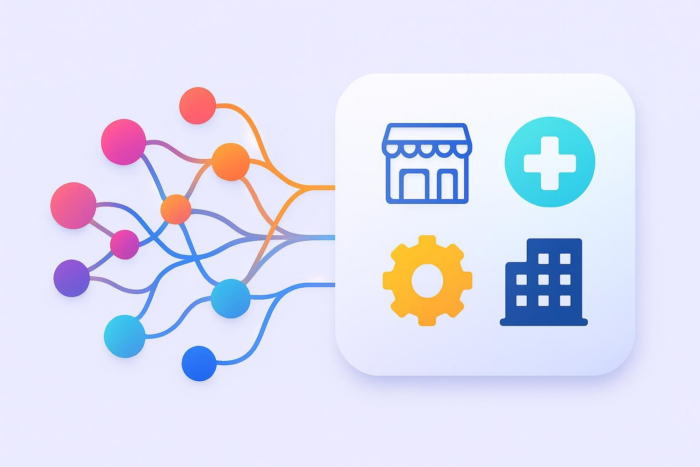
Generative AI is an advanced form of artificial intelligence that produces outputs, automates complex tasks, and personalizes experiences across key industries like healthcare, finance, education, and manufacturing.
Generative AI isn’t a tool of the future anymore. At this moment, it’s changing how people create, work, and solve problems. AI helps users do more with less, including jobs such as running a small business, managing healthcare data, and building customer experiences.
Today, we’ll explore real-world generative AI applications to demonstrate how it’s transforming healthcare, finance, education, manufacturing, and other industries. You’ll also learn how it actually works and what to consider before incorporating it into your own operations.
We’ll also take a look at how tools like Jotform AI Agents make it simple to put generative AI to work for you.
Introduction to generative AI and its growing importance
Generative AI is everywhere, from marketing departments and hospitals to classrooms and call centers. Before exploring its most valuable applications, we’ll discuss what it is, why it’s spreading so fast, and at what rate organizations already use it.
What is generative AI?
Generative AI refers to technology that creates something new from existing data, such as text, images, code, video, or even sound. These computer systems learn patterns and relationships from massive datasets and then use that knowledge to produce realistic outputs that resemble human work. You’ve probably already seen examples: chatbots summarizing emails in your inbox, AI art tools creating images, or platforms that build forms from basic prompts.
Generative AI differs from traditional automation in its creativity. It doesn’t just repeat information; it interprets it to generate new combinations of words, pixels, or other data.
Why is generative AI so popular?
Generative AI makes once-complicated processes simple and efficient. You can go from idea to finished product in minutes. Think of the time that frees up for strategy and problem-solving. A McKinsey & Company report estimated that generative AI could add up to an astonishing $4.4 trillion in annual value to the global economy.
Healthcare, banking, and education organizations are exploring generative AI for better productivity and creativity. Hospitals use AI to summarize patient records. Banks rely on it for personalized budgeting tools. Teachers use it to design lesson plans that adapt to each student’s learning style.
It’s also popular because it’s accessible through user-friendly tools, such as ChatGPT, Midjourney AI, and Jotform AI Agents.
Real-world adoption signals
According to an IDC study, generative AI adoption jumped from 55 percent in 2023 to 75 percent in 2024 among organizations surveyed.
The same report shows that companies using generative AI gain an average return of $3.70 for every dollar invested. Top performers report returns as high as $10.30 per dollar.
These figures show that many enterprises have moved from speculating about generative AI to using it strategically.
How generative AI works: Foundations and key concepts
Generative AI works by learning from large datasets, analyzing patterns in the data, and then producing new outputs.
Foundation models and neural networks
Most generative AI systems depend on foundation models: large-scale models trained with massive, diverse datasets. These models act as a base layer you can adapt to perform various tasks, such as writing a medical summary, generating code, and designing an image.
Neural networks are the core of those foundation models. They stack multiple layers of “neurons” that transform input data (such as words or pixels) into internal representations. During training, the model captures syntactic, semantic, and structural relationships. Once the model is trained, when it receives a prompt, it can generate new content from the patterns it has learned.
Training: Semisupervised, unsupervised, and transfer learning
Generative AI often uses unsupervised or semisupervised training, which means every data point doesn’t need a label. Instead, it learns structure from raw data to refine internal models.
If you then fine-tune the model by training it with smaller, labeled datasets, you can specialize it for a particular domain, such as healthcare or finance. The process of adapting the foundation model is called transfer learning.
The more data variety and volume you use during training, the richer the internal representations. A model trained on various types of text, languages, genres, domains, and modalities tends to generalize better. Diverse training data helps it handle new prompts, less common scenarios, and cross-domain context.
How it produces new outputs
When you enter a prompt, the AI model uses its learned internal structure to predict the most likely next token (word, pixel, etc.). It might predict using the highest probability or with some randomness, to allow variation. It repeats that process until it constructs full sentences, images, or other artifacts. Because it isn’t just copying, it can generate new text, visual styles, solutions, and so on.
Why data volume and quality matter
Generative AI can’t perform well from a small dataset. The model needs volume to see a wide range of contexts, edge cases, and counterexamples.
If you train the model on low-quality data that contains biases or errors, those will appear in its outputs. If your training set has gaps or skewed representation (for example, the majority of its medical images are from one population group), your model may work poorly or unfairly.
As you scale model parameters and dataset size, improvements will often be unsteady, and you may face diminishing returns and higher costs. That’s why building generative AI models involves balancing size, compute, data, and domain needs.
Major use cases for generative AI, by industry
Across industries, teams are using generative AI for content, prediction, personalization, design, and more. Here are some generative AI applications in key sectors, including example usage, benefits, and challenges.
Healthcare innovations
Healthcare is one of the most ambitious testing grounds for generative AI. These systems, including Jotform’s Healthcare & Wellness AI Agents, take on some of the most time-consuming and life-critical tasks in medicine, from automated paperwork to faster drug discovery.
Synthetic data generation for patient privacy
Hospitals and labs often face the challenge of training models while preserving patient confidentiality. Generative models can create dummy datasets that mirror real ones in statistical properties, without exposing personal information.
Accelerating drug discovery and personalized care
Some teams use generative AI models to propose molecular structures and then simulate their behavior, hastening early-stage drug design.
In care settings, models help customize treatment plans by combining genetic data, lifestyle inputs, and outcomes.
Conversational AI for patient engagement
Chatbots and voice AI agents can answer routine questions, schedule checkups, and guide patients through symptom assessment. These tools improve patient engagement, free staff for other tasks, and offer patients 24-7 access.
Automated documentation and clinical summarization
Clinicians spend a lot of time typing notes. Generative AI systems draft visit summaries, transcribe spoken notes, extract key findings from records, and suggest billing codes, potentially reducing documentation time by almost 30 percent.
Surveys that collect patient feedback
Another AI use case in healthcare is feedback collection. With tools such as Jotform’s Hospital Satisfaction AI Agent, you can collect patient feedback in an engaging way.
Challenges and cautions
Healthcare AI must handle privacy, biases, and verification. Because models can present faulty “facts” (hallucinations), they require oversight. Regulatory approval and clinical validation remain significant barriers to use of AI in this industry.
Manufacturing and industrial evolution
Factories, energy plants, and logistics hubs are using generative AI to reimagine how they design, maintain, and optimize machinery. The results are faster iteration, fewer breakdowns, and more sustainability.
Design optimization and generative design
Using generative AI, engineers produce component shapes or structures optimized for weight, stress tolerance, or material use. The model proposes several design variants, and engineers choose the best one.
Predictive maintenance and anomaly detection
AI models predict when machines will fail by synthesizing sensor data, historical logs, and operating conditions, helping users avoid unexpected downtime and expensive repairs.
Energy sector analytics
In utilities or heavy industry, AI can forecast energy demand, simulate energy flows, and propose configurations to reduce waste.
Improved operational efficiency
Processes such as scheduling, supply allocation, or quality-check planning benefit from AI-generated alternative plans and scenario explorations.
Challenges and cautions
Data silos and legacy systems often hamper AI integration in this area. In safety-critical settings, AI requires rigorous testing, fail-safes, and human-in-the-loop systems.
Finance and risk management
Banks and insurers were among the first to try generative AI in banking and finance, using it to flag fraud, automate reporting, and simulate complex decision-making models.
Fraud detection and anomaly alerts
Systems learn customers’ usual transaction patterns and generate alerts when behavior deviates (for example, when a system sees sudden large transfers or unusual merchant codes).
Budget forecasting and planning agents
Generative AI can build forecast models, propose budget allocations, and simulate what-if scenarios for CFOs. For instance, Jotform’s Budget Planning AI Agent allows users to create personalized budgets.
Personalized banking experiences
Chatbots can generate financial advice, explain account activity, and help users set financial goals.
Risk assessment and compliance
AI can prepare draft compliance reports, simulate regulatory scenarios, and flag high-risk portfolios automatically.
Automating repetitive tasks
Generative AI can streamline time-consuming tasks, such as expense request approvals, invoice reviews, and small account reconciliation. Jotform’s Expense Request AI Agent is an excellent example.
Risks and constraints
Financial firms must carefully validate outputs to avoid hallucinations and bias across customer segments. In this highly regulated industry, it’s also essential that your tools follow strict audit trails.
Customer interactions and marketing
Customer support and marketing teams love generative AI because it saves time and sparks ideas. It’s a creative partner, helping teams brainstorm, create, and personalize.
AI-driven customer support
Bots handle FAQs, prioritize tickets, and generate draft responses that your staff can refine. The chatbots reduce wait times, and they escalate to human agents only when necessary.
Automated content creation
Marketers use AI to generate blog drafts, social media posts, product descriptions, email subject lines, and landing page copy, all at scale.
Personalized recommendations
Generative models can suggest products, add-ons, bundles, and content based on user profiles and behavior, improving upsell and conversion rates.
Campaign ideation and creative variation
Marketers can ask AI to propose dozens of slogans, visuals, and layouts, and then pick or perfect the best ones.
Considerations
Overusing AI-generated content can make your materials bland or repetitive. Always review your drafts, and inject a human feel whenever possible. It’s also crucial to keep an eye on copyright and attribution issues if your AI training included copyrighted sources.
Logistics, supply chain, and transportation
Generative AI helps logistics companies anticipate problems, reroute shipments, and balance stock with demand, all in real time.
Route optimization and mapping
AI generates the best travel routes, multistop approximations, and alternative paths when disruptions occur.
Demand prediction and inventory
Models can forecast demand spikes and create ordering plans to prevent out-of-stock events and overstock waste.
Supply chain simulation
Generative AI can simulate logistics scenarios, such as supplier delays and route closures, and propose fallback plans.
Security and surveillance
Teams can flag risks using AI with facial recognition tools and AI that detects anomalies in cargo. Models can generate alerts from visual or sensor feeds.
Challenges and cautions
Unpredictable events, such as weather and geopolitical shifts, can derail AI models. Always have real-time data and fallback plans.
Retail and e-commerce
Retailers use AI to engage customers, stay ahead of trends, and boost overall customer satisfaction with simplified processes and customized experiences.
Personalized email campaigns and product suggestions
AI writes personalized email copy based on user history and recommends products that are likely to convert a prospect to a customer.
Fraud detection and analysis
As in finance, in this industry, AI learns a customer’s usual transaction behavior and spots suspicious activity.
Conversational payments and checkout bots
With tools like Jotform’s PayPal Business Payment form, customers can pay through chat or voice flows.
Inventory management and demand forecasting
AI predicts trends and creates restocking orders or markdown plans. Tools like Jotform’s Inventory AI Agent use this automation.
Visual merchandising simulation
AI generates virtual storefront setups, layout options, or cross-sell bundles to test what might improve conversion.
Challenges and cautions
Supply chain ripple effects and sudden demand changes, such as viral spikes, can overwhelm AI predictions. Models used in retail and e-commerce need frequent retraining.
Education and learning
Schools, universities, and online platforms are exploring how generative AI can personalize education, gather feedback, and make learning more interactive and beneficial for students.
AI tutoring and course creation
Generative AI can personalize lessons, quizzes, explanations, and feedback.
Intelligent, adaptive learning strategies
Models such as Jotform’s Quiz Manager AI Agent generate next-step suggestions based on a student’s responses, strengths, and learning gaps.
Feedback collection and engagement
Generative AI can create conversational tools that collect survey responses, quiz reflections, and other feedback in a natural and engaging way, leading to continuous improvement.
Content summarization and knowledge extraction
For dense textbooks or articles, AI can summarize content, generate glossaries, and propose learning exercises.
Cautions
Student data privacy is paramount, so take measures to protect it. Also, overreliance on AI for core instruction risks dehumanizing pedagogical creativity. As in all industries, human oversight remains crucial here.
Key advantages of embracing generative AI
Generative AI can help you work faster and smarter, and be more creative. Organizations adopting these systems have seen measurable improvements in efficiency, quality, and insight, and their teams have more time to focus on higher-value tasks.
Here are some of the tangible benefits reported across industries.
Accelerated content creation and automation
Generative AI can produce reports, marketing copy, code snippets, and design concepts in minutes rather than hours. Amarra, a gown store based in New Jersey and distributing globally, uses AI to write product descriptions. It reports a 60 percent reduction in content creation time.
With AI, your business can produce more without increasing staff. This benefit can be particularly valuable for small and mid-sized organizations.
Enhanced decision-making with data
AI can analyze large volumes of structured and unstructured data, summarize insights, and generate predictive models. For example, AI-driven predictive models have been shown to provide more accurate return forecasts by identifying complex, nonlinear patterns that traditional linear models miss.
The ability to convert complex data into actionable guidance gives your organization a competitive edge. Thus, AI helps you respond to changes faster and more confidently.
Cost-efficiency and operational gains
Generative AI can optimize operations by suggesting more efficient workflows or detecting errors early. In manufacturing, AI-fueled predictive maintenance has reduced unplanned downtime by up to 50 percent, leading to significant cost savings.
In retail, AI-powered inventory management can reduce overstock and out-of-stock events, which translates to tangible savings and improved customer satisfaction.
Creativity and innovation support
Contrary to popular belief, AI can’t replace creativity. Instead, it supplements it. Marketing teams use AI to generate campaign details and brainstorm product ideas, while R&D departments use it to simulate potential solutions before committing resources. By lowering the cost and risk of experimentation, AI allows you to explore more options.
Personalization and improved user experiences
From healthcare to e-commerce, generative AI is customizing experiences. In education, adaptive learning platforms develop customized lesson plans. In banking, AI-powered chatbots help customers manage budgets and explore investment options. Personalized interactions increase engagement, satisfaction, and retention.
Balanced human-AI collaboration
While AI handles repetitive or data-intensive tasks, humans can focus on using their judgment, conducting oversight, and being creative. Organizations that adopt generative AI with this kind of balanced approach often report higher employee and customer satisfaction and better overall results.
Preparing for generative AI adoption: Challenges and considerations
While the benefits of generative AI are compelling, successful adoption depends on how well you manage the associated challenges. If you understand these hurdles and proactively address them, you can more smoothly integrate AI into your workflows and maximize the technology’s potential.
1. Data quality and availability
Effective generative AI models train on high-quality, relevant data. Many organizations face challenges in data collection, cleaning, and integration, which can impede the development and deployment of AI solutions.
A study by the Boston Consulting Group found that 74 percent of companies struggle to achieve and scale value from their AI investments, often due to data-related issues.
2. Talent acquisition and skill development
The rapid advancement of AI technologies has created a powerful demand for skilled professionals. However, there’s a noted shortage of individuals with expertise in AI, machine learning, and data science. According to the World Economic Forum, 94 percent of leaders face AI-critical skill shortages, with one in three reporting gaps of 40 percent or higher.
3. Ethical and regulatory concerns
As AI systems become more integrated into business processes, it’s essential to consider ethical considerations regarding bias, transparency, and accountability. Address complex regulatory requirements to maintain public trust.
One such requirement is the European Union’s proposed EU Artificial Intelligence Act, which is the first of its kind. It aims to regulate AI technologies, emphasizing the need for ethical guidelines and accountability measures.
4. Integration with existing systems
Integrating generative AI into legacy systems can be technically challenging and resource intensive. Compatibility issues, data silos, and infrastructure limitations can hinder integration.
A Deloitte survey indicates that 60 percent of organizations face difficulties integrating AI solutions with their existing IT infrastructure.
5. Change management and organizational culture
Adopting generative AI often requires major changes in organizational processes and culture. Resistance to change, lack of leadership support, and insufficient training can stymie successful implementation.
McKinsey and Company reports that 70 percent of digital transformation initiatives fail, primarily due to cultural and organizational challenges.
Future outlook and emerging possibilities
Generative AI is still evolving, and its potential applications continue to expand. The next few years will likely bring deeper integration, more sophisticated models, and broader accessibility. Staying informed about emerging trends can better position your organization for innovation.
Advances in model capabilities
AI research is pushing the limits of what generative models can do. Newer models are learning to produce outputs with fewer errors, understand context more deeply, and even generate multimodal content, combining text, images, and audio.
OpenAI reports that the latest generation of models can handle increasingly complex reasoning tasks while producing more creative outputs.
Industry-specific innovations
Industries such as healthcare, finance, and education are exploring specialized AI applications. In healthcare, researchers are experimenting with AI-assisted diagnostics that combine patient imaging and genetic data (a field known as multimodal AI) to improve personalized treatment options.
In finance, AI-driven forecasting tools are being refined to detect market trends sooner and indicate potential risks. These developments suggest organizations can increasingly rely on AI to augment their critical decisions.
Democratization and accessibility
Generative AI is becoming more accessible to small businesses and nontechnical users through SaaS platforms and AI agents. Because these tools are designed to require minimal technical expertise while providing powerful capabilities, they enable wider adoption and experimentation without huge infrastructure costs.
Ethical and responsible AI
As adoption grows, emphasis on ethical AI, transparency, and bias mitigation will continue to increase. Organizations investing in responsible AI frameworks are likely to gain trust with customers, employees, and regulators. Monitoring and auditing AI outputs will remain a priority to prevent unintended consequences.
Opportunities for R&D and cross-industry collaboration
Ongoing research highlights some of AI’s unexpected applications, from creative arts to scientific discovery. Cross-industry collaboration may accelerate breakthroughs, particularly in areas such as climate modeling, drug discovery, and advanced robotics.
Generative AI: Revolutionizing industries
Generative AI is transforming how organizations operate, assisting with everything from a routine tasks to decision-making. As you can see from these highlighted use cases, across industries, AI-driven solutions are helping teams work more efficiently, engage customers, and explore new possibilities.
Embracing generative AI doesn’t mean replacing humans. It involves augmenting expertise, simplifying workflows, and reaching new levels of innovation. With well-planned adoption, your organization can enjoy better efficiency, insights, and experiences for employees and customers alike.
If you’re ready to explore how generative AI can level up your operations, Jotform AI Agents make it easy. They can collect feedback, automate repetitive tasks, assist with customer service, and support industry-specific workflows, whether it’s for personalized budget planning in finance, patient engagement in healthcare, or secure payment collection for e-commerce.
Key features of Jotform AI Agents
Jotform AI Agents bring generative AI into your workflow and don’t require technical expertise. They combine autonomy, advanced technologies, and versatile applications to simplify tasks and improve productivity.
1. Autonomous operation: Perform tasks without human intervention
Jotform AI Agents can perform repetitive or structured tasks on their own, reducing manual workload. They can automatically handle survey responses, event registrations, order form processing, and more, which frees up your team for more effort-intensive work.
2. Advanced technologies: Use machine learning and natural language processing
These agents use machine learning and natural language processing to understand inputs and generate relevant, context-aware outputs. By interpreting customer questions, summarizing data, and providing insights, they enable your team to respond faster and more accurately.
3. Diverse applications: Launch agents in customer service, healthcare, e-commerce, and more
Jotform AI Agents are useful across various industries, including
- Healthcare: They can collect patient feedback, provide HIPAA-friendly assistance, and support appointment scheduling.
- Finance: AI assists with personalized budgets, expense tracking, and automation of repetitive requests.
- E-commerce: These models facilitate secure payments, manage inventory queries, and provide product recommendations.
- Education: Adopters in this industry use generative AI to support quiz management, adaptive learning, and course design.
Integrating Jotform AI Agents allows you to streamline processes, improve engagement, and deliver better experiences to customers and internal teams.
This article is for professionals, teams, and business leaders interested in using generative AI to streamline workflows and boost efficiency. It’s also for those looking to enhance customer experiences, automate repetitive tasks, and explore AI applications across industries.


























































































Send Comment: