
Top 5 generative AI tools for e-commerce
A few years ago, it took a whole team of specialists to run an e-commerce store: copywriters for product descriptions, support agents for customer queries, and designers to create visuals. Today, generative AI can handle much of that, faster and at scale.
From AI-powered assistants that answer product questions in real time to tools that help shoppers find the right products and automatically generate descriptions, generative AI is helping online stores improve customer experience, increase sales, and operate more efficiently, even with a small team.
In this guide, I’ll walk you through everything you need to know about generative AI in e-commerce and the best tools to use.
How generative AI enhances online shopping experiences
When a shopper lands on your site, AI can already be working behind the scenes to make the experience smoother, more personal, and more engaging. Here are some ways it can do that:
Personalized product recommendations
One of the biggest benefits of generative AI is how it recommends products to shoppers. Instead of showing generic suggestions, these systems use signals such as browsing behavior, past purchases, search queries, and time spent on specific pages to generate highly personalized product recommendations. For example, someone who frequently browses outdoor gear might be shown a discounted camping chair right when they’re planning a trip.
This level of personalization is also what shoppers now expect. According to Capgemini, around two-thirds of Gen Z and millennials want hyper-personalized content and product recommendations. And more than half of consumers say they’ve already replaced traditional search engines with generative AI tools for discovering products and services.
If your store delivers that level of relevant product recommendations, you’re more likely to convert visitors.
AI-powered virtual assistants
Another way AI improves the customer experience is by powering chatbots and virtual assistants. These conversational commerce solutions can understand context, handle multistep conversations, and assist shoppers in real time with choosing a size, checking order status, and processing returns.
They work 24-7, and you can train them to match your brand’s tone so they sound more like a human team. Using AI assistants also helps resolve issues faster and reduces the number of human agents you need. Data from Rep AI shows AI chat resolves 93 percent of customer inquiries, and, on average, 12.3 percent of shoppers who engage with AI chat make a purchase — four times the conversion rate of those who don’t.
Automated content generation
E-commerce businesses need a steady stream of content like product descriptions, SEO metadata, ad copy, and more to stay competitive. Creating all this manually is time-consuming, but with AI tools like ChatGPT or Claude, you can generate content faster and even customize the tone and style to match your brand.
Hyper-personalized email marketing and retargeting
Generative AI in e-commerce makes it easier to send the right email to the right person at the right time. It analyzes customer data to generate personalized emails that align with each person’s behavior and timing. Instead of sending the same blast to everyone, you can create targeted messages that feel more relevant and are more likely to convert.
You can also use AI to test subject lines and other elements to see what performs best with your audience. Irresistible Me, a hair extensions brand, uses AI in Klaviyo to generate and optimize subject lines. And it has consistently reported an 8 to 12 percent lift in open rates compared to manually written ones.
Personalized pricing and dynamic discounts based on consumer behavior
AI can also help businesses in developing effective pricing strategies. By analyzing demand trends, customer behavior, and competitor data, AI tools can dynamically adjust prices or offer targeted discounts to maximize both conversion and profitability.
For example, loyal customers might see special offers based on their purchase history, while new visitors might get limited-time discounts to encourage their first sale.
How to automate e-commerce operations with AI
Below are some ways you can automate your e-commerce operations with AI:
AI-driven inventory management and demand forecasting
Keeping the correct stock levels is tricky: too little means lost sales; too much ties up cash. AI changes that by analyzing historical data, market trends, and real‑time signals to forecast demand more accurately. This helps prevent overstocking or running out of popular items, two operational challenges in e-commerce. It’s why 61 percent of executives in a Capgemini research say genAI helps us predict demand fluctuations and optimize inventory levels.
Automated product tagging and image generation for e-commerce listings
Creating and tagging hundreds of product images is tedious and time-consuming. AI tools can automatically recognize and tag product attributes, making listings more searchable and consistent across your store.
Generative AI can also produce high-quality visuals from simple prompts or base images. That means you can generate lifestyle photos or promotional graphics without needing a full photoshoot.
For example, Mr. Mintz, a printable craft brand, uses Sora 2 to generate short-form video content. In one case, the AI turned a basic product concept into a Halloween-themed clip featuring a band of skeletons playing instruments at the door and added an animated intro in Canva. The whole video was done in under an hour and was still on brand without involving a videographer.
While that’s a video use case, it shows how generative tools can quickly fill content gaps, reduce production costs, and help brands scale their visuals faster.
Fraud detection and AI-powered risk management in e-commerce transactions
As online transactions increase, so do fraud, chargebacks, and fake accounts. In fact, online payment fraud caused an estimated $44 billion in losses in 2024, and that figure is projected to more than double by 2029, surpassing $100 billion.
AI helps manage these risks by analyzing large volumes of transaction data in real time. It can detect unusual patterns, flag suspicious activity, and adapt to new fraud tactics faster than rule-based systems.
By using AI for fraud detection, businesses can block risky transactions before they go through, reduce chargebacks, and protect both their revenue and their customers.
The 5 best generative AI tools for e-commerce
1. Jotform AI Agents
Jotform AI Agents helps e-commerce businesses create conversational AI experiences without writing a single line of code. You can train agents on your own data and customize them to match your brand’s voice, tone, and workflows. Once deployed, they can assist customers, take orders, check inventory, and handle other key e-commerce tasks with the same intelligence and context awareness you’d expect from a human team. Essentially, these agents help you deliver faster, more responsive support without having to hire more staff.
Best for: Businesses that want to build customizable, no-code, conversational AI agents to collect information and engage customers
Developer: Jotform Inc.
Limitations: Platform is form-centric; many Jotform AI Agents tied to form-based workflows
Key features:
- No-code AI agent builder: Jotform’s Agent Builder lets you create conversational commerce solutions from scratch, clone an existing agent, or choose from 7,000-plus templates. You can train the agents using documents (PDFs) or URLs or by uploading common questions and answers, so they respond based on your specific business data.
- Customizable agents: Define tone, voice, brand avatar, and conversation flow. You can even clone agents to replicate setups across different use cases.
- Pre-built e-commerce agents: Choose from Jotform’s library of ready-made agents tailored to e-commerce needs. For instance, the Product Purchase Order AI Agent can streamline your customers’ ordering process by engaging them in dynamic conversations. The Pre-Order AI Agent can collect customer preferences to gauge their interests before a product becomes available. Use the Inventory AI Agent to gather essential stock data without human error. The Sales AI Chatbot provides your customers with real-time assistance as they move through your sales funnel, and the Personal Shopping AI Agent helps tailor shopping experiences to each customer.
- Multi-channel deployment: Deploy agents across website chat, embedded forms, WhatsApp, Messenger, SMS, Instagram DMs, etc.
- Mobile app support: Manage, train, and customize your AI Agents from anywhere using the Jotform AI Agent mobile app (available on iOS and Android).
Pros:
- Is easy to build and deploy; no coding required
- Supports human handoff (take over chats from mobile or desktop)
- Is a strong fit for e-commerce workflows like sales, support, pre-orders, and inventory
- Connects with tools like Slack, Google Calendar, Dropbox, OneDrive, Twilio, and more
- Has generous free plan with high session limits
Cons:
- Requires training with your business data for best results
Plans/Pricing:
- Starter: Free with up to five agents and 10,000 monthly agent sessions
- Bronze: $34 per month with up to 25 agents and 100,000 monthly sessions
- Silver: $39 per month with up to 50 agents and 1,000,000 monthly sessions
- Gold: $99 per month, up to 100 agents, and 2,000,000 monthly sessions
- Enterprise: Custom pricing, unlimited agents, unlimited monthly sessions
G2 rating: 4.7/5
2. Tidio
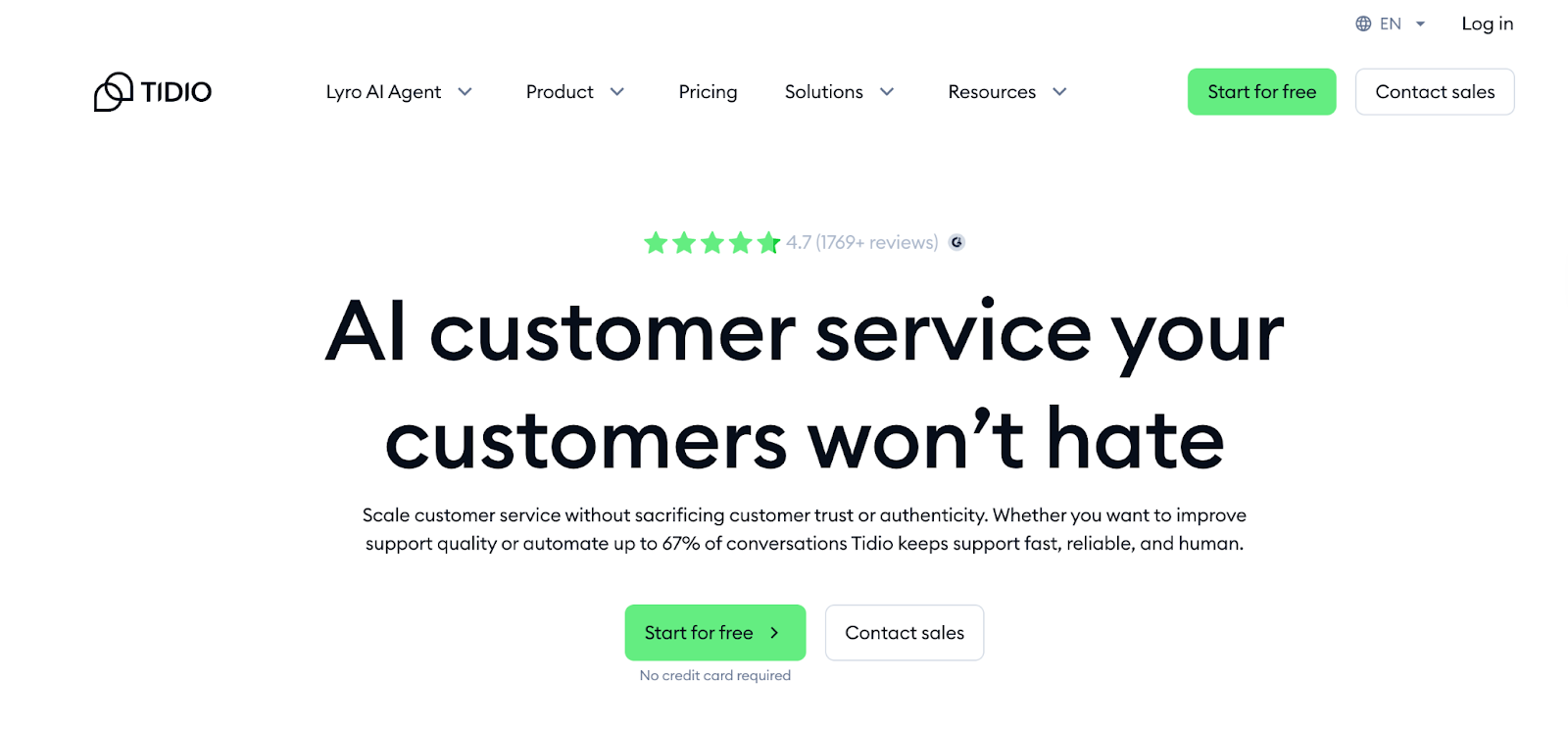
Tidio combines chatbot automation with live chat tools to help businesses respond faster and reduce support costs. Its AI assistant, Lyro, can handle common customer queries using your support content, boasting a 67 percent resolution rate. With a unified inbox and omnichannel support, Tidio keeps customer communication centralized and efficient.
Best for: Growing e-commerce businesses that need scalable live chat and AI-powered customer support
Developer: Tidio Ltd
Limitations: Offers only a seven-day free trial, which may not be enough time to explore all features in depth
Key features:
- AI chatbot (Lyro): Instantly answers customer questions using your own verified data. You can customize the agent’s tone and personality and decide when to route to a human.
- Live chat: Real-time support offers live typing preview, canned responses, pre-chat surveys, and visitor tracking.
- Unified inbox: Manage conversations across website chat, email, Instagram, WhatsApp, and Messenger in one dashboard.
Pros:
- Features fast, automated customer support
- Offers lower cost compared to hiring a full support team
- Is easy to set up and use
Cons:
- Increases in cost quickly as usage scales
- Has only limited free plan; most advanced features require higher-tier plans
Plans/Pricing:
- Free plan available (limited to 50 conversations per month)
- Starter: $24.17 per month (limited to 100 conversations per month)
- Growth: $49.17 per month (limited to 250 to 2000 conversations per month)
- Plus: $749 per month
- Premium: Custom pricing
- Add-ons: Lyro from $32.50 per month, Flows from $24.17 per month
G2 rating: 4.7/5
3. Synthesia

Synthesia is an AI video-generation platform that allows teams to create videos in just a few minutes, saving a ton of production time and costs. With 230-plus avatars and 140-plus language options, Synthesia helps e-commerce businesses create videos for a global audience at scale and with minimal overhead.
Best for: Creating marketing, product, or training videos at scale without a production team
Developer: Synthesia Ltd
Limitations: Customization options limited compared to traditional video production; not ideal for videos with complex scene transitions or long duration
Key features:
- AI video assistant: Turn scripts, files (.docx, .pptx, .pdf), or links into short, engaging videos.
- Text-to-video workflow: Type or upload a script, select an avatar, and generate a video in minutes.
- Bulk personalization: Create multiple personalized videos at once.
- Video dubbing: Translate existing videos into other languages while retaining the original voice tone.
Pros:
- Is beginner friendly — no need for production or editing experience
- Boasts global scalability with 140-plus languages
- Offers 230-plus AI avatars and custom-avatar-creation options
Cons:
- Doesn’t let credits roll over, so unused minutes expire monthly
- Increases in cost quickly at higher usage levels
Plans/Pricing:
- Basic: Free with one editor, nine AI avatars, and up to 360 credits or three minutes of video per month
- Starter: $18 per month with three guests, 125-plus AI avatars, and up to 14,500 credits or 120 minutes of video per month
- Creator: $64 per month with five guests, five personal avatars, 180-plus AI avatars, and up to 44,000 credits or 360 minutes of video per month
- Enterprise: Custom pricing for large teams with unlimited video minutes and 230-plus AI avatars
G2 rating: 4.7/5
4. Nosto
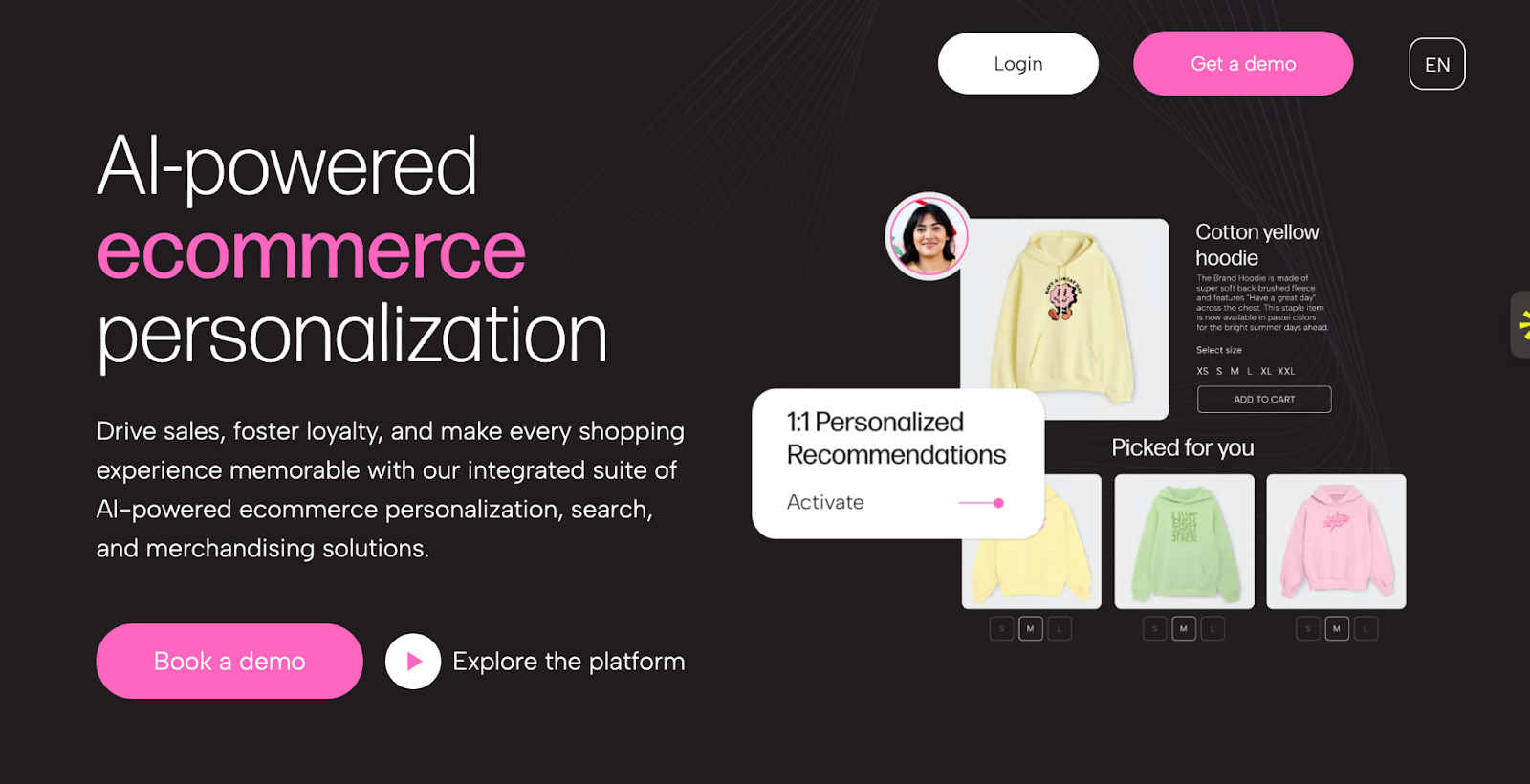
Nosto is an AI personalization platform designed to optimize e-commerce experiences in real time. It combines behavioral, product, and customer data to deliver highly relevant product recommendations and shopping experiences. This helps shoppers discover what they’re most likely to love in the moment, increasing conversions, average order value, and long-term retention.
Best for: Delivering AI-powered personalized shopping, search, product, and content recommendations
Developer: Nosto Solutions Ltd
Limitations: Pricing not publicly available, which can be a challenge for smaller businesses evaluating affordability
Key features:
- Predictive product recommendations: Nosto uses behavioral data and predictive AI to show the right product at the right time, boosting conversions and average order value.
- Search personalization: AI-powered e-commerce search understands shopper intent and delivers hyper-relevant results.
- Smarter category merchandising: It automatically arranges category pages based on performance, product attributes, and shopper preferences.
- Content personalization: Tailor messages, banners, and offers to specific audience segments (e.g., show UGC or exclusive offers to returning customers).
Pros:
- Combines personalized product recommendations, search, content, and merchandising in one platform
- Integrates with Shopify Plus, BigCommerce, Adobe Commerce, Klaviyo, Salesforce, Tapcart, and other tools in your e-commerce stack
Cons:
- Doesn’t have transparent pricing
- Takes time to fully learn the platform’s features
Plans/Pricing: Custom pricing. Book demo to get a quote
G2 rating: 4.6/5
5. Klaviyo AI
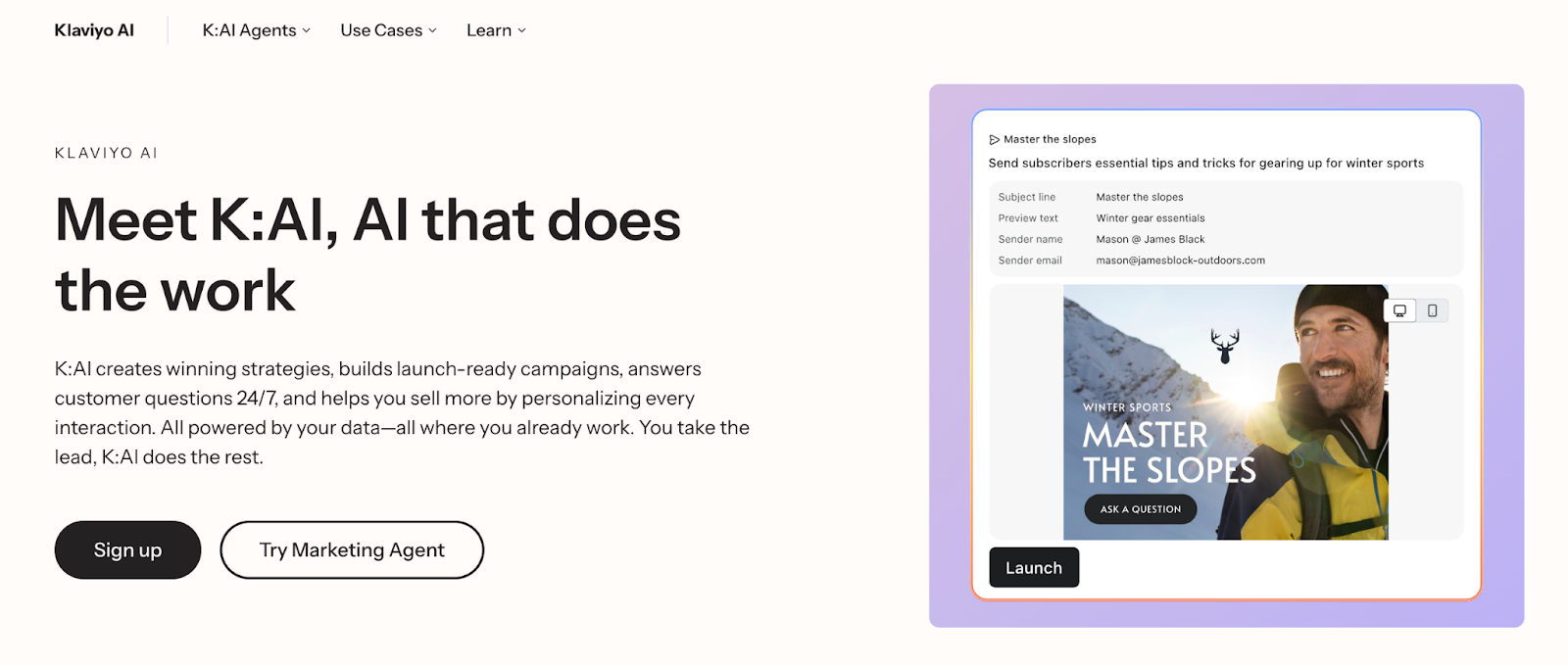
Klaviyo AI (K:AI) brings automation and personalization to email, SMS, and support workflows for e‑commerce brands. Its AI agents can generate full marketing strategies and ready‑to‑launch email and SMS flows, and they function as digital sales assistants that recommend products and respond to customers. By combining marketing, service, and personalization in one platform, Klaviyo AI offers a comprehensive solution for engaging customers across channels.
Best for: Automating email, SMS, and customer support with AI that builds marketing campaigns, answers customer questions, and personalizes every interaction.
Developer: Klaviyo Inc.
Limitations: AI features billed separately from Klaviyo’s main features
Key features:
- K:AI Marketing Agent: Klaviyo’s AI assistant automatically builds an entire marketing strategy — email flows, signup forms, and campaigns — just by analyzing your website.
- K:AI Customer Agent: This AI agent acts like your best digital salesperson, recommending products and resolving questions across channels using real-time data.
- AI personalization tools: 40-plus built-in AI tools help you automatically send the right message and product, at the right time, on the right channel, and to the right customer.
- Remix (AI image editor): Use Google Gemini–powered image editing directly in the email builder to generate or personalize visuals using just a prompt.
Pros:
- Integrates with e-commerce platforms like Shopify, WooCommerce, and BigCommerce
- Offers robust AI marketing and support features in one platform
Cons:
- Bills email, analytics, and AI separately, so costs add up fast
- Takes some time to learn due to its wide feature set.
Plans/Pricing:
- Customer agent: Starts from $50 per month with 75 AI conversations
- Customer hub: Starts from $20 per month with zero to 10,000 active profiles
- Helpdesk: Starts from $10 per month with 50 monthly tickets
G2 rating: 4.6/5
The future of generative AI in e-commerce
It’s only been a few years since generative AI became mainstream, and it’s already reshaped how e-commerce brands market, personalize, and support customer interactions. But we’re still at the beginning of what this technology can do.
As these models become more advanced, we’ll likely see even more intelligent AI-powered personalized shopping, not just in email or on-site recommendations, but across every customer touchpoint. Customer experiences will become increasingly tailored in real time, adapting to each customer’s intent, preferences, and behavior with little human input.
Generative AI is also expanding into shopping channels. Voice assistants and augmented reality tools will make online shopping feel more natural, enabling people to search, order, and visualize products hands-free. For e-commerce brands, that means building virtual try-ons and personalized previews to serve customer needs.
Still, these advancements raise important ethical and privacy questions. As AI systems rely on growing volumes of customer data to deliver hyper-personalized experiences, brands must be more transparent about how that data is collected, used, and protected. Customers are increasingly aware of their privacy rights, and the brands that prioritize consent, fairness, and data security will be more likely to earn long-term trust.
Generative AI won’t replace human creativity or strategy, but for e-commerce teams, it offers a powerful way to deliver more relevant, engaging experiences faster and with less effort than ever before.
If you’re ready to start using GenAI to better serve and support customers, try Jotform AI Agents today. You don’t need any coding experience to get started. Just choose from thousands of ready-made AI Agent templates or quickly build a custom AI Agent tailored to your business needs.
Frequently Asked Questions
AI has many practical uses in e-commerce. It can automatically chat with customers to answer questions, resolve issues, and guide them through purchases. It can also personalize product recommendations and adjust pricing based on real-time behavior. Beyond that, AI can help create marketing content — like emails, images, and videos — and ensure it reaches the right audience at the right time.
The best AI for e-commerce depends on your needs. If you want to build custom chatbots and automate support, Jotform AI Agents and Tidio are great options. For video content at scale, Synthesia helps create product and training videos using AI avatars. If you need help with email and SMS automation, Klaviyo AI offers powerful personalization and workflow features. And if your focus is real-time product recommendations and on-site personalization, Nosto is built for exactly that. Many e-commerce brands use a combination of these tools to power marketing, support, and sales.
This guide is for e-commerce founders, online store owners, and digital retail teams looking to improve customer experience, boost sales, and streamline operations using generative AI. It’s also useful for marketers, customer support teams, and small businesses exploring AI-powered tools for product recommendations, automated content creation, virtual assistants, and operational efficiency.





































































































Send Comment: