

Today’s businesses need intelligent payments to meet the demands of the modern digital economy. ChatGPT payment apps use conversational AI to generate invoices, support checkout flows, and assist with billing-related conversations.
Traditional payment gateways focus only on processing transactions. ChatGPT tools combine payment capabilities with AI‑driven intelligence, helping teams automate payment workflows and reduce manual work.
We’ll look at five of the best ChatGPT payment apps available today, exploring what they do, whom they’re best suited for, and what you should know before adopting them.
Top 5 ChatGPT financial & payment apps
ChatGPT payment apps serve varying purposes. Some focus on payment processing and billing workflows, while others provide financial insights or conversational checkout support. Here are the five best apps to look for.
Build faster with Jotform AIDescribe what you need, and let Jotform AI build it for you instantly.
Get Started Now
1. PayPal
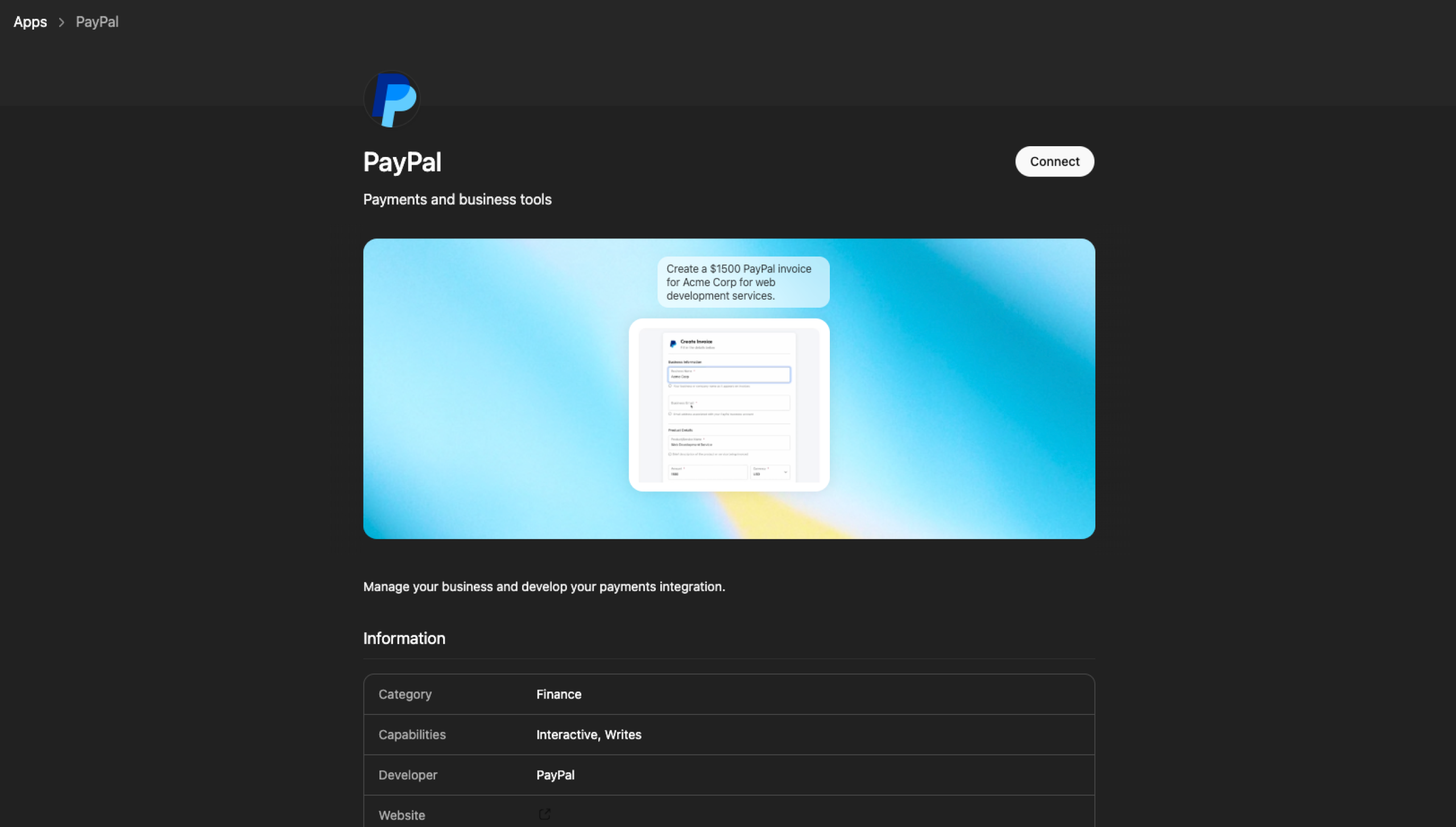
PayPal’s ChatGPT integration brings AI into one of the world’s most widely used payment networks. It helps users retrieve transaction histories, check balances, and find customer payment details. It generates payment links using simple natural-language prompts to enable a smooth workflow.
For small businesses and nonprofits already using PayPal as a gateway, this ChatGPT connector adds productivity without disrupting the existing payment stack.
Best for: Small businesses, creators, and nonprofits that already use PayPal for invoicing and online checkout
Primary task: Simplifies common PayPal tasks, including checking recent sales, generating payment requests, and explaining transaction statuses, directly in ChatGPT .
Developer: PayPal
Key features
- AI‑assisted transaction summaries
- Natural-language retrieval of balance and payout info
- Payment link generation
- Support for retrieving invoice details
Pros
- Uses a payment system familiar to millions of people
- Reduces time spent toggling between systems
- Great for quick insights and common financial queries
Cons
- Limited control over complex gateway settings
- Not a full replacement for the PayPal dashboard
2. Stripe
Stripe’s ChatGPT app brings advanced gateway and billing insights directly into AI workflows. Known for its developer‑friendly API, Stripe integrates with ChatGPT to generate invoices, retrieve payment intents, and view reporting metrics using plain language. It also supports AI subscription management.
Stripe is one of the best ChatGPT payment apps for businesses that want AI to provide actionable financial intelligence.
Best for: E-commerce brands, SaaS companies, and developers who already run payments through Stripe
Primary task: Offering billing insights, handling subscription management queries, and generating up‑to‑date financial snapshots outside the Stripe dashboard
Developer: Stripe
Key features
- Subscription and invoice retrieval
- Payment intent summaries
- Revenue reporting insights
- Natural-language querying of Stripe data
Pros
- Ideal for high‑volume payment environments
- Strong reporting and billing workflows
- Native support for subscription‑based business models
Cons
- Steeper learning curve for nontechnical users
- Requires Stripe permissions and configuration
3. Daloopa
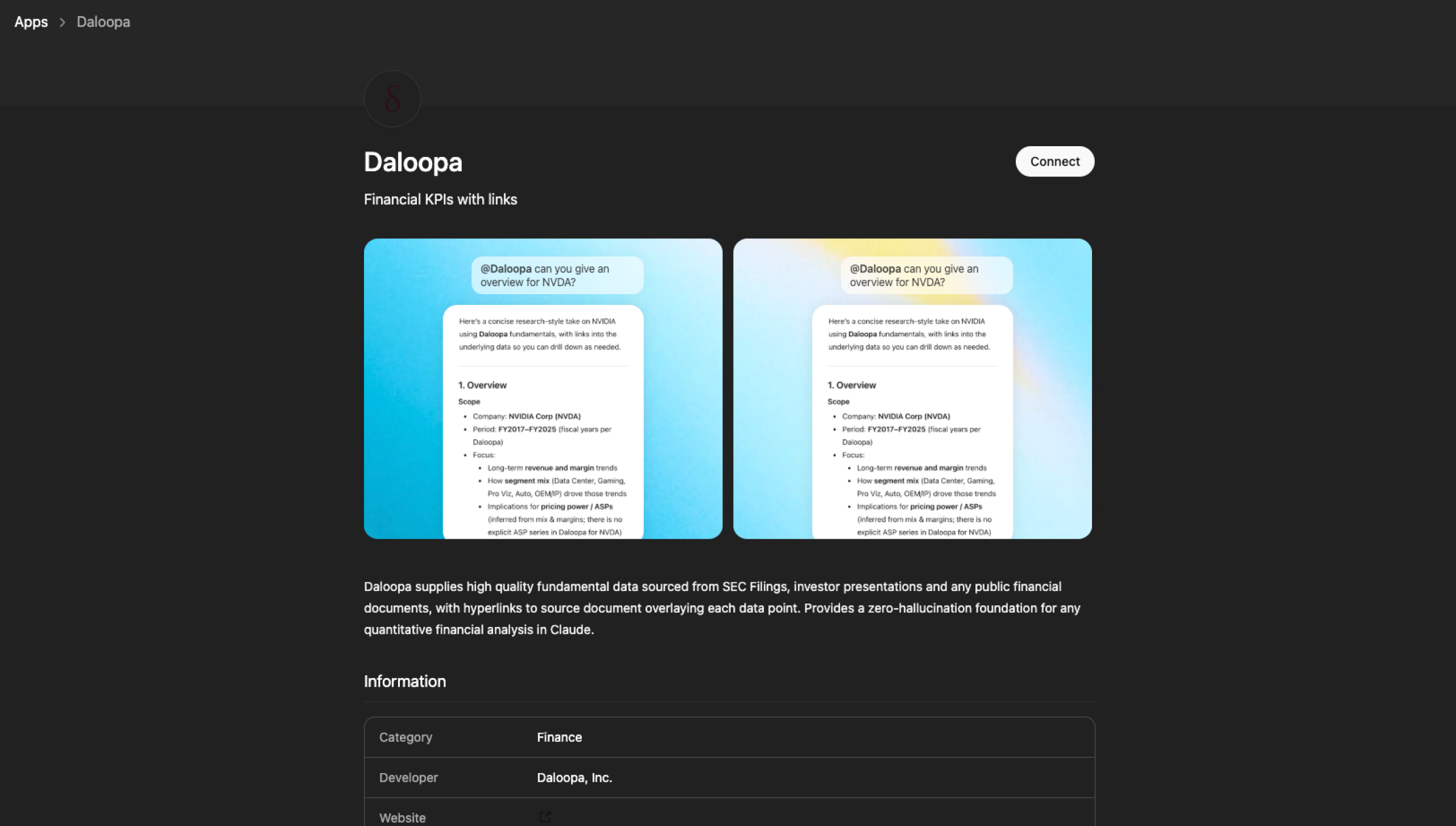
Daloopa’s ChatGPT integration is less of a traditional payment processor and more of an AI‑based finance data assistant. It specializes in financial data extraction, analysis, and modeling to support transactional analysis.
While not a payment processor in the traditional sense, Daloopa transforms financial data into business insights with its AI tools. This makes it one of the best ChatGPT payment apps for analytics.
Best for: Enterprises and financial teams that need high‑quality data extraction and analysis from billing documents, histories, and finance reports
Primary task: Extracting structured financial data from documents and supporting contextual analysis within ChatGPT
Developer: Daloopa
Key features
- AI‑powered data extraction
- Financial modeling assistance
- Document summarization
- Analysis of billing reports and transactions
Pros
- Excellent for firms that need data‑driven insights
- Works with unstructured financial data
- Helpful for audits and finance planning
Cons
- Not a direct payment gateway
- Best suited for analytical or enterprise use cases
4. Kraken
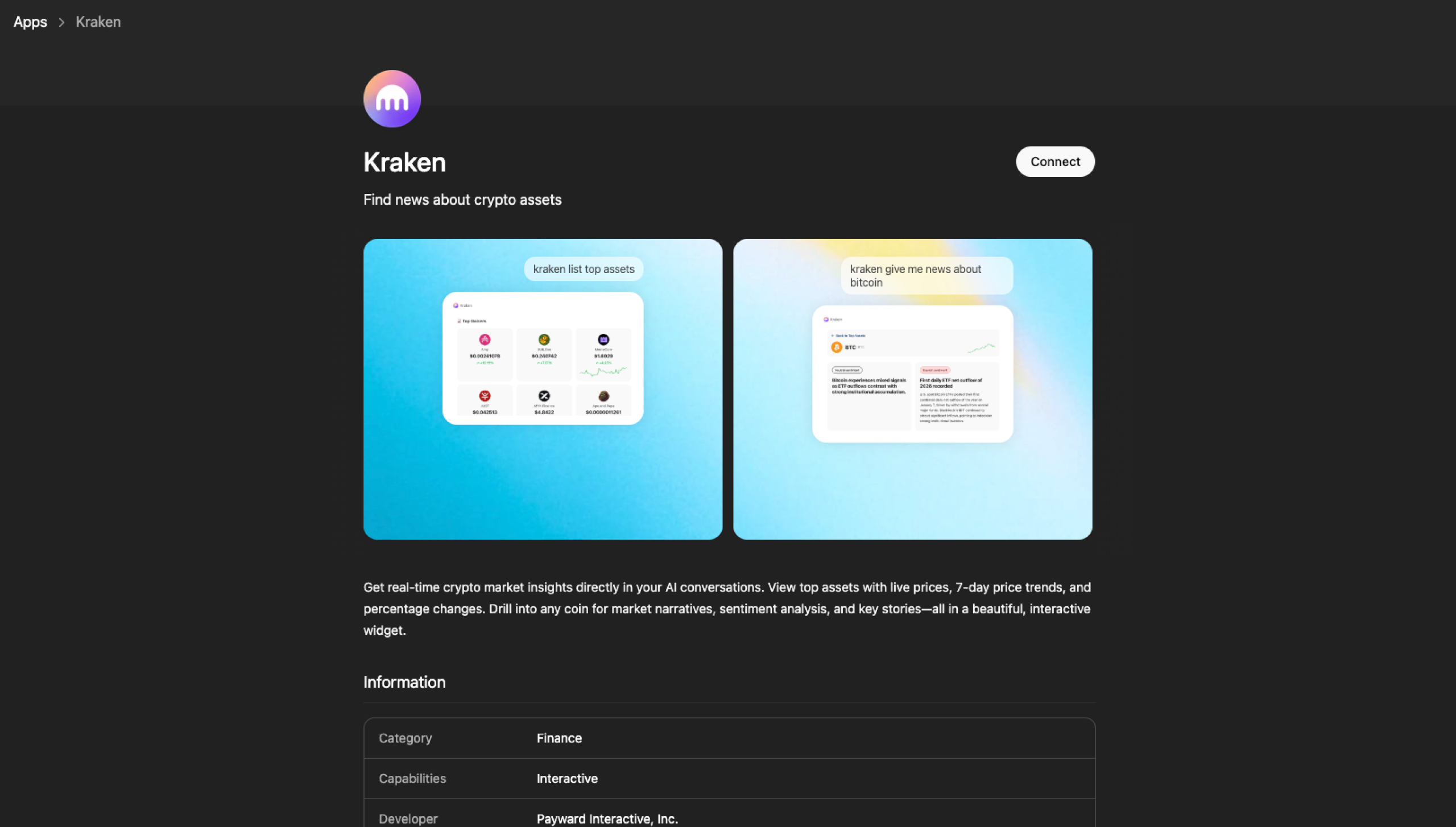
Kraken is a global digital asset exchange that offers trading, withdrawal histories, and market insights. Its ChatGPT app allows users to pull crypto balance information, trading data, and market evaluations conversationally.
You can easily pair the app with financial workflows that involve digital assets. This can help your team blend traditional finance with emerging digital payment methods.
Best for: Organizations or creators engaged in digital asset payments, crypto holdings, or blockchain‑based revenue
Primary task: Provides conversational access to balance info, price summaries, and trading activity without leaving ChatGPT
Developer: Kraken
Key features
- Crypto balance retrieval
- Market price summaries
- Withdrawal and deposit summaries
- Contextual investment insights
Pros
- Useful for digital asset management
- Combines finance and AI in a single interface
Cons
- Narrower focus (crypto, not general payments)
- Compliance and volatility concerns for traditional businesses
5. LONA
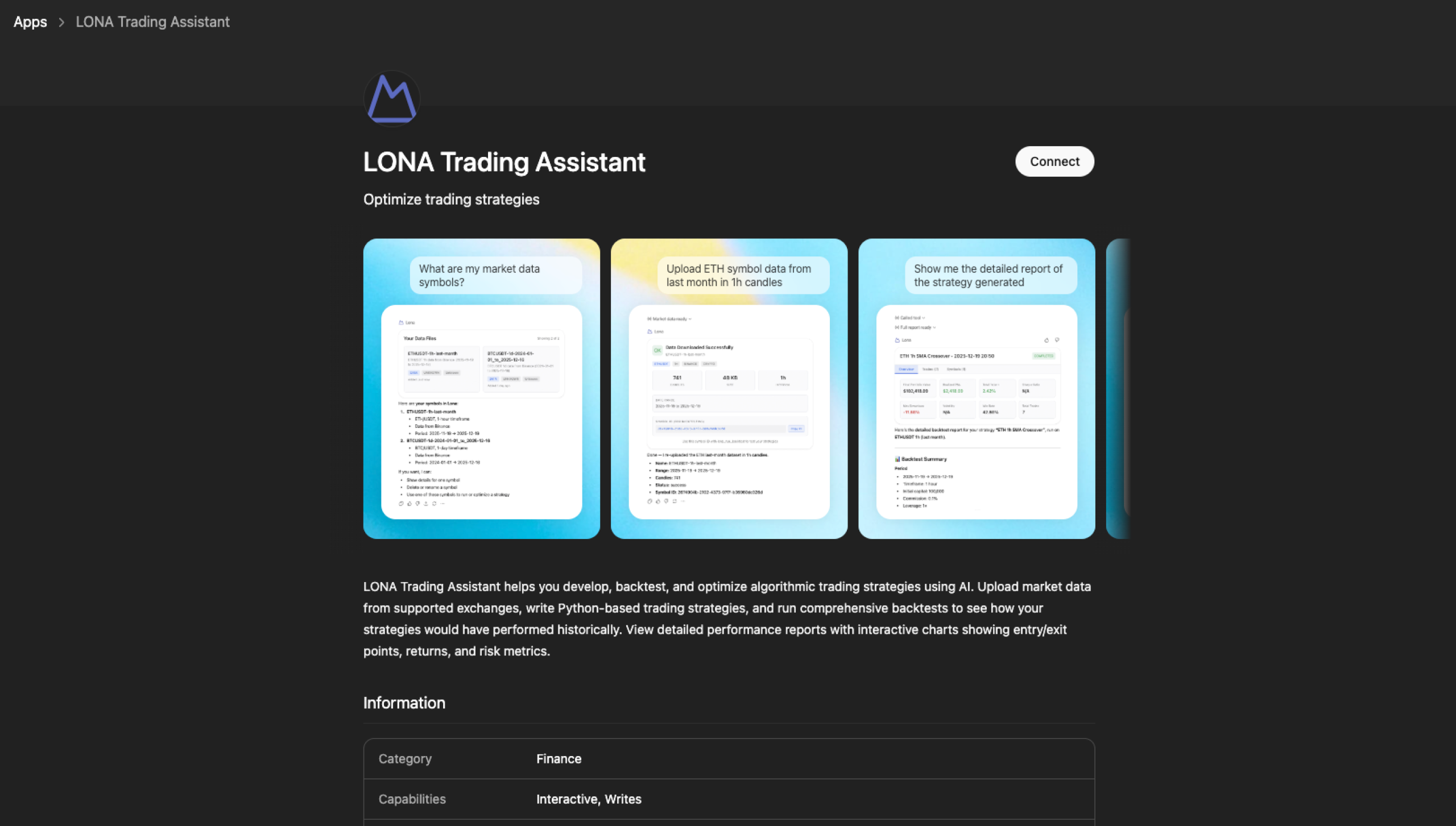
LONA positions itself as a commerce assistant that helps businesses handle conversational payments, checkout flows, and real‑time support. It uses AI to guide customers through payment steps and generate invoices on demand. LONA’s AI chatbot can also answer billing questions.
LONA focuses on customer engagement as much as on back-end transactions, making it one of the more human‑facing payment tools in the ChatGPT ecosystem. .
Best for: Retail, service‑based businesses, and teams that want interactive support for checkout and billing
Primary task: Supporting AI‑driven checkout interactions, payment conversations, and customer billing assistance
Developer: LONA
Key features:
- AI‑assisted conversational billing
- Checkout guidance
- Real‑time payment intent support
- Natural-language handling
Pros
- Great for customer‑facing workflows
- Improved payment experience with conversational logic
Cons
- Not a replacement for traditional gateways
- May require customization to fit certain workflows
How to choose the right ChatGPT payment app
When choosing from the best ChatGPT payment apps, you shouldn’t look only at their feature lists. Instead, focus on apps that align your business needs with your long‑term strategies.
Here are some key factors to evaluate when selecting an AI finance tool.
Business model fit
Your business model determines which workflows matter most. SaaS companies may prioritize subscription management, while e-commerce brands need fast checkout assistance and payment summaries.
Similarly, educational institutions or nonprofits might focus on tracking and reporting donations. Ask yourself which daily tasks you do manually; this will help you identify where AI can offer the most value.
Compatibility with AI payment gateways
Many organizations already rely on established gateways such as Stripe, PayPal, or Square. Integrations that work with existing gateways save time and reduce friction.
If your payment infrastructure is deeply tied to a specific provider, choose the ChatGPT app that natively supports it. This is more efficient than selecting one that requires completely new systems.
Level of AI automation vs manual control
Not all AI payment tools are created equal. Some automate conversational tasks, such as assisting a support agent or answering queries. Others, such as AI billing tools, allow you to trigger actions including generating invoices or retrieving financial reports.
Consider how much automation your team needs vs how much manual control you want to maintain. If there is too much automation without transparency, you might introduce risk or confusion into sensitive financial workflows.
Security & compliance
Finance and payments always involve sensitive data. Look for tools that adhere to industry compliance standards, such as Payment Card Industry Data Security Standard for payment processing and General Data Protection Regulation for data privacy.
When you’re using AI, security shouldn’t be an afterthought. Always ask vendors about encryption and data retention policies, and whether AI responses are stored or logged.
Scale & team size consideration
If you run a small business, your first priorities when choosing the best ChatGPT payment app should be ease of use and rapid deployment. That’s not the case with large enterprises; they usually prioritize granular controls, audit logs, and governance features.
Your decision also depends on your level of scale. A solution that works well for a freelancer or small nonprofit might not fit a healthcare provider or large e-commerce brand with complex finance operations. So choose the app that’s suitable for your team size and scale-up goals.
Integration ecosystem
Payment workflows rarely work alone. They need to connect to CRM systems, accounting tools, customer support desks, and analytics platforms to deliver their full potential.
When deciding on a ChatGPT payment app, always consider how well it fits into your broader tech stack. Does it integrate natively with your reporting tools? Can it push or pull data from systems you already use? Integration maturity can be just as important as AI capabilities.
In practice, AI improves conversion and reduces cognitive load for teams, but only if you have thoughtfully implemented it. Teams that prioritize novelty over core integration requirements may end up handling new problems instead of solving existing ones.
Introducing Jotform ChatGPT App
Besides payment and finance tools, many organizations need AI‑powered apps that streamline form creation, data collection, and reporting. That’s where the Jotform ChatGPT App comes in.
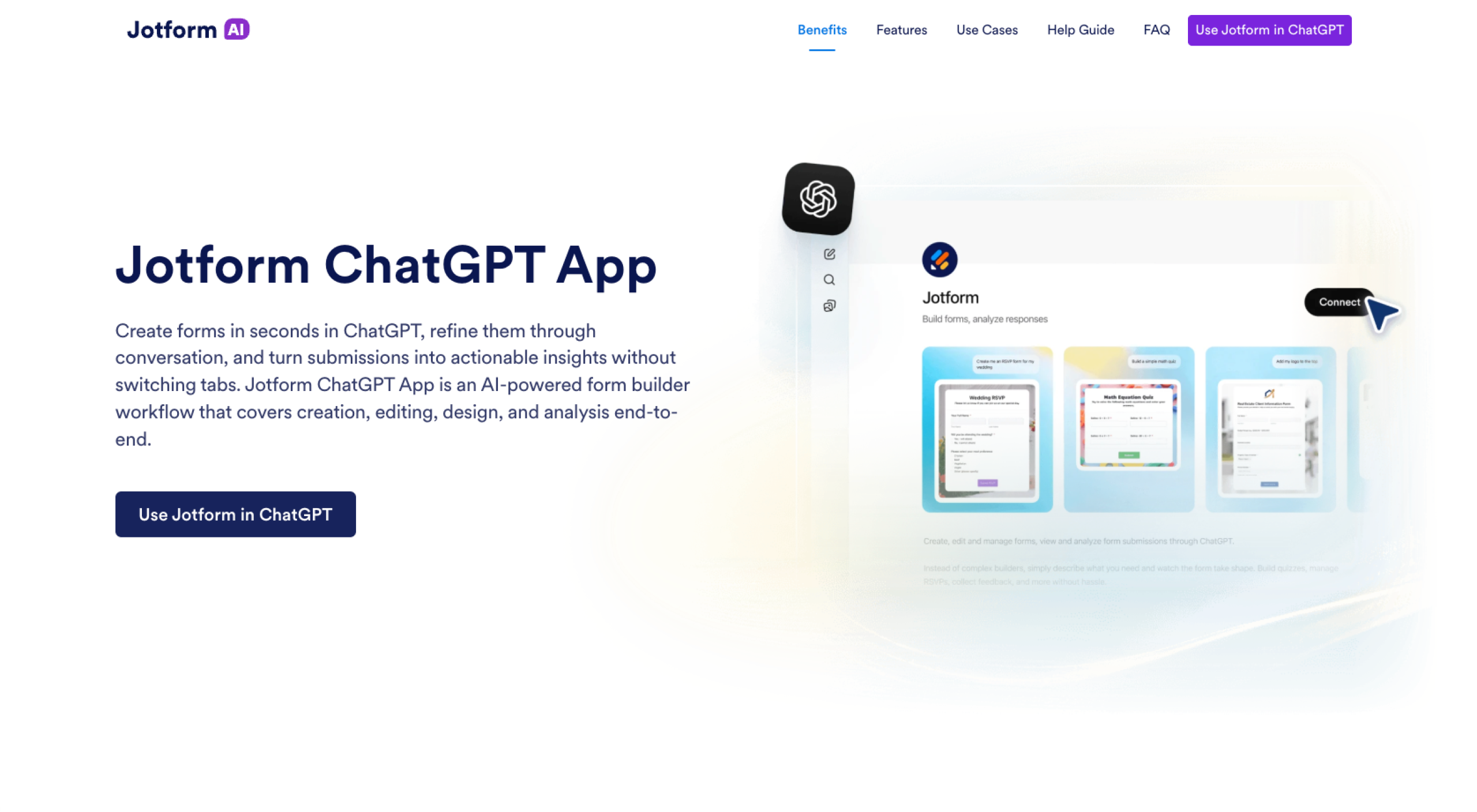
Jotform’s integration with ChatGPT allows users to build, edit, design, and analyze forms using natural-language prompts. You don’t have to navigate multiple menus or learn form logic manually. Instead, you ask the AI to create forms, customize fields, connect integrations, and generate insights from responses.
Jotform ChatGPT App pairs effectively with payment tools that process payments, registrations, subscriptions, or event sign‑ups. You can codesign both sides of your revenue funnel (payments and data collection) using AI conversations. This saves you from building forms and then having to figure out how to connect payment workflows.
These capabilities align with the broader trend toward no‑code payment and AI checkout apps. Jotform’s AI accelerates business operations without technical overhead. Whether you’re invoicing clients or managing recurring billing, AI assistance for both the form and payment sides of your systems can significantly boost your business’s overall productivity.
Final thoughts on the best ChatGPT payment apps
The quick adoption of ChatGPT-powered payment tools shows how modern finance teams are accelerating their workflows with AI. These apps augment traditional payment processing systems by making financial data more conversational, accessible, and actionable.
Are these tools ready for long‑term use? Yes, but with thoughtful integration. Businesses should adopt them as complements to existing systems rather than wholesale replacements. The ideal approach is to rely on established gateways for core settlement and reconciliation while using ChatGPT payment tools to enhance reporting, customer support, and internal workflows.
When paired with secure practices, the best ChatGPT payment apps can be a strong addition to modern finance and product teams. They help teams automate routine requests, summarize complex data, and uncover insights previously buried in dashboards.
This article is for small business owners, e-commerce and SaaS operators, finance and billing teams, and customer support leaders who want to reduce the manual back-and-forth behind getting paid, from generating invoices and payment links to answering “Did my payment go through?” questions.






































































































Send Comment: