

Today’s customers expect seamless support. One customer might DM you on Instagram, follow up via email, and message your team on live chat — all for the same issue — and still expect a smooth, consistent conversation across every channel. Without the right customer service technology in place, this could lead to a fragmented support experience: scattered conversations, inconsistent context, and overwhelmed agents struggling to keep up.
Omnichannel support tools like Trengo and Zendesk help calm the chaos by unifying customer conversations all in one place. But while Trengo gives smaller teams a collaborative AI-powered inbox for responding to customers, Zendesk offers enterprise businesses a full-scale help-desk system for turning conversations into structured tickets. In this Trengo–Zendesk comparison, we’ll break down the key features, automation capabilities, and pricing of both platforms and then introduce a flexible alternative that might better suit your customer service workflow.
Trengo vs Zendesk at a glance
 Trengo |  Zendesk | |
|---|---|---|
| Best for | Small and medium-sized businesses in ecommerce, travel, automotive, energy, financial services, and hospitality | Mid-market and enterprise businesses in retail, healthcare, government, tech, and more |
| Channel coverage | Email, WhatsApp, Instagram, Facebook, VoIP, live chat, SMS | Email, help center, SMS, social media, live chat, mobile SDK, voice, API |
| Support style | Omnichannel support | Omnichannel and self-service support |
| Automation tools | No-code customer journeys for automated ticket routing, proactive communication, and 24-7 support via AI agents | Intelligent workflows for routing tickets, assisting human agents, and resolving tickets with AI |
| AI capabilities | AI agents, journeys, summarizations, suggested replies, translation, labeling | AI agents, Copilot, Zendesk AI assistants, AI research, insights, and reports |
| Reports & analytics | Live dashboards and detailed reports on customer conversations and team performance | Pre-built dashboards, customizable reports, and SLA tracking for internal teams |
| Integrations | Connects with 20+ business tools | Connects with 1,200+ business tools |
| Pricing | Boost: $347/month Pro: $579/month Enterprise: Custom pricing | Support team: $19/agent/month Suite team: $55/agent/month Suite professional: $115/agent/month Suite enterprise: $169/agent/month |
What is Trengo?
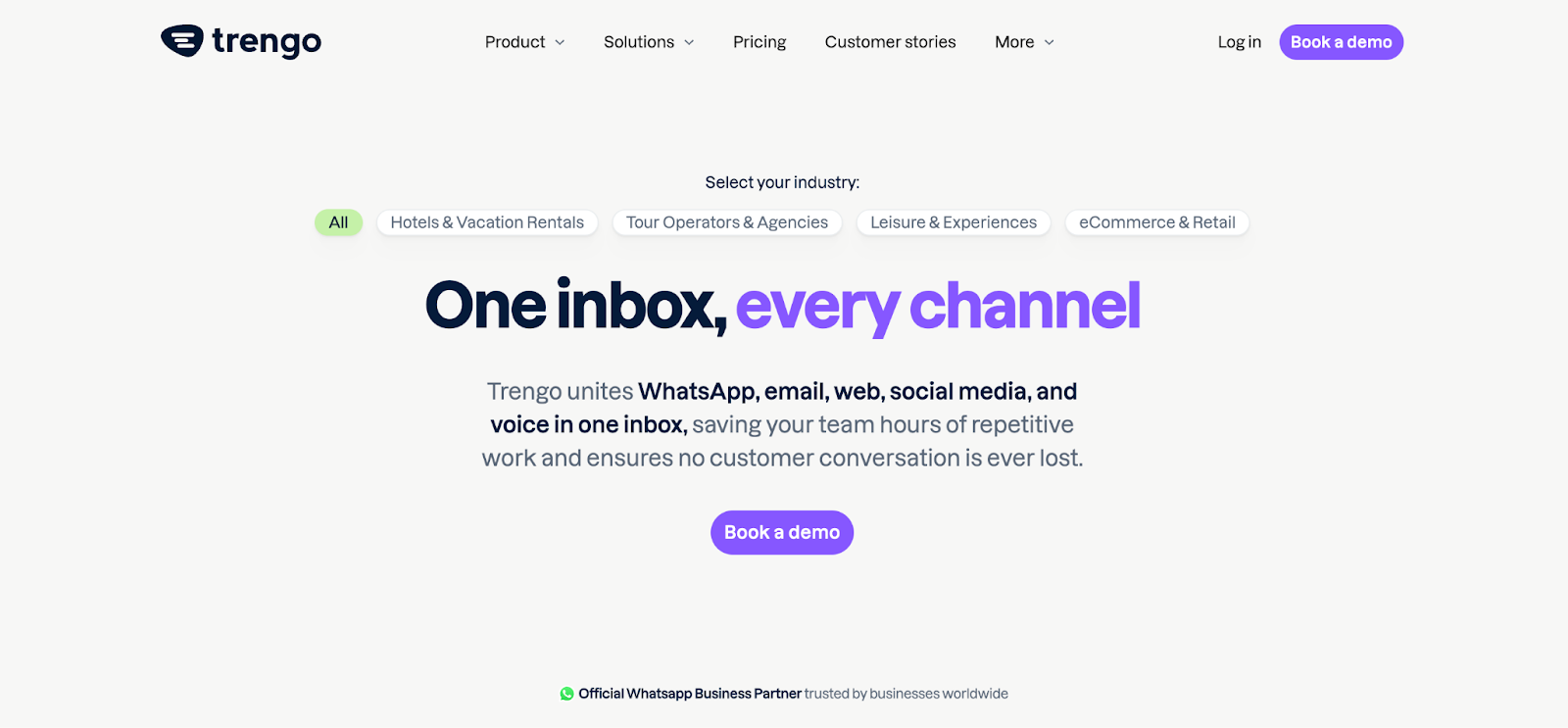
Trengo is an AI-powered customer engagement platform for centralizing all your communication channels. The app unites email, social apps, live chat, and voice in one inbox — enabling support agents to keep track of every interaction, no matter where it originates. It includes a shared inbox and tools that balance workloads and help teams become more efficient. With features like tags and conversation caps, agents can easily assign conversations, request help from colleagues, and manage interactions without overwhelm.
Trengo also offers Helpmate, an intelligent AI assistant that handles simple and repetitive conversations, allowing human agents to focus on more complex issues instead. The platform is designed for small and medium-sized businesses seeking a simple, intuitive way to unlock meaningful conversations with customers, collaborate, and deliver excellent customer service. Even though Trengo offers premium pricing, it packs an extensive suite of features for growth-focused teams. Plus, it connects with 20-plus business platforms through direct integrations.
What is Zendesk?
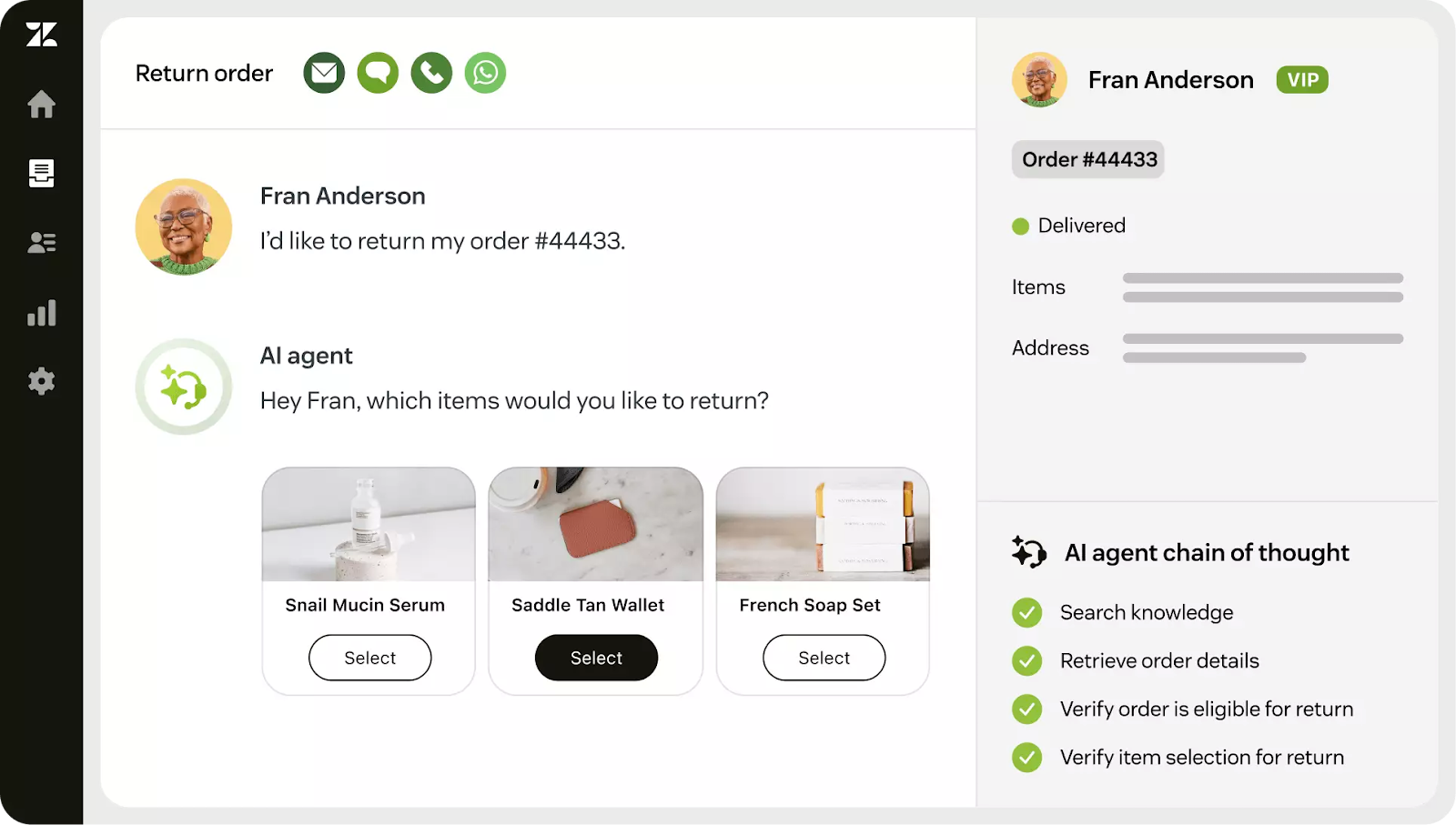
Zendesk is a complete customer service platform with a help desk, AI tools, and an omnichannel inbox. Its AI-powered ticketing system gives agents the context, insights, and tools they need to conduct real-time conversations, prioritize interactions, and deliver excellent customer support on any channel. Zendesk’s automated workflows allow you to save time on ticketing flows, stay ahead of customer needs, and track agent performance at scale.
Zendesk boasts an out-of-the-box solution with intelligent AI agents that reason, adapt, and act independently to resolve complex issues without scripting or training. The platform is built for mid-market and enterprise businesses looking for robust customer support and employee engagement tools. Zendesk connects with 1,200-plus business-critical apps and offers entry-level pricing that scales with your needs.
Key features of Trengo and Zendesk
Trengo and Zendesk offer all the essential support features that enhance team coordination and improve customer response quality. Next is a breakdown of the key features of both platforms.
Trengo features
- Omnichannel inbox: Trengo is well known for its centralized inbox as part of its all-in-one approach. The platform lets you communicate with customers across WhatsApp, Instagram, Facebook, SMS, live chat, email, Telegram, and VoIP from one organized place. This way, agents can prioritize valuable conversations as they come in and never miss critical business opportunities. Trengo’s omnichannel inbox is powered by artificial intelligence, which assists with engaging customers, handling common FAQs, translating conversations into any language, and summarizing ongoing interactions so teams can respond quickly.
- Internal collaboration tools: With Trengo, agents can collaborate internally within conversation threads. Use @mentions to request help from colleagues or draw their attention to important matters. Agents can route conversations and incoming messages to the right team member, and managers can set conversation caps to limit the number of tickets an agent can pick up at a time.
- AI agent and customer journeys: Trengo’s AI agent is a conversational AI chatbot that frees up support agents by resolving 80 percent of repetitive customer conversations. Trengo lets you design customer journeys to guide the AI in delivering the best experience to your customers. You can trigger proactive messaging on high engagement channels like WhatsApp, automatically route complex queries to human agents, and auto-label conversations, customer sentiments, and opportunities without manual effort.
- Reporting and analytics: From team performance to conversation metrics, Trengo makes it easy to track and gain insights into your customer support operation. It provides a live dashboard and detailed reports on customer behavior, communication channels, and team performance.
- Integrations: Trengo integrates with about 20 business-critical apps across communication tools, e-commerce platforms, CRMs, and more. It also integrates with Zapier, so you can connect it with thousands of other apps.
Zendesk features
- Advanced ticketing system: Zendesk offers an AI-powered ticketing system that combines email, phone, messaging, and social channels into one tool. It gives support agents a collaborative workspace to resolve queries quickly with automation and AI. Agents can view customer information and conversation context from one unified view. They can also use predefined responses and a centralized knowledge base to answer common questions and even customize their workspaces to improve focus and prioritization. Zendesk ticketing allows you to build customizable workflows that can alert teams of unattended tickets, refund escalations, and more. The workflows can even predict customer needs and give you a bird’s-eye view of your service operation.
- AI agents: With Zendesk AI agents, you can deliver nonstop personalized service to customers wherever they need it. The AI agents work across the entire Zendesk suite to give customers accurate responses in your brand’s tone of voice. They can handle complex requests from start to finish while you stay in control with built-in quality assurance and automatic resolution validation.
- Knowledge base and self-service portals: Use Zendesk knowledge to build self-service portals where customers can quickly find answers with or without support agents. Sync knowledge from your community forums, help centers, and external resources, then get instant answers whenever and wherever customers are — regardless of your business hours.
- Detailed analytics and SLA tracking: Zendesk lets you monitor real-time service performance, uncover trends with historical reporting, and generate quick reports with AI. Use pre-built dashboards to stay on top of all your critical metrics and customize every report to make cross-team collaboration seamless. The platform also allows you to track internal service level agreements (SLAs) to make sure your teams are delivering optimal support to customers.
- Integrations: Zendesk offers a massive marketplace with direct integrations to 1,200-plus business-critical apps. Connect the platform to your contact center, project management tools, messaging apps, and content management systems to streamline workflows across your organization.
What are the similarities between Trengo and Zendesk?
You may have noticed that Trengo and Zendesk share several core capabilities. Both are omnichannel support tools that enable teams to deliver consistent, personalized service. They also integrate generative AI in customer service to handle repetitive customer queries and reduce response times. In addition, both platforms let you build automated workflows, deploy AI agents, and route conversations intelligently.
But where Zendesk sets itself apart is in its advanced routing capabilities. It offers multiple options, including omnichannel, skill-based, and round-robin routing, giving teams more control over how tickets are assigned and handled. This level of flexibility is part of what makes Zendesk a better fit for complex, high-volume support operations.
Unique features of Trengo and Zendesk
Here’s a deeper look at some of the features that make Trengo and Zendesk unique — and may appeal to you depending on your priorities.
Trengo’s unique features
- Built for social and messaging channels: Trengo is designed with customer-preferred channels in mind — particularly high-engagement channels like WhatsApp. As a Meta Business Partner and WhatsApp Business Provider, it has seamless integrations with WhatsApp, Instagram, and Facebook. Teams can use message templates and workflows to send timely updates, reminders, and personalized messages at scale.
- Unified inbox with a clean, user-friendly interface: Trengo boasts an intuitive UI, helpful for teams with limited technical experience. The shared inbox enables smoother collaboration in real time and ensures that no message slips through the cracks.
- Quick onboarding for small teams: Many users praise Trengo for its fast, frictionless setup. Teams can deploy AI agents and launch no-code workflows in just a few clicks, making it a strong choice for small teams that need to move quickly.
Pro Tip
If you want AI-powered Instagram engagement that goes beyond basic DMs — covering comments and Story replies with context-aware, on-brand responses — Jotform’s Instagram Agent is built for exactly that.
Zendesk’s unique features
- AI-powered voice support: Zendesk’s AI voice agents answer inbound calls using natural language and escalate to human agents where necessary.
- Deep automation and customization: Zendesk enables deep automation across the entire support workflow. From ticket creation to resolution, agents can build tailored views, set custom triggers, and automate tasks to improve prioritization and deliver faster responses.
- Employee engagement: Beyond customer-facing support, Zendesk provides tools that enable employees to work smarter, collaborate better across departments, and stay efficient.
Pro Tip
Want a form-first help desk you can tailor to your process? Build it with Jotform Workflows + Tables + Boards. Turn intake forms into trackable tickets, auto-route with conditional logic, and manage statuses on a Kanban board — no heavy help desk required.
Plans and pricing
When it comes to pricing, Trengo and Zendesk take very different approaches. Zendesk offers entry-level pricing using a per-agent pricing model. It also offers a 14-day free trial with full access to its Professional plan. Trengo, on the other hand, uses a tiered pricing model based on team size and doesn’t offer a free trial, limiting hands-on evaluation before purchase. However, both customer service AI tools offer optional add-ons to expand functionality depending on your needs. Here’s a full breakdown of their price plans:
Trengo pricing
- Boost: $347 per month (billed annually) includes 10 users, 6,000 conversations per year, access to key features like unified inbox, WhatsApp Business API, AI agent, AI journeys, internal collaboration tool, and more. It excludes live chat and phone support with Trengo, custom integrations, and API actions. This plan is ideal for small businesses with simple support needs, looking for basic multichannel inbox software to centralize communications.
- Pro: $579 per month, includes everything in the Boost plan plus 18,000 conversations per year, live chat and phone support, and custom integrations via API.
- Enterprise: Custom pricing. Everything on the Pro plan plus a custom number of conversations, voice calls, custom-built integrations, and a dedicated success manager.
Add-ons
- Conversations: $18 per 100 conversations (billed annually)
- Conversations with an AI surcharge: $0.29 per conversation
- Users: $29 per user on Boost and $47 per user on Pro
- Additional WhatsApp, voice, and SMS with an AI surcharge: Charges apply per usage
Zendesk pricing
- Support Team: $19 per agent per month (billed annually) with access to email and ticketing support, ticket routing, analytics dashboards and reports, 1,200-plus integrations, and streamlined onboarding with on-demand training. This plan doesn’t include AI agents, but you can unlock AI agents by adding the Zendesk Help Center add-on at checkout.
- Suite Team: $55 per agent per month includes everything in the Support Team plan plus AI features, social messaging on Instagram, WhatsApp, Slack, and more.
- Suite Professional: $115 per agent per month for everything in the Suite Team and the ability to optimize your support operations with AI, data, and customizations. Includes features like app builder, CSAT surveys, skill-based routing, SLAs, HIPAA compliance, and more.
- Suite Enterprise: $169 per agent per month for everything in the Suite Professional, plus approval workflows, sandbox environment, custom agent roles, audit logs, business rules analysis, and more.
Add-ons
Pricing for additional features like Copilot, Zendesk quality assurance, advanced AI agents, advanced data privacy and protection, and contact center is displayed at checkout.
Who should use Trengo and Zendesk?
Trengo is a great fit for small to mid-sized teams in e-commerce, hospitality, and financial services looking to streamline their customer service process by consolidating communication channels. Its collaborative features enhance alignment between sales and service teams. Also, the platform’s focus on WhatsApp and other social platforms makes it a solid Zendesk alternative for teams driving the most customers from social media.
On the other hand, Zendesk is one of the best customer service software options for mid-sized to enterprise businesses. Its extensive feature suite makes it the ideal Trengo alternative for teams needing an enterprise help desk, advanced reporting, and highly customizable AI flows across channels.
If you’re evaluating a help desk vs shared inbox tool like Trengo and Zendesk, then it’s safe to assume that budget is not an issue, as both platforms require significant financial investments. So, your choice ultimately comes down to your team’s needs, support complexity, and channel focus. Choose Trengo if your priority is fast, personalized engagement on social platforms. Choose Zendesk if your team needs to scale workflows across multiple touchpoints beyond social media.
Why Jotform might be the better customer service solution for your business
Whether you’re leaning toward Trengo or Zendesk, both platforms give you pre-built solutions for running your customer support operation. Trengo consolidates your inbox into one place while Zendesk locks you into a complicated help desk ecosystem. But what if your business doesn’t really fit into either model?
Maybe you don’t need complex ticketing systems, or you want more control than a shared inbox provides. Either way, you need a platform that gives you the flexibility to create your own customer service system — one that works around your process, not the other way around.
That’s where Jotform comes in. Jotform lets you blend the strengths of Trengo and Zendesk — shared workspaces, automation, structured workflows — and then customize every part to fit your team. Whether you’re looking for a customized help desk, AI Agents, a centralized database for customer conversations, or automated workflows, Jotform gives you the freedom to design a support experience around your exact needs. It’s flexible enough for startups and robust enough for large teams that want complete visibility and control over their support operations.
Next, we’ll cover the key benefits of using Jotform to power your support workflows.
Build faster with Jotform AIDescribe what you need, and let Jotform AI build it for you instantly.
Get Started Now
Automate multichannel engagement with AI agents
Jotform AI Agents help you deliver fast, consistent support across all your key communication channels, including web chat, Instagram, WhatsApp, Messenger, SMS, phone, Gmail, Shopify, and more. These agents run 24-7, pulling answers from a single knowledge base to resolve simple and complex customer questions accurately. As your business grows, they scale with you, eliminating the need to increase headcount just to keep up with support volume.
Use Jotform AI Agents to cover every customer touchpoint, maintain a consistent tone across channels, and seamlessly escalate to human agents when needed.
Build a flexible help desk with Jotform Workflows, Tables, and Boards
With Jotform Tables, Boards, and Workflows, you can design a fully customized help desk for resolving customer requests. Every interaction captured by your Jotform AI Agent flows into Jotform Tables, where support agents can view requests, complaints, feedback, and resolution histories — all in one centralized database that is filterable, searchable, and easy to manage.
Jotform Boards then converts those queries into tasks displayed in Kanban-style view, to give agents a clear, visual way to track progress, collaborate on requests, and manage tickets through different stages of resolution. From there, you can set up Jotform Workflows to
- Auto-assign tasks based on channel or request type
- Route complex issues for approval
- Send automated notifications
You can even connect external sources like WhatsApp, Messenger, or VoIP systems to your workflow. The result is a unified workspace for managing omnichannel conversations without expensive or complicated ticketing software.
Reply smarter and faster with Gmail Agent
Use Jotform’s Gmail Agent to respond to customer emails in less time. The intelligent AI Agent analyzes incoming messages, understands intent, and generates personalized, on-brand draft replies based on your tone and style. Because it draws from the same centralized knowledge base as your other Jotform tools, the Gmail Agent ensures your customer communication remains consistent across all channels.
Deliver instant website support with AI chatbots
Give visitors round-the-clock support on your website and mobile apps — even when your team is offline — with Jotform AI chatbots. These chatbots can assist with order tracking, product recommendations, and guiding visitors through forms in real time. By automating these routine interactions, you free up your support team to focus on higher-value tasks, boost conversion rates, and improve the overall customer experience.
Whether you’re just starting out or scaling a complex operation, Jotform gives you everything you need to build a support system that fits the type of customer service you offer. Get started for free today, or reach out for a custom quote.
Customer support managers, small-to-medium business owners, and marketing or sales teams evaluating whether a shared inbox/omnichannel platform like Trengo or a full-scale helpdesk like Zendesk better suits their workflow.





































































































Send Comment: