
Customer cohort analysis examines how specific customer groups engage with your product, service, or brand. You group customers by shared characteristics, such as date of acquisition or account type. Then you crunch the numbers to gain insights into each group’s needs and preferences.
Cohort analyses help you better understand customer behavior and identify patterns that can affect customer satisfaction. They tell you how different customer groups behave and what inspires them to interact with your brand. These insights support more effective business decisions, potentially driving faster growth. Let’s dive into how customer cohorts work.


What are customer cohorts?
A customer cohort is a group of buyers who share something important in common. That characteristic may relate to when they became a customer or how they’ve interacted with your brand in the past.
There are two types of cohorts. The first is called a time-based or acquisition cohort. You might categorize your customers this way if you’re looking to understand churn or spending patterns over time.
The second type is an interaction-based group, or behavioral cohort. Customers are grouped based on purchase decision-making, such as those who subscribe versus buy à la carte. You can also create behavioral cohorts based on longer-term behavioral patterns, such as those who use App Feature A versus App Feature B.
Cohorts are dynamic and purpose-driven, meaning you create them as needed. A marketing team might create time-based cohorts to understand the long-term effectiveness of a particular campaign. A product development team may develop a behavioral cohort to research a potential new feature. It all depends on the information you need to answer your core business question.
What does customer cohort analysis mean?
Customer cohort analysis compares the behavior of different customer groups to identify critical patterns and trends. It’s often used to understand customer retention and churn, including which factors contribute to churn across customer groups.
When done well, a cohort analysis increases the value of your behavioral analytics by incorporating a time component. It shows how customer milestones and events affect behavior so you can personalize solutions to customer needs. This personalization can be the difference between an effective intervention and one that falls flat.
What is the difference between a customer segment and a cohort?
If you use or have heard of customer segmentation, all this might sound familiar. Audience segmentation serves a purpose similar to that of cohort analysis, but there is a slight difference between a customer segment and a cohort. It has to do with time.
In most cases, customer cohort analyses involve time-based actions or milestones. You may look into why customer behavior changes at a particular milestone or why churn rates increase at specific points in the life cycle.
Segments are more evergreen and applicable across multiple projects. Marketing teams often use segments to personalize campaigns to make them more relevant, while product teams use them to build features that meet specific needs.
Here’s a more detailed comparison, based on information published on LinkedIn:
| Customer segmentation | Customer cohort analysis | |
|---|---|---|
| Common grouping criteria | Demographics, location, buying behavior, values, attitudes, lifestyle preferences | Event-based behaviors, timing of first engagement |
| Typical use cases | Personalized marketing, market-aware product development, customer experience enhancement | Understanding churn, identifying friction points, improving retention |
| Scope | Broad and long-term | Specific to a business or research question |
| Advantages and challenges | Requires simpler analysis but may not provide detailed insights | Involves detailed multifactor analysis but can yield more actionable information |
Customer cohort analysis is instrumental when you’re working on a timely business problem, such as a lack of engagement with a new feature. Segmentation may show you which demographics interact with that feature, or which characteristics are more likely to bounce when encountering it.
Cohort analysis offers immediately applicable insights. It shows which group takes a particular action and when, allowing you to make the most effective changes.
What is an example of cohort analysis?
The most common cohort analysis looks at customer retention and churn for a digital product, such as a consumer mobile app. For example, you want to know why some users stay active for years, while others stop logging in after a few months.
The first step is to decide on a cohort breakdown. Because you’re looking at the customer life cycle, you want to compare users by acquisition date. Ultimately, you choose to categorize them by month of signup.
While examining your user data, you identify month two as the first significant drop-off point. You want to know why customers churn at that stage, so you submit a survey to each cohort. The results, alongside your app usage data, show that the two-month mark is a few weeks after users stop trying new features. You can use that information to develop an engagement solution to send at the six-week mark.
Implementing cohort analyses in your business
Every customer cohort analysis will have a different goal and dataset, but each one follows a similar workflow.
Step 1: Define your cohorts
A common starting point is to group users by acquisition date. You’ll also need to determine your grouping intervals. For example, will your cohort be users who joined on June 29, or users who joined in June? Smaller intervals give you more precise data, but the analysis is more time-consuming.
Pro Tip
Don’t have customer groupings yet? Jotform makes it easy to group customers based on survey responses. It also integrates with multiple CRM platforms, including Salesforce and Zendesk, enabling you to import the data you need.
Step 2: Identify your key metrics
Before you analyze anything, identify what you want to know. A typical first cohort analysis project is tracking churn, which you can calculate manually or with a customer experience or business intelligence platform. Other options to track include user engagement, conversion rates, and revenue per user. Jotform Report Builder let you review customer data and choose the customer metrics that matter most.
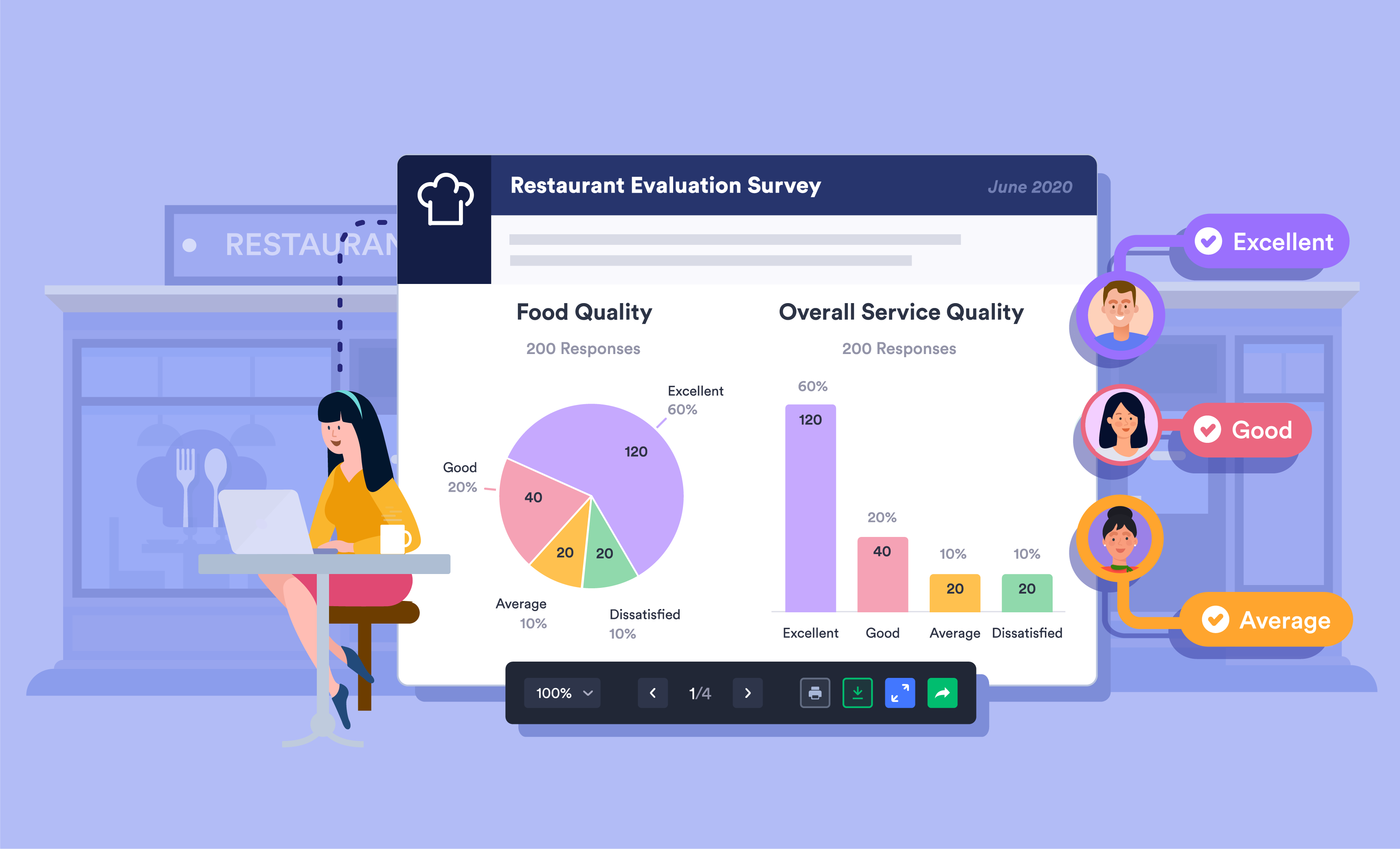
Step 3: Gather and chart your data
Import relevant data into your chosen analysis tool and create a visualization to reveal insights.
If nothing jumps out at you right away, don’t worry. Try increasing your sample size or changing how you define your cohorts. For example, if you’re looking at acquisitions by month, try breaking it down by week.
Also, consider other contributing factors. Consumers churn or convert for many reasons, some of which are challenging to track with behavioral data. Jotform surveys make it convenient and straightforward to learn what your customers are thinking.
Imagine you want to know why your churn rate is increasing. You learn that customers who joined in the summer churn sooner than those who joined in the fall. You wonder if users have less time to engage as the holidays approach, but what if the reason is a change in your product? Sending a Jotform survey may be the best way to find out.
Step 4: Draw conclusions and test solutions
Patterns in the data will reveal potential reasons for customer actions. Your job is to theorize why these patterns exist, based on what you’ve learned about your customers. Jotform’s data visualization tools make those insights stand out so you can draw insights quicker.
Once you have a theory, brainstorm ways to solve the problem. If consumers seem to churn right after a product update, what can you do to make the transition smoother?
From there, you might break your updates into smaller components to reduce the risk of user confusion. You can create an A/B test to apply the change to half of each cohort, then analyze the results to see whether it worked.
Step 5: Iterate and repeat
A customer cohort analysis is an ongoing process, not a one-time project. Continue collecting and analyzing your customer data, focusing on various factors and metrics. Use tools like Jotform’s Data Chart Maker to view multiple metrics at a glance and uncover insights that might otherwise be hidden.
Also, remember that cohorts are flexible. As you incorporate customer cohort analyses into your business processes, you’ll eventually see the need for new or adapted cohorts or segments. Create the data groups you need, and adjust them as you see fit.
Data collection methods
Customer cohort analysis uses several types of data. Time-based data, such as acquisition date and churn, often comes from online tracking. Google Analytics makes it easy to track user actions, such as conversions, engagement, and user journeys. It also collects valuable user data for cohort creation and segmentation.
You can also get valuable data from your CRM platform. These tools provide you with key information such as acquisition date, account cancellations and suspensions, and purchase history.
Customer comments have to come directly from the customer. This data should be representative of each cohort, so it’s important not to rely on reviews and other biased samples.
Instead, use an integrated form builder like Jotform to survey your customers directly. Jotform’s Survey Maker makes it easy to customize your questions and add follow-ups so you get the information you need.
Using survey data in cohort analysis
Surveys provide direct feedback that can explain why customers take specific actions. Jotform’s customizable forms let you collect the data you need most in whatever format is necessary, from numerical scales to open responses. You can then use your customer data to create multiple segments and analyze them in detail.
Jotform’s system is uniquely scalable and integrates with numerous analytics and reporting tools, such as Google Analytics 4, SEMrush, and Power BI. These connections let you collect and analyze data from multiple forms without error-prone manual imports.
Add your existing data and integrate survey responses with Jotform Tables, a spreadsheet-database hybrid platform that builds a complete picture of your cohort. The team-friendly interface lets you track event-based cohorts and expand your knowledge with recurring surveys.
A growing customer base is no problem with Jotform’s workflow automation features. Send surveys based on cohort status or event engagement to drive the most actionable insights from your cohort analysis.
Understand your customers better with cohort analysis
Customer cohort analysis is the difference between knowing your customers as a group and understanding individual interactions. Cohorts reveal which time-based factors and events affect the customer experience, helping you make more informed marketing and product decisions.
Use this article as a guide for your first cohort analysis. The strategies and tools you’ve learned about can help you master each step until the process feels intuitive. Get started today, and learn what you never knew about your customers.
Frequently asked questions
Businesses often use customer cohort analysis to understand churn patterns. For example, a company with a subscription-based app might create cohorts by sign-up month and analyze how engagement changes over time.
The steps of a cohort study are
- Iterate and repeat: Monitor data changes based on your solutions and adjust accordingly.
- Define cohorts by characteristics: Based on what you want to learn, choose how you’ll separate customer groups.
- Identify key metrics: Decide what you’ll measure and how.
- Collect data: Use customer information to calculate values for each metric and create a visualization.
- Draw conclusions and test solutions: Identify patterns and determine the appropriate action to resolve the issue.
The two types of cohort analysis are
- Behavioral analysis: Cohorts that share a specific buyer behavior or make a specific decision
- Time-based analysis: Cohorts separated by an event, such as acquisition
This article is for product managers, marketers, founders, and growth teams who want to understand customer behavior over time, reduce churn, improve retention, and make data-driven decisions using practical cohort analysis strategies.





















Send Comment: