
Top 7 real estate AI lead generation tools
- Jotform AI Agents: Best for no-code capture and qualification
- BatchLeads: Best for data-driven seller targeting
- NextProp.ai: Best for investor-focused outbound automation
- Lindy: Best for flexible AI agents and workflows
- Manus: Best for CMA and deep market research
- Gamma: Best for AI content creation and presentation support
- Lone Wolf: Best for lead delivery into CRM
AI lead generation in real estate is no longer just about collecting names and emails. The most successful real estate agents know how to adapt and harness the power of automation, scoring, and conversational AI. These modern tools help prioritize the right prospects and book more appointments with less manual follow-up.
In testing tools for AI lead generation real estate workflows, I discovered the strongest results came from platforms that combined no-code setup, robust integrations, and transparent routing rules. Read on for deep dives into my top seven picks and find the perfect fit for your real estate needs.
What is AI lead generation in real estate?
AI lead generation in real estate uses algorithms and automation to capture, qualify, and prioritize buyer and seller leads based on their behaviors and unique profile data.
Certain tools monitor actions like listing views, email engagement, and form submissions to surface the hottest prospects and trigger timely follow-ups across channels.
The best real estate AI lead generation stacks go even further, with features like predictive scoring, real estate chatbot experiences, and automated nurture sequences that keep deals moving along even when agents are out on showings.
Read more about real estate automation
- A guide to real estate automation: Learn more about real estate automation and 10 great tools we picked.
- 10 best real estate software solutions: Learn more about the best automation tools in the real estate market.
- 15 best AI tools for real estate agents: Learn more about essential AI tools of a professional real estate agent.
- 7 best real estate agent apps: Learn more about must-have apps of a professional real estate agent.
How to implement AI in your real estate business
To implement AI in your real estate business, start with one or two high-impact workflows (like lead capture and follow-up) and connect them to your existing CRM and calendar. This allows new inquiries to be scored, routed, and nurtured without manual effort.
Manual follow-up breaks down when agents also have to juggle open houses, showings, and ongoing competitive market analysis. AI helps by ranking leads, personalizing every outreach, and keeping prospects on a consistent nurture track.
A practical rollout for implementing AI in a real estate business might look like this:
- Audit your lead sources, including website forms, portals, paid ads, and referrals.
- Choose one or two use cases, such as new buyer inquiries and seller valuation requests.
- Pick tools that support calendar booking and integrations with your customer relationship management platform and email, then connect your CRM and calendar.
- Set lead scoring real estate rules and routing. Define criteria like engagement level, budget range, or location to automatically prioritize and assign leads to the right agent.
- Build a simple 14-day nurture track. Try a mix of email, SMS, and a real estate chatbot or AI agent.
- Launch, then iterate based on results.
Before going live, use a data readiness checklist to make sure you’re capturing consent, assigning unique IDs, defining dedupe rules, and mapping fields cleanly into your CRM with UTM tracking for every paid source. Don’t forget about compliance, either: consider the Telephone Consumer Protection Act (TCPA)/Federal Communications Commission consent, opt-out automation, do-not-call hygiene, audit logs, and fair-housing review. Have a human-in-the-loop escalation plan for complex or sensitive conversations.
To measure success after you get up and running, track speed to lead, contact rate, appointments set, and cost per appointment. Run simple A/B tests across message, offer, and send time. Over time, predictive models can use this data to highlight which behaviors (like repeat listing views, valuation requests, or financing questions) correlate with closings so your AI tool for appointment setting focuses on the right people first.
Top 7 AI lead generation tools for real estate in a glance
| Tool | Best for | Standout feature | Pricing | G2 Rating |
|---|---|---|---|---|
 Jotform AI Agents |
No-code capture and qualification |
Multichannel AI agents capture and route leads to forms, CRMs, and calendars 24-7 |
Free plan available; Bronze: $39/mo or $36/mo (annual) |
4.7/5 |
 BatchLeads |
Data-driven seller targeting |
Deep property data, list stacking, and configurable lead scoring rules |
Growth plan: $119/mo or $71/mo (annual) |
4.8/5 |
 NextProp.ai |
Investor-focused outbound automation |
Scrapes listings, homeowner data; conducts SMS/voicemail outreach |
Basic plan: $149/mo (annual) |
N/A |
 Lindy |
Flexible AI agents and workflows |
Agents qualify leads, read documents, coordinate multi-step workflows across apps |
Free plan with 400 credits/mo; |
4.9/5 |
 Manus |
CMA and deep market research |
Chat interface for research; shows thinking process; has PDF exports |
Free plan available; Basic plan: $19/mo or $16/mo (annual) |
1.8/5 |
 Gamma |
AI content creation and presentation support |
AI-powered presentations to pitch listings, neighborhoods, or investments |
Free plan available; Plus plan: $10/mo or $8/mo (annual) |
4.6/5 |
 Lone Wolf |
Lead delivery into CRM |
Templates, paid campaigns, reporting; exclusive buyer and seller leads |
Not listed |
3.4/5 |
How I tested these AI tools for real estate lead generation
My hands-on testing approach for AI lead generation tools in real estate centered on real-world use cases, from 24-7 lead capturing to prospect scoring by intent and booking appointments without manual follow-up. For each platform, I built scenarios to simulate what agents experience daily, like handling inbound inquiries, prioritizing leads, nurturing prospects, and integrating with CRMs and calendars.
Key areas I considered during testing included
- Lead scoring: I evaluated how the platforms automatically rank prospects by conversion likelihood, including whether scores update instantly or require manual review. I checked if agents get clear, prioritized lists of “hot” leads to ensure timely outreach.
- Tailored lead engagement: I tested how well AI personalizes messages based on prospect behaviors, adjusting tone, timing, and frequency. A critical area was the flexibility in customizing scripts, follow-up cadences, and nurture flows by property type or client segment as well as how easily teams can deploy seasonal or targeted campaigns.
- 24-7 lead qualification and automation: I assessed if tools continuously qualify leads around the clock, providing instant alerts for high-priority contacts. Can the service schedule appointments, answer FAQs instantly, and automate remarketing or follow-ups?
- Predictive analytics: I reviewed whether the platforms analyze historic data and behaviors to forecast who’s likely to buy or sell next.
- Integrations and compliance: I tested the ease of connecting AI tools with major real estate CRMs, calendars, and outreach platforms, plus listing databases and marketing automation. Compliance features like TCPA consent capture, opt-out management, lead tracking, and audit logs are key to ensuring legal and operational safeguards.
This comprehensive evaluation helped me pinpoint which AI lead generation tools truly excel in real estate and provide the most value for today’s busy agents and teams.
The 7 best AI tools for real estate lead generation in 2026
The top tools are organized by how they fit in with real-world workflows for brokers, small teams, and solo real estate agents. Explore the options to decide which combination best supports your strategy.
1. Jotform AI Agents: Best for no-code capture and qualification
Key features:
- Built-in calendar booking and appointment workflows
- 150-plus templates specifically created for the real estate industry
- Lead scoring and routing rules to prioritize high-intent contacts
- Multichannel conversations across web, phone, SMS, WhatsApp, and Messenger
- Conversational real estate chatbot widgets that sit on your site, forms, and landing pages for 24-7 capture
- No-code builder with specialized real estate AI agent templates for property inquiries, rental applications, valuations, and more
Jotform’s Real Estate AI Agents help generate and convert leads by turning every form, landing page, or chat widget into a 24-7 virtual property assistant. They’re capable of answering questions, scoring intent, and booking appointments, all while syncing data into your CRM. The result is fewer dropped inquiries and a consistent process for triaging buyer and seller interest without writing custom code or maintaining complex workflows.
The convenient templates cover a wide variety of real estate topics, from vacation rentals and homeowner’s insurance to property showings and value estimates. The agents can qualify leads using criteria like budget, location, timeline, and financing readiness, then route them based on territory or team, making it easier to scale AI lead generation in real estate without losing the personal touches that matter most. All this real-time support allows you to focus your efforts on high-intent buyers and renters.
I found setup to be a breeze, with the ability to fine-tune and train my agent with pasted text, property listings, FAQs, uploaded files, and links to entire websites. When properly trained with these resources, a Jotform AI Agent can serve as a 24-7 virtual property assistant to answer questions (like availability, pricing, and even neighborhood details) and book property viewings with interested parties.
It can also guide existing clients and new prospects through the process of submitting essential documents (like mortgage preapprovals and rental applications) and automatically organize the submissions, reducing paperwork bottlenecks and streamlining transactions. If there’s a question your agent can’t answer, the conversation is escalated and you’ll find callback forms sent straight to your email.
Pros:
- Strong routing and calendar sync so hot leads get to the right agent and onto the calendar quickly
- Can instantly reply with property info, FAQs, and document guidance so prospects are never left hanging
- Deep integration with Jotform’s forms and workflows, plus support for AI customer service for real estate scenarios like inquiries, applications, and document collection
Cons:
- Initial setup requires investment in AI training for best results
- Image and video generation require connected external tools
- Higher-volume teams may need to watch conversation limits and upgrade tiers as traffic scales
Plans/Pricing:
- Free plan available
- Bronze: $39 per month or $36 per month (annual)
G2 rating: 4.7/5
2. BatchLeads: Best for data-driven seller targeting

Key features:
- Built-in skip tracing and SMS campaign tools to reach homeowners
- Access to Multiple Listing Service (MLS) and foreclosure data for investors chasing off-market or distressed opportunities
- Nationwide property data with 140-plus filters, including absentee owners, equity levels, pre-foreclosure, and more
BatchLeads helps generate and convert leads by giving investors and agents a powerful way to find motivated sellers with targeted outreach. With skip tracing, SMS, and pipeline management all built into one platform, you can run end-to-end campaigns without stitching together multiple tools.
BatchLeads includes a reporting dashboard, property search map, nationwide agent outreach directory, and even campaign management tools for calls and personalized content for direct mail campaigns. It also provides hundreds of help articles and expert-led onboarding webinars to help you make the most of its wide variety of features.
The extensive property filtering options and owner demographic insights stood out to me immediately. I was able to use Quick Filters to identify high-priority leads instantly and organize my data with custom tags, folders, and lists. I was especially impressed by the virtual driving routes, which allowed me to canvass neighborhoods with a Google Street View POV and add intriguing properties to my lists.
In addition, the BatchLeads Al Suite features Reia Al, an intelligent copilot geared toward streamlining property analysis, writing cold call scripts, calculating offer prices, and connecting with property owners. The Dialer AI feature also enabled me to call leads directly using BatchLeads’ in-app softphone and receive Al guidance for tailored, real-time conversation prompts.
Pros:
- Integrated outreach (SMS, dialer, direct mail)
- Configurable scoring rules that make it easy to surface local hot prospects
- Highly granular property data and filters for building seller lists and segmenting leads
Cons:
- Fully customizable lead scoring and other advanced features require higher-tier plans
- Many features are more suitable for investors and wholesalers rather than traditional buyer-agent pipelines
Plans/Pricing:
- Growth plan: $119 per month or $71 per month (annual)
G2 rating: 4.8/5
3. NextProp.ai: Best for investor-focused outbound automation

Key features:
- Conversational AI agents
- Automated outreach via personalized SMS
- Data scraping from property-listing platforms (such as Redfin and/or an MLS) matched to customizable criteria
Best suited for investment-oriented strategies, NextProp.ai helps real estate investors automate outbound communication to agents and homeowners. It has the potential to generate and convert leads by automating the heavy lifting of prospecting like scraping data, starting conversations at scale, and homing in on sellers or agents who show genuine interest.
It starts by scraping property listing platforms (such as Redfin or an MLS) and routing qualified conversations into your CRM or pipeline. Instead of blanket cold calling, the AI manages early responses and presents you only with opportunities that meet your custom criteria. This reduces manual filtering and is particularly useful for investors seeking a more predictable deal flow. The integrations with data providers also allow you to pull homeowner lists or connect to APIs for continuous pipelines.
Packages are matched to use cases and volume. Basic plans give you core outreach and automation features, while higher pricing tiers can scale contacts, campaigns, and integrations for larger investor teams.
Pros:
- Ability to plug in external data source to make it easier to scale
- AI-managed conversations that reduce time spent on unqualified leads
- Strong focus on investor workflows, including direct-to-seller and agent outreach
Cons:
- Lack of user reviews makes evaluation difficult
- Newer tool, so pricing and feature tiers are subject to change
- It isn’t a good fit for traditional brokerage-style buyer pipelines
Plans/Pricing:
- Basic plan: $149 per month (annual)
G2 rating: N/A
4. Lindy: Best for flexible AI agents and workflows
Key features:
- 100-plus AI agent templates
- Multilingual voice prompting capabilities
- Integration with Google Workspace, Slack, HubSpot, and more
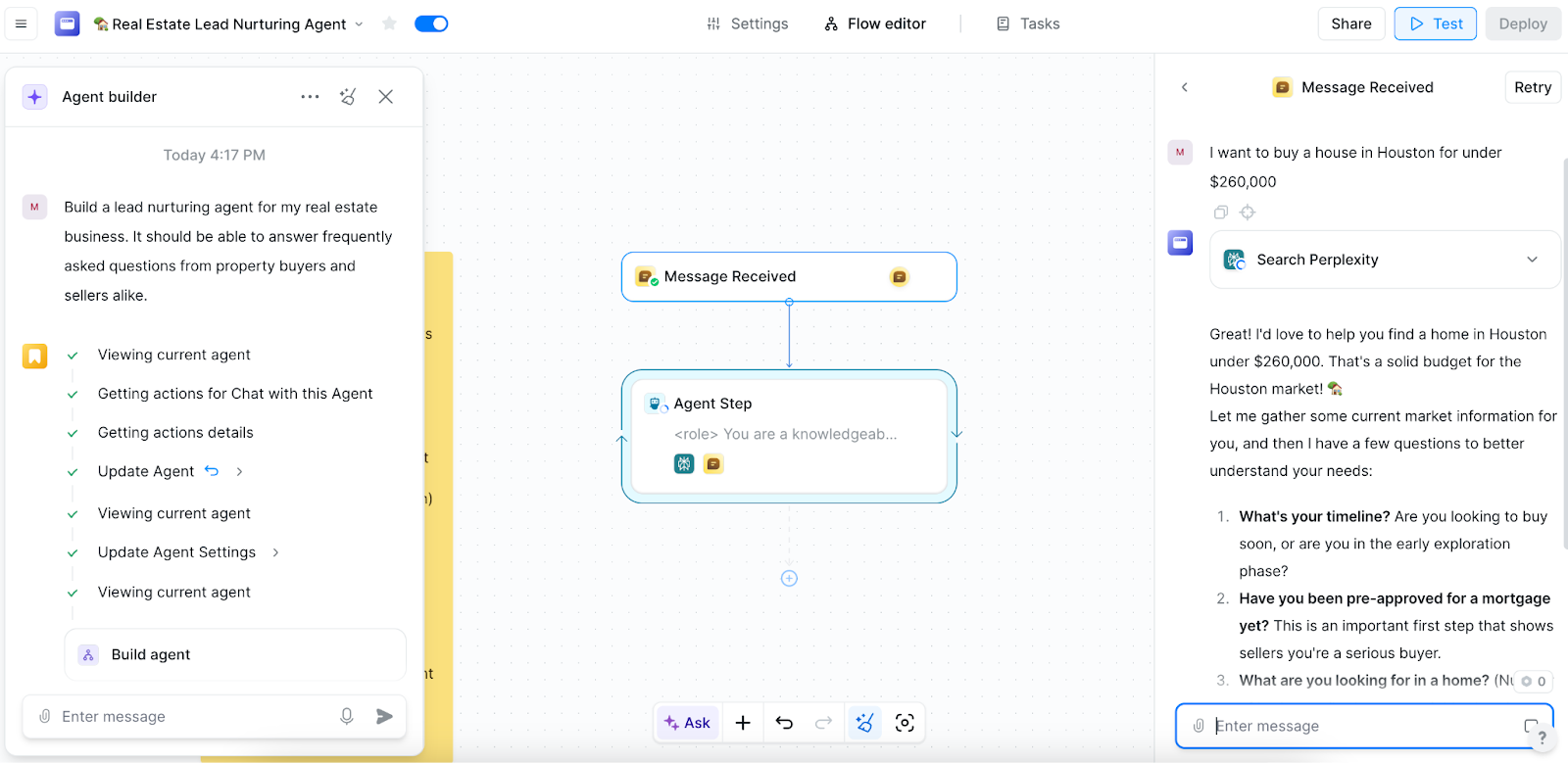
Lindy offers dozens of pre-made AI agent templates for a variety of applications like HR, customer support, engineering, marketing, sales, and even personal productivity. You can choose from more than 15 different language models and build agent logic in the intuitive Flow Editor.
Lindy has the potential to help with real estate AI lead generation by acting as a flexible layer between your data and your outreach tools. For example, you could connect Lindy to your CRM and create an agent to analyze existing contacts and new inquiries, use Lindy’s AI assistant to draft personalized communication for lead outreach and follow-up, or employ Lindy’s calendar integration to automate scheduling of property showings and calls. The Outbound Phone Agent can also serve as your automated calling assistant to handle customer outreach.
I found it easy to specify what I wanted to build via the chat interface and by talking to Lindy with voice input. I was able to import files to give more context as well as add instructions and constraints in the “Memories” field to train my agent further. All in all, Lindy has a lot of potential but may be overwhelming for newcomers seeking more straightforward purpose-built solutions.
Pros:
- Good at working with messy data and multistep workflows beyond simple chatbots
- AI agents that can make decisions, qualify leads, and prioritize tasks using stored knowledge and rules
- Multistep workflows that can have different agents handle research, outreach, and meeting booking across tools
Cons:
- There is a steep learning curve
- It was not created specifically for real estate agents
- Credit-based pricing can be hard to forecast, especially when agents run long or frequent workflows
Plans/Pricing:
- Free plan with 400 credits per month
- Pro plan: $49.99 per month or $39.99 per month (annual)
G2 rating: 4.9/5
5. Manus: Best for CMA and deep market research
Key features:
- No-code web-based chat interface
- Support for creative outputs and marketing materials like images, video, and slides
- Autonomous AI agents that can run tasks like summarizing, content creation, and simple workflows using a credit model
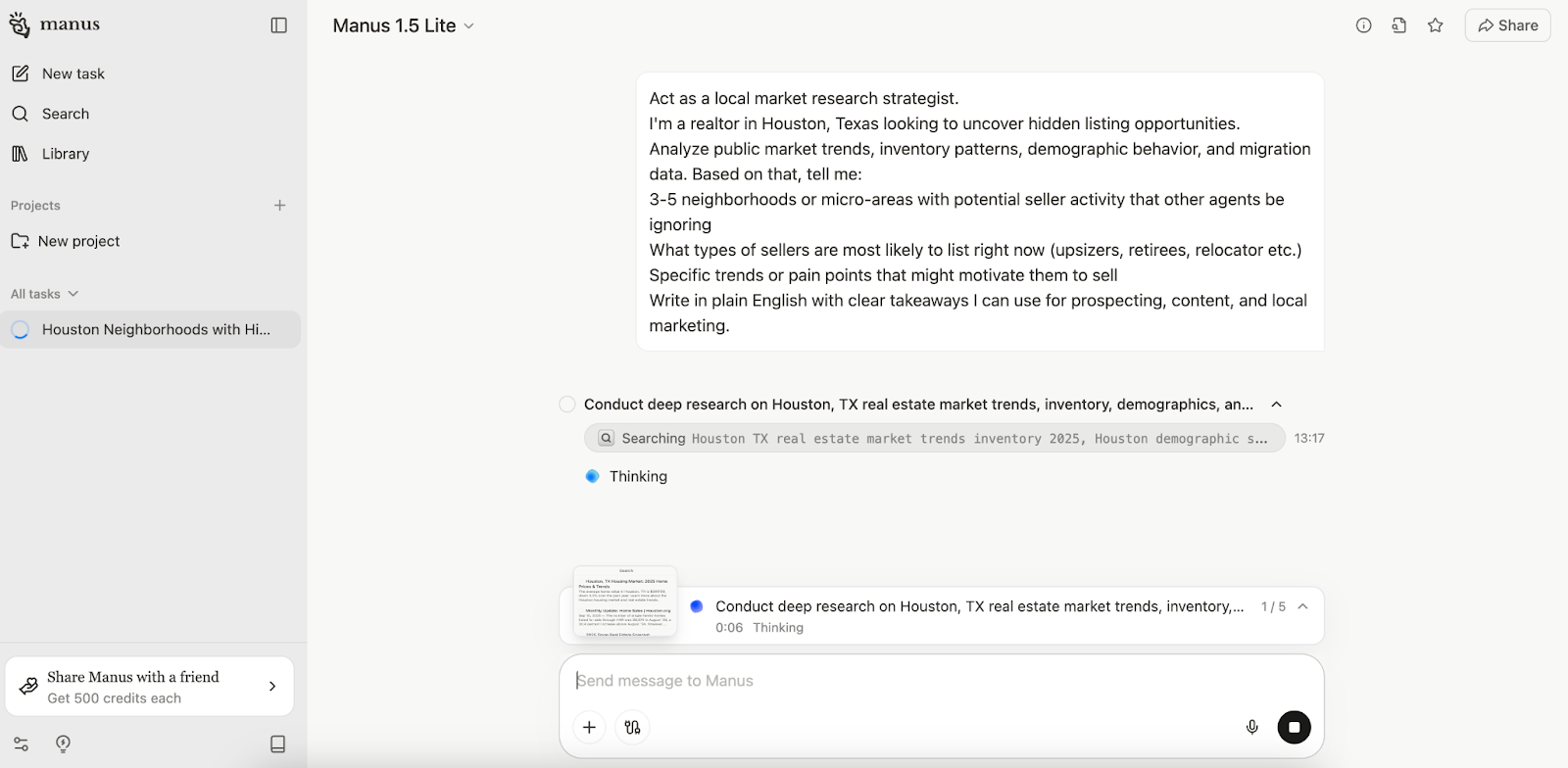
Manus excels at deep research. It can help real estate professionals uncover hidden listing opportunities by analyzing public market trends, inventory patterns, migration data, and even demographic behaviors. It then uses these insights to identify overlooked neighborhoods, properties, and motivated sellers.
I found Manus to be refreshingly transparent about its “thinking” process, citing sources and serving up the data and results I needed in convenient PDFs I could repurpose and share. It’s also possible to use Manus’ output and ideas for prospecting and localized marketing content creation.
For many users, pricing is the main appeal here. Credit-based tiers let small teams experiment with agents at relatively low monthly cost before rolling out more sophisticated workflows. In higher paid tiers, Manus AI agents can also support lead generation by automating content tasks (like follow-up templates or property blurbs) and running simple scripted outreach flows, though it is much less vertically focused on real estate than some other tools I covered.
Pros:
- Transparent “thinking” process with sources cited
- Streamlined research process so you can focus on outreach/follow-up
- AI agent capabilities that can support marketing and admin tasks around your pipeline
Cons:
- It has limited customization
- User review ratings are low
- It can get stuck on certain tasks/steps
- Cost can be prohibitively high, especially when adding AI agents
Plans/Pricing:
- Free plan available
- Basic plan: $19 per month or $16 per month (annual)
G2 rating: 1.8/5
6. Gamma: Best for AI content creation and presentation support

Key features:
- Highly versatile premade presentation templates
- AI tools for generating slide decks, documents, and web pages
- Agent to automatically incorporate your feedback and make edits to cards
- Engagement analytics to show how viewers interact with shared presentations
While Gamma does not qualify or score leads directly, it can play a supporting role in AI lead generation for real estate by helping agents quickly produce polished listing presentations, neighborhood guides, and investor decks.
Gamma offers intuitive visual building blocks like smart layouts, diagrams, and charts to help your presentations resonate with your target audience. Use prompts or pasted text to create slick AI-powered content to support lead nurturing. Those assets can then be plugged into your AI agents, email drips, or remarketing campaigns to keep nurtured leads engaged with high-quality content.
With no coding or design experience necessary, I decided Gamma was an incredibly useful tool, especially for real estate agents in a rush with limited graphic design resources. Simple one-click redesign and layout options kept my materials on brand with minimal design work.
Gamma user reviews continuously cite the ease of content creation and the flexible design tools. AI credits determine how many presentations or edits you can generate, with paid tiers adding more credits, premium AI image models, custom branding and fonts, and more detailed analytics.
Pros:
- No coding or design experience necessary
- Fast way to turn rough ideas into shareable decks and pages without a designer
- Analytics can show which slides or sections prospects engage with most, informing future follow-ups
Cons:
- Initial setup can be lengthy
- AI output still needs manual editing
- Translation options and branding controls are only available on higher tiers
- You’ll still need a separate system for capture, scoring, and routing
Plans/Pricing:
- Free plan available
- Plus plan: $10 per month or $8 per month (annual)
G2 rating: 4.6/5
7. Lone Wolf: Best for lead delivery into CRM
Key features:
- Automation for follow-ups and other outreach tasks
- AI-powered outreach templates and pipeline management tools
- Direct CRM integration for real-time lead delivery and notifications
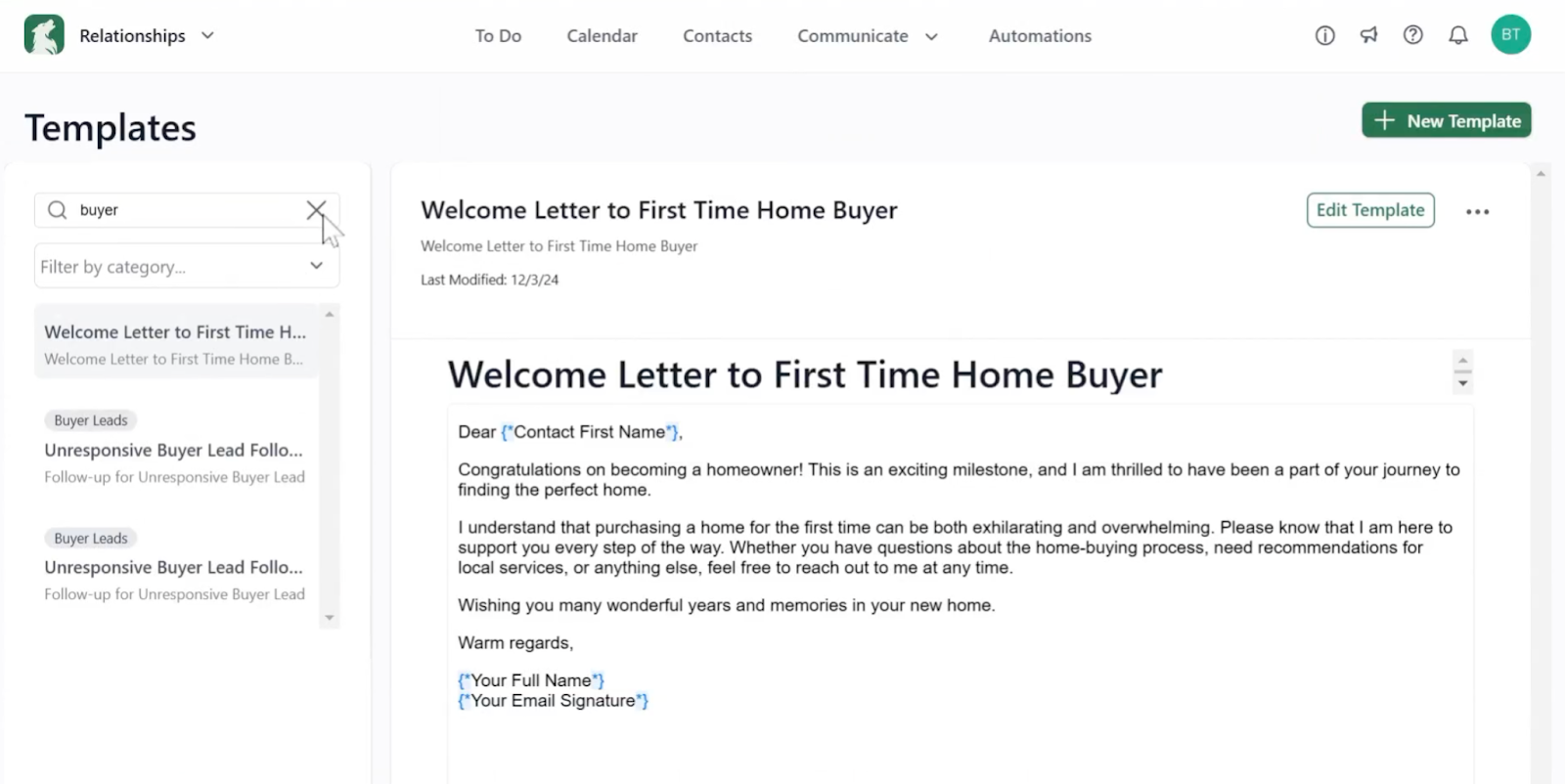
Lone Wolf offers a variety of real estate tools. Lone Wolf Foundation is a centralized contact management system, while Lone Wolf Relationships is a newer software specifically built to close deals faster and nurture client relationships. Lone Wolf’s Leads+ is a service that runs targeted marketing campaigns in chosen markets to deliver high‑intent buyer and seller leads to a CRM in real time, giving agents a steady stream of contacts to work with. When paired with your own scoring and nurture stack, this supports AI lead generation in real estate.
The plain, no-frills layout of the reporting dashboard makes for easy navigation, and it has its own calendar and to-do list to support you in your goals. I found the process of adding and organizing my contacts to be simple yet thorough, complete with specific categories for clients, vendors, or agents. The custom tagging system and notes fields were also very useful, and I could conveniently import contacts from a CSV or VCF file.
Lone Wolf sports a robust resource center, including a library of help videos, training webinars, and step-by-step guided workflows. The branding features are a nice extra touch, giving you the ability to customize your templates with branding for over 15 popular real estate franchises. You can also input your state and agent ID to connect to an MLS.
Pros:
- Direct CRM routing and notifications
- Supportive and detailed training resources
- Exclusive, high-intent leads targeted to chosen markets rather than generic shared lists
Cons:
- It isn’t a full 24-7 AI qualification engine
- User reviews mention glitches and service interruptions
- Pre-vetting and scoring still rest largely with your internal tools
Plans/Pricing: Quote available upon request
G2 rating: 3.4/5
Good AI doesn’t replace your agents — it helps them win more appointments
Across these tools, the pattern is clear: Good AI handles capture, triage, and consistent follow-up to boost productivity and lighten the mental load placed on real agents. This allows them to focus on tours, negotiations, CMAs, and building trust with their treasured clients. Combining AI lead generation in real estate with AI customer service for real estate can also improve the post-inquiry experience by automating status updates, application guidance, and FAQs for buyers and renters.
Jotform AI Agents are designed specifically for this partnership, using real estate AI Agents to answer questions, qualify prospects, and route hot leads to the right person with calendar links ready to go.
The next step is to choose one platform that fits your CRM and lead sources, launch a small pilot, and track simple KPIs like speed to lead, contact rate, and appointments booked. If you’re early in your journey of exploring real estate lead generation ideas or even becoming a real estate agent, starting with a no-code stack like Jotform makes it easier to test, learn, and iterate.
This article is for real estate agents, brokers, and teams seeking to automate lead capture and qualification, reduce manual follow-up, and book more appointments using AI-powered tools and no-code workflows.






































































































Send Comment: