
The following suggestions are for informational purposes only. For current requirements, see the IRS instructions for Form W-8BEN-E.
When a foreign business receives income from a U.S. company, marketplace, financial institution, or other payer, the paperwork can feel deceptively simple: A request arrives for Form W-8BEN-E, and the entity needs to complete it before payment is released or withholding is applied. But this is not just an address form. The selections on the form help the payer understand the entity’s foreign status, potential U.S. withholding treatment, and FATCA classification.
That is why a careful, document-first approach matters. Form W-8BEN-E is long because it serves many kinds of foreign entities, yet most organizations complete only the parts that apply to their own situation. This guide walks through the form at a practical level, highlights the decisions that deserve a second look, and explains where an authorized tax professional should step in.
What is Form W-8BEN-E?
Form W-8BEN-E, Certificate of Status of Beneficial Owner for United States Tax Withholding and Reporting (Entities), is an IRS form used by foreign entities to document their status for U.S. tax withholding and reporting purposes. A foreign corporation, partnership, trust, foundation, or other entity may provide it to the person or institution making a U.S.-source payment.
The form can establish that the recipient is foreign for Chapter 3 purposes and, when required, provide a Chapter 4 (FATCA) status. It may also be used to claim a reduced rate of withholding under an applicable income tax treaty—but only when the entity is eligible and can make the relevant certifications. Form W-8BEN-E is generally given to the withholding agent or payer, not filed directly with the IRS.
Who needs to fill out Form W-8BEN-E?
Use Form W-8BEN-E when a foreign entity is the beneficial owner of income and a U.S. payer, platform, bank, or other withholding agent asks it to document its foreign and FATCA status. The entity should use its legal name and determine its own classification under the form’s rules rather than assuming that its local business label automatically answers every U.S. tax question.
This form is not for individuals; a foreign individual generally uses Form W-8BEN. It is also not the right certification for every entity arrangement. An entity receiving income effectively connected with a U.S. trade or business may need Form W-8ECI, while intermediaries, foreign partnerships, and certain flow-through entities may need Form W-8IMY. Foreign governments, international organizations, and certain foreign tax-exempt organizations may need Form W-8EXP. If there is uncertainty about which W-8 form applies, pause and obtain professional advice before signing.
What to gather before you start
Collect the entity’s exact legal name, country of incorporation or organization, permanent and mailing addresses, tax identification information, and the information request from the payer. You should also know the entity’s Chapter 3 status and FATCA status, and have a clear record of the income being paid.
If you plan to claim treaty benefits, gather the treaty country, the type of income, the requested withholding rate, and the treaty provision you believe applies. Some certifications require a U.S. TIN, foreign TIN, GIIN, or other supporting details. Because these determinations can be technical, foreign entities often ask a qualified international tax adviser to review the completed form before it is delivered.
How to fill out Form W-8BEN-E
1. Complete Part I: Identification of beneficial owner
Start with the entity’s legal name on line 1. On line 2, enter the country of incorporation or organization. The remaining fields in Part I ask you to identify the entity’s Chapter 3 status and FATCA status, provide addresses, and supply tax identification details where applicable.
Take extra care with the classification fields. Line 4 addresses the Chapter 3 status, while line 5 asks for the Chapter 4 (FATCA) status. These are related but distinct U.S. withholding concepts, so do not select a status simply because it sounds similar to the entity’s local legal form. Follow the instructions and get advice when the classification is unclear.
2. Add your addresses and taxpayer identification information
Enter the entity’s permanent residence address in the country where it claims to be a resident for income tax purposes. Use the mailing address only when it differs. Follow the form instructions carefully, as the permanent residence address generally must be a physical address rather than a P.O. box or in-care-of address. Depending on the entity’s facts and the payer’s request, Part I may also require a U.S. taxpayer identification number, foreign tax identifying number, GIIN, or reference number.
Do not treat these fields as optional by default. A missing identification number can delay onboarding or prevent a payer from accepting a treaty claim. At the same time, share sensitive identifying information only through an approved, secure process with the verified withholding agent or payer.
3. Complete only the FATCA-status section that applies
After selecting the FATCA status in Part I, turn to the corresponding certification part later in the form, if applicable. Form W-8BEN-E includes many possible parts because it covers financial institutions, active and passive NFFEs, publicly traded entities, governments, retirement funds, and other classifications. Most entities do not complete all of them.
RIf applicable, read the certification for the exact status you selected and complete the required lines there. If a requested status requires a GIIN, substantial U.S. owner information, or another representation, make sure the entity can support it. Selecting a status and then signing an unrelated certification section is a common avoidable error.
4. Make a treaty claim in Part III only if the entity qualifies
Part III is where an eligible beneficial owner may claim treaty benefits. Enter the treaty country of residence and, where applicable, identify the treaty article, paragraph, withholding rate, income type, and any additional conditions needed for the claim.
A treaty claim is not automatic merely because the entity is organized in a treaty country. The entity generally must satisfy the treaty’s requirements, which may include beneficial-owner and limitation-on-benefits rules. If the payment is material or the eligibility analysis is not straightforward, obtain professional tax advice instead of guessing at a reduced rate.
5. Review the certifications and sign Part XXX
Before signing, review every entry against the entity’s records and the payer’s request. Confirm that you completed only the applicable certification parts, that any treaty claim is supported, and that no material facts have been omitted. An authorized individual must sign and date Part XXX and state their capacity to sign for the entity.
Send the completed form to the requesting withholding agent or payer using its stated process. Keep a secure copy in the entity’s records. Do not mail the form to the IRS unless the IRS or a specific official instruction tells you to do so.
Generally, Form W-8BEN-E remains valid from the signature date through the last day of the third succeeding calendar year, unless a change in circumstances makes the information incorrect. Some forms may remain valid indefinitely under specific rules, but a payer may still request an updated form.
Which W-8 form should you use?
| Form | Typical use |
|---|---|
| Form W-8BEN | Foreign individuals documenting their status or claiming treaty benefits. |
| Form W-8BEN-E | Foreign entities acting as beneficial owners of the income. |
| Form W-8ECI | Foreign persons claiming that income is effectively connected with a U.S. trade or business. |
| Form W-8IMY | Intermediaries and certain flow-through entities. |
The correct form depends on who receives the income and how that recipient is treated for U.S. withholding purposes. If more than one description appears plausible, ask the payer what information it needs and seek international tax advice.
Common Form W-8BEN-E mistakes to avoid
- Using Form W-8BEN for an entity: That form is generally for foreign individuals, not organizations.
- Confusing Chapter 3 and FATCA classifications: Review each field under its own rules.
- Completing every certification section: Complete the parts tied to the selected status, not every possible status.
- Claiming a treaty rate without checking eligibility: Treaty residence alone may not be enough.
- Sending the form to the IRS: In ordinary cases, give it to the withholding agent or payer and retain a copy.
- Ignoring changes in circumstances: If a change makes any certification incorrect, notify the withholding agent or financial institution within 30 days and provide updated documentation as required.
Form W-8BEN-E Generator by Jotform
Form W-8BEN-E can require input from finance, legal, tax, and the person authorized to sign for the entity. Jotform’s Form W-8BEN-E Generator provides a structured, fillable workspace to organize the entity details, classifications, and certifications needed for review before the form is sent to the requesting payer.
Organize entity and withholding details
Use the labeled fields to gather the entity’s legal name, country of organization, addresses, tax-identification information, Chapter 3 status, FATCA classification, and treaty-claim details when applicable. Keeping this information in one place can make it easier to compare the completed form with organizational records and payer instructions.
Build a careful review process
W-8BEN-E classifications can have significant withholding and reporting consequences. Before signing, create an internal review step for the entity’s classification, FATCA status, treaty eligibility, and the specific certification part that applies. In complex cases, have a qualified international tax adviser review the form.
Keep sensitive information secure
Form W-8BEN-E can contain tax identification numbers, entity details, and financial-account information. Jotform protects submissions with 256-bit SSL encryption and GDPR- and CCPA-enabled features. You can also use Encrypted Forms for additional protection.
Download a completed copy for review
After completing the fields, download a PDF for internal review and recordkeeping. Jotform does not determine the correct W-8 form, certify FATCA status, establish treaty eligibility, or submit Form W-8BEN-E to the IRS. The entity remains responsible for accurate certifications and delivery to the withholding agent or payer.
Prepare Form W-8BEN-E before payment
A complete Form W-8BEN-E helps the payer understand the entity’s foreign status, potential withholding treatment, and FATCA classification. Before signing, confirm the correct form, review each certification against the entity’s records, and make sure any treaty claim is fully supported.
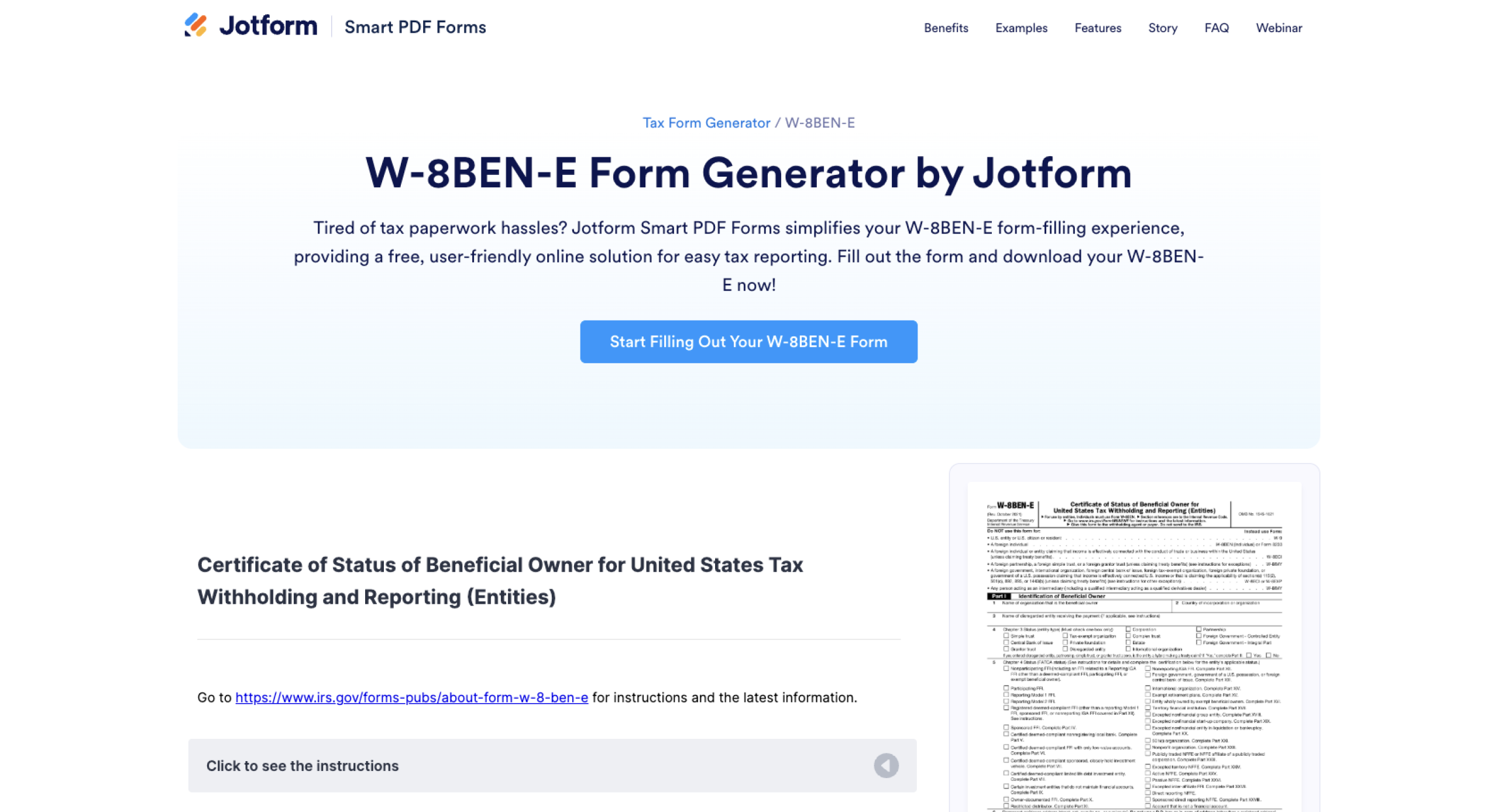
Ready to organize your entity’s withholding documentation? Use Jotform’s Form W-8BEN-E Generator to prepare a fillable form and download a PDF for review before sending it to the payer.
Frequently asked questions about Form W-8BEN-E
Usually, no. The entity typically gives the completed form to the withholding agent, payer, or financial institution that requested it. Follow that requester’s delivery instructions.
Yes, an eligible beneficial owner may use Part III to claim a treaty benefit. The entity must meet the treaty’s requirements and provide the requested certifications.
Update the form when a change in circumstances makes the information or certifications inaccurate, and whenever the payer asks for a new form. The IRS instructions contain the rules on validity periods and changes in circumstances.
This article is for international business owners, finance professionals, accountants, and tax compliance teams who need to complete IRS Form W-8BEN-E when receiving payments from U.S. companies or financial institutions. It’s especially useful for foreign entities navigating U.S. tax withholding requirements, FATCA classifications, and potential tax treaty benefits
AS ALWAYS, CONSULT AN ATTORNEY AND/OR OTHER APPLICABLE PROFESSIONALS BEFORE RELYING ON ANY INFORMATION ON THIS PAGE. THE CONTENT ABOVE IS FOR INFORMATIONAL PURPOSES ONLY. JOTFORM IS NOT PROVIDING LEGAL, TAX, FINANCIAL OR OTHER ADVICE.






















Send Comment: