

ChatGPT is a great tool for generating trivia questions. You type in a prompt and within seconds you have a set of questions you can adapt and edit for all of your trivia needs. However, a fun and engaging trivia quiz needs strong prompts, balanced difficulty, verified answers, and an audience-friendly format. ChatGPT trivia questions can meet these requirements when paired with Jotform, one of the best ChatGPT apps to integrate.
This guide walks through how to use ChatGPT to create trivia questions, including reusable prompt templates and ways to publish the quiz quickly online.
Need trivia question ideas? We have you covered!
- General trivia questions
- Science trivia questions
- History trivia questions
- Geography trivia questions
- Halloween trivia questions
- Sports trivia questions
- Movie trivia questions
- Music trivia questions
- Animal trivia questions
- Food trivia questions
- Easter trivia questions
- Christmas trivia questions
- Summer trivia questions
- Holiday trivia questions
- Wedding trivia questions
Best ChatGPT prompts for trivia questions
The prompt is the most important component for ChatGPT-generated trivia questions, because it determines whether the output is genuinely useful for your quiz or just generic. Your prompt needs these components to be effective:
- Topic: Be as specific as possible about the topic of your ChatGPT quiz questions — for example, music history or general science.
- Audience information: Include who the quiz is for, as well as what their age and interests are.
- Difficulty level: Age and other demographics will determine how hard the questions should be.
- Answer format: What kinds of answers are you looking for? For instance, free response, multiple-choice, or true and false.
- Verification expectations: Prompt the tool to provide any resources it used to pull the questions to make verification easier.
Use the following template when giving ChatGPT trivia prompts:
“Create [number] trivia questions for [audience] about [topic/theme]. Use [easy/medium/hard] difficulty. Format each question with 4 multiple-choice answers, mark the correct answer, add a 1-sentence explanation, and keep the language clear enough for [age group/context]. Avoid recent facts unless they can be verified. Mix categories and randomize the correct answer position.”
Remember ChatGPT works best when you use its output as a first draft you then edit, adapt, and verify. It isn’t meant to be the final source of truth. Sometimes ChatGPT can provide facts that aren’t true or are outdated, so it’s always wise to ensure accuracy and read through trivia questions generated by AI before using them.

40 ChatGPT trivia questions and answers
ChatGPT is packed with tons of knowledge that can easily translate into straightforward trivia questions for all levels, from easy to difficult. The 40 questions below are solid examples of outputs the tool can provide for your trivia quiz based on five different categories.

General knowledge trivia questions
- What is the world’s largest ocean?
A. Atlantic Ocean
B. Indian Ocean
C. Pacific Ocean
D. Arctic Ocean
Correct answer: C. Pacific Ocean
Explanation: The Pacific Ocean is the Earth’s largest, covering more than 60 million square miles.
- Which language has the most native speakers worldwide?
A. Spanish
B. English
C. Mandarin Chinese
D. French
Correct answer: C. Mandarin Chinese
Explanation: Mandarin has the most native speakers, with almost 1 billion native speakers around the world, followed by Spanish in second and English in third.
- Which of our solar system’s planets is known as the red planet?
A. Venus
B. Mars
C. Mercury
D. Jupiter
Correct answer: B. Mars
Explanation: The surface of Mars contains high levels of iron oxide, creating the reddish or rust color.
- What is South America’s longest river?
A. Amazon
B. Orinoco
C. São Francisco
D. Paraná
Correct answer: A. Amazon
Explanation: The Amazon River carries more water than any river on the planet and flows through much of northern South America.
- In what year did humans first land on the moon?
A. 1975
B. 1972
C. 1970
D. 1969
Correct answer: D. 1969
Explanation: In July 1969, Apollo 11 landed on the moon, making Neil Armstrong and Buzz Aldrin the first astronauts to walk on the moon’s surface.
- What is the capital of Australia?
A. Canberra
B. Syndey
C. Melbourne
D. Perth
Correct answer: A. Canberra
Explanation: Canberra has been Australia’s capital since 1913, though Sydney is the largest Australian city.
- Which main gas do plants absorb from the atmosphere during photosynthesis?
A. Nitrogen
B. Carbon Dioxide
C. Oxygen
D. Hydrogen
Correct answer: B. Carbon Dioxide
Explanation: Plants absorb carbon dioxide in photosynthesis. They use sunlight to convert it into energy and then release oxygen.
- Which is the smallest prime number?
A. 0
B. 1
C. 2
D. 3
Correct answer: C. 2
Explanation: A prime number has two positive divisors: one and itself. Two is the smallest and only even prime number.
Create a general knowledge trivia quiz preloaded with these 8 questions.
Pop culture trivia questions
- What road does Dorothy travel in The Wizard of Oz?
A. Silver Road
B. Emerald Road
C. Yellow Brick Road
D. Golden Path
Correct answer: C. Yellow Brick Road
Explanation: Dorothy follows the Yellow Brick Road when going to the Emerald City.
- Which band recorded the album Abbey Road?
A. The Rolling Stones
B. The Beatles
C. Queen
D. The Beach Boys
Correct answer: B. The Beatles
Explanation: Abbey Road was released in 1969 by the Beatles, featuring famous songs like “Come Together” and “Here Comes the Sun.”
- Which famous author wrote Pride and Prejudice?
A. Charlotte Brontë
B. Emily Dickinson
C. Virginia Woolf
D. Jane Austen
Correct answer: D. Jane Austen
Explanation: Jane Austen wrote Pride and Prejudice, which was published in 1813 and is one of the most widely read novels in English literature.
- What is the name of the coffee shop on the TV show Friends?
A. Central Station
B. Central Perk
C. Coffee Corner
D. Manhattan Café
Correct answer: B. Central Perk
Explanation: Central Perk is the friends’ primary gathering place and appears in most of the episodes.
- Which movie franchise features the quote “May the Force be with you”?
A. Star Trek
B. The Matrix
C. Star Wars
D. Blade Runner
Correct answer: C. Star Wars
Explanation: The phrase became one of the most recognizable lines in movie history after appearing in Star Wars.
- Which singer was the King of Rock and Roll?
A. Elvis Presley
B. Chuck Berry
C. Little Richard
D. Johnny Cash
Correct answer: B. Elvis Presley
Explanation: Elvis popularized rock and roll in the 1950s and became one of the most influential entertainers of all time.
- In Harry Potter, which Hogwarts house is Harry sorted into?
A. Slytherin
B. Ravenclaw
C. Hufflepuff
D. Gryffindor
Correct answer: D. Gryffindor
Explanation: Harry is placed into Gryffindor, as are his friends Ron Weasley and Hermione Granger.
- Which animated movie was the first full-length feature produced by Disney?
A. Pinocchio
B. Fantasia
C. Snow White and the Seven Dwarfs
D. Cinderella
Correct answer: C. Snow White and the Seven Dwarfs
Explanation: Snow White was the first full-length animated feature film produced by Disney in 1937.
Create a pop culture trivia quiz preloaded with these 8 questions.
Classroom trivia questions
- What do you call the main character in a story?
A. Narrator
B. Protagonist
C. Antagonist
D. Editor
Correct answer: B. Protagonist
Explanation: The protagonist is a story’s central character.
- Which word is a synonym for “enormous”?
A. Huge
B. Average
C. Tiny
D. Narrow
Correct answer: A. Huge
Explanation: “Huge” and “enormous” both describe something very large, so they are synonyms.
- What is 15 percent of 200?
A. 20
B. 25
C. 30
D. 35
Correct answer: C. 30
Explanation: To find 15 percent of 200, multiply 200 by 0.15. The answer is 30.
- What is water’s chemical symbol?
A. CO₂
B. NaCl
C. O₂
D. H₂O
Correct answer: D. H₂O
Explanation: Water’s chemical symbol is H₂O because it is made of two hydrogen atoms and one oxygen atom.
- In the United States, which branch of government interprets laws?
A. Executive
B. Legislative
C. Judicial
D. Municipal
Correct answer: C. Judicial
Explanation: The judicial branch includes the courts and interprets laws, determining whether they are constitutional.
- What is the perimeter of a rectangle that is 8 inches long and 5 inches wide?
A. 13 inches
B. 26 inches
C. 40 inches
D. 64 inches
Correct answer: B. 26 inches
Explanation: Find the perimeter of a rectangle by adding all sides: 8 + 5 + 8 + 5 = 26.
- What was the primary purpose of the U.S. Constitution?
A. Establish a national government
B. Declare independence from Britain
C. End the Civil War
D. Create state governments
Correct answer: A. Establish a national government
Explanation: The Constitution created the framework for the federal government and outlined its powers and responsibilities.
- Which of Earth’s layers is the outermost layer where we live?
A. Core
B. Mantle
C. Inner Core
D. Crust
Correct answer: D. Crust
Explanation: The Earth’s crust contains continents, oceans, mountains, and all known life.
Create a classroom trivia quiz preloaded with these 8 questions.
Workplace and team-building trivia questions
- Which of the following practices supports good teamwork?
A. Keeping information to yourself
B. Avoiding feedback
C. Communicating clearly
D. Working independently
Correct answer: C. Communicating clearly
Explanation: Clear communication keeps team members aligned so they can work more effectively together.
- What does the acronym FAQs stand for?
A. Fast Answer Queue
B. Frequently Asked Questions
C. Formal Approval Query
D. File Access Quality
Correct answer: B. Frequently Asked Questions
Explanation: FAQs provide answers to common questions.
- Which skill promotes active listening?
A. Interrupting frequently
B. Multitasking
C. Making eye contact and asking clarifying questions
D. Planning your next response while someone is speaking
Correct answer: C. Making eye contact and asking clarifying questions
Explanation: Active listening involves focusing on the speaker and making sure you understand their message.
- What is the purpose of a brainstorming session?
A. Assigning performance ratings
B. Approving budgets
C. Conducting interviews
D. Generating ideas and solutions
Correct answer: D. Generating ideas and solutions
Explanation: Brainstorming lets participants share ideas freely and explore possible solutions as a group.
- Which of the following items would you use to organize project tasks?
A. Recipe book
B. Task checklist
C. Passport
D. Calendar invitation only
Correct answer: B. Task checklist
Explanation: Task checklists help teams track responsibilities, deadlines, and progress.
- What should you do first when you receive an email requiring action?
A. Read it carefully and identify the requested action
B. Delete it
C. Ignore it until someone follows up
D. Forward it to everyone on your team
Correct answer: A. Read it carefully and identify the requested action
Explanation: You need to fully understand what is being asked to handle the request properly.
- Which of the following is a benefit of working with people who have different backgrounds and experiences?
A. Fewer perspectives
B. Less creativity
C. More varied ideas and approaches
D. Identical viewpoints
Correct answer: C. More varied ideas and approaches
Explanation: Diverse teams bring a variety of ideas, experiences, and problem-solving approaches to work.
- Which teamwork skill is most useful when team members have different opinions?
A. Avoiding the topic
B. Collaborative problem-solving
C. Waiting for a manager to decide
D. Defending your own idea without listening
Correct answer: B. Collaborative problem-solving
Explanation: Collaborative problem-solving helps team members compare different ideas, address concerns, and choose a solution that supports the team’s shared goal.
Create a workplace and team-building trivia quiz preloaded with these 8 questions.
Event and custom trivia questions
- What age does a traditional quinceañera celebrate?
A. 13
B. 14
C. 15
D. 16
Correct answer: C. 15
Explanation: A quinceañera is a traditional celebration of a girl’s 15th birthday in many Latin American cultures.
- Which city is hosting this year’s conference?
A. [City A]
B. [City B]
C. [Host City]
D. [City D]
Correct answer: C. [Host City]
Explanation: Event-specific questions help attendees learn more about the conference details.
- What is the primary mission of our organization?
A. [Mission Option]
B. [Mission Option]
C. [Mission Option]
D. [Correct Mission]
Correct answer: D. [Correct Mission]
Explanation: Mission-focused questions educate fundraiser participants while reinforcing the event’s purpose.
- Which feature was introduced in our newest product?
A. [Feature A]
B. [Feature B]
C. [New Feature]
D. [Feature D]
Correct answer: C. [New Feature]
Explanation: Product trivia is a simple way to help attendees learn key details about a launch.
- Fill in the blank: Our company was founded in ______.
A. 1989
B. 1993
C. 1997
D. 1998
Correct answer: C. 1997
Explanation: Founding-year questions help participants learn a bit about the company’s history.
- Which company department handles recruiting and onboarding for new employees?
A. Marketing
B. Finance
C. Human Resources
D. Operations
Correct answer: C. Human Resources
Explanation: This type of workplace trivia can help new team members become familiar with organizational roles.
- What is the main purpose of a silent auction?
A. To provide live entertainment
B. To raise money for a cause through competitive bidding
C. To recruit volunteers
D. To announce award winners
Correct answer: B. To raise money for a cause through competitive bidding
Explanation: Silent auctions invite guests to bid on items, and the proceeds support an organization or cause.
- What is the purpose of a product prototype?
A. To test and refine a product before launch
B. To begin mass production immediately
C. To create advertising materials
D. To set the final retail price
Correct answer: A. To test and refine a product before launch
Explanation: A prototype is an early version of a product that allows teams to identify and address potential issues before release.
Create an event and custom trivia quiz preloaded with these 8 questions.
How to turn ChatGPT trivia questions into an online quiz
Using ChatGPT to generate a list of AI trivia questions is fast and easy. However, this list on its own isn’t yet a playable quiz. For a successful trivia game, you need a scoring strategy, design, plan for sharing, embedding capability, submission guidelines, and results management.
You have two ways to achieve these goals: Build your quiz within ChatGPT with the Jotform ChatGPT App, or use Jotform ChatGPT Trivia Generator.
Here is a deeper look at each of these approaches:
1. Build your quiz inside ChatGPT with the Jotform ChatGPT App
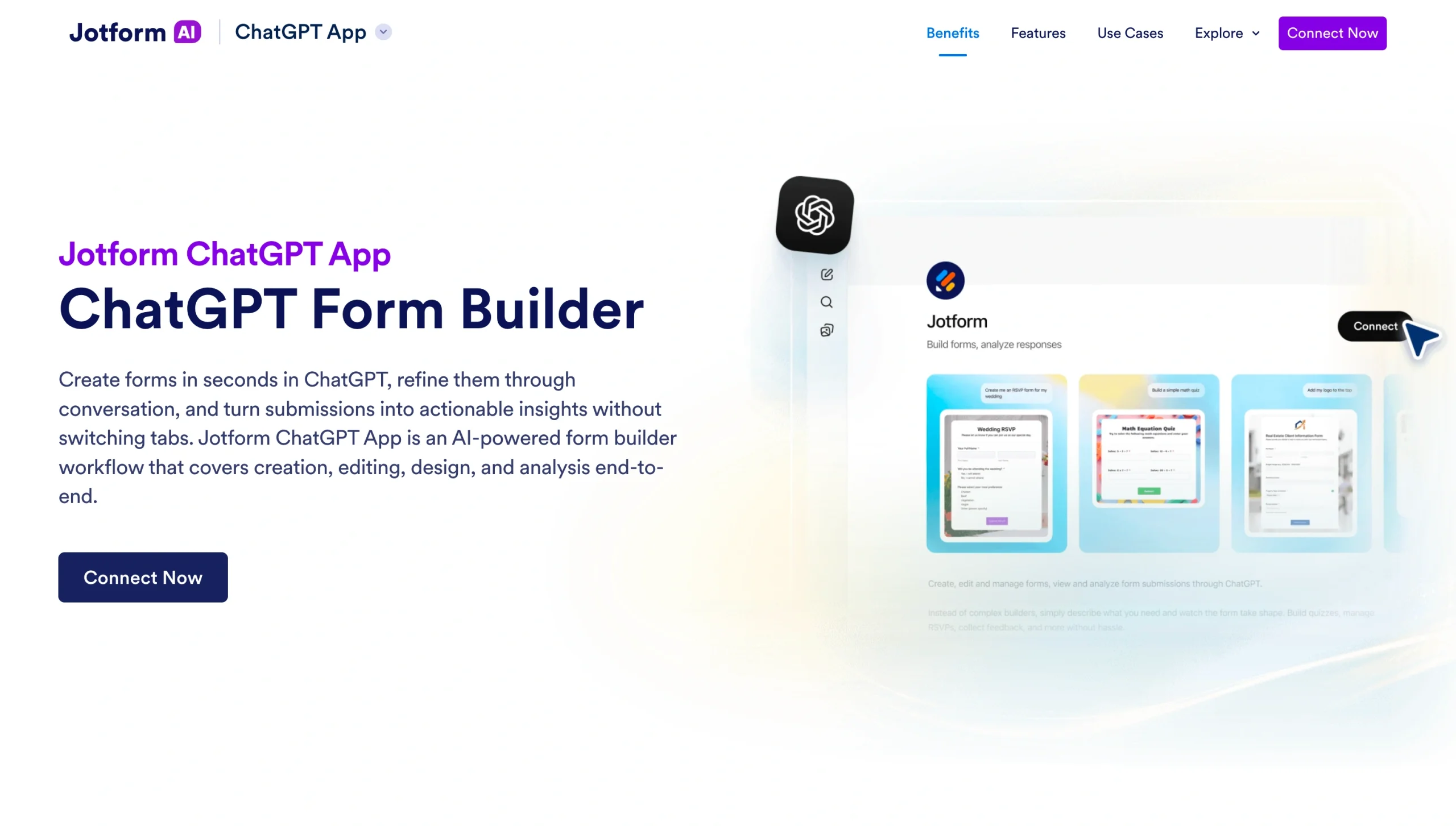
If you already use ChatGPT, combining that tool with the Jotform ChatGPT App is the most natural workflow. The app allows users to create, edit, refine, and analyze your forms directly inside ChatGPT. You just have to connect your Jotform account to get it to work. Here’s how:
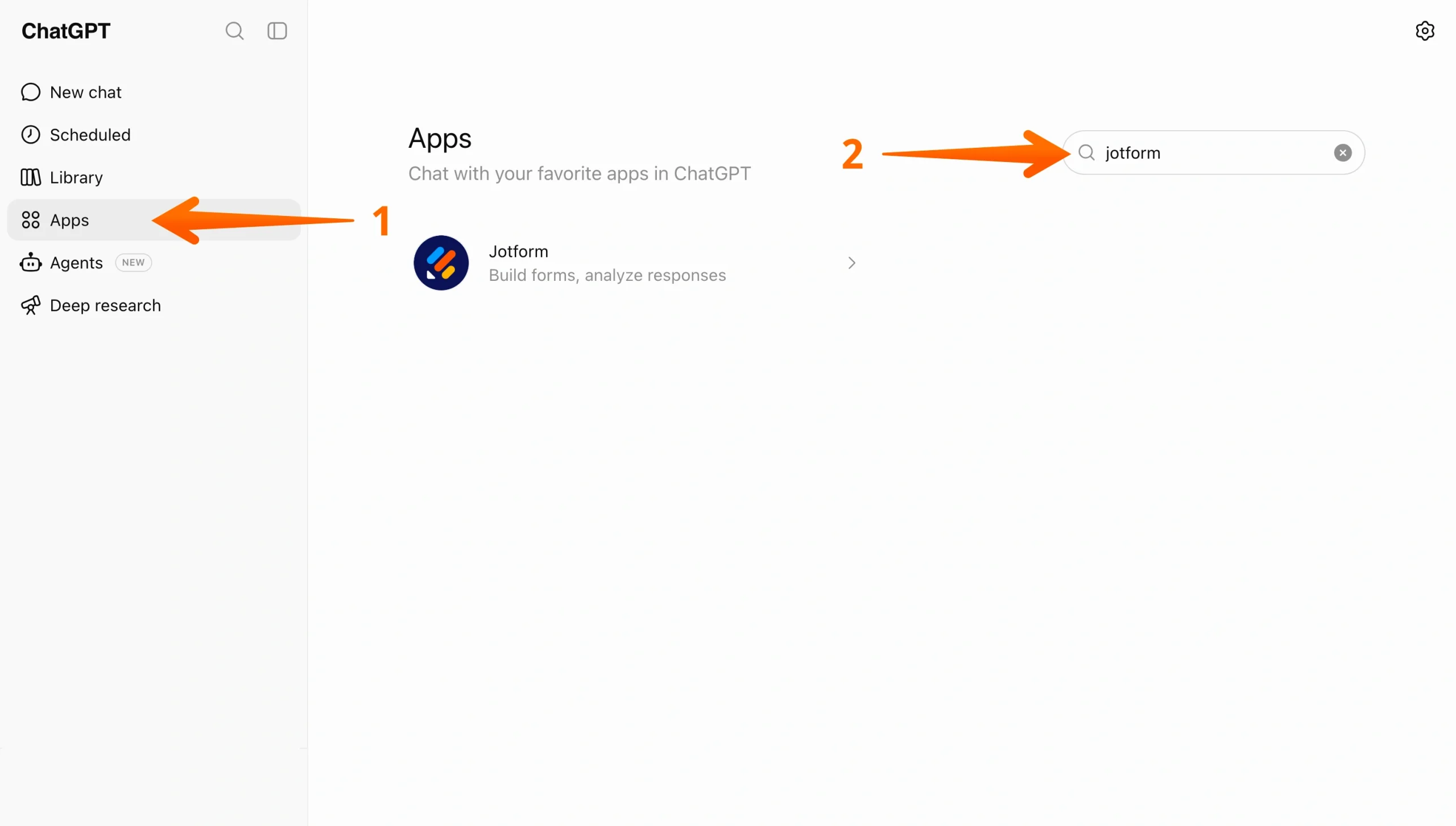
- Open ChatGPT and click on Apps in the left sidebar. Then, search for Jotform.
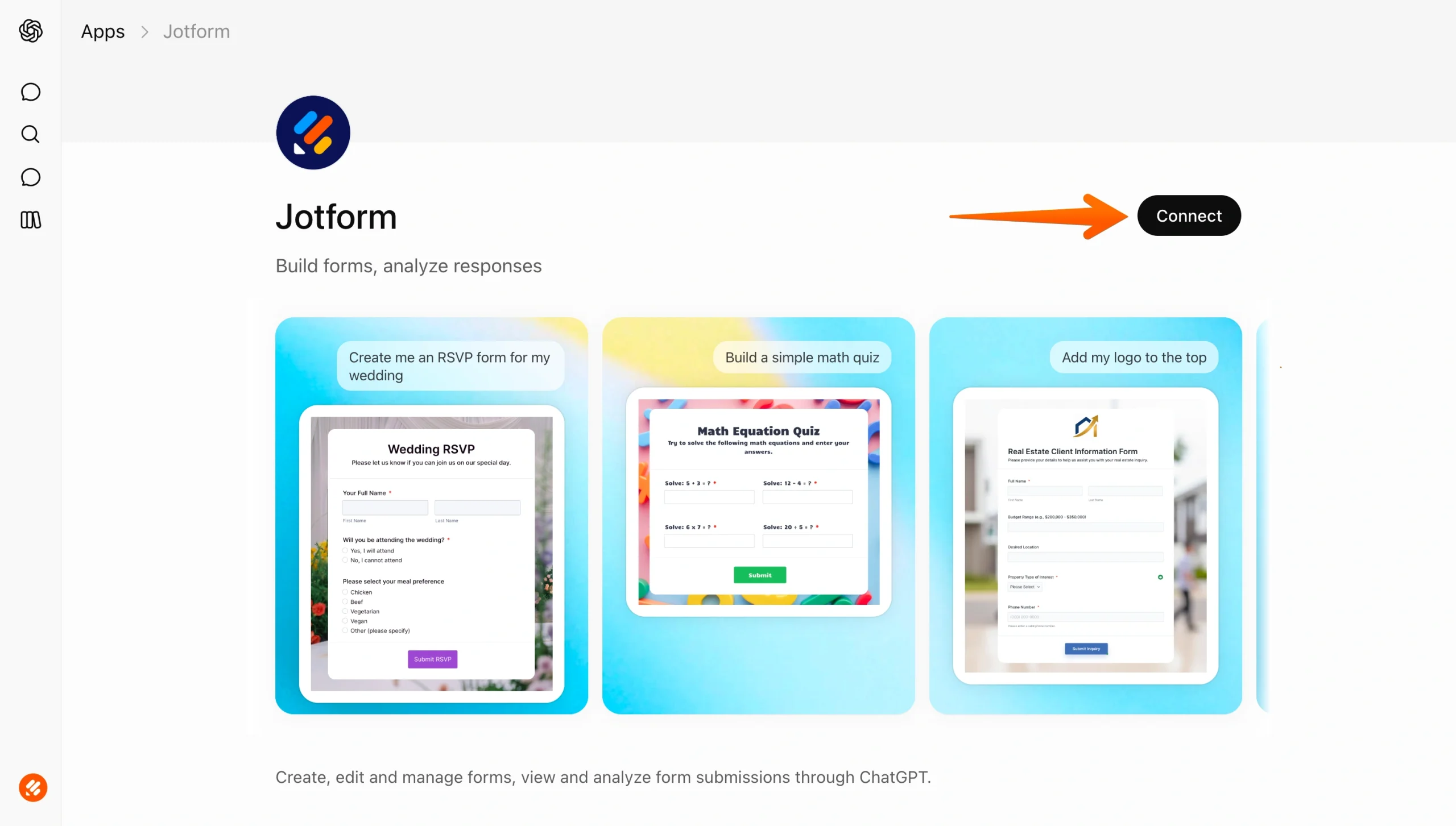
- Click on Jotform and select Connect. Log in to your Jotform account to securely authorize the integration.
- Prompt ChatGPT to create a trivia quiz, including topic, question count, audience, and difficulty level.
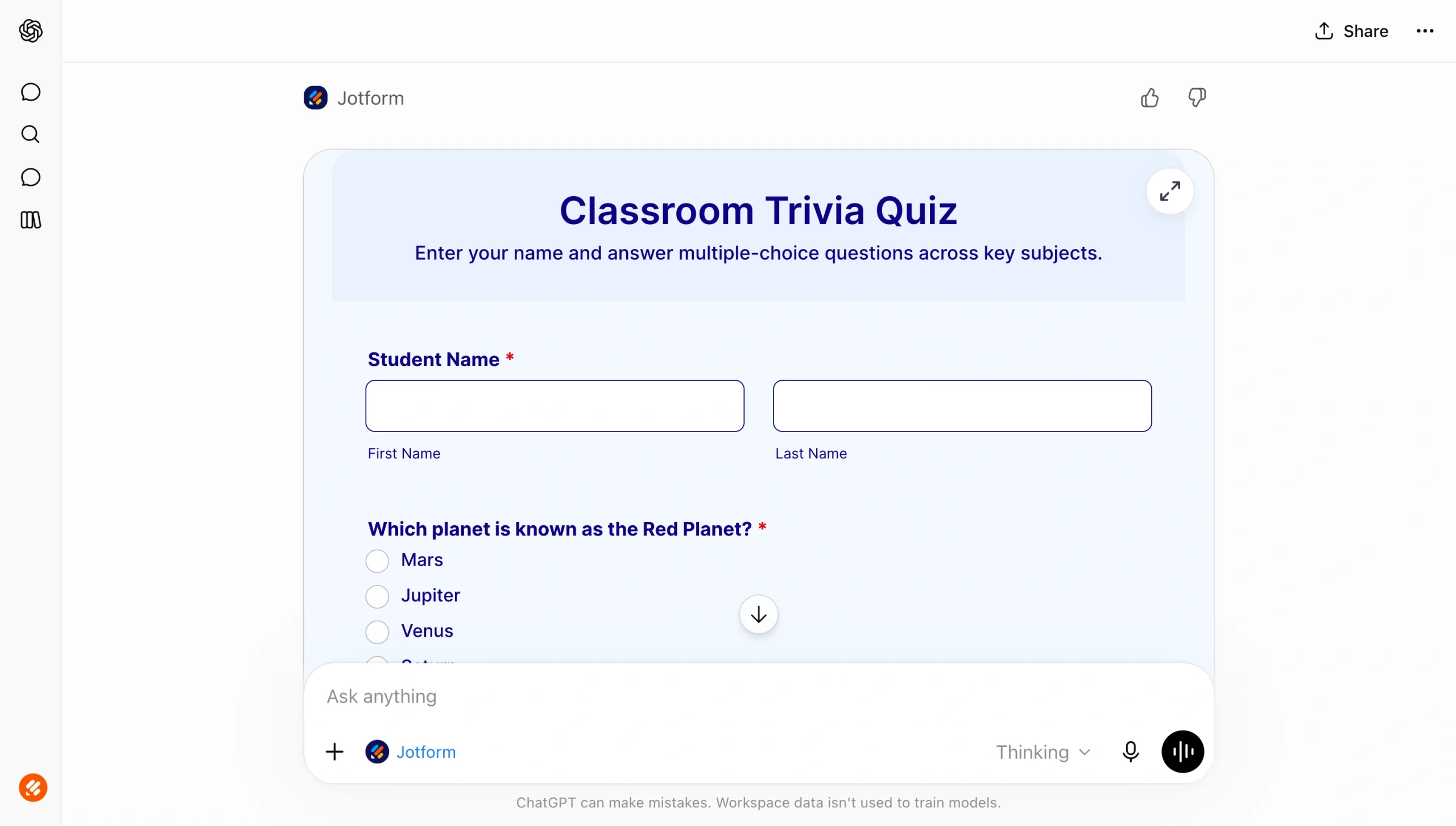
- Ask the tool to refine each question, reorder them, adjust difficulty, or rewrite unclear answer choices.
- Open your quiz in Jotform to finalize the design, scoring, sharing, and embedding settings.
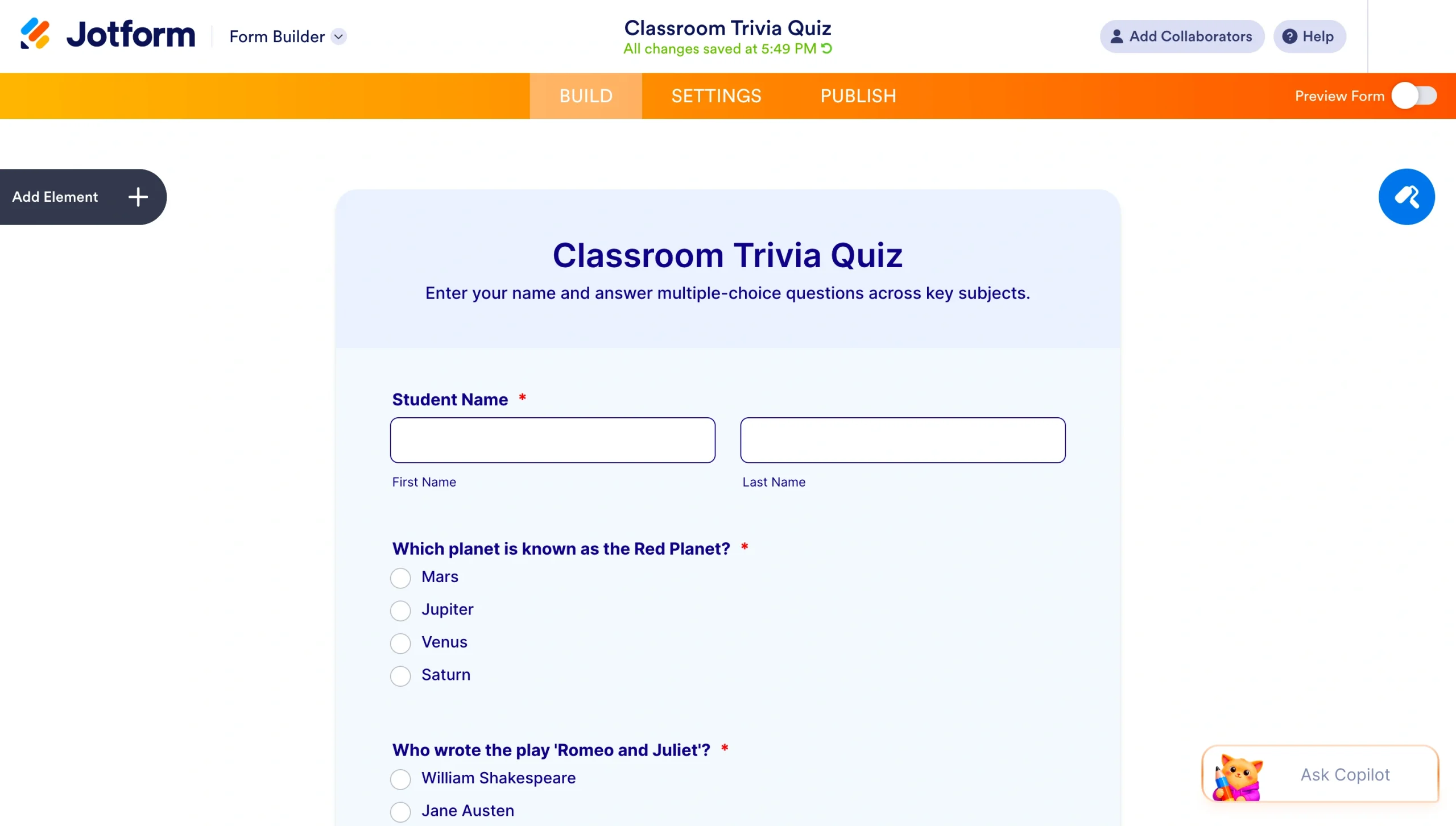
- Collect responses, and use ChatGPT with Jotform to review results, spot missed questions, and improve the quiz.
When you’ve connected ChatGPT and Jotform, you’re ready to move forward with an effective, engaging trivia quiz. Here’s an example prompt to enter into ChatGPT:
“Create a 20-question trivia quiz in Jotform for a company team-building event. Use medium difficulty, 4 multiple-choice answers per question, one correct answer, randomized answer positions, and a short explanation for each answer. Organize the questions from easiest to hardest.”
2. Use Jotform AI Trivia Generator
Your second option is to use the Jotform AI Trivia Generator. This is the best path if you have a document or quiz questions ready and don’t need ChatGPT to generate them. Jotform AI Trivia Generator can quickly create trivia from your prompt or uploaded document. It also allows you to choose the number of questions, your language, and the type of questions.
When you’re ready, you can share your trivia quiz by copying the link, sending an email, posting on social media, sharing a QR code, or embedding it on your website.
Create trivia quizzes instantly
How to make ChatGPT trivia questions better
ChatGPT’s output depends on your input, so improving what you ask can improve the results. Follow these steps for better ChatGPT-generated trivia questions:
1. Give ChatGPT a clear audience and difficulty level
If you don’t provide any guidelines, ChatGPT won’t know how to provide the questions you need. Be clear about your target audience and their difficulty level. Provide the number of questions you need. Here are examples of a weak prompt versus a strong prompt:
Weak prompt: Create a general trivia quiz.
Better prompt: Write 30 multiple-choice trivia questions for adults between ages 25 and 65. Keep the difficulty moderate. Include a mix of history, geography, sports, science, and entertainment.
2. Ask for plausible wrong answers
Trivia won’t be much fun if the right answers are always clear. Strong multiple-choice trivia needs distractors, or answers that feel possible without being misleading. When feeding information to ChatGPT, include a prompt line such as, “Make the incorrect options plausible, but ensure only one answer is clearly correct.”
3. Request answer explanations
Some teachers or quiz masters think having the questions and answers is enough. However, asking for explanations for each question, even if those explanations are very brief, can help you review the quiz for accuracy, check sources, use it as a teaching tool, or engage audiences after answers are revealed. Having an explanation for an answer makes the overall game more interesting.
4. Randomize correct answer positions
Another thing to watch for with ChatGPT is accidental patterns. For example, ChatGPT may select Bs and Cs as answers much more often than As and Ds, which makes the quiz too predictable or confusing. Ask ChatGPT to vary the correct answers across all options so they are random rather than patterned.
5. Ask ChatGPT to revise the quiz for balance
Sometimes, you’ll need to use ChatGPT to improve or correct its own work or to review questions after you’ve made changes. It always helps to have an additional review of your quiz before launching it. Your prompt could be something like this: “Review the following trivia quiz. Flag any questions that are too easy, too obscure, repetitive, outdated, or hard to verify. Then, rewrite the questions for a more balanced quiz.”
How to fact-check ChatGPT trivia questions before publishing
Remember ChatGPT is not perfect. The tool often gives you incorrect answers, even when it is confident in its accuracy. This can be especially true for more recent events, dates, statistics, or niche topics.
You need a set process for fact-checking the ChatGPT quiz maker. You never want to produce a quiz with incorrect information. Use this checklist of best practices for fact-checking ChatGPT responses:
- Cross-check answers with reliable sources, sometimes confirming across multiple authorities.
- Avoid facts that change regularly, such as world records or the latest award winners.
- Pay careful attention to dates, names, and numbers, always verifying precision and accuracy.
- Ensure explanations match the answers provided.
- Watch out for questions with multiple valid answers.
- Read questions aloud to uncover confusing language or wording that gives away the right answer.
ChatGPT isn’t always right. OpenAI recommends users verify important information, as the tool can produce incorrect or misleading outputs.
All you really need is Jotform for a memorable trivia night
AI tools can be extremely valuable for teachers and trivia quiz creators. They come up with random questions that appeal to many different audiences in seconds. But while ChatGPT is useful for brainstorming, Jotform turns your trivia questions into an effective, engaging quiz ready for your audience.
Jotform AI Trivia Generator provides instant quiz creation with the Jotform Quiz Maker for customization, scoring, analytics, and sharing. Create a more memorable trivia night with Jotform.
FAQs about ChatGPT trivia questions
“Create [number] trivia questions for [audience] about [topic/theme]. Use [easy/medium/hard] difficulty. Format each question with 4 multiple-choice answers, mark the correct answer, add a one-sentence explanation, and keep the language clear enough for [age group/context]. Avoid recent facts unless they can be verified. Mix categories and randomize the correct answer position.”
Be clear about your difficulty level. State that you need questions for knowledgeable, experienced trivia players. Tell ChatGPT to avoid elementary-level questions and focus on lesser-known but verifiable facts for players who are ready for a challenge.
Yes. ChatGPT can easily produce questions for the classroom. Be specific about the age group, the number of questions you need, the difficulty level, and the topics you’ll need. The more details you provide about the classroom and audience, the better the questions will be.
Use Jotform AI Trivia Generator to go beyond brainstorming and turn your quiz into a shareable game that’s perfect for your audience.
Yes. Upload any document you already have to ChatGPT, and make sure to connect your Jotform account. AI will generate trivia questions that match your needs and audience in seconds. Review questions, answers, and explanations carefully before including them in your lesson planning.
This article is for teachers, trainers, event hosts, marketers, content creators, and team leaders who want ChatGPT to help them create trivia questions quickly.




















Send Comment: