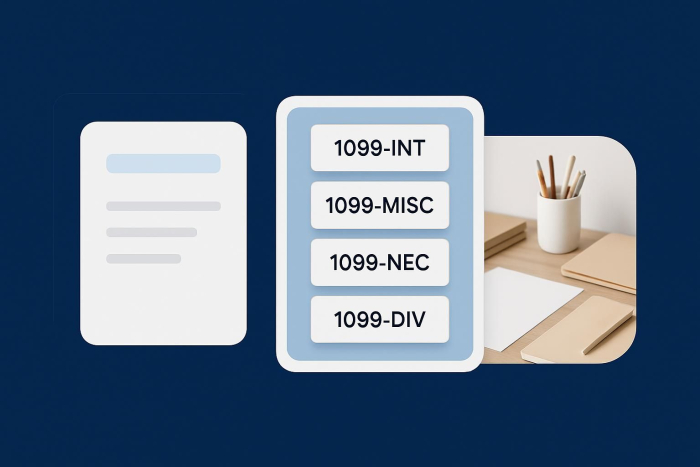
The following suggestions are for informational purposes only. For official IRS instructions on the Forms 1099, go to https://www.irs.gov/charities-non-profits/information-returns-forms-1099.
There are many types of 1099 forms, more than a dozen active versions, and each one reports a specific kind of non-wage income, like contractor pay, interest, dividends, retirement distributions, or payment network sales. The IRS treats these as “information returns,” which is why you’ll see multiple 1099 versions instead of one catch-all form.
The IRS uses multiple versions because non-wage income comes from very different sources, and each type needs its own boxes and reporting rules. Some 1099s are common (like 1099-NEC and 1099-INT), while others are more specialized and only show up in certain scenarios.
If you’re a business owner, you may need to issue 1099s to nonemployees or for certain business payments, and worker classification matters (employee vs contractor). Freelancers often receive 1099-NEC instead of a W-2, investors commonly get 1099-INT/1099-DIV/1099-B, and retirees may receive 1099-R for distributions.
This article breaks down the most important 1099 forms, explains who receives each one and why it exists, and walks you through deadlines and a practical process for filling out the right form with less stress, including how 1099-K reporting works for third-party payment platforms.
What is a 1099 form?
A 1099 is a family of IRS “information return” forms used to report income that isn’t regular wages. Think of it as a paper trail, one that tells the IRS, “This person received money (or a taxable benefit) from this source during the year.”
Form 1099 isn’t one single document. It’s a series of related forms labeled “1099-” plus a letter code. The letter code tells you what kind of income is being reported, like NEC for nonemployee compensation or INT for interest.
Who receives the 1099 form?
Generally, the person or business that receives the income gets the 1099. Examples include:
- A freelancer who was paid for design work
- A landlord who received rent
- A saver who earned bank interest
- An investor who got dividends
- A retiree who took a distribution from an IRA
1099 vs W-2
A W-2 Form reports wages paid to employees. A 1099 Form reports many kinds of non-wage income, often paid to nonemployees or tied to investments and benefits. If you’re an employee, your employer reports your wages on a W-2. If you’re paid as an independent contractor, you’re more likely to receive a 1099-NEC.
Why the IRS requires it
Information returns help the IRS match what payers report with what recipients report on their tax returns. It’s a built-in accuracy check that reduces underreporting and makes audits less likely for people who file correctly.
How many types of 1099 forms are there?
In everyday conversation, people say “a 1099” like it’s one form. In reality, the IRS has a long 1099 form list that covers many situations, including some niche and industry-specific cases. Some forms are common (you’ll see them every year), while others are specialized and show up only when a very specific event happens.
A practical way to think about it: there are well over a dozen active 1099 types, plus a handful that have been discontinued, renamed, or replaced over time. For most small businesses and individuals, you’ll deal with a smaller subset, usually 1099-NEC, 1099-MISC, 1099-INT, 1099-DIV, 1099-B, 1099-K, and 1099-R.
Also note: forms and rules can evolve. For example, contractor payments moved from 1099-MISC to 1099-NEC starting in tax year 2020, which is why older advice sometimes feels “off” when you compare it to current filing instructions.
Some 1099 versions have been discontinued or replaced, which is why older articles may mention forms you can’t find in current software. For instance, contractor payments moved to 1099-NEC, and other niche forms may be retired as reporting laws change. When you’re building your year-end checklist, rely on the current IRS instructions for the specific form and tax year, not last year’s screenshot or a template you found in a forum. It saves time when corrections are needed.
Most common types of 1099 forms
Below are the most common 1099 forms you’ll run into, with simple examples and quick tips on who should care.
1099-NEC (Nonemployee Compensation)
Use Form 1099-NEC to report payments to independent contractors and other nonemployees for services. The IRS generally requires you to furnish the payee statement and file with the IRS by January 31 (in a normal year).
- Who uses it: Businesses that pay contractors, freelancers, consultants, or gig workers.
- Typical example: You pay a copywriter $2,500 for blog posts. If the writer is not your employee, that payment is generally reported on 1099-NEC.
- Common threshold: If you paid $600 or more to a nonemployee for services, you generally need to issue 1099-NEC.
- Why it matters: This form replaced the old practice of reporting contractor compensation on 1099-MISC, which still trips people up when they’re comparing old checklists.
Pro Tip
If you want to speed things up, you can generate your form with Jotform’s 1099-NEC Generator
1099-MISC (Miscellaneous Income)
Form 1099-MISC is still widely used, but for different kinds of payments than contractor services. Think “miscellaneous” as in rent, prizes, legal settlements, and certain other business payments.
- Common situations:
- Rent: You pay rent for office space to a landlord.
- Prizes and awards: You run a contest and pay a cash prize.
- Attorney payments: Certain legal payments are reported here.
- Royalties: Royalties have their own reporting rules and thresholds.
- Typical example: You rent a small studio and pay the landlord $1,200 per month. Depending on how the payments are made and who the landlord is, you may need to report total rent paid on 1099-MISC.
1099-INT (Interest Income)
Form 1099-INT reports interest income, often from banks and financial institutions.
- Who gets it: People who earned interest from savings accounts, CDs, bonds, or certain other interest-bearing products.
- Typical example: Your bank pays you $85 of interest across the year. If it meets reporting rules, the bank will typically issue a 1099-INT.
- Why it’s helpful: It keeps interest reporting consistent across banks, credit unions, and brokers.
1099-DIV (Dividends and Distributions)
Form 1099-DIV reports dividends and certain distributions from investments.
- Who gets it: Investors who hold stocks, mutual funds, ETFs, or other dividend-paying products.
- Typical example: You own shares of a dividend stock and receive quarterly dividends. Your brokerage typically issues a 1099-DIV.
- Quick tip: Dividend reporting can include qualified dividends and capital gain distributions, so this form often affects which tax rates apply.
1099-B (Broker and Barter Exchange Transactions)
Form 1099-B reports proceeds from broker transactions, like selling stocks, plus certain barter exchange transactions.
- Who gets it: Anyone who sold securities through a brokerage account.
- Typical example: You sell shares of a stock for $4,000. Your broker typically reports the sale on 1099-B, often including basis and holding-period details.
- Why it matters: Even if you reinvest or roll money into another investment, the sale itself can be reportable.
1099-K (Payment Card and Third-Party Network Transactions)
Form 1099-K reports payment card transactions and payments through third-party networks, like some marketplace platforms and payment apps.
- Who issues it: Payment settlement entities, including card processors and third-party payment networks.
- Platforms you might recognize: Stripe, PayPal, Square, marketplaces, and certain payment apps.
- Important note on thresholds: The filing threshold has changed in recent years. For example, for tax year 2025 and beyond, the IRS has published guidance indicating the dollar limit may revert to $20,000 (with the older transaction-count rule also referenced in FAQs). Always check the current IRS instructions for the relevant tax year.
- Typical example: You sell handmade items online and accept card payments. If you cross the reporting threshold, you may receive a 1099-K.
- Reality check: Not receiving a 1099-K doesn’t automatically mean the income isn’t taxable. It just means you didn’t meet that form’s reporting trigger.
1099-R (Retirement Distributions)
Form 1099-R reports distributions from pensions, annuities, retirement plans, IRAs, and similar accounts.
- What it reports: Form 1099-R reports distributions from pensions, annuities, retirement plans, IRAs, and similar accounts.
- Who gets it: Retirees, or anyone who took a withdrawal from a retirement account.
- Typical example: You withdraw money from a traditional IRA. The custodian typically issues a 1099-R showing the distribution and any withholding.
Less common types of 1099 forms
These are less common for the average small business, but they’re worth recognizing, especially if you’re handling tax form management for a growing company or you have multiple income streams.
1099-G (Certain Government Payments)
Form 1099-G reports certain government payments, such as unemployment compensation and some state tax refunds.
- Typical example: You received unemployment benefits during the year and get a 1099-G showing total payments.
1099-C (Cancellation of Debt)
Form 1099-C may be issued when a lender cancels or forgives a debt.
- Typical example: A credit card company settles a portion of your debt and cancels the rest. The canceled amount may be reported on a 1099-C.
1099-S (Proceeds From Real Estate Transactions)
Form 1099-S reports proceeds from real estate transactions.
- Typical example: You sell a home or investment property and the closing agent issues a 1099-S showing gross proceeds.
1099-Q (Payments From Qualified Education Programs)
Form 1099-Q reports distributions from qualified education programs, like 529 plans.
- Typical example: You take a distribution from a 529 plan to pay tuition and receive a 1099-Q.
1099-LTC (Long-Term Care and Accelerated Death Benefits)
Form 1099-LTC reports benefits paid under a long-term care insurance contract and certain accelerated death benefits.
- Typical example: A long-term care insurance provider pays benefits that are reportable and issues a 1099-LTC.
1099 filing deadlines
1099 deadlines depend on the specific form and whether you’re talking about giving the statement to the recipient, filing with the IRS, or both.
For Form 1099-NEC, the IRS instructions generally specify that you must furnish the payee statement and file with the IRS by January 31.
If January 31 falls on a weekend or holiday, the due date generally shifts to the next business day. For example, January 31, 2026 falls on a Saturday, so many “January 31” deadlines are observed on Monday, February 2, 2026.
Other common 1099 deadlines
Other 1099 forms often have different IRS filing deadlines depending on paper vs electronic filing. Also, some recipient statements have later deadlines. For instance, the IRS general instructions note that statements for certain forms (including 1099-B, 1099-S, and some 1099-MISC reporting) are due to recipients by February 15, 2026. If the 15th falls on a weekend or holiday, the deadline moves to the next business day.
Because deadlines can vary, the safest approach is to check current IRS instructions for the exact form you’re filing and build your internal checklist around that.
That works, it just needs a tiny tweak for clarity and flow, plus the anchor:
Pro Tip
For a broader look at federal tax timing beyond 1099s, check out our guide on when do you file taxes for a complete breakdown of U.S. tax deadlines.
Electronic vs paper filing
In many cases, electronic filing deadlines are later than paper filing deadlines. Businesses that file enough information returns may also be required to e-file under IRS rules, so it’s smart to confirm whether an e-file mandate applies to your total volume for the year.
How to fill out a 1099 form: Step-by-step guide
Even though each version has its own boxes, the workflow is similar across most 1099s. Here’s a practical step-by-step process you can follow.
1) Confirm which 1099 type applies
Start with the question, “What kind of payment or income is this?” Contractor services point to 1099-NEC. Rent often points to 1099-MISC. Card or third-party network payments may point to 1099-K. Interest and dividends have their own forms.
If you’re unsure, use the IRS instructions for the specific form, or lean on your accounting software’s mapping rules.
2) Collect the recipient’s legal name and taxpayer ID
For vendor payments, many businesses collect a W-9 from the payee before sending any money. That gives you the payee’s legal name, address, and taxpayer identification number to help ensure you can populate the 1099 accurately.
3) Add your payer information
You’ll need your business name, address, and taxpayer ID (often an EIN). Accuracy matters because the IRS uses payer information for matching and processing.
4) Enter the totals in the correct boxes
This is where the form-specific details matter. For example:
- 1099-NEC reports nonemployee compensation in its dedicated boxes.
- 1099-MISC uses different boxes for rent, royalties, and other income types.
- 1099-R includes codes for the kind of distribution.
If you’re building a repeatable process, use a checklist that says, “For this payment type, use this form, and report it in this box.”
5) Use a 1099 generator to speed up filling, downloading, and keeping records
If you manage multiple payees, forms can become a project, fast. Jotform’s 1099 Generator helps you create, complete, and store 1099 forms in a simpler workflow.
Here’s what makes it practical for teams and busy filers.
First, security stays front and center. Safeguarding your data is Jotform’s top priority, especially confidential tax information. All form submissions are protected with GDPR- and CCPA-compliant features, a 256-bit SSL connection, and optional HIPAA compliance features for healthcare professionals. You can also secure sensitive data using Encrypted Forms 2.0 or add CAPTCHA protection.
Next, you can work from anywhere. Jotform works seamlessly across desktop, tablet, and mobile devices. This flexibility allows you to complete your 1099 forms whenever it’s convenient, whether you’re at home or on the go.
Also, if you’re working with the two most common scenarios, you can use Jotform’s dedicated generators, the 1099-NEC Generator, and the 1099-R Generator.
6) Review for common errors
Before you finalize:
- Double-check names and taxpayer IDs.
- Confirm you’re using the correct tax year’s form.
- Verify that totals match your books.
- Watch out for duplicate vendors or split payments.
7) Furnish the statement to the recipient and file with the IRS
Finally, deliver the recipient copy by the deadline and file your IRS copy using the required method (paper or e-file). Keep copies for your records in case you need to make a correction later.
Pro Tip
Check out Jotform’s step-by-step guide on how to fill out a 1099 form to understand reporting requirements, deadlines, and key tips.
8) Put it in a bigger workflow with tax form management
If you’re juggling W-9s, multiple payees, deadlines, and year-end reporting, it helps to think in systems instead of one-off tasks. That’s the idea behind tax form management, the end-to-end process of generating the right forms, organizing what you need, filing on time, and securely storing records so you can find them later.
Choose the right 1099 and file with confidence
There are many types of 1099 forms because there are many kinds of non-wage income, and each version is built to report a specific category, from contractor pay (1099-NEC) and rent (1099-MISC) to interest (1099-INT), dividends (1099-DIV), stock sales (1099-B), payment network activity (1099-K), and retirement distributions (1099-R).
If you’re a payer, your next step is to confirm which forms you owe, collect accurate payee details, and meet the right filing deadlines. If you’re a recipient, use each 1099 to make sure your return matches what was reported. Accurate filing keeps you compliant, reduces follow-up questions, and helps you close out tax season with fewer surprises.
This article is for small-business owners, bookkeepers, and finance/payroll teams who need to issue the right year-end information returns, plus freelancers, investors, sellers, and retirees who receive these forms and want to understand what they mean.
FAQs about the types of 1099 forms
Form 1099-NEC reports nonemployee compensation, usually payments to independent contractors for services (often $600 or more). Form 1099-MISC reports other types of income like rent, royalties, prizes/awards, and certain legal payments, not contractor service pay.
Form 1099-B reports proceeds from broker or barter exchange transactions, like selling stocks or securities. Form 1099-C reports canceled or forgiven debt, typically issued by a lender when a debt is canceled, which may be taxable depending on the situation.
Form 1099-R reports distributions from retirement accounts and plans, like IRAs, pensions, and annuities. Form 1099-NEC reports payments to nonemployees for services, such as contractor or freelance work. They cover different income types and apply to different payers.
AS ALWAYS, CONSULT AN ATTORNEY BEFORE RELYING ON ANY INFORMATION ON THIS PAGE. THE CONTENT ABOVE IS FOR INFORMATIONAL PURPOSES ONLY. JOTFORM IS NOT PROVIDING LEGAL, FINANCIAL OR OTHER ADVICE.




















Send Comment: