
AI has evolved dramatically, reshaping industries, businesses, and everyday interactions at an unprecedented scale. Two prominent categories stand out distinctly in this technological transformation: traditional AI and generative AI. Understanding their fundamental differences, capabilities, strengths, limitations, and practical applications is critical for businesses seeking competitive advantages, innovative solutions, and optimized efficiency in a digitally driven world.
What is traditional AI?
Traditional AI primarily involves rule-based systems and predictive analytics. It uses structured and clearly labeled data to analyze and interpret information, predict outcomes, and make informed decisions. This form of AI depends heavily on predefined logic, statistical models, and structured datasets, focusing intensely on efficiency, accuracy, and reliability in repetitive or well-defined scenarios.
Key technologies underpinning traditional AI include
- Machine learning: Algorithms improve through exposure to data, allowing AI models to adjust predictions and responses dynamically.
- Deep learning: Complex neural networks, designed to replicate humanlike pattern recognition capabilities, can effectively be used in applications ranging from voice recognition to image analysis.
- Supervised learning: AI models learn from clearly labeled data to predict outcomes accurately, making it ideal for scenarios with known patterns and clearly defined goals.
Real-world applications demonstrate how widely traditional AI is used, especially in the finance sector. For instance, FinSecure Bank reported a 60 percent reduction in fraudulent activity within its first year of implementing an AI-driven fraud detection system. E-commerce platforms employ recommendation systems based on user browsing and purchasing behavior, enhancing user experience through personalized product suggestions. Automation of customer services through rule-based chatbots exemplifies how traditional AI streamlines routine queries, significantly reducing operational costs. Nevertheless, traditional AI has limitations, such as rigidity in response, over-dependence on historical data accuracy, and considerable challenges with adapting rapidly to unpredictable scenarios or entirely new data types.
What is generative AI?
Generative AI represents a notable leap in AI capabilities, enabling the creation of original and novel content. It analyzes vast datasets, recognizes complex patterns, and generates entirely new data that reflects learned characteristics. This emphasis on creativity, flexibility, and innovation has critically altered the way industries approach problems and content creation. According to a KPMG survey, 77 percent of executives predict that generative AI will affect broader society more significantly than any other emerging technology over the next three to five years.
Core technologies driving generative AI include
- Transformer models: These sophisticated neural network architectures have revolutionized natural language processing, enabling advanced language comprehension and generation along with conversational capabilities.
- Generative adversarial networks: These models employ dual neural networks that compete with each other to produce incredibly realistic images, videos, and even audio content.
- Diffusion models: This is a novel method that gradually transforms random noise into coherent, detailed images, a considerable advancement in generating highly realistic visual data.
The practical applications of generative AI span numerous domains. Text generation technologies such as ChatGPT support diverse roles, from content creation to customer interaction automation. Image creation platforms such as DALL-E offer unprecedented capabilities to produce imaginative visuals based purely on text prompts. Generative AI also supports synthetic data creation for machine learning, significantly improving training by providing comprehensive, representative datasets. Its video and audio generation capabilities push creative boundaries, opening entirely new avenues for digital content creators and marketers. Despite these advancements, generative AI introduces ethical challenges, including the risks of perpetuating bias and generating misinformation, coupled with concerns about intellectual property and authenticity.
Traditional AI vs generative AI: Key differences
| Aspect | Traditional AI | Generitive AI |
|---|---|---|
|
Data focus |
Analytical, structured datasets |
Creative, typically unstructured |
|
Model types |
Predictive, rule-based algorithms |
Generative, creativity-driven algorithms |
|
Use cases |
Task-oriented solutions |
Innovation, creativity, novel solutions |
|
Ethical issues |
Data privacy concerns, biases |
Potential for bias, misinformation, misuse |
AI applications across industries
Both types of AI have distinct applications across various sectors, each demonstrating unique capabilities:
- Healthcare
- Traditional AI effectively manages predictive diagnostics, patient monitoring, and administrative automation to significantly enhance patient care and operational efficiency.
- Generative AI excels in creating synthetic medical data for clinical research, assisting in drug discovery, and simulating realistic clinical trial scenarios, thereby accelerating medical advancements.
- Traditional AI effectively manages predictive diagnostics, patient monitoring, and administrative automation to significantly enhance patient care and operational efficiency.
- Finance
- Traditional AI primarily focuses on identifying fraud, assessing credit risk, and automating transactions to safeguard financial systems.
- Generative AI creates realistic synthetic data for modeling various financial scenarios, aiding strategic planning, risk management, and stress testing in dynamic market conditions.
- Traditional AI primarily focuses on identifying fraud, assessing credit risk, and automating transactions to safeguard financial systems.
- Marketing
- Traditional AI enables marketers to analyze consumer behaviors, predict purchase patterns, and tailor targeted advertisements, which helps improve campaign effectiveness.
- Generative AI empowers marketers to create content, personalize ads, and ideate innovative campaigns.
- Traditional AI enables marketers to analyze consumer behaviors, predict purchase patterns, and tailor targeted advertisements, which helps improve campaign effectiveness.
- Entertainment
- Traditional AI enhances personalized content recommendations based on user data, providing tailored viewing and listening experiences.
- Generative AI revolutionizes content creation by generating original music compositions, visual arts, and engaging multimedia content, substantially expanding creative possibilities.
- Traditional AI enhances personalized content recommendations based on user data, providing tailored viewing and listening experiences.
The future: Coexistence or replacement?
Generative AI is likely to coexist harmoniously with traditional AI, each complementing the other’s capabilities rather than replacing one another entirely. While generative AI pushes the boundaries of creativity and innovation, traditional AI remains indispensable for structured, predictable tasks that demand precision and consistency.
However, integrating these AI systems poses several challenges, including ethical practices, data privacy, transparency in AI decision-making, and potential biases and inaccuracies in AI-generated content.
How businesses use AI
Businesses aiming to thrive in competitive markets must strategically integrate both AI types effectively:
- Traditional AI is highly beneficial for structured, repetitive, and precision-critical tasks, improving accuracy, consistency, and efficiency.
- Generative AI is ideal for creative tasks, innovation-driven projects, and highly personalized customer interactions, fostering dynamic and engaging experiences.
Practical implementation strategies involve phased integration, rigorous monitoring, continuous training of AI models, and establishing clear ethical and compliance standards.
Jotform AI Agents: Harnessing generative AI for smarter customer interactions
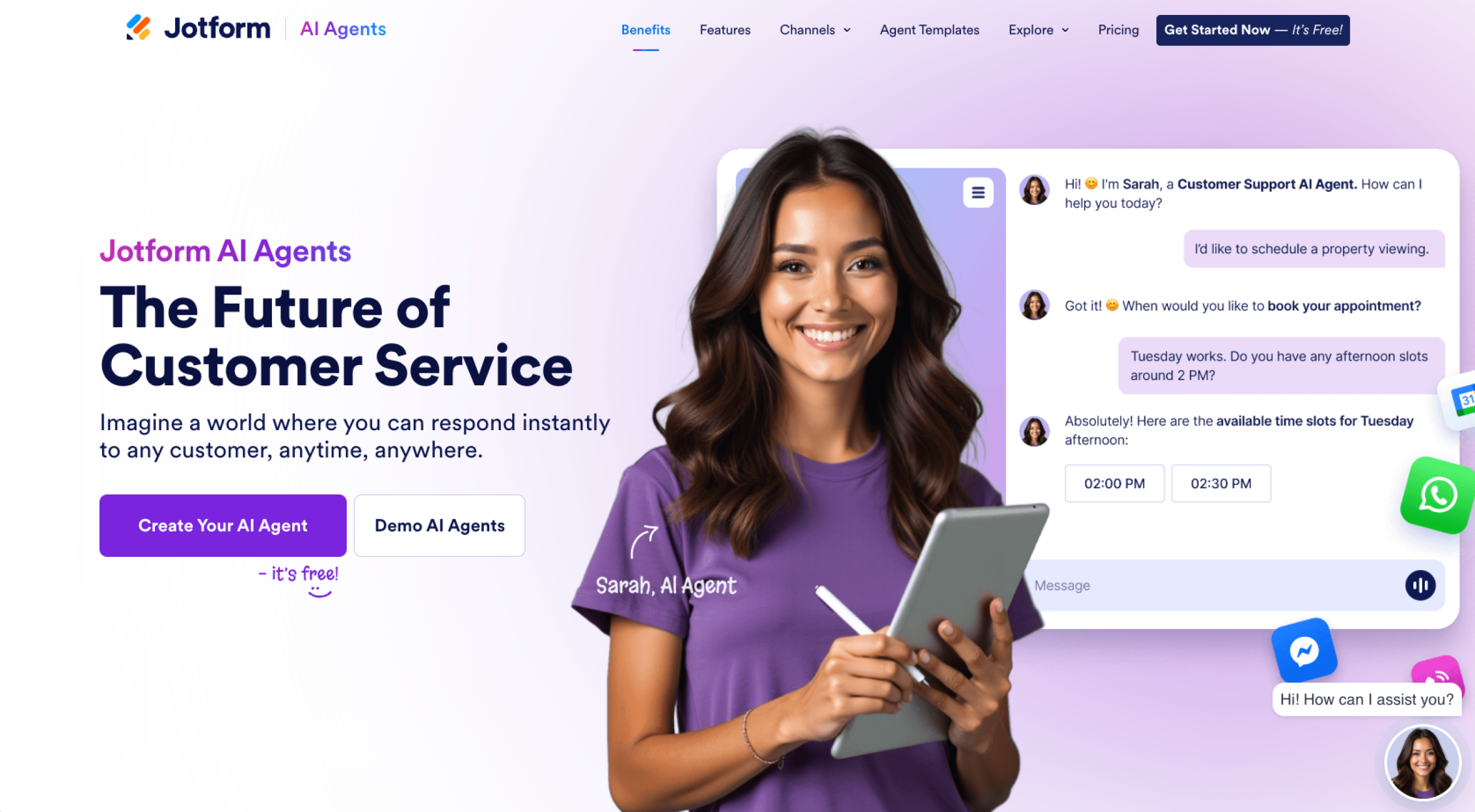
Jotform AI Agents represent a significant advancement in using generative AI to enhance customer interactions, surpassing traditional chatbot capabilities. Powered by GPT-4, these agents provide intuitive, personalized, and contextually relevant conversational experiences.
Comprehensive training methods
Jotform enables detailed training of AI agents through several robust methods:
- Knowledge base training: Users can upload diverse formats, such as documents, links, or Q&A pairs, enabling the agent to answer precisely by learning company-specific information.
- URL crawling: This feature allows the agent to scan webpages and subpages, automatically gathering relevant content to enhance its knowledge base.
- Custom Q&A creation: Users can create tailored Q&A pairs that address frequent or critical inquiries effectively, ensuring highly accurate responses.
Extensive customization options
Customization ensures seamless alignment with brand identity and customer service objectives:
- Visual customization: Adjust avatars, color schemes, and branding elements to ensure a consistent visual identity.
- Tone and style: Adjust the conversational tone to effectively match industry norms and customer demographics in everything from formal legal communication to casual retail interactions.
- Response behavior: Tailor the length, detail, and depth of responses to meet specific interaction needs and customer expectations.
Advanced features and automation capabilities
Jotform AI Agents offer sophisticated automation functionalities:
- Appointment scheduling and event registration: Seamlessly automate bookings, reservations, and registrations.
- File processing: Efficiently handle user-uploaded files for verification, document review, and form submissions.
- API integration: Connect effortlessly with existing business systems for streamlined data exchange.
- Sentiment detection: Detect customer emotions, enabling timely escalation to human agents when necessary.
Multichannel and multilingual support
Jotform AI Agents operate across multiple communication channels, including web chat, SMS, voice calls, email, and phone, ensuring consistent engagement. Additionally, they support 19 languages, allowing users to switch languages mid-conversation, which is crucial for global businesses.
Monitoring and continuous improvement
Jotform provides robust monitoring tools to analyze conversations, review logs, and interpret customer feedback. This data-driven approach enables continuous refinement, ensuring the AI agents remain effective, accurate, and relevant as customer needs evolve.
Real-world applications
Jotform also offers a wide selection of ready-to-use AI Agent templates tailored for various industries, helping businesses get started quickly without building their agents from scratch. These templates cover diverse use cases and can be customized to match specific brand needs and workflows. For example, the Healthcare & Wellness AI Agent templates are ideal for clinics, hospitals, and wellness centers looking to automate patient engagement, while the Finance AI Agent templates help streamline client communication and service in banks, accounting firms, and financial institutions.
Addressing user challenges and feedback proactively, Jotform continually refines its AI Agent offerings to improve ease of use, data-handling efficiency, and onboarding processes. Ready to transform your customer experience? Explore Jotform AI Agents today and discover how generative AI can power smarter, more engaging interactions across your business.
This piece is for product and operations leaders, data teams, and CX/marketing managers who are deciding where traditional, predictive AI belongs in their stack versus when to deploy generative, creative models.



























































































Send Comment: