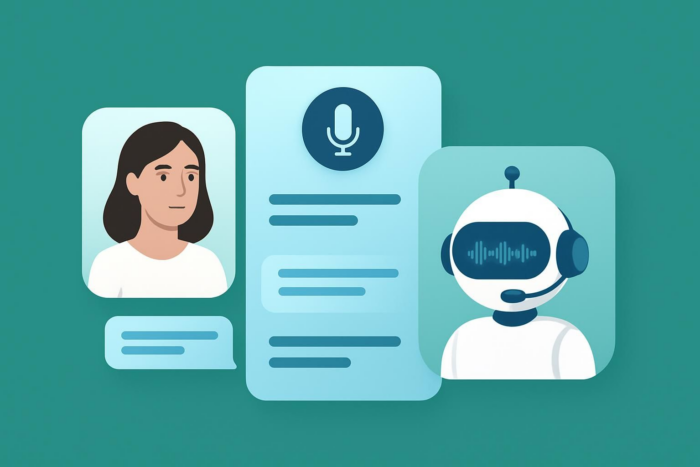
How common is this experience for your business? A customer calls in for help, only to meet a lengthy queue and hold music that gives them a headache. By the time they manage to speak to anyone, they have to wait again while being rerouted to another department that handles their specific issue.
The truth is your agents can’t handle every call as fast as modern customers expect them to. That’s why voicebot customer service is more popular than ever.
Unlike text-based chatbots, which help customers on your website, voicebot technology brings the power of AI to your call center. These solutions are particularly beneficial if your business experiences a high volume of calls or primarily relies on personal calls for customer service.
Using AI and natural language processing (NLP), voicebots can easily handle simple customer requests. For example, a voicebot could update a customer on when their order will be delivered or answer FAQs.
These digital solutions not only help speed up the customer-service process, but also reduce costs and improve your team’s quality of service. If you want to take your business’ support to the next level, consider the benefits, challenges, and best practices of customer-service voicebots outlined in this article.
Key benefits of voicebots in customer service
Voicebot customer service is the next wave of support technology. These bots transform often lengthy and frustrating customer-service channels into streamlined avenues for customer satisfaction.
Faster response times
Long queues constitute one of the greatest headaches in the customer experience. Waiting can be especially frustrating for customers who have simple issues that could be resolved quickly if they could just get someone on the phone. Voicebots reduce the time customers have to wait for help by providing immediate service for basic inquiries.
These AI assistants aren’t limited by how many customers they can help simultaneously, and they can also reduce the number of calls being escalated to your team. Your voicebot support takes care of easy-to-handle issues, and your agents have more time to dedicate toward complex concerns, producing a higher overall customer satisfaction rate.
Cost savings for businesses
As your business grows, your budget might also grow to staff for high-quality customer service. Voicebot support solutions reduce this staffing need and the costs associated with it. These tools allow you to manage and scale your customer-service operations without impacting your budget or service quality by handling the influx of customer inquiries.
While it’s unlikely that human agents will be entirely replaced anytime soon, voicebots reduce your need to expand your team.
Around-the-clock availability
One of the top benefits of voicebots is their ability to offer 24-7 support. Your customers can access answers whenever they need them, increasing their satisfaction and improving your brand’s overall reliability. This feature is especially useful for companies with operations across multiple time zones and in industries in which after-hours emergencies are common, such as the medical field and international retailers.
Reduced workload for human agents
Not all benefits of voicebot technology are for customers and businesses. These solutions are an asset to your team members as well. Voicebots act as assistants to your human agents, handling low-value tasks like repetitive inquiries so your team can focus on more fulfilling work. The bots can also intelligently route calls to the right agent, so your team doesn’t have to waste time trying to find the right person for the query.
To successfully introduce voicebots to your customer-service workflow, create a hybrid approach. This strategy involves developing a clear plan for what your voicebot will handle and which tasks need a human touch. Identifying applications for your team and their AI assistants can help avoid confusion, increase productivity, and boost your return on investment.
Personalized customer experience
AI voicebots also can do something traditional interactive voice response (IVR) systems can’t: personalize customer interactions. By accessing past interaction data, voicebot support tools can provide tailored responses to your customers’ unique needs.
Your team can enhance these personalization capabilities even further by integrating your voicebots with your CRM system. With access to CRM customer data, voicebots can make data-backed product recommendations, create a more customized client experience, and streamline the inquiry resolution process.
Challenges and limitations of voicebot technology
While voicebots provide a wide range of benefits, this technology is still developing. Like any work in progress, voicebots are limited in what they can do. During implementation, keep in mind the following challenges:
- Incomplete understanding of accents and dialects: Although AI is slowly becoming more capable of understanding sentiment and language, it still struggles with diverse speech patterns and regional accents. This barrier may present challenges when serving some customers, making effective handoff to human agents an essential part of your process.
- Narrow ability to handle complex inquiries: Voicebots are also still relatively limited in their ability to solve complex issues. Most voicebots are designed to handle simple, repeatable tasks, so human agents should handle any nuanced issues that require empathy and personal experience.
- Technical limitations: The base for AI models is also still evolving. NLP and machine learning models are still in the relatively early stages. As this technology develops, the limitations of AI voicebots will decrease. For now, these solutions are only as efficient as the widely available technology.
How to implement a voicebot in customer support successfully
Your implementation contributes significantly to how effective your voicebot support solution works. While a voicebot is a powerful tool on its own, it still requires careful consideration, planning, and setup to provide the maximum return on your investment. Before adding a voicebot into your customer support workflow, keep these tips in mind:
Define clear use cases
While you may be tempted to use your voicebots for everything and anything, it’s important to consider which tasks it can handle most effectively. For example, it can likely answer simple questions, route calls, and schedule appointments with ease. What’s more, removing these tasks from your agents’ plates will lighten their workload and increase their productivity in other areas.
Integrate with existing systems
Effective voicebot customer-service solutions should also play well with your other digital tools. Not every voicebot program is capable of syncing with your CRM, ticketing, and IVR systems, but you should seek solutions with integrations that align with your existing tech stack. Integrating these solutions will ensure maximum efficiency and reduce the manual work required from your team, as well as reducing any costs or human error associated with it.
Ensure a smooth handoff to human agents
Your voicebot won’t be able to handle every issue that comes its way, so you’ll need to create a handoff process for involving human agents when necessary. This process must be structured so your agents have the information they need to take over customer interactions seamlessly, without requiring customers to repeat information or wasting their time.
It’s also important to program your voicebot to know when a human agent should be involved. Forcing your customers to flounder with a voicebot that is incapable of solving their issues could lead to reduced satisfaction and unnecessarily elevated issues.
Optimize voicebot performance with AI training
To create an ideal voicebot experience for your customers, you’ll need to invest time and resources into training your AI. Whether that means uploading internal documentation or applying direct user feedback, the level of refinement your voicebot has will ultimately be determined by the effectiveness of your training. With the right training, your AI voicebot can use machine learning to respond and adapt to different scenarios.
Monitor and improve voicebot interactions
Over time, you should apply customer feedback about your voicebot to ensure it improves. You can monitor voicebot customer service by analyzing performance metrics and collecting feedback. Key performance indicators include response times, resolution times, and customer satisfaction ratings. This process allows you to find opportunities for improvement, identify areas of success, and adjust your strategy accordingly to boost future performance.
How to transform customer service with the Jotform AI Phone Answering System
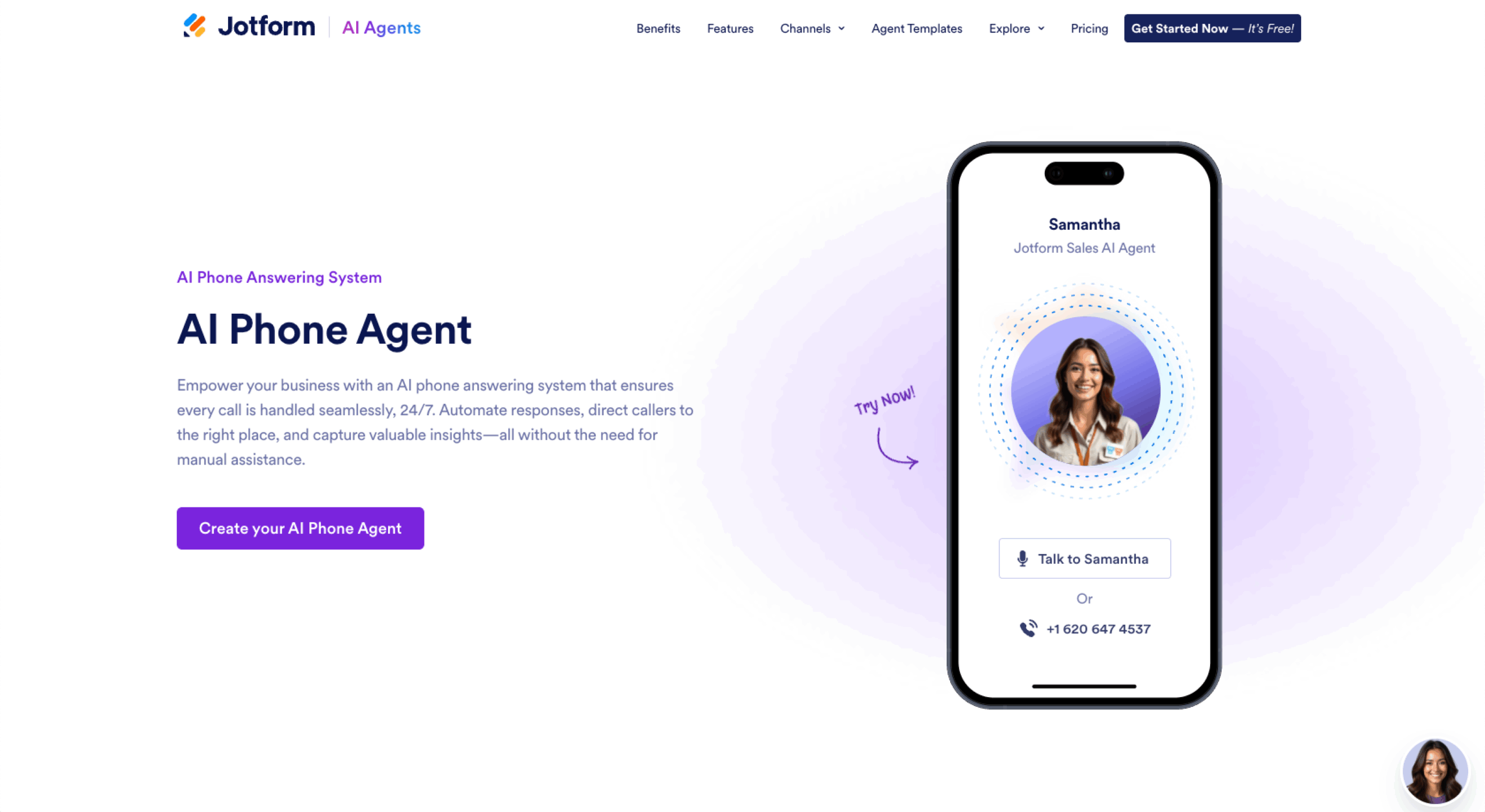
Getting the maximum value from voicebot technology starts with choosing the right solution. You need a tool that’s budget friendly and flexible, and offers powerful features, like the Jotform AI Phone Answering System. Jotform’s AI Phone Answering System lets you train AI agents to handle calls seamlessly, 24-7.
Jotform’s AI voicebots provide your team with an easily customizable solution capable of handling many simple tasks that can slow down your team. From automating tasks to handling FAQs, the Jotform AI Phone Answering System can be an asset to your team’s productivity.
To create your own AI phone answering system from scratch, simply follow these steps:
- Build and train your AI Agent in the Jotform drag-and-drop chatbot builder: Create your voicebot to meet your brand standards using Jotform’s user-friendly design suite. Then, teach it exactly how to interact with customers using data like FAQs, product details, company policies, brand voice, tone, and escalation policies.
- Select the Phone Agent option: When you’re ready to publish, you can choose which channel you’d like to use. Get ready to select your preferred numb er.
- Get your dedicated phone number: You can purchase your voicebot’s phone number directly from Jotform by selecting your preferred country and area code.
- Review and activate: Once your voicebot is set up, review your preferences and finalize to activate your new solution.
If you want to skip this building process, you can choose from more than 7,000 free AI Agent templates. Many of these templates offer a text and voice option. You can have an AI agent designed for your exact needs up and running in a few minutes.
Your agents can handle a wide variety of tasks with Jotform’s full suite of capabilities, including features like
- Customizable voice and identity to match your brand
- Around-the-clock customer-service capabilities
- Customizable responses
- Call routing
- Appointment scheduling
- Automated follow-up distribution
- Seamless escalation workflows
Adding voicebots like the Jotform AI Phone Answering System to your customer-service voice channel can streamline your customers’ experience, offer 24-7 service, and reduce the burden on your team.
AI is changing the way businesses approach customer service. From voicebots to AI assistants, these tools offer the chance to improve customer loyalty and your bottom line. Consider a solution like Jotform AI Agents today, and discover the difference these tools can make in your customer-service workflow.
This guide is for people who run or influence phone-based support; from customer service and operations leads to IT/ops evaluators, at organizations that field lots of calls.


















































Send Comment: