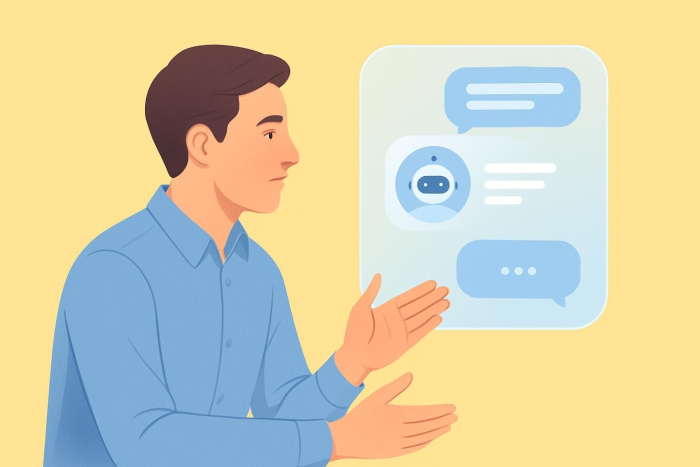
Natural Language Processing (NLP) chatbots are AI-powered systems that understand and generate human language to carry on conversations with users in a natural way.
AI is everywhere these days. As of 2024, 78 percent of all businesses use AI for at least one business function. For many of these businesses, chatbots are a top AI application, and natural language processing (NLP) works at the core of certain chatbots.
NLP chatbots are AI enabled and mimic human conversation in a variety of applications. Whether answering customer service questions or handling data analysis, a chatbot using NLP is a valuable addition to any business.
But while this technology is increasingly common, many still don’t understand how it works and how to use NLP chatbots to their advantage. In this guide, we’ll break down the basics on these digital assistants and highlight ways to use this technology for your business.
Chatbot comparison: NLP vs rule-based models
Many companies are switching from having live chat on their websites to having a chatbot as their customer support solution, or at least, they’re adopting a hybrid approach, because of the financial, customer experience, and task automation benefits of chatbots. But what kind of chatbot is best?
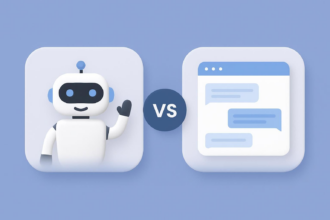
Most chatbots are either an NLP model or a rule-based model. NLP chatbots use AI and machine learning to interpret human messages and provide human-like responses. Rule-based models, however, use predefined rules or scripts to do certain tasks, such as answering FAQs or submitting forms.
Rule-based chatbots and conversational AI solutions that use NLP are both effective, but they differ in flexibility, maintenance, and their ability to facilitate humanlike interaction. For example, NLP chatbots offer a high degree of flexibility and naturalness and can provide personalized, contextual, and humanlike answers to complex questions.
Rule-based chatbot responses are restricted to specific tasks or inquiries and cannot deviate from the scripts used to train them. So using these chatbots for customer interactions can be tricky if customers phrase their questions differently from the bot’s training materials or if a customer’s question is more nuanced. Still, rule-based chatbot responses are much more predictable compared to those from NLP models.
Rule-based chatbots also require more general upkeep than AI NLP chatbots, which can adapt and learn over time. Rule-based bots must be consistently updated with new information, so they don’t give irrelevant or inaccurate information.
Ultimately, NLP chatbots are better suited to handle complex issues and work better with users who want a personalized solution. Rule-based chatbots are better for users who need a simple solution that won’t diverge from provided scripts.
| Feature | NLP chatbot | Rule-based chatbot |
|---|---|---|
| Flexibility | High | Low |
| Maintenance | Low | High |
| Naturalness | High | Low |
| Best for | Humanlike interactions | Simple requests |
What is natural language processing?
NLP is a type of AI that enables computers to understand, interpret, and process human language. Using a mix of machine learning, deep learning, and statistical methods, NLP allows chatbots to interact with humans using written or spoken language.
NLP is typically used in human-facing applications like
- Chatbots
- Digital assistants
- AI agents
- Digital translation
- Sentiment analysis
- Search engines
Although this technology is often used in customer service, it’s helpful in a wide range of applications. NLP is the basis for everyday assistants like Siri and Alexa, and it can be used for analysis, interpreting user feedback to make insightful business decisions.
But how do NLP chatbots process information and generate responses? There are a few more key terms to review before we fully explain how this technology works.
NLP vs NLU vs NLG: What’s the difference?
It can be hard to keep track of all the acronyms thrown around in the AI world. When working with NLP, you may encounter the terms NLU and NLG. Natural language understanding (NLU) and natural language generation (NLG) are the two main processes behind NLP.
Let’s use a real-world analogy to understand the process. Imagine you’re talking to your friend and they ask you a question. To answer, you must first hear and consider their question, then formulate a response, and respond accordingly. Think of this entire process as NLP.
Although this process seems instantaneous , NLPuses two subprocesses to respond to a question:
- Understanding and interpreting the question
- Finding an answer and generating a response that fits the situation
With NLP chatbots, NLU is the first of these two processes. NLU uses AI to analyze a question’s grammar, intent, sentiment, and context to best understand what is being asked. The NLG step takes this information and generates an accurate response.
Let’s take an even more granular look.
How NLP chatbots work: From input to response
NLP chatbots process your requests in an instant, but this action is broken down into several key steps:
- Standardization: Your NLP chatbot must first convert your user’s message into a format it can understand. This step removes unnecessary details and converts the text into a standard format (typically all lowercase).
- Tokenization: To improve its understanding of a message, your chatbot will break it down into key components called tokens. These could be key words and phrases. This process requires your chatbot to remove all punctuation from the message.
- Intent detection: Using AI, your NLP chatbot will analyze the tokens it has created to determine the exact intent behind your user’s message.
- Entity recognition: If necessary, your NLP bot will identify any other important information in the provided message (such as order numbers, IDs, or email addresses).
- Generation: Advanced AI models will generate multiple potential responses based on the information provided and select the one that’s the most appropriate for the situation.
By using this step-by-step logic, NLP chatbots can produce dynamic and personalized responses that create an exceptional customer experience.
So what does this look like in real-world scenarios?
- A customer submits a question about the status of their order, providing their order number. An NLP chatbot breaks down the message, identifying the order number, to determine what the customer needs and to find the information relevant to their request. It pulls the order tracking data from your internal database and uses it to generate a response.
- A patient is trying to figure out what their symptoms mean before scheduling a healthcare appointment. To get clarification, they submit these symptoms to an NLP healthcare chatbot. The chatbot pulls out the symptoms from the text, cross-checks them with internal data, and generates a potential list of conditions and recommendations for the user.
NLP chatbots use a variety of technological components, each playing a distinct role in chatbot language comprehension. These are reviewed in the next section.
Core components of an NLP-powered chatbot
NLP chatbots represent a layered technological environment that requires multiple pieces to run smoothly. Each component is essential to the overall AI NLP chatbot experience.
The core layers of your NLP chatbot include the following:
- User interface: This layer, also known as the front end, determines how your user will interact with an NLP chatbot. Your user interface will likely be influenced by the platform you use to launch and design your chatbot.
- Logic integration: While NLP enables your chatbot to understand user messages, your logic layer determines what your NLP bot will do next. It uses predetermined business logic.
- Dialogue manager: To create natural conversations, your NLP chatbot will use a dialogue manager. It will track the context of dialogue in a single session to provide more coherent responses.
- Backend integration: To be connected to other tools in your tech stack, your NLP chatbot must be capable of integrating with external services. This layer allows it to retrieve data and interact with secondary tools, so you can create a unified technical solution.
- Database and logging area: Your NLP chatbot must store and analyze interaction data to improve its performance. This layer provides the memory storage and data retrieval capabilities necessary to facilitate better interactions.
These core components make your bot more adaptable, a factor that will determine its overall performance. Together, the components help your chatbot flex and learn based on previous interactions, allowing it to improve over time.
Your contribution is also key to your chatbot’s performance. The quality of your training influences how well your chatbot can handle requests. In addition to the input you provide, the type of NLP chatbot matters.
Types of NLP chatbots: Traditional vs generative AI
NLP chatbots are typically available in two key types: traditional and generative AI. Both models use NLP technology, but each is best suited for different purposes. Traditional NLP chatbots use conversational AI to answer questions or fulfill requests based on an existing context. So they excel at straightforward workflows and repetitive tasks.
Generative AI takes NLP technology to the next level by creating new content, rather than simply personalizing existing content. This technology is the base for popular AI assistants like ChatGPT, which can create highly personalized responses and recommendations, as well as new content.
Business benefits of NLP chatbots
NLP chatbots can accelerate business operations, transforming how you approach everyday work. Here are some benefits:
- Increased efficiency through automation
- Multilingual and 24-7 support
- Improved message personalization
- Faster resolutions
- Reduced employee burden
These digital solutions can also be applied across various industries in many different roles:
- Healthcare symptom checker
- Educational administrator assistant
- Logistics analyst
- Financial advisor
- Customer service representative
- Chatbot marketing coordinator
Your team need only define the role of your NLP chatbot and plug in the relevant training. The NLP chatbot then instantly assists your target audience.
Limitations and considerations
AI NLP chatbots offer many business advantages, but they aren’t without their issues. Your team may encounter some implementation challenges, like chatbot hallucinations. These inaccuracies can result from poor data quality or a fluke in the system.
Other limitations include
- A complex chatbot setup
- Long-term maintenance needs
- Variable scalability
- Operational friction caused by a lack of human conversational skills
To avoid these issues, take a strategic approach to your NLP chatbot’s deployment.
How to deploy an NLP chatbot: From basic to advanced automation
Proper NLP bot deployment is paramount to its success. Approaching your implementation process thoughtfully will help you optimize your chatbot’s performance and minimize friction after the launch.
Though your approach may vary slightly, depending on the complexity of your NLP chatbot, use these key steps:
- Identify your audience, purpose, and pain points using a data-driven approach.
- Design your chatbot to match your branding, considering its visuals, voice, and tone.
- Train your NLP chatbot using effective, unbiased data. Consider using hands-on training scenarios to test its responses.
- Integrate other key digital solutions into your chatbot’s back end.
- Implement across your preferred channels.
- Test, troubleshoot, and train continuously to optimize results.
- Scale as needed, focusing on supporting your team rather than replacing them.
If you’re performing a custom build, the front end of this process will likely take longer. However, customizing your NLP chatbot from the ground up will give you more control over your end product and may be worth the additional effort.
Enterprise businesses may find it more feasible to build an NLP chatbot from scratch (and doing so may help the team adhere to strict requirements). For smaller businesses, however, a custom build may be more of a lift than necessary. Instead, such teams should consider solutions offering AI chatbot templates, which make it easy to generate and launch a bot that fits a designated role.
Your chosen platform for building, training, and launching your chatbot will also affect how easily your bot deploys. Popular chatbot-building platforms include
- Google Cloud
- IBM Watson Assistant
- Microsoft Bot Framework
- Botpress
These solutions vary in complexity and pricing. Find one that meets your needs and is within your budget.
Pro Tip
Streamline your NLP chatbot deployment with a free, customizable chatbot platform like Jotform AI Agents. Build, train, and launch in minutes with Jotform’s user-friendly, no-code chatbot builders.
Next steps: Ready to build a smarter bot?
These digital assistants are ideal for users who want to streamline repetitive tasks, enhance their customer experience, and improve efficiency. Now that you understand the ins and outs of how they work, you can take the next step and create your own.
The process begins with reliable, user-friendly tools (like Jotform AI Agents) that allow you to build, test, and troubleshoot your bot, leading to an optimized experience across all channels.
FAQs about NLP chatbots
NLP stands for natural language processing, a type of AI technology that allows computers to understand and analyze human language. NLP can be used to process both written and spoken language and uses machine learning algorithms, deep learning, and statistical modeling.
Yes, ChatGPT uses NLP technology. ChatGPT is a large language model (LLM), which is a type of NLP. Whereas natural language processing encompasses all interactions between computers and human language, LLMs are advanced and specific versions of this technology. ChatGPT uses transformer, a deep learning neural network technology, to take NLP capabilities to the next level.
NLP and LLM chatbots may use similar technologies, but they differ in application and complexity. NLP chatbots are typically used for applications centered on structure or keywords. For example, you might use NLP chatbots to answer FAQs or analyze text. These solutions are more basic and are easier to train and predict.
LLM chatbots are more complex and used for more abstract purposes that call for flexibility. Such applications require a chatbot to mimic human conversation, generate content, or produce dynamic and personalized responses.
Much like humans, NLP chatbots break down conversation into two key parts: analysis and response. NLP chatbots use natural language understanding (NLU) and natural language generation (NLG). NLU and NLG are not separate from natural language processing; think of them as the two halves of the NLP process. While these elements can be used separately, they’re often used together in chatbots.
When you send a message to an NLP chatbot, the chatbot uses NLU to break down your message, analyzing its grammar, sentiment, intent, and context so it can understand what you’re asking. Then the chatbot uses NLG to generate a personalized response that aligns with its understanding of the original message.
NLP chatbots can be easily trained using your internal data. First, define the role of your chatbot, and then provide it with information that would be relevant for performing that role. Your training methods will likely depend on your chatbot platform, but Jotform AI Agents can be trained using inputs like the following:
- Knowledge bases
- Internal documents
- External links
- Example conversations
- YouTube videos
As your NLP chatbot engages with its tasks, you can train it further to make sure its knowledge is up-to-date, comprehensive, and aligned with user needs.
This article is for website operators, content managers, marketing agencies, and anyone who wants to understand how NLP chatbots work, what distinguishes them from rule-based models, and how to deploy them effectively across diverse business use cases.











































Send Comment: