
According to a 2024 Gallup study, 80 percent of employees who receive meaningful feedback in a given week say they’re fully engaged at work. That’s the upside.
The downside? Most organizations still rely on outdated, inconsistent, or overly generic evaluation forms that make delivering meaningful feedback difficult. Even teams that want to run fair, effective performance reviews often end up with vague ratings, rushed conversations, and documentation that doesn’t help anyone improve their performance.
The problem isn’t one of intent — it’s one of structure.
The right employee evaluation form creates consistency, prompts better conversations, and ensures feedback is actionable rather than performative. The wrong form, on the other hand, turns reviews into an ineffective checkbox exercise.
In this guide, you’ll find six practical employee evaluation form templates you can adapt immediately, as well as links to some of Jotform’s best free employee evaluation forms. Each example includes when to use it, what to include, and real question frameworks, so you don’t have to start from a blank page every time.
What is an employee evaluation form?
An employee evaluation form is a structured assessment tool used by managers and HR teams to measure employee performance, document feedback, set goals, and track development over time. It creates consistency across reviews, provides a written record for HR, and identifies broader workforce trends. Common types include manager-led reviews, self-evaluations, peer reviews, and 360-degree feedback forms.
What to include in an employee evaluation form
A strong employee evaluation form doesn’t just document performance; it shapes how feedback is given and received. The right structure reduces bias, improves consistency across teams, and ensures evaluations lead to clear next steps rather than vague conclusions. These core components appear across the most effective performance tracking forms.
While formats vary, most high-quality employee review form samples rely on the same general building blocks. Skipping or weakening any of these sections can lead to incomplete evaluations or misaligned expectations.
- Basic recordkeeping data: Essential data includesthe employee name, role, department, reviewer name, and review period. This information ensures the evaluation is properly documented and easy to reference later.
- Rating scale: A clear scoring system (e.g., 1–4) is essential for consistency. Ambiguous scales lead to inconsistent ratings across teams. Define what each number represents (e.g., “meets expectations” vs “exceeds expectations”) to improve calibration across managers.
- Competency and job duty assessment: You should be able to evaluate the employee’s role-specific skills and behaviors across both technical and soft skills. For example, an operator performance evaluation can focus on day-to-day execution, safety habits, and quality standards, while a laboratory competency assessment template can document a medical laboratory scientist’s knowledge across pre-analytic, analytic, and post-analytic work. Strong employee evaluation form templates tailor this section to the role, rather than using a one-size-fits-all competency list.
- Accomplishments and development opportunities: Includea section for highlighting wins, progress, and areas for improvement, ideally with supporting examples. This balance helps avoid overly negative reviews while still identifying meaningful growth areas, which creates a fuller picture of the employee’s performance.
- SMART goals: SMART stands for specific, measurable, achievable, relevant, and time-bound. Base the goals that will guide evaluations in the next review period on this framework to set the employee up for success.
- Signatures: Both employee and manager should acknowledge the process. Digital tools streamline this with built-in e-signature functionality, so there’s no printing required.
Together, these elements create a framework that supports fair, consistent, and actionable evaluations. Whether you’re building from scratch or adapting existing employee evaluation form templates, getting these fundamentals right will have a bigger impact than adding more questions.
6 employee evaluation form examples for better performance reviews
Not all employee evaluation form templates serve the same purpose. The six examples below cover the most common review scenarios, ranging from annual appraisals to 360-degree feedback, so that you can choose the right structure for each situation. Each format includes key sections, real employee performance review examples, and practical tips for immediate use.
Not sure which format to use? Start with your goal. Annual reviews call for structured performance appraisal form examples, while onboarding benefits from a 90-day review form template. If you’re trying to reduce bias or improve leadership visibility, a 360-degree evaluation form or manager evaluation form will give you better data.
1. Performance appraisal form
What it is: A standardized form used for annual or semiannual performance reviews across any role
Key sections to include:
- Employee information
- Rating scale key
- Competency ratings with comment fields
- Accomplishments
- Development opportunities
- SMART goals
- Signatures
Example criteria (rated on a 1–4 scale with comments):
- Demonstrates job knowledge and technical skills
- Produces high-quality work consistently
- Communicates clearly and professionally
- Meets deadlines reliably
- Embodies company values in daily work
- Takes initiative beyond core responsibilities
Pro Tip
Require a written comment for every rating. A score without context doesn’t help employees improve and can create confusion or mistrust.
This is the foundation of most performance appraisal form examples. It standardizes evaluation across teams while leaving room for meaningful feedback. When done well, it improves calibration between managers, creates a defensible record for HR, and gives employees clear, actionable direction, especially when paired with check-ins to avoid “recency bias.” Resist the urge to treat all roles identically. Generic competency lists often fail to reflect what success actually looks like in different functions, leading to inaccurate or unhelpful evaluations.
2. 30/90-day new hire review form
What it is: A structured check-in used at 30, 60, and 90 days to assess onboarding progress and early performance
Key sections to include:
- Review period selection (30/60/90 days)
- Key priorities for each phase
- Training completion checklists
- Performance notes
- Next steps and goals
Example questions:
- Has the employee completed required onboarding training?
- Is the employee meeting expectations for this stage?
- How well has the employee integrated with the team?
- What support or resources are needed?
- What goals should be set for the next 30 days?
Pro Tip
Use conditional logic so the form adapts based on the selected review period and shows only relevant goals and criteria for each stage.
A well-designed 90-day review form template helps organizations catch issues early and support new hires proactively. Instead of waiting for an annual review, managers guide employee performance in real time, clarify expectations, and identify onboarding gaps. This structured approach improves retention and ensures new employees feel supported, rather than evaluated too late to course-correct. Don’t rely on the same expectations at 30, 60, and 90 days. Early-stage evaluations should focus on learning and integration, not full performance output.
3. Employee self-evaluation form
What it is: A form employees complete before their manager review to reflect on their own performance
Key sections to include:
- Open-ended reflection questions
- Self-rating scale
- Accomplishments
- Development areas
- Career goals
Example questions:
- What are your key accomplishments since your last review?
- What are your strongest skills, and how have you applied them?
- Where do you have the most room to grow?
- How does your work align with company goals?
- What support would help you perform at your best?
- What goals would you like to set next?
Pro Tip
Send the form at least one week before the manager review so both sides have time to reflect and compare perspectives.
Among the most valuable self-evaluation form examples, this format encourages ownership and surfaces insights managers might otherwise miss. It also reduces bias by introducing the employee’s perspective into the review process. When compared alongside a manager’s evaluation, it can highlight alignment gaps, creating a more productive, evidence-based conversation compared to a one-sided assessment. Don’t allow self-ratings to stand alone. Without manager comparison, self-evaluations lose their value as a calibration and alignment tool.
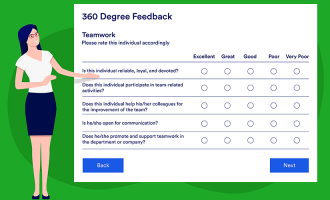
4. 360-degree feedback form
What it is: A multi-source evaluation that gathers feedback from managers, peers, and direct reports
Key sections to include:
- Relationship to employee (peer, manager, report)
- Competency ratings
- Open-ended feedback
- Development suggestions
Example questions (peers and direct reports):
- How effectively does this person collaborate?
- How clearly do they communicate?
- How do they respond to shifting priorities?
- What are their top strengths?
- What is one key development area?
Example questions (managers):
- Does this employee set clear goals and direction?
- How do they handle conflict or underperformance?
- Do they foster an inclusive team environment?
Pro Tip
Keep responses anonymous to encourage honesty and more useful feedback. Also, to keep feedback useful, group questions by competency (e.g., communication, collaboration, leadership) so patterns are easier to identify across responses.
A strong 360-degree evaluation form example provides a broader picture of performance than a single-manager review does. By incorporating multiple perspectives, it reduces individual bias and reveals patterns that might otherwise go unnoticed. It’s particularly valuable for leadership roles, where impact is often felt across teams, and for organizations looking to build more transparent, feedback-driven cultures. Watch out for question overload. Longer forms reduce completion rates and lead to lower-quality feedback.
5. Quarterly performance check-in
What it is: A lightweight, recurring review conducted every quarter to maintain ongoing feedback
Key sections to include:
- Quick performance rating
- Quarterly highlights
- Challenges faced
- Support needed
- Goals for next quarter
Example questions:
- How would you rate your performance this quarter (1–5)?
- What were your top achievements?
- What was your biggest challenge?
- What would most improve your performance next quarter?
- What goals are you committing to?
Pro Tip
Keep it short (five to seven questions max) to maintain focus and encourage consistent use. Moreover, these forms work best when responses are reviewed before the actual meeting, so the conversation can focus on problem-solving and forward planning rather than information gathering.
These employee performance review examples reflect a shift toward continuous feedback. Quarterly check-ins help managers address challenges early, reinforce progress, and keep goals aligned with changing priorities. Because they’re shorter and more focused than annual reviews, they’re more likely to be completed consistently. This makes them one of the most practical ways to improve engagement over time. However, you should supplement these check-ins with more thorough annual or semiannual performance reviews.
6. Manager evaluation form
What it is: A form that allows employees to review their direct manager’s performance
Key sections to include:
- Leadership competency ratings
- Communication and support evaluation
- Open-ended feedback
- Suggestions for improvement
Example questions:
- Does your manager set clear expectations?
- Do they provide useful feedback?
- Do they support your development?
- How well do they handle conflict?
- Do they create an inclusive environment?
- What do they do exceptionally well?
- What could they improve?
Pro Tip
Always make this form anonymous. Without anonymity, feedback will be filtered or withheld entirely.
Manager evaluation form templates are often overlooked but critical for improving leadership quality. They go beyond merely revealing how your managers are perceived by senior leadership to provide insight into how managers support, communicate with, and develop their teams. Using anonymous submission settings (like those in Jotform employee evaluation templates) ensures feedback is honest, making it far more actionable for leadership development and organizational improvement.
6 best practices for creating exceptional employee evaluation forms
Even the best performance appraisal form examples fall flat if they’re poorly implemented. These best practices ensure your forms drive better outcomes for you, your employees, and your company:
- Keep forms short and focused: Long, bloated forms reduce completion rates and feedback quality. To increase completion rates and ensure the best possible guidance for your employees, make your forms succinct by prioritizing the most important criteria.
- Make it a two-way conversation: Evaluation forms should guide dialogue, not replace it. Build in space for employee input and discussion. This improves employee engagement and further develops positive corporate culture.
- Be specific: Avoid vague or generic questions like “Is the employee doing well?” Focus on observable behaviors and outcomes.
- Train your reviewers: Inconsistent evaluations often stem from untrained managers. Provide guidance on using rating scales, avoiding bias, and writing constructive feedback. Even short calibration sessions significantly improve consistency across teams.
- Don’t overemphasize weaknesses: Nobody enjoys being criticized, so if you want your employees to grow and improve, make the evaluation even-handed. Balance constructive feedback with recognition of strengths and progress.
- Go digital: Digital employee review form samples improve accessibility, tracking, and consistency while reducing administrative overhead. They also make it easier to analyze trends across teams and ensure evaluations are completed on time.
- Leave space for qualitative feedback: Open-ended responses are where the most actionable insights often emerge. Even the best rating scales can’t capture nuance, so every employee evaluation form template should include space for specific examples and context.
Even with strong employee evaluation form templates in place, execution matters. How forms are used by managers and employees has a direct impact on whether reviews feel fair, useful, or performative.
Choose from hundreds of employee evaluation templates on Jotform
The difference between a frustrating review process and an effective one often comes down to tools. While there are lots of online HR forms you could download and use, there’s a better, more efficient way: Jotform’s evaluation form templates.
With Jotform employee evaluation templates, HR teams can quickly build, customize, and distribute forms for every scenario covered in this guide, from self-evaluation form examples to full 360-degree evaluation form examples.
Key features include
- E-signatures for seamless, speedy acknowledgment
- Automatic PDF generation to improve personnel record-keeping
- Email notifications when forms are submitted to keep the process moving smoothly
- Conditional logic for dynamic forms like 90-day reviews
- Response analytics to identify trends across teams, departments, and roles
Instead of building forms from scratch, you can start with proven employee evaluation form templates and adapt them to your organization’s needs. With 20,000-plus free online form templates to choose from, you’ll find a form to suit just about every business need.
Digital employee review form samples improve accessibility, tracking, and consistency while reducing administrative overhead. They also make it easier to analyze trends across teams and ensure evaluations are completed on time.
Start exploring employee evaluation form templates and try Jotform for free.
This article is for HR managers, people ops leads, and team managers who want to run fairer, more consistent employee evaluations and are looking for ready-to-use form examples with real question frameworks they can adapt immediately.


























Send Comment: