
Generative AI (GenAI) is a type of artificial intelligence that creates new content based on patterns it has learned from existing data. It can draft emails, design marketing visuals, summarize reports, and even help with customer support.
That said, how helpful it is depends on what you’re asking it to do. The use cases for generative AI in business vary widely, from automating simple daily tasks to powering advanced decision-making. Let’s take a closer look at how companies are using GenAI in 2026 and beyond, and what’s worth keeping an eye on.
What is generative AI in a business context?
If you’ve ever used ChatGPT to brainstorm ideas or watched AI tools like DALL·E create custom graphics on the fly, you’ve already seen GenAI in action. In a business context, GenAI refers to tools that simplify business operations by generating content that sounds or looks human-made.
And generative AI tools go far beyond chatbots and image generators. They help you write better marketing copy, summarize complex data, generate software code, or create personalized content for customers. In other words, they help you move faster and think bigger without burning out.
Unlike traditional automation tools — like CRM systems that follow preset rules or workflow automations that move tasks from one stage to another — GenAI can think outside routine checklists. It doesn’t merely execute a process; it improves or even reinvents it.
Why generative AI matters for enterprises
Enterprises are jumping on the GenAI train because it offers big gains in productivity, lowers costs, and provides a serious edge over the competition. Generative AI enterprise solutions help you do more with less time, fewer mistakes, and way more creativity.
Here’s what’s fueling adoption right now:
- Cost efficiency: Fewer manual tasks, faster outputs
- Productivity: Automation that feels like magic, not maintenance
- Innovation: New ideas, products, and experiences that weren’t possible before
What’s changed the game is accessibility. Thanks to large language models (LLMs) like GPT-4, generative AI in business is no longer limited to tech giants with massive budgets. Anyone with an internet connection and a login can tap into it.
Enterprises using GenAI see sharper competitive advantages, more personalized customer experiences, and faster product delivery. It’s like giving your business a creative turbo boost — one that doesn’t need lunch breaks!
Key use cases of generative AI for businesses
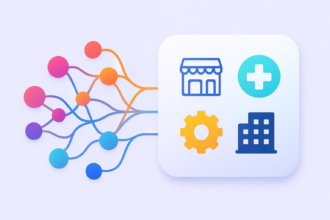
GenAI isn’t just for tech teams. It’s showing up in every department, quietly rewriting how work gets done. From automating the boring stuff to inspiring new ideas, generative AI business applications are as diverse as the teams that use them.
Here’s how different teams are using GenAI:
- Marketing: Use cases include content generation, copywriting, and ad ideation. Small marketing agencies use generative AI tools to brainstorm social media campaigns in minutes, while enterprise brands like Coca-Cola have used it to create entire AI-driven ad concepts.
- Customer service: Small retailers use chatbots to answer FAQs 24-7, and large companies like Sephora use GenAI to provide personalized product recommendations in real time.
- Human resources: HR professionals can use GenAI to create onboarding materials, job descriptions, and more. A small business might use AI to write clear, consistent job ads, while global firms like IBM use it to speed up workflows and provide personalized HR support.
- Product teams: These teams can use GenAI for prototyping and UX writing. Startups use AI to draft interface copy and test user flows faster, while Microsoft uses GenAI to generate early-stage design ideas for product features.
- Legal: GenAI can help with contract drafting and compliance summaries. Almost 55 percent of legal professionals are excited about using GenAI to draft basic agreements and scan and summarize lengthy contracts for review.
- Data teams: Code generation and documentation are a couple of GenAI use cases here. Freelance developers use AI to write quick SQL queries, and companies like Shopify have used AI to help engineers code more efficiently.
Whether it’s writing, designing, or debugging, generative AI applications in business make work faster, smarter, and — dare we say — more fun.
Key considerations for adopting generative AI at the enterprise level
GenAI can supercharge productivity, but it’s not plug-and-play magic. Like any powerful tool, it comes with risks that must be handled carefully.
Here’s what you should watch out for:
- Data availability and quality: Large, high-quality datasets are critical; if you have poor data, you have limited accuracy and trust in results.
- Security and privacy risks: Sensitive data exposure, compliance gaps, and vulnerabilities must be addressed from the start.
- Intellectual property risks: Public models may generate copyrighted content; enterprise-trained data reduces the risk.
- Bias and inaccuracy: Training data issues can amplify bias or cause hallucinations, leading to unsafe or misleading outputs.
- Domain models: Custom enterprise-trained models improve accuracy, minimize risk, and ensure reliability in real-world use.
To make the most of GenAI enterprise solutions, you need reliable partners — ones that balance innovation with safety. That’s where AI agents help: You use them to build, test, and scale AI tools that truly fit your business.
Jotform AI Chatbot Builder: The solution your enterprise needs to succeed
Jotform AI Agents are powerful automated customer service tools that provide real-time assistance, answer user queries, and guide customers through processes like form-filling and troubleshooting.
By offering personalized, conversational AI interactions and 24-7 availability, these agents enhance customer satisfaction, streamline support workflows, and reduce response times. All of this ensures a seamless and efficient customer experience.
Here are some key features of AI Agents:
- Chatbot and conversations that embed directly on your site to answer questions, guide users, and automate tasks with natural dialogue
- Customer support and live chat to deliver 24-7 assistance with AI and smoothly hand off to human agents when needed
- Phone and voice agents that handle customer inquiries via phone or web calls with immediate, natural responses
- Forms and actions that turn forms into dynamic conversations, collect payments, and set rules for tailored interactions
- Tools and integrations to automate workflows, send emails, share links, and connect with apps like Slack or Google Calendar
- Multichannel support to engage customers across chat, phone, SMS, WhatsApp, or QR codes, providing consistent experiences across each
- Security with enterprise-grade safeguards that keep your customer and business data protected
You can also use our pre-built AI Agent templates to get started faster, which is perfect for businesses that want to launch smarter, more responsive customer experiences without the long setup time.
The future of generative AI for businesses
Over the next few years, GenAI will likely shift from a nice-to-have tool to a must-have across enterprises. Models will get smarter and more specialized, so companies that invest early will move faster, make better decisions, and deliver more personalized experiences — everyone else will be scrambling to catch up.
And adoption is already accelerating. According to McKinsey’s State of AI report, 71 percent of organizations now use GenAI in at least one business function, up from 65 percent in early 2024. This is a clear sign the technology is moving from experimentation to everyday use.
Key trends shaping business AI adoption include the rise of domain-specific models, stronger regulations around data use, and a growing focus on transparency and governance. That said, compliance and ethical use will stay top of mind, with privacy, bias, and intellectual property risks leading the list of enterprise concerns.
To future-proof your strategy, you’ll need secure data pipelines, AI-savvy teams, and scalable tools like Jotform AI Agents that evolve with new standards.
What this means for your business
Generative AI business transformation is happening now. From automating workflows to personalizing customer experiences, the best generative AI for business leaders helps you work faster, smarter, and with more creativity.
That’s exactly what Jotform AI Agents deliver. They bring automation, real-time assistance, and secure data handling together in one easy-to-use platform, so your enterprise scales efficiently and stays ahead of the competition.
Explore Jotform AI Agents to experience the best GenAI tools for your business and start your transformation today.
FAQs: Generative AI for business
Most teams use it for content creation, customer service automation, data summarization, and rapid prototyping. It’s basically a turbo boost for any task that needs writing, organizing, or analyzing.
No, not always. Many tools work well out of the box. You only need large datasets if you want a custom model tailored specifically to your business.
Yes, but only when it’s handled with the right safeguards. The biggest risks involve data privacy, bias, and accuracy, so choosing secure, compliant tools is key.
Start with something easy to deploy and built for real workflows, like AI agents that handle customer questions, automate tasks, and integrate with your existing tools. That way, you see effects fast without a heavy setup.
This article is for business leaders, IT strategists, innovation managers, and anyone looking to leverage generative AI to streamline operations, improve customer engagement, and drive transformation across enterprise functions.























































































Send Comment: