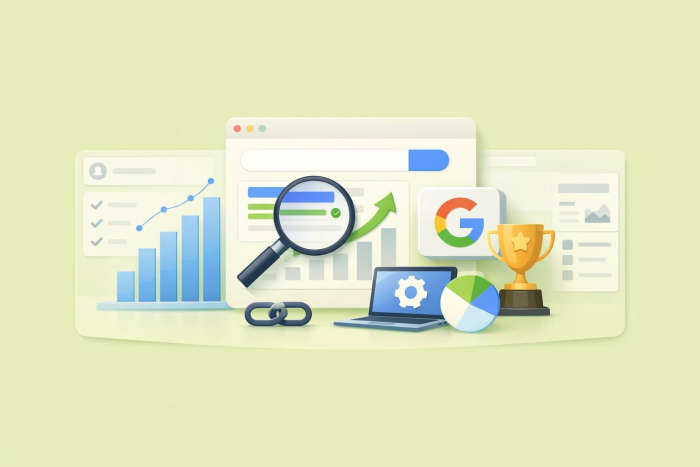
Every business owner has done it at least once: typed their own company name into Google, held their breath, and scrolled down only to find themselves buried on page three. It’s the digital equivalent of opening a shop on a street nobody walks down.
Here’s the good news: Ranking on the first page of Google isn’t reserved for tech giants with six-figure marketing budgets. With the right strategies, small businesses, solo entrepreneurs, and early-stage startups can absolutely compete and win. And the most effective tactics are completely free.
In this guide, we’ll break down exactly how to get on the first page of Google in 2026. No jargon, no fluff — just practical and proven strategies you can start applying today.


Why ranking on the first page of Google changes everything
Think of Google’s first page as the main commercial strip in your town. The businesses on that road get all the foot traffic, and everyone else is tucked away on a side street that most people never venture to. The same dynamic plays out in search results, only the stakes are arguably higher.
A landmark study by Backlinko analyzed 4 million Google search results and over 12 million search queries. The findings were striking: The number one organic result has an average click-through rate (CTR) of 27.6 percent, and it’s 10 times more likely to receive a click than a result sitting in the 10th spot. The top three results combined capture 54.4 percent of all clicks.
What happens beyond page one? Almost nothing. Only 0.63 percent of searchers ever click something on the second page. Put simply, Google’s search engine results page (SERP) is the internet’s front door and almost everyone who walks through it stops at page one and never scrolls past it. The farther down you go, the less visible you become, until you’re essentially invisible.
What first-page rankings actually do for your business
Understanding the “why” behind getting on the first page gives the strategy real purpose. This isn’t ranking for ranking’s sake — it translates into concrete, measurable business outcomes.
75 percent of clicks stay on page one, and so do your customers
Before diving into tactics, it helps to understand just how much is at stake. HubSpot research found that 75 percent of people never scroll past the first page of Google results. That means three-quarters of your readers, leads, and potential customers are making all of their decisions based entirely on what appears on page one.
The jump from page two to page one isn’t a minor upgrade. It’s often a multi-hundred-percent increase in visibility. Because search volumes tend to stay consistent month to month, a first-page ranking delivers a reliable, predictable stream of traffic that compounds over time.
Google’s top results are a trust signal — use that to your advantage
People trust Google. When your business appears at or near the top of search results, users subconsciously interpret that as a third-party endorsement. Google placed you there, so you must be a credible, relevant source.
There’s also a brand awareness benefit that works even when someone doesn’t click. Seeing your name at the top of search results repeatedly plants a seed. The next time that person needs your product or service, they’ll recognize you — and that dramatically increases the chance they’ll choose you over a competitor they’ve never heard of.
Organic rankings keep working after you stop paying
Paid advertising delivers fast results, but it’s also a faucet that stops the moment you turn it off. Organic vs paid marketing each have their place, but organic search has an advantage that paid simply can’t replicate: Once you’ve earned a strong position, the cost per lead drops significantly over time.
Your website becomes a round-the-clock lead generation engine, attracting and qualifying visitors at 2 a.m. on a Tuesday without requiring a single dollar in ad spend to stay visible. For small businesses with limited marketing budgets, that kind of sustainable ROI is a genuine game-changer.
What Google wants from your site is exactly what your visitors want
This one surprises people: The process of earning a first-page ranking actually forces you to build a better website. Google prioritizes specific ranking factors, and they’re the same elements that create a genuinely enjoyable experience for real visitors:
- Fast loading speeds
- Mobile optimization
- Clear navigation
- High-quality content
In other words, you can’t game your way to page one with a bad website anymore. The path to higher rankings is identical to the path to better conversions.
7 best strategies to get on the first page of Google
The strategies below break down what it takes to rank in 2026. Work through each one and you’ll cover the key dimensions Google weighs when deciding where to rank your site.
1. Win the AI overview with GEO
Open Google right now and search for almost anything. Chances are, the very first thing you see isn’t a blue link, it’s an AI-generated summary that attempts to answer your question before you click anywhere. That box is Google’s AI Overview, and it has become the most valuable real estate on the search results page.
To be the source that Google cites in these summaries, you need to practice generative engine optimization (GEO), a new discipline within search engine optimization (SEO).
To be the source Google cites, you need to nail three things:
- Lead with a direct answer: Open every article with a clear, concise 40–60-word summary that answers the primary question upfront. AI systems prioritize content that cuts straight to the point.
- Structure your headings as questions: Use H2 and H3 tags phrased as “How do I do X?” or “What is Y?” This makes your content easy for both AI crawlers and human readers to navigate.
- Back everything with data: AI Overviews strongly favor content with specific statistics, original research, and clear factual statements. Generic observations get skipped, and concrete data gets cited.
Pro Tip
Jotform’s SEO Specialist AI tool provides expert, up-to-date guidance on optimizing your content for both traditional search rankings and AI-powered overviews. This helps you stay ahead without having to constantly monitor every algorithm change yourself.
2. Place your keywords where Google looks first
Google can’t rank you for something it doesn’t understand. Before your page can appear in search results, it needs to be crawled, indexed, and clearly categorized. Keyword placement is how you communicate your content’s purpose to Google’s algorithm.
Start with thorough keyword research. Focus on specific, longer-tail phrases rather than broad, hyper-competitive terms. Tools like Google Search Console, Google Keyword Planner, and Semrush make this research straightforward even for beginners. Once you have your target keyword, place it naturally in these four locations:
- Meta title: This is the clickable headline that appears in search results. Keep it between 40–60 characters — according to Backlinko, title tags in that range have the highest organic CTR.
- Meta description: This is the short summary beneath your title in the SERP. It doesn’t directly influence rankings, but a compelling meta description significantly improves click-through rates and brings more of the right visitors to your page.
- URL slug: Pages with keyword-rich URLs see a significantly higher CTR than generic ones. Use /how-to-get-on-first-page-of-google instead of /blog-post-14 — it signals relevance to both Google and the reader before they even click.
- Alt tags: Every image needs descriptive alt text that includes your keyword where relevant. It helps with accessibility and gives Google additional context about your page’s content.
Google’s own SEO Starter Guide is an excellent free reference for understanding exactly how the search engine reads and evaluates your pages.
Pro Tip
Once visitors land on your page, give them a reason to stay. Embedding Jotform’s newsletter signup and lead generation forms turns passive readers into engaged subscribers, and longer time-on-page sends a strong relevance signal back to Google.
3. Build topical authority and become Google’s go-to source
In 2026, Google rarely ranks a single isolated page that exists in a content vacuum. It wants to see evidence that your entire website is an expert resource on a subject, not just one article that happened to target the right keyword. This concept is called topical authority, and it’s one of the most effective long-term SEO for lead generation strategies you can invest in.
You build topical authority through what’s known as a content hub model. Here’s how it works:
- Create a pillar page: Write one definitive guide on a broad topic. This is your flagship piece, the article that covers the subject so thoroughly that a visitor doesn’t need to go anywhere else.
- Build cluster content around it: Write 10–20 shorter, focused articles that explore every sub-topic connected to your pillar. If your pillar covers email marketing, cluster articles might address subject line writing, list segmentation, welcome sequences, and deliverability rates.
- Connect everything with internal links: Link every cluster article back to the pillar page. This web of interlinked content tells Google’s algorithm that your site is a knowledge hub with genuine depth, not just a blog with a handful of posts.
This structure also makes your site more valuable for readers, who can follow related links and go deeper into topics that interest them without ever leaving your domain.
4. Fix your technical SEO before it quietly kills your rankings
Technical SEO is the infrastructure nobody sees but everyone depends on. When it’s working, it’s invisible. When it’s broken, everything else stops working too. The most brilliant, well-researched content in the world will still get buried if your site is slow, broken, or insecure.
These are the three non-negotiables you need to get right:
- Pass your Core Web Vitals: Google measures your site’s real-world performance using a set of metrics called Core Web Vitals. Your Largest Contentful Paint (LCP) — how long it takes for your main content to load — needs to be under 2.5 seconds. You can check this for free using Google’s PageSpeed Insights tool.
- Make mobile your priority: Google has been using mobile-first indexing since 2021, which means it primarily evaluates your site’s mobile version when determining rankings. With voice search and mobile browsing dominating user behavior in 2026, a site that isn’t fully responsive is actively working against itself.
- Switch to HTTPS: If your website still runs on HTTP, browsers mark it as “Not Secure” and Google penalizes it in rankings. So if you haven’t done it yet, it’s the first thing to fix.
Pro Tip
Jotform’s Website Widgets let you add powerful interactive elements, contact forms, review widgets, booking tools, and more to your site without writing a single line of code. Interactive pages tend to have lower bounce rates and longer session times, both of which send strong positive signals to Google’s ranking algorithm.
5. Give visitors a reason to stay on your page
Google has become increasingly sophisticated at detecting how real users behave on your pages. Do they read the content, click through to related pages, and spend meaningful time on your site? Or do they arrive and immediately hit the back button?
When users bounce right back to the search results, it’s called “pogo-sticking” — and it’s a direct negative ranking signal. Here’s what keeps visitors on your page:
- Clear navigation: Visitors should be able to find what they need quickly and easily. Confusing menus and cluttered layouts send people straight back to Google.
- Strong calls to action: Guide visitors to the next logical step, whether that’s reading a related article, signing up for a newsletter, or filling out a form. A page without direction loses people.
- Interactive elements: Forms, quizzes, and embedded tools keep visitors engaged long enough for Google to interpret the visit as a positive signal.
Pro Tip
Add an AI chatbot to your website to create a fully branded, interactive experience for every visitor. A chatbot that answers questions in real time, helps users navigate your content, and guides them toward the right form or page dramatically reduces friction and keeps visitors on your site far longer than static text alone.
6. Design for mobile first and watch your rankings follow
Mobile-first indexing doesn’t just mean your site should “work” on a phone. It means Google is evaluating your mobile experience as the primary version of your website when deciding where to rank you. A site that’s technically functional but difficult to use on a small screen will consistently underperform in search results, regardless of how polished its desktop version looks.
Run through this practical checklist to make sure you’re covered:
- Use a responsive layout: Your design should adapt fluidly to any screen size — no pinching, zooming, or horizontal scrolling required.
- Make it easy to tap and read: Buttons should be large enough to tap comfortably, and fonts should be readable without zooming in.
- Speed it up for mobile users: Page speed matters even more on mobile. Every extra second of load time increases the chance a visitor abandons your page before it finishes loading.
For website owners using WordPress, there’s a wide range of best WordPress plugins to help with mobile optimization. You can also explore AI SEO WordPress tools that automate technical improvements and flag mobile usability issues before they affect your rankings.
7. Use social proof and community content to build real authority
One of the more interesting shifts in 2026’s search landscape is Google’s growing appetite for authentic community content. Platforms like Reddit, Quora, and niche forums are appearing more frequently on the first page of Google search results because they reflect real human opinions, experiences, and debates that polished brand content often doesn’t capture.
For smaller websites and newer brands, this is genuinely great news. You don’t need a massive domain authority to get started. Here’s how to tap into it:
- Incorporate user-generated content: Add a comment section to your blog posts, or embed relevant social discussions directly into your content. User-generated content adds freshness and authenticity — two qualities Google increasingly values.
- Earn brand mentions: Getting mentioned on reputable websites and publications, even without a direct hyperlink, now acts as a meaningful authority signal. Pursue guest articles, podcast appearances, press mentions, and active participation in industry communities.
- Display social proof on your site: Embedding widgets for Google reviews builds visible credibility with both human visitors and search engines. Reviews signal that real people have interacted with your business and found it worth recommending.
These outdated practices will hurt your rankings
Some strategies that worked in SEO’s early days will now actively damage your rankings. Save yourself the trouble and steer clear of these common mistakes.
- Keyword stuffing: Repeating your target keyword in every paragraph doesn’t help — it reads as unnatural, frustrates genuine readers, and modern Google algorithms are sophisticated enough to detect and penalize it. Instead, use your keyword where it flows naturally and rely on related terms and synonyms to cover the topic comprehensively.
- Irrelevant directory listings: Getting listed in dozens of random online directories might look like an easy way to build backlinks, but low-quality links from irrelevant sources can dilute your site’s authority. Focus on earning links from reputable, topically relevant websites instead.
- Duplicate content: Publishing the same content across multiple URLs wastes Google’s crawling budget and causes your own pages to compete against each other. Consolidate similar pages into one strong resource, or use canonical tags to point Google to the version you want to be ranked.
- “Thin” or scraped content: Google’s quality framework, E-E-A-T (experience, expertise, authoritativeness, and trustworthiness), means shallow or copied content will consistently lose to content that demonstrates genuine expertise and real-world experience. Every piece you publish should offer something original and valuable, not just regurgitate what’s already ranking.
Page one is closer than you think
Getting on the first page of Google in 2026 is less about outsmarting an algorithm and more about building something genuinely worth finding. When you combine strategic keyword targeting with authoritative content, a fast and mobile-friendly site, strong user experience, and active community engagement, you’re not just optimizing for search engines — you’re building a better digital presence for your business.
Start with the fundamentals: Research the keywords your audience actually uses, create content that answers their questions directly, and make sure your technical foundation is solid. Layer in topical authority, GEO strategies for AI Overviews, and community-driven signals, and you’ll have an SEO engine that keeps delivering traffic long after you hit publish.
Your path to page one starts with a better website. Explore Jotform’s full suite of website tools, from embeddable forms and chatbots to interactive widgets, and give both Google and your visitors more reasons to choose you.
FAQs on how to get on the first page of Google
If you’re asking how to set Google as your browser’s default homepage, go to your browser settings and update the homepage URL to https://www.google.com. If you’re asking how to get your website to appear on Google’s first page of search results, that requires an ongoing SEO strategy as outlined throughout this guide.
No — the first page of Google includes both paid ads and organic results. Paid ads can get you there faster, but organic rankings are completely free — they just require consistent SEO effort. Most clicks actually go to organic results, which makes earning a free first-page spot a worthwhile long-term investment.
To create a basic site, go to Google Sites, sign in with a Google account, and click “Blank site” to get started. You can add pages, text, images, and embedded content without any coding knowledge. For a more professional presence with stronger SEO potential, consider building your site on a dedicated platform like WordPress, Squarespace, or Wix instead.
This article is for small business owners, solo entrepreneurs, startup founders, and marketing professionals who want to increase their visibility and drive consistent organic traffic by ranking on the first page of Google.




















Send Comment: