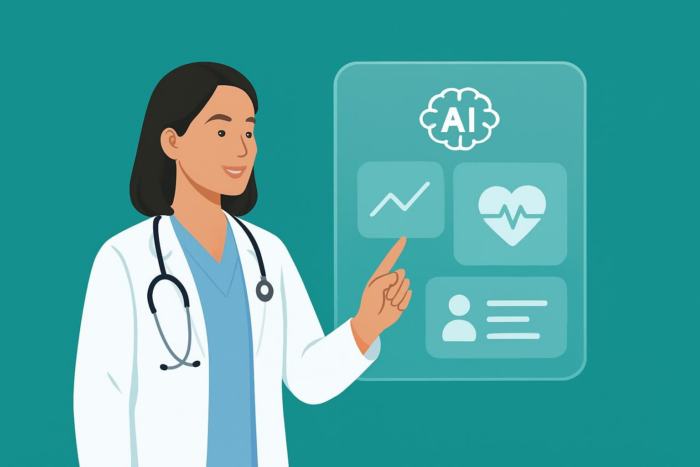
More Americans are concerned about their health, so accurate diagnoses, personalized treatment plans, and preventative care are more important than ever. Using artificial intelligence (AI) in healthcare practices lets medical professionals analyze patient data with greater precision, positioning them to identify early risk factors and tailor treatment plans to individual needs.
AI-powered algorithms can now analyze medical images, vital signs, and genetic data, plus make predictions about a patient’s health based on current and historical data. Doctors can then use these insights and take steps to prevent patients from developing serious conditions like stroke or heart disease.
Artificial intelligence also plays a big part in managing modern healthcare operations. From automating administrative tasks to optimizing workflows, AI takes the burden of scheduling appointments and managing records off the human staff while making healthcare services more accessible to everyone.
Let’s examine the various ways AI can be applied in modern healthcare practices along with the benefits of using it in medicine. While this technology does come with practical and ethical concerns, understanding how AI will transform future healthcare operations prepares us for new trends. By familiarizing ourselves with the chatbots, algorithms, and AI agents being integrated into the healthcare system, we’ll learn how to leverage this technology for our benefit.
Applications of AI in medicine
From treatment planning to appointment scheduling, AI transforms every level of healthcare. Medical staff now use artificial intelligence for
Improving diagnostic accuracy
AI algorithms are designed to quickly analyze huge datasets, spotting patterns and connections that human doctors might not see on their own. In medicine, this means AI algorithms can identify early signs of disease based on a patient’s medical images, lab results, and historical records. This alerts doctors to potential health risks, letting them start patients on a treatment plan earlier.
On the flip side, because AI offers unbiased analysis, it can reduce false positives and prevent patients from undergoing expensive and potentially invasive procedures like biopsies. AI cannot replace human doctors, but it can suggest better treatment options, saving money and improving patient care.
Developing more personalized therapy
More accurate diagnoses can lead to better patient treatment. AI can identify patients with higher risk of developing serious conditions and list them as an urgent case. Physicians can then concentrate on these patients before their risk factors become major issues.
By analyzing patient profiles, including genetic and clinical data, AI can tailor a better treatment plan. For instance, AI tools can help predict a patient’s response to different drugs and recommend optimal dosages and medicines better suited for a specific individual’s metabolism. Certain AI tools can even analyze the molecular data of new drugs and predict how they will interact with patient cells, helping healthcare professionals develop more personalized therapies for patients most likely to benefit from a drug.
Tracking patient health in real-time
Wearable technology like smartwatches and biosensor patches can now track blood oxygen levels, body temperature, irregular heart rhythms, and more, all in real time. By continuously monitoring an individual’s vital signs, AI wearable technology offers patients regular access to their health data, so they can manage any chronic conditions and reduce hospital visits through early detection.
AI can also adjust a patient’s treatment based on these real-time readings. They may adjust insulin dosages based on glucose readings or send personalized tips and reminders to patients to keep up with their treatment plan and/or checkups.
Optimizing administrative tasks
On an administrative level, AI can streamline and optimize workflows by automating repetitive tasks like scheduling, data entry, and billing.
By analyzing data related to staff availability, patient flow, and resources, AI-powered systems can make appointments for patients in a way that minimizes wait times and accommodates multiple schedules. The system can even send automated reminders, which reduces the number of no-shows.
When it comes to billing, AI can process insurance claims, spot coding errors, and identify potentially fraudulent activity. This results in fewer claim denials and faster payments. AI chatbots can also be used to answer payment questions and other common queries, providing patients with a 24-7 resource.
When AI takes over many rote tasks such as these, staff can focus more on patient care. AI further improves workflows by predicting patient volume based on historical data. Administrators can then optimize staff levels and make sure different departments are not over (or under) staffed.
Additional benefits of AI in healthcare
AI healthcare benefits go beyond diagnosing medical conditions or scheduling appointments. More advanced AI tools can help doctors perform delicate surgical procedures. For instance, the Smart Tissue Autonomous Robot (STAR) is a robotic system with 3D and near-infrared (NIRF) imaging capabilities that let it suture severed intestines together, an act requiring a great deal of precision. Its algorithm can even adjust surgical plans in real time based on patient breathing and tissue movement.
Being able to process data from multiple sources also allows AI to forecast future medical demands and make data-driven recommendations for resource allocation. For example, AI predictive models can analyze patient flow and maintenance records to identify when vital medical equipment like ventilators or imaging machines are needed. They can also inform staff when the machinery needs servicing, so the equipment is functional when needed.
Accidentally overstocking medical drugs can lead to expired medications and expensive waste. AI systems reduce this waste by tracking when these products are used and predicting depletion rates. Automated systems can then reorder needed supplies, which optimizes inventory control.
Challenges and ethical considerations
For all the benefits and advantages offered by AI in healthcare, there are still several ethical considerations and practical challenges.
Much of the patient data AI processes is private and contains sensitive information, including patient medical and financial records. Many patients are justifiably concerned about leaving such information open for potential data breaches and cyberattacks. The data could then be reused for unauthorized or illegal purposes, such as marketing or identity theft. Even if the data is anonymized, AI algorithms can re-identify patients, compromising security.
To alleviate these concerns, healthcare organizations must implement strong security measures, including data encryption and biometric access controls. Patients also need to be informed about how AI uses their data and any risk factors so they can provide informed consent. Finally, your system should only collect the data necessary for AI to complete its tasks to prevent data misuse.
Bias can enter the AI algorithm through the data collected, the algorithms used, or the interactions with clinicians and patients. For instance, if the datasets used to train AI underrepresent minority groups or people from lower economic groups, the AI may fail to identify diseases in these groups or may not allocate resources fairly for minority communities.
AI developers can counter this by collecting diversified data from sociologists and patient advocates to train algorithms. Human operators also need to retain final decision-making power to question and cross-check AI recommendations.
Finally, AI itself can be a costly investment for healthcare organizations. In addition to the initial price of the new hardware and software, managers must consider installation, staff training, and security costs. The system also needs to be regularly monitored and audited to see if any software or practices need updates. All this needs to be factored into your budget when investing in an AI system.
The future of AI in medicine
As AI advances, its role in medicine will continue to transform healthcare. As organizations around the world use AI in their day-to-day practices, AI can be used in global public health management, surveying public health records to predict disease outbreaks and prepare for possible pandemics.
AI is also accelerating the field of genomics, or the study of an organism’s complete set of genetic material, known as its genome. By speeding up the analysis of large genome datasets, AI can identify genetic markers linked to diseases, helping doctors diagnose diseases earlier and design gene therapy techniques. This extends to drug discovery and development through computerized simulations and identifying promising candidates.
AI can also potentially democratize healthcare access worldwide by providing all communities with internet access to AI-powered virtual health assistants that schedule appointments and even triage patients. Meanwhile, telemedicine lets doctors consult with patients in remote areas while predictive analytics aid in early disease prevention, reducing treatment costs.
How do Jotform AI Agents revolutionize healthcare?
As chatbots and AI virtual assistants become more important in delivering medical care, it’s important to provide patients with the most user-friendly options.
Jotform’s Healthcare & Wellness AI Agents streamline patient intake, appointment scheduling, medical history documentation, and wellness program enrollment — all without requiring any coding on your part. Unlike regular chatbots, Jotform AI Agents are specialized AI assistants that handle complex, goal-oriented tasks autonomously without relying on pre-scripted answers to basic questions.
This makes AI agents ideal for collecting sensitive medical information securely, guiding customers through processes like form filling, and troubleshooting common issues. You can even customize your Jotform AI Agent to respond in specific ways by setting up smart triggers that activate key responses when users mention a topic, express an intention, or request a service.
For instance, if a patient mentions a new symptom like a rash while filling out a form, a smart trigger can activate an AI agent to schedule a follow-up appointment with the right nurse practitioner, send an email confirmation to the patient, and inform the nurse of the new symptom. This streamlines communication and administrative tasks while making the whole process feel intuitive for the patient.
AI agents can transform medical offices and wellness centers, allowing healthcare providers to engage more efficiently with patients while maintaining compliance and accuracy. Jotform already provides AI agent templates, including agents for hospice care coordination, new patient enrollment, patient care coordinating, and more. All these templates can be trained and customized, allowing you to provide patients with the specialized attention they need.
Engage patients with AI tools for medicine
Medical AI promises to redefine healthcare delivery by offering both patients and medical staff better healthcare technology. By using AI in diagnostics, patients receive more accurate diagnoses and manage early risk factors before they become major issues. Working with nurses and physicians will become easier with AI handling scheduling and other administrative tasks. And when treatment does become necessary, AI can create more personalized plans or even help provide better surgery.
If you’re ready to enhance your healthcare services with AI, start by exploring the opportunities offered by Jotform’s Healthcare & Wellness AI Agents. Our specialized AI assistants are ready to show you some of the exciting AI healthcare applications machine learning in medicine can provide you. Check out our website and learn how to adopt AI technologies to stay ahead in your industry.
This article is written for healthcare professionals, medical administrators, and health IT decision-makers who want to understand how AI is transforming clinical care and hospital operations.





































































Send Comment: