
Top 8 AI tools for GEO
You may have heard the predictions that “organic search is dead” or we’re heading into a “zero-click future” — a future where people won’t scroll through or click on Google results to find something, but instead rely only on the AI overview provided at the top of the page to answer their query.
It’s true: People are half as likely to click on a search result, and 62.5 percent more likely to end their session entirely, when there’s an AI summary vs when there isn’t one.
But that’s not the whole story. Generative engine optimization, or GEO, goes beyond only the AI summaries you’ll see at the top of the page on a search engine like Google. GEO also includes the answers AI tools give users in response to prompts — widely used tools such as ChatGPT, Claude, Microsoft Copilot, and other LLMs — known as answer engine optimization (AEO).
With more people relying on AI tools for everyday tasks, including research and brand discovery, GEO optimization is necessary to remain competitive and adapt to today’s technology.
These are the eight best AI tools for GEO to help you track, monitor, and optimize your brand for the new wave of search that’s here to stay: AI.
GEO vs SEO: How GEO differs from SEO
GEO is to 2026 what SEO was to the early 2000s. They’re essentially the same strategy — boosting discoverability — adapted for new technologies.
Essentially, traditional SEO optimizes content for search engines to show it higher in results, making it more likely humans will click on it. You’re competing for the top search result spot by including keywords and headings, cross-linking, and so forth. The higher you rank, the better your SEO is performing.
Traditional SEO includes
- Organic search engine results
- SEO lead generation
- Keyword research
- Keyword rankings
- Competitor keyword ranking benchmarking and comparison
GEO optimizes content for AI models so they mention your brand or product in replies to user questions, building trust and brand visibility right inside AI. People don’t need to click over to your website to learn more about you or get their question answered; AI acts as their personal FAQ answerer and, more importantly, a trusted source for recommendations.
Unlike SEO, using the same keyword 20 or more times doesn’t make AI more likely to mention you. AI wants clear, concise, and authoritative advice it can scrape from you and use in its replies to user questions and prompts.
GEO optimization includes
- AI summaries that appear at the top of search results pages
- Mentions of your brand or products by generative AI tools (e.g. ChatGPT, Claude, DeepSeek, etc.)
- Optimizing your products in AI shopping tools listings
- Competitor share of voice benchmarking
- Industry share of voice
- Content gaps and topic clusters that influence AI tool citations
- Total citations
- And more
You need both SEO and GEO as part of your overall marketing strategy.
Here’s a breakdown of SEO vs GEO to illustrate the key differences:
| SEO (Search Engine Optimization) | GEO (Generative Engine Optimization) | |
|---|---|---|
Intention |
Rank webpages as close to No. 1 as possible in organic search result listings |
Be cited in AI summaries by search engines, and by AI models in their interactions with users |
Format |
Web pages |
Text answers in AI summaries or in information provided by AI models such as ChatGPT, Claude, and others |
Goal |
Increase website traffic |
Increase appearances in AI summaries in search, and citations by AI models |
User behavior |
Click over to your website |
Read AI summary or AI model answer and influence their perception of your brand |
Performance metrics |
Traffic, specifically organic search referrals |
Share of brand voice per each AI model, brand mentions, citations |
What to look for in an effective GEO tool
When I tested out these GEO tools, I focused on finding the best overall AI SEO tools that have basic features, such as prompt monitoring, research tools, and growth suggestions. Some of these GEO tools also offer content generation, team workflows, or other more niche features.
When testing, I measured over 20 GEO optimization tools against the following criteria:
- AI platform support: Some GEO tools support 10 or more AI platforms while others cover only a few. You don’t need to track every platform out there to succeed with generative optimization, but broader coverage generally means better potential results.
- Tracking capabilities: What matters more than how many platforms a GEO tool covers is what it can track, from sentiment analysis to share of voice to related themes in answers you appear in and more.
- Value for money: The best GEO tool for you has all the features you require at a price that fits your budget.
- Content optimization capabilities: Besides tracking mentions and share of voice, the best GEO tools provide actionable suggestions to improve your content, both for existing content and research features to plan future content.
- Analytics and insights: The best AI GEO tools make it easy to understand performance over time and share insights in custom reports to present to leadership, plan marketing campaigns, and more.
- Ease of use: The last thing your team needs is more complexity. Adding an AI GEO tool should make content marketing easier and more fluid, so it needs to be intuitive and easy to get started with for the people who will use it.
After all my testing, these are the eight best AI tools for generative engine optimization.
| Tool | Best for | Key features | Pricing |
|---|---|---|---|
 Writesonic |
All-in-one GEO content optimization and creation |
|
|
 Profound |
Deep insights and analytics |
|
|
 Semrush AI Toolkit |
Existing Semrush users |
|
|
 Goodie |
Laser-focused AI answer engine optimization (AEO) |
|
|
 Otterly AI |
Affordability |
|
|
 AthenaHQ |
Enterprise users |
|
|
 AirOps |
Content teams |
|
|
 Promptmonitor |
Agencies and managing multiple clients |
|
|
Best 8 GEO tools compared
Whether you want the most detailed analytics or an easy way to manage multiple GEO clients, one of these top AI GEO tools will help you level up.
1. Writesonic
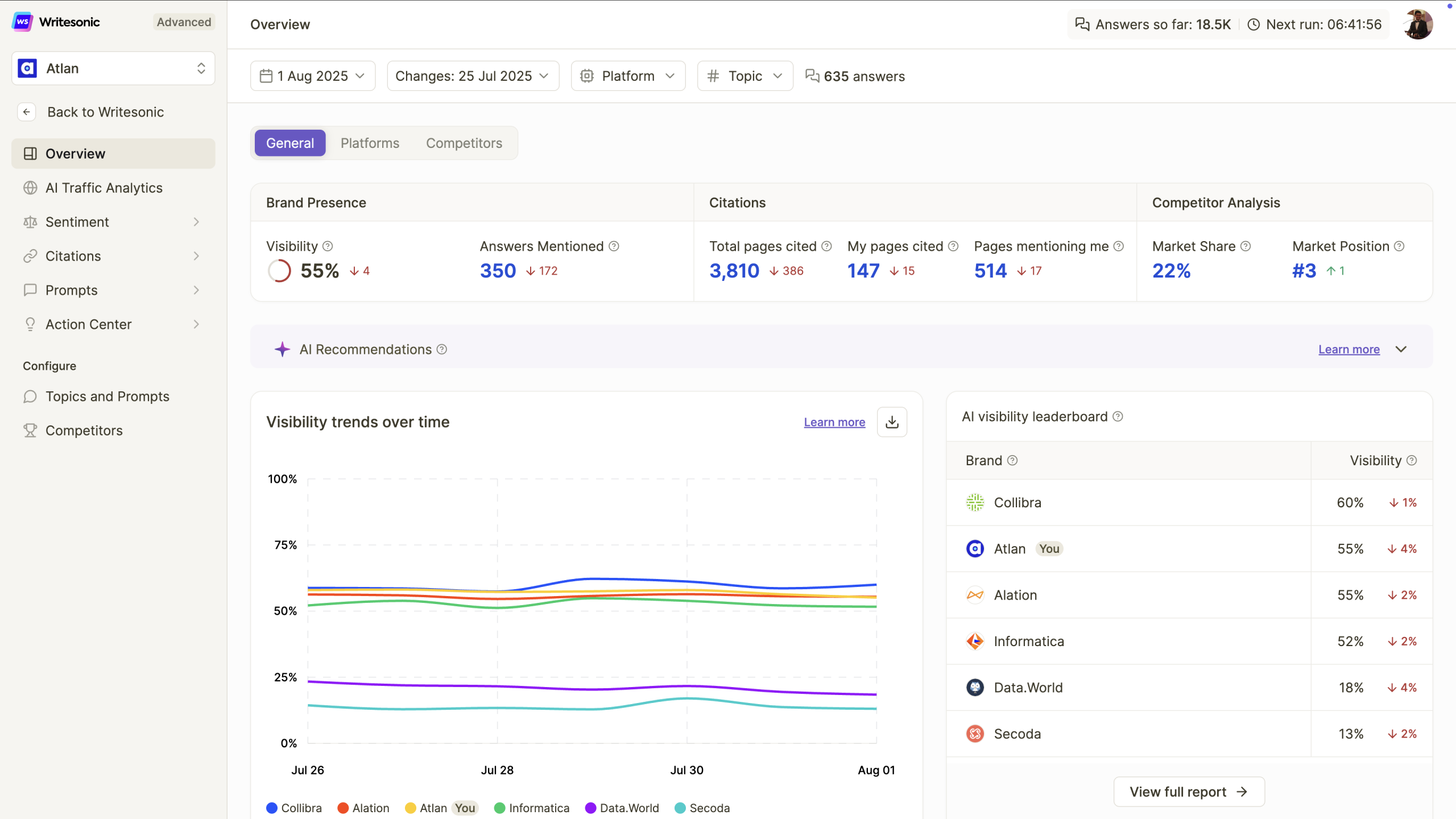
Writesonic packs a lot into one tool. Besides optimizing new and existing content for GEO and AI search, Writesonic uncovers sources that mention your competitors but not you, tracks AI citations by page, and measures your share of voice vs competitors.
There is a lot of data in Writesonic, but it never feels overwhelming. It has a clean and intuitive UI that’s easy to navigate, and each growth recommendation is actually specific. As a marketer, I’ve used too many tools in the past that offer vague, simplistic recommendations, such as, “Consider user search intent.” (Gee, thanks.) Instead, Writesonic delights with actionable advice you can copy to your to-do list, such as, “These are the exact subtopics you should add to this topic cluster,” or, “Get mentioned by XYZ site.”
However, all that data comes at a steep price. The lower-tier plans still feature plenty of GEO tools, such as their best-in-class (in my opinion) article generator, but Writesonic’s most powerful features — prompt recommendations, content refreshing, citations compared to competitors, Reddit discovery, and more — are available only in the custom-priced Enterprise plan, which is likely more than several hundred dollars per month.
If your budget can support the Enterprise plan, Writesonic is the best all-in-one GEO optimization and creation tool for most content-heavy organizations.
- Best for:
- All-in-one GEO content optimization and creation
- Key features:
- Built-in content creation
- Advanced optimization
- Strong data and analytics
- Pros:
- High quality, fact-checked AI content generation for articles, social media, email series, and more
- Track analytics, sentiment, citations, and more across 10-plus AI platforms
- Refresh existing content and continually improve both traditional SEO and GEO in one tool
- Cons:
- Content refreshing, sentiment analysis, AI search volume, and other valuable tools limited to the Enterprise plan
- Plans/Pricing:
- Free trial up to 10,000 words per 25 AI credits.
- Paid plans start at $39 per month without GEO tools, or $199 per month with GEO optimization, billed annually.
How to Use Writesonic for GEO:
- Find specific content improvement and technical recommendations in the Action Center, including exact steps to take to boost your AI visibility.
- Create new SEO and GEO content to fill gaps in Article Writer 6.0 using a topic or uploaded documents, or refresh existing articles in over 30 languages. While there are many AI copywriting tools out there, it saves time being built into Writesonic. (Will it entirely replace human writers like me? I think not, but it did impress me.)
- Quickly check your share of voice, citations, and competitor benchmarks in one dashboard with the AI Visibility Report.
- Detailed competitive intelligence tracks the sites who mention competitors but not you, so you can prioritize those sites and outperform competitor content in AI search.
2. Profound
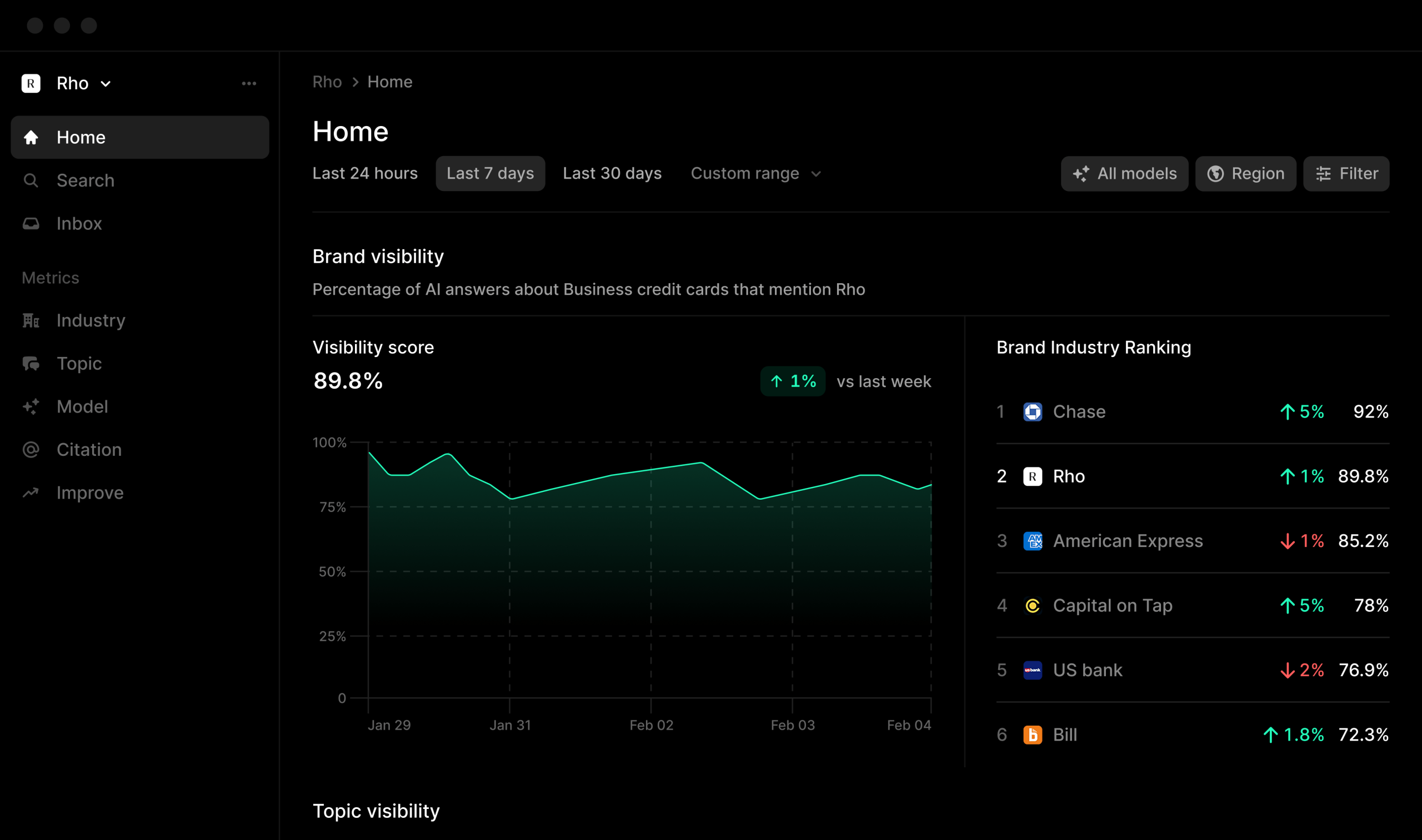
Similar to Writesonic, Profound is an all-in-one style AI GEO tool with deep analytics that can also optimize your website and create new content. But where Writesonic excels more in content creation, Profound excels more in the depth and scope of its analytics.
Profound describes its analytics as “seeing what AI sees about you.” Profound’s ability to accurately track AI search activity is more advanced than measuring simple web traffic, but my first thought after seeing the dashboard was, “This is exactly like Google Analytics, but for AI!” (Be still, my nerd heart.) In other words, it’s easy to use while still offering every data point you could want.
Report sections are organized by terms familiar to marketers, such as referrals, attribution, and indexing, and it offers everything you need to measure and boost GEO performance, from content repurposing to technical fixes and product listing recommendations.
In addition to its analytics, Profound creates GEO content, although Writesonic produces more factually accurate, higher-quality content. Still, Profound certainly speeds up your content workflow while offering detailed performance metrics and reports your stakeholders will love.
- Best for:
- Deep GEO insights and analytics
- Key features:
- Powerful “see what AI sees about you” analytics
- Workflows for content research
- Deep AI shopping optimization
- Pros:
- Deep attribution tracking: Accurately track how many real people take action on your website from AI search responses
- Easy visual automation builder in Workflows for content creation, GEO research, and custom reports
- Measure visibility across 10 major AI platforms, plus Reddit, ChatGPT Shopping, and more
- Cons:
- Content generation quality lags behind Wordsonic, still requiring heavy fact-checking and editing before publication
- Plans/Pricing:
- Starts at $82.50 per month for ChatGPT support only
- $332.50 per month for three AI platforms, billed annually.
- Contact for Enterprise pricing, which supports all 10 major AI platforms.
How to use profound for GEO:
- Create custom automations in Workflows, or use the built-in templates, for everything from writing articles to generating topics, identifying citation opportunities, and understanding “People also ask”-style questions for AI search.
- Research shows AI answer engines cite Reddit the most — 3.11 percent of all answers vs YouTube, the next highest, at 2.13 percent — indicating they prioritize “human conversations to build trust.” Profound tracks your citations as well as competitor Reddit results, so you can optimize your Reddit presence and grow AI share of voice at the same time.
- Find new keywords for your products to boost AI shopping performance. Almost half (47 percent) of Gen Z, and 36 percent of all demographics, use ChatGPT to discover new products, so don’t sleep on AI search for e-commerce.
3. Semrush AI Toolkit
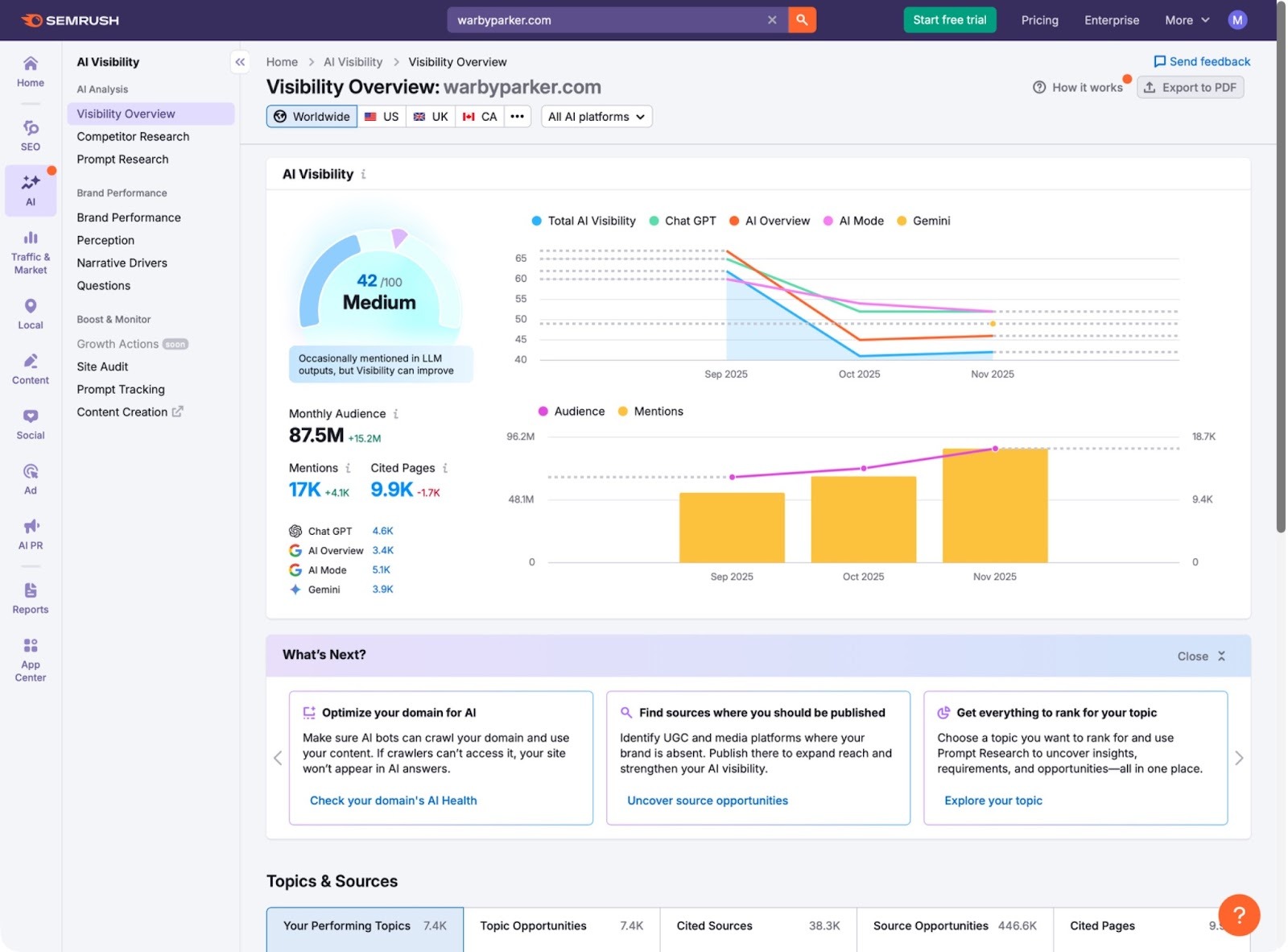
Semrush AI Toolkit is a no-brainer add-on if you already use Semrush for SEO optimization — just get it! — but you can use the AI Toolkit by itself. It’s excellent for measuring overall GEO performance and brand visibility while suggesting topic, prompt, and source opportunities in an easy-to-understand way.
I love that Semrush goes beyond big metrics like total mentions or share of voice for a keyword or prompt and includes your share of intent as well. Knowing your user’s search intent is more powerful than having the highest share of voice. Semrush splits user search intent into five categories: informational, navigational, commercial, transactional, and task-based. This gives you insights beyond volume and sentiment into what your customers really want to know.
The AI visibility reports in Semrush give you all the numbers you need for persuasive reporting to stakeholders, but I appreciate its AI-powered summaries to make sense of changes in performance and new opportunities. They’re specific and show a deep understanding of my brand. Semrush feels like a helpful assistant I can turn to for quick advice, not another spreadsheet to wade through.
- Best for:
- Existing Semrush users
- Key features:
- SEO and GEO in one tool
- Competitive benchmarking
- Detailed prompt and topic research
- Pros:
- Understand the topics and prompts that drive sales with easily readable AI insights
- A longtime leader in SEO, Semrush’s AI GEO tools are equally powerful and useful, especially when combined
- On the affordable side for a standalone AI GEO tool at $99 per month
- Largest U.S. AI database coverage, and 213 million prompts globally
- Cons:
- Growth Actions tab still listed as “coming soon,” which feels unfinished
- Plans/Pricing:
- Add to existing Semrush plans for $99 per user per month.
- Semrush One plans combine SEO and AI GEO tracking starting at $199 per month, billed annually.
How to use Semrush AI Toolkit for GEO:
- Track your overall AI visibility against up to four competitors (more available in campaign-level or custom reports). The AI insights make it easy to understand your position relative to competitors and exactly how to improve it.
- Semrush splits the questions and prompts that real users ask into three stages: research, shopping, and comparison. Create content around your top-performing questions and, more importantly, the ones your competitors show up in more often.
- In the Prompt Research tab, enter any topic to find what people ask AI about it. Use this for new campaign planning, content strategy, or general research.
4. Goodie
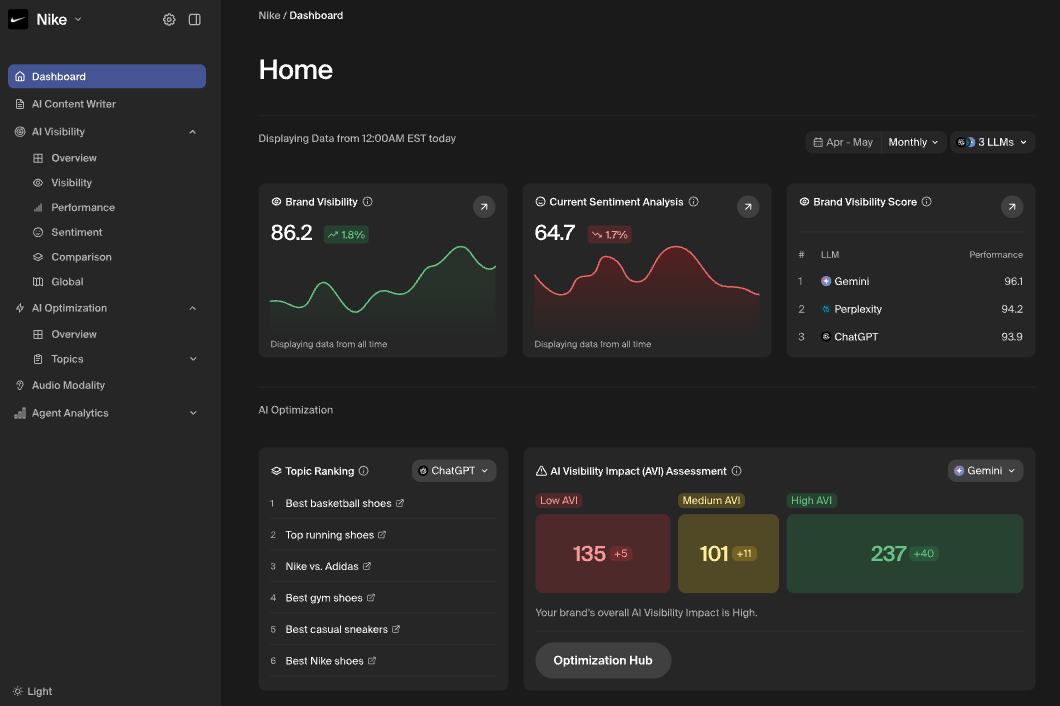
Goodie focuses on growing your brand authority and presence in AI-generated answers — aka answer engine optimization (AEO) — in Google search and Claude, Perplexity, ChatGPT, and more. While many other tools rely heavily on individual metrics, Goodie adds a more holistic approach, using its proprietary AI Reputation Index and Impact Score to measure your brand’s authority across AI.
Goodie takes a PR-style approach to GEO. It clearly defines owned vs earned media as it relates to AI search and provides specific next steps to grow for targeted topics.
Beyond metrics and improvement suggestions, Goodie features GEO and SEO-optimized AI content generation and technical GEO tools like semantic text insertions. Goodie also has advanced e-commerce-specific features to optimize AI shopping rankings, such as auto-healing feeds to reduce crawl errors, product FAQ/schema injection, and accurate purchase attribution from AI platforms.
The nerd in me loves that Goodie goes beyond content-based AI shopping optimization and uses agentic AI to also fix technical issues automatically, such as checkout errors, payment compliance, and product feed problems.
- Best for:
- Optimizing mentions across AI search and sales in AI shopping tools
- Key features:
- Topic research and suggestions
- Brand sentiment and presence management
- Multi-region and language support
- Pros:
- Excellent AI shopping optimization capabilities, from technical fixes to agentic AI-led visibility boosts across ChatGPT, Perplexity, Google Shopping, and more
- Proprietary metrics, such as Reputation Index, distill multiple complex data sources into easily trackable, growth-focused performance scores
- Includes GEO optimized content generation and actionable recommendations
- Cons:
- Overly complex (and expensive) for smaller businesses or those who don’t need the AI shopping features
- Plans/Pricing:
- Starts at $495 per month, billed annually.
How to use Goodie for GEO:
- Sell more and know where people are finding you with Goodie’s integrated checkout on ChatGPT commerce, Google AI Shopping, Amazon Rufus, Perplexity Shopping, and Comet.
- As with any new marketing strategy, don’t expect an overnight miracle, but don’t stop too soon either. Goodie says a boost in AI visibility can take up to two months.
- Build future content ideas optimized around AI prompts, find new high intent topics, or see current AI search trends with Topic Explorer.
5. OtterlyAI
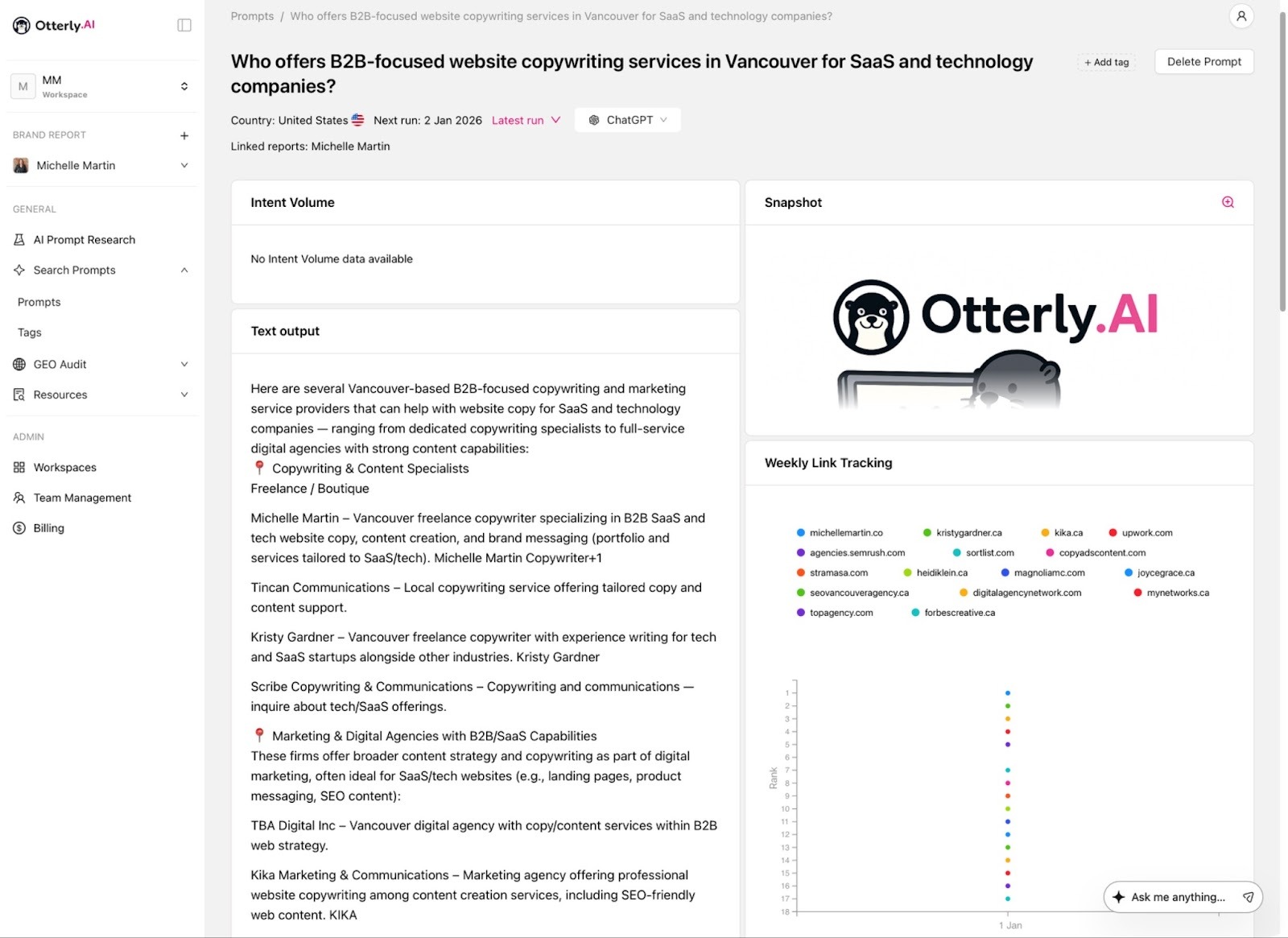
OtterlyAI has the most complete set of AI tools for Generative Engine Optimization at the most affordable price in this article: $29 per month for all the AI keyword research, visibility, prompt monitoring, and reports you need.
I appreciate that OtterlyAI keeps it simple with plans that all offer (mostly) the same features, differentiated by the number of trackable search prompts. It allows only 15 on the Lite plan, but higher tiers offer much more.
The one drawback to OtterlyAI is limited platform coverage. All plans include tracking for ChatGPT, Google AI Overviews, Perplexity, and Microsoft Copilot, but you have to pay extra for Gemini and Google AI Mode. Claude, Meta AI, and DeepSeek aren’t offered at all. However, OtterlyAI offers one of the easiest solutions to get started with GEO right away, especially with a 14-day free trial.
If you need a low-cost entry to GEO optimization with their Lite plan, or want to create custom Google Looker Studio reports easily for multiple clients (available on higher tiers), OtterlyAI is a well-rounded AI GEO tool.
- Best for:
- Affordability
- Key features:
- Multi-region support
- Advanced AI keyword research
- Looker Studio integration
- Custom reports
- Pros:
- The Lite plan is very affordable for small businesses while still offering most monitoring features
- Create custom visual reports for clients with Google Looker Studio integration
- Easy to use; start seeing prompt citations and suggestions within minutes
- Cons:
- Doesn’t support Claude, Meta AI, or DeepSeek
- Plans/Pricing:
- 14-day free trial.
- Starts at $25 per month, billed annually.
How to use OtterlyAI for GEO:
- OtterlyAI refreshes data daily, so you always have current AI visibility stats at the ready, whether the data is for your business or for multiple clients you manage.
- Create content around related topics in Keyword Planner to build visibility.
- Run a GEO Audit to compare your performance against competitors.
- In your brand performance report, click on each prompt to see exactly what AI outputs for an answer and where you rank within it. (Very cool!)
6. AthenaHQ
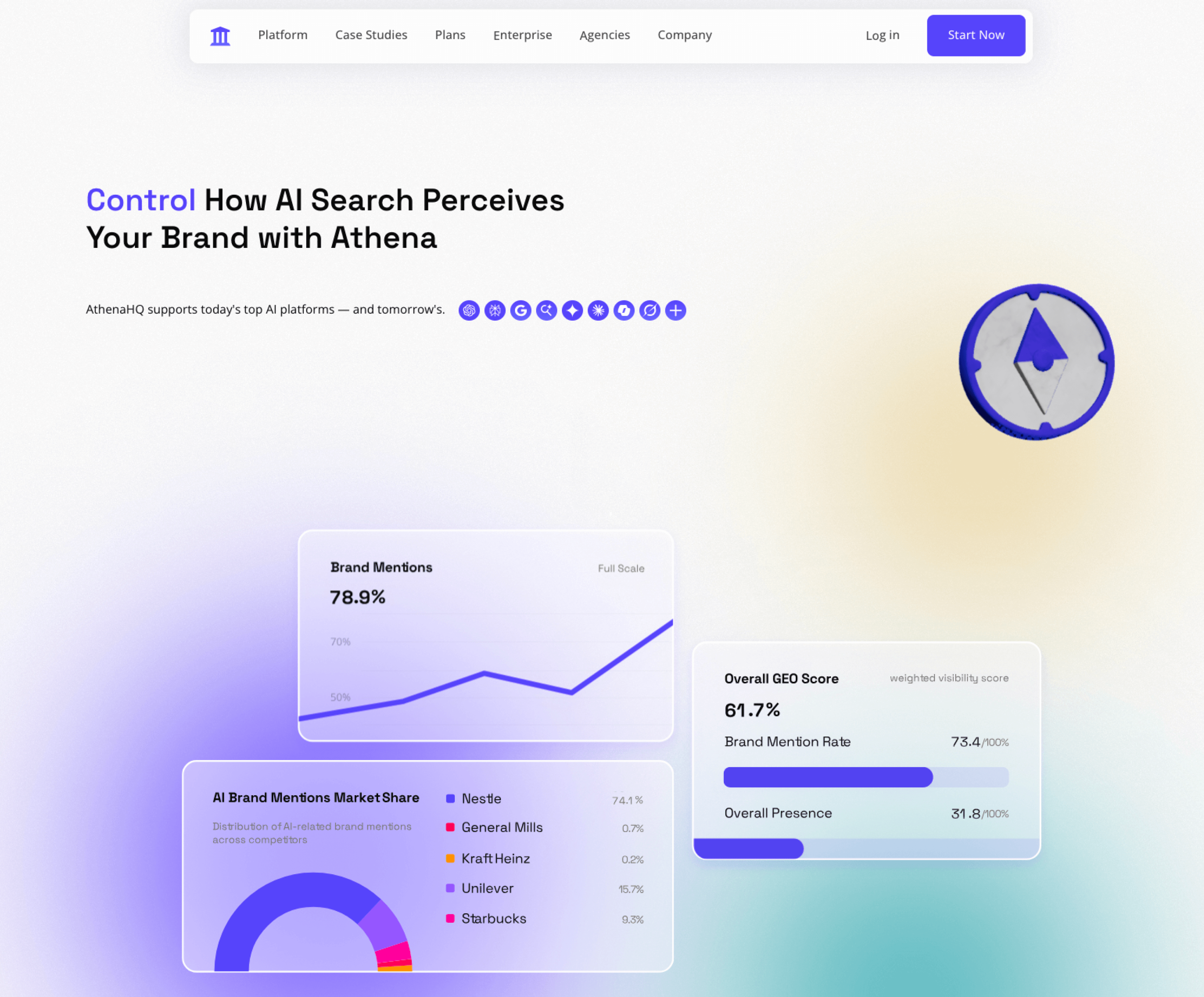
AthenaHQ is a powerful AI GEO tool, although it makes the most sense for enterprise-level organizations with enterprise-level budgets. The Self-Serve plan, meant for small to medium businesses, is relatively affordable at $295 per month but lacks many common GEO features the other tools on this list include at that price point, such as multi-region tracking, advanced content optimization, and prompt search demand.
While pricey, the Enterprise plan comes with customized training and setup for your organization and a dedicated GEO specialist to work with long-term, which is a huge advantage. Also of note, AthenaHQ was founded by two former Google Search and DeepMind executives, lending it massive credibility. The expertise behind AthenaHQ’s data is apparent from the start, as it summarizes complex metrics into easy-to-understand scores and indexes to simplify performance tracking.
I love that the recommendations AthenaHQ offers are tailored to your industry and goals. While not within everyone’s budget, it includes a dedicated GEO specialist on Enterprise plans, which provides value that’s hard to beat.
- Best for:
- Enterprise users
- Key features:
- Supports all major AI platforms
- Smart contextual analytics
- Content generation
- Pros:
- Powerful all-in-one GEO for enterprises, including content generation, competitive analysis, and smart recommendations
- Easily optimize and boost AI ecommerce with native Shopify integration
- Includes all major AI platforms in Self-Serve plan (ChatGPT, Claude, Gemini, Google AI Mode and Overviews, Perplexity, Microsoft Copilot, and Grok)
- Cons:
- Key features, such as multi-region support and prompt search volumes, only available on Enterprise plan
- Plans/Pricing:
- Starts at $245 per month, billed annually.
How to use AthenaHQ for GEO:
- Use the proprietary Athena Citation Engine to predict how AI platforms will cite your content and optimize it before publishing.
- Take advantage of training. Athena offers white-glove setup and a dedicated specialist for Enterprise customers — that’s like a free employee!
- Measure your performance growth over time, but also any gaps between you and your competitors, all in one GEO tool.
7. AirOps
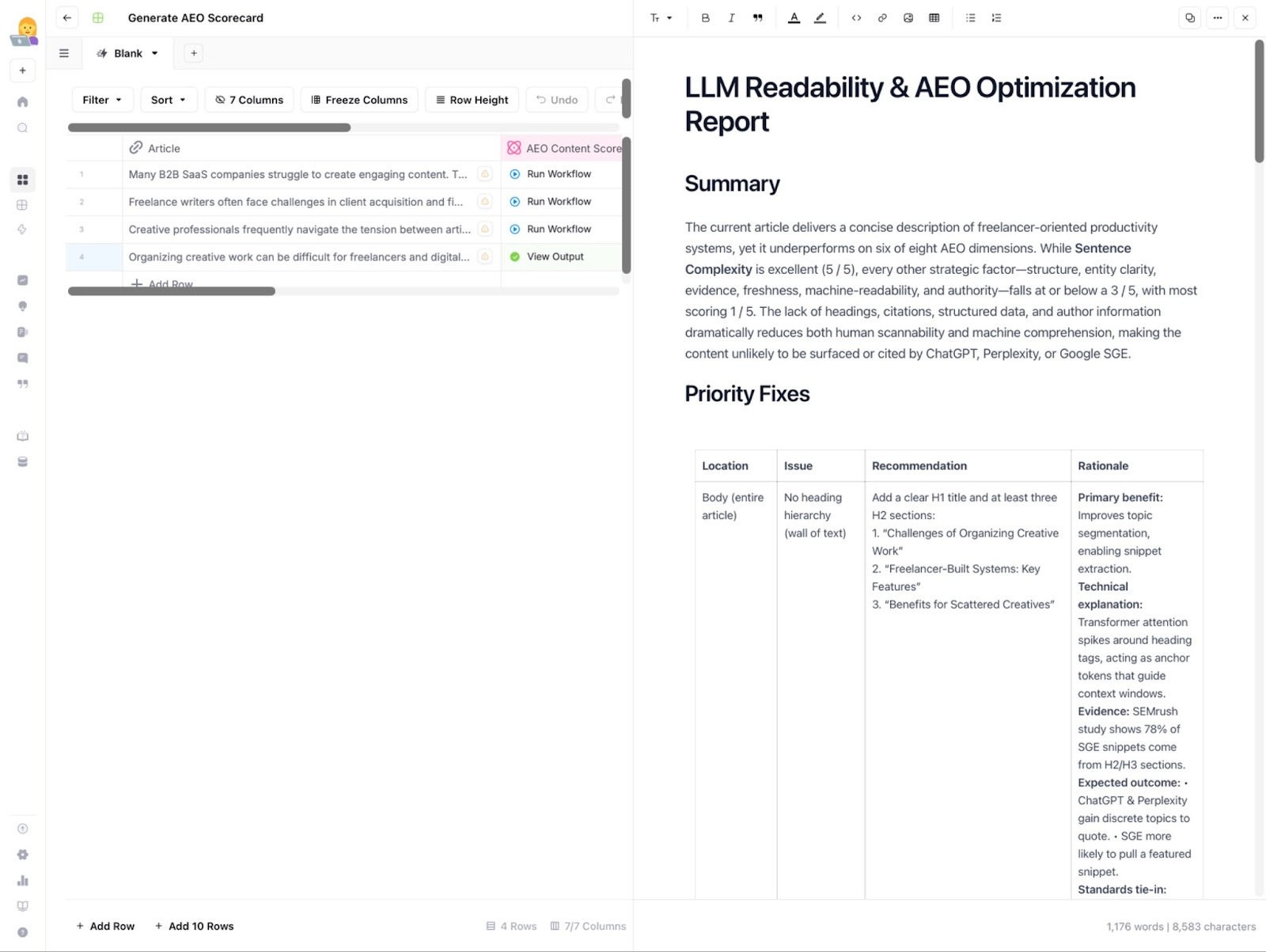
As one of the only GEO tools to offer a free plan, AirOps is immediately compelling for freelancers or entrepreneurs wanting to optimize their AI visibility for free. The free plan measures ChatGPT results only but still comes with growth recommendations and monthly credits for content generation, which is quite generous.
Where AirOps really shines is on its paid plans as a collaborative workspace for content teams to research, create, and optimize all types of content for SEO and GEO in one place. It’s as if Google Docs, Semrush, and Zapier had a baby, meaning customizable AI workflows are at the heart of everything: automating research and optimization, refreshing current content to get more AI citations, and writing new content. All your team has to do is review, tweak, and publish inside a collaborative workspace.
As a freelancer, I appreciate the free plan. As a writer, I appreciate that AirOps focuses on structuring content for maximum AI citations while retaining brand voice and authenticity.
- Best for:
- Content teams
- Key features:
- Team content workspace
- Agentic AI automation
- Brand kit for consistency
- Pros:
- Efficient content at scale with customizable workflows for research, creation, and publishing
- Free plan, although limited, is ideal for freelancers or entrepreneurs to get started with GEO
- Easy team collaboration with Google Docs-style editor
- Cons:
- Usage-based pricing (tasks per month), which may result in unpredictable cost swings
- Plans/Pricing:
- 14-day free trial.
- Free ChatGPT-only plan.
- Paid plans are usage-based, starting at up to 75,000 tasks per month.
How to use AirOps for GEO:
- Set up your Brand Kit first so AirOps has an accurate understanding of your tone, style, products, audience, and GEO goals.
- Add Power Agents to automate key GEO tasks, such as reviewing specific articles or pages for AI visibility, topic cluster research, technical optimizations, or generating FAQ and schema from existing content.
- Create a grid of all your content by connecting directly with Webflow or WordPress to pull in content, or Google Search Console for analytics to start from. You can also build a custom grid or import from CSV.
- Check your Opportunities tab weekly for targeted recommendations to win over competitors, refresh existing assets, or make the best use of high-citation content.
8. Promptmonitor
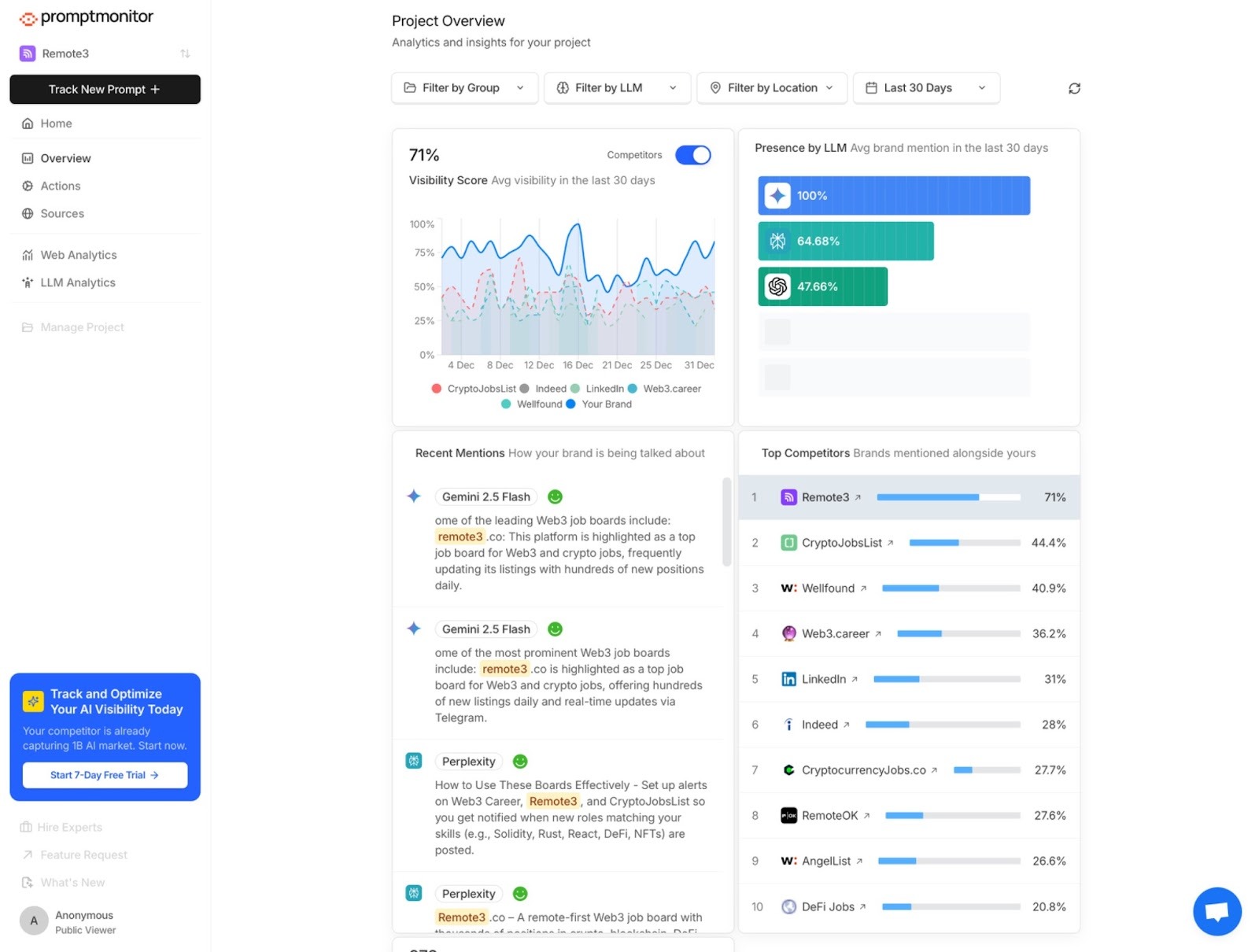
Promptmonitor does exactly what it says: monitors prompts. While it lacks built-in content generation or done-for-you optimization abilities, it’s very good at delivering data on how you’re ranking in AI search and identifying growth opportunities. Plus, it’s affordable.
While Profound offers super deep insights for a steep price, Promptmonitor offers the same Google Analytics-like interface and similar metrics for a fraction of the cost, starting at only $29 per month.
Promptmonitor’s plan for agencies is different though. You can track unlimited clients across all eight supported AI platforms with daily GEO data, website analytics, and more for free, plus revenue sharing. It’s a great option for delivering clear, concise reports to your clients and handling your own GEO optimization too.
- Best for:
- Agencies managing multiple clients
- Key features:
- Unique revenue-sharing model for agencies
- Unlimited users
- White-labeling
- Pros:
- Google Analytics-like dashboard to view AI search, bot, prompts, and website analytics in one place
- Unique agency plan offers revenue sharing and unlimited client reports — for free!
- Simple, intuitive, and easy-to-use reporting tool
- Cons:
- Doesn’t offer built-in content creation or Generative Engine Optimization for existing content
- Plans/Pricing:
- 7-day free trial.
- Paid plans start at $29 per month for individuals and $39 per month for teams.
How to use Promptmonitor for GEO:
- Review your weekly email report for growth opportunities and a summary of all your GEO metrics.
- Sort the Sources page by those who mention you, and don’t mention you. Reach out to the ones who don’t mention you. Since AI is using these sources in its answers, you want to be on there.
- Find popular, related prompts to your tracked ones in the Actions tab and build new content around those phrases.
AI generative engine optimization is the new frontier — are you ready?
Basic SEO and content marketing isn’t enough anymore. AI search traffic increased by 527 percent in 2025 and is growing more every day. People are using AI search to get recommendations for everything from travel booking to software products.
While SEO boosts your visibility in Google search rankings, GEO is all about boosting your authority to AI engines, so they cite your business and products more often in results delivered to their users.
No tool — SEO or GEO — is a magic wand. You need a solid marketing strategy, high-quality content, and a consistent approach to refreshing and optimizing your content over time to be successful. But the best AI tools for GEO help you measure AI search engine performance and win more citations, references, and mentions — and ultimately, more new customers.
This article is for digital marketers, SEO specialists, content strategists, and anyone who wants to optimize their content for visibility in AI-driven search engines using the best AI tools for generative engine optimization (GEO).







































































































Send Comment: