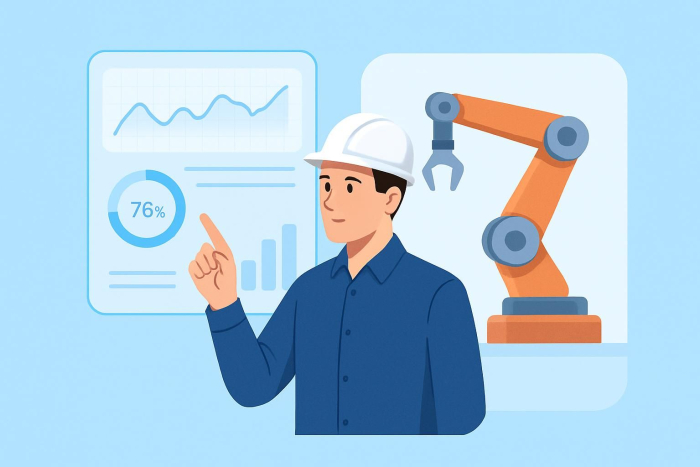
Downtime, equipment failures, and production bottlenecks are some of the everyday challenges manufacturers face. To address these issues, more and more companies are using AI in manufacturing. It helps in many ways, including analyzing sensor data, automating repetitive tasks, and spotting inefficiencies long before they impact output.
And adoption is gaining traction quickly. The global AI manufacturing market was valued at $5.32 billion in 2024 and is expected to soar to $47.88 billion by 2030. That’s a staggering compound annual growth rate of 46.5 percent. Machine learning is driving most of this growth, and North America is leading the charge with a 33.2 percent market share.
As factories embrace Industry 4.0, AI is fast becoming the backbone of intelligent, automated production systems. Get into the nitty-gritty of AI-powered manufacturing with us and explore how you can transform your manufacturing operations with AI.
What is AI in manufacturing?
AI in manufacturing refers to the use of artificial intelligence technologies, like machine learning (ML), robotics, and data analytics, to optimize factory operations. It brings intelligence and adaptability to every stage of production.
AI helps you automate tasks, improve efficiency, and make smarter, data-driven decisions that boost productivity and reduce downtime. And the impact goes far beyond automation.
Here are some artificial intelligence applications in manufacturing:
- Detect patterns and predict outcomes using real-time data analysis.
- Predict maintenance needs before equipment fails.
- Optimize production lines by adjusting workflows for maximum efficiency.
- Improve quality control by identifying defects with minimal manual effort.
- Optimize inventory levels by predicting demand and material usage accurately.
- Strengthen supply chain planning with smarter routing, sourcing, and logistics.
- Automate documentation and reporting to reduce manual admin work.
- Reduce energy consumption by adjusting machine usage in real time.
- Improve worker safety by detecting hazards and anomalies instantly.
- Speed up product customization by adjusting production parameters on the fly.
The evolution of smart factories
The foundation for today’s smart factories was laid in the 1970s, with the rise of computer-aided design and computer numerical control machines, which brought precision and repeatability to manufacturing.
Over the decades, automation evolved into the connected factory era, powered by Internet of Things (IoT) sensors, cloud computing, and predictive analytics, enabling real-time insights into every corner of production.
Industry 4.0, the fourth industrial revolution, is taking the evolution further — a new era where advanced technologies like AI, IoT, and automation merge physical production with digital intelligence.
Here’s how:
- IoT in manufacturing enables seamless connectivity across equipment.
- Machine learning in manufacturing drives adaptive decision-making.
- Robotics and collaborative robots (cobots) handle repetitive or high-risk tasks safely.
- AI-based quality assurance systems catch defects instantly.
Together, these tools are turning factories into intelligent systems that can adapt, predict, and optimize on their own.
Applications of AI in manufacturing
Here are some use cases showcasing how AI in manufacturing underpins smart manufacturing and business process automation, turning manual, reactive processes into intelligent, proactive ones:
- Supply chain optimization: AI helps manage inventory, forecast demand, plan logistics, and optimize supplier networks to ensure smooth operations.
- Customization: With AI, you can offer more tailored products without sacrificing efficiency. ML systems help balance variation and throughput, making personalized manufacturing scalable.
- Quality control: AI-enabled vision and analytics systems inspect products in real time, identifying defects or deviations faster than humans.
- Workplace safety: AI monitors equipment, environment, and worker activity to detect unsafe conditions or risky behaviors, enabling proactive intervention and safer operations.
- Autonomous material handling: Robots and AI-driven transport systems move materials, parts, and goods around the factory floor with minimal human intervention.
- Training and support: AI-driven simulations, digital twins, and augmented reality help train workers faster and support them during operations, reducing errors and ramp-up time.
- Market adaptation: Smart factories use AI to shift rapidly when demand or conditions change, such as switching product lines or reacting to supply shocks. This keeps operations flexible.
- Predictive maintenance: Companies like PepsiCo use predictive maintenance to reduce downtime, extend machine lifespans, and cut waste.
Benefits of AI in manufacturing
Here’s a snapshot of the key benefits manufacturing leaders are seeing from automation in production, AI-powered quality control, and other forms of AI agents on the factory floor:
- Increased productivity: AI systems take over repetitive, low-value tasks so human workers can focus on higher-value work, lifting overall output.
- Enhanced product quality: With AI-powered inspections and analytics, defects are caught early, which improves consistency.
- Reduced waste: By spotting inefficiencies and predicting errors before they occur, AI helps minimize raw material loss and scrap.
- Increased savings: Fewer breakdowns, fewer defects, less waste, and leaner operations translate into lower operational costs.
- Improved decision-making: Real-time data and predictive models give you actionable insights, replacing gut feel with evidence.
- Refined, real-time analytics: AI monitors everything from machine performance to supply chain signals, enabling rapid responses to changes.
- Enhanced safety: Smart sensors and AI analysis detect risky conditions or unsafe behaviors, helping prevent injuries or incidents.
- Improved sustainability: Optimized energy use, reduced waste, and smarter logistics all contribute to greener operations.
- Accelerated innovation: AI frees up resources and provides insights, enabling faster iteration and development of new products or processes.
- Decreased time to market: With more automated workflows, smarter manufacturing, and fewer delays, new products hit the floor sooner.
AI manufacturing challenges
Implementing machine learning for manufacturing is exciting, but it’s far from plug and play. Several practical hurdles stand in the way of factories fully harnessing AI agents and automation in production.
High initial costs
Deploying AI systems isn’t cheap. Development and integration costs vary widely, with some projects starting at around $50,000 and scaling to $500,000 depending on complexity. These costs include model development, data preparation, infrastructure, and software licenses.
While many off-the-shelf AI tools exist, most factories still need some level of customization to fit unique workflows and legacy equipment, which drives costs up. For manufacturers, this means a large up-front investment that must be justified by future savings.
Workforce upskilling and talent readiness
Even if the technology is ready, the people often aren’t. A recent survey found that 59 percent of the manufacturing workforce is not ready to effectively use AI-driven tools.
That means your operators, engineers, and managers may need new skills in data analysis, ML logic, and digital workflows — training that takes time and resources.
Cybersecurity and data concerns
As factories become smarter, they also become more vulnerable. AI systems rely on massive data flows, often across operational technology and IT systems. This convergence introduces threats like data poisoning, IP leakage, and attack vectors unique to AI environments.
Also, sharing sensitive production data with cloud services or external vendors may raise concerns about privacy and data sovereignty.
Data quality, integration, and complexity limitations
If your sensor data is inconsistent or poorly structured, AI models can deliver flawed results, such as forecasting errors or wrong defect detections. Plus, integrating AI with legacy equipment, enterprise resource planning systems, and production workflows is rarely straightforward.
Not to mention some complex scenarios simply defy neat algorithmic modeling. Edge cases remain a challenge for many AI agents.
Regulatory compliance and ethical risks
As manufacturers deploy AI and automation inside regulated sectors or sensitive environments, navigating complex compliance requirements becomes a serious challenge. Companies must ensure that AI tools adhere to safety standards, environmental rules, labor regulations, and emerging laws — for example, around the EU’s AI Act or data privacy frameworks.
Ethical issues like algorithmic transparency, bias, and liability also come into play: if an AI-powered decision leads to a product defect or safety issue, responsibility and governance need to be clearly defined.
Supply chain resilience and external dependencies
Even if the factory itself has strong AI systems, external dependencies in raw materials, logistics, suppliers, or geopolitical disruption can derail the best-laid plans. Manufacturers face risks when their supply chain data is incomplete, suppliers don’t share data, or global disruptions make predictions unreliable.
AI models also depend heavily on upstream data and stable inputs — if supplier data is inconsistent or there’s a sudden shortage or disruption, that can limit effectiveness and reduce resilience.
AI manufacturing trends
The next wave of business automation trends in manufacturing leans heavily on industrial machine learning and AI tools for factories. Here’s what to expect.
Digital twins and real-time simulation
Digital twins are virtual replicas of machines, processes, or whole factories that use real-time IoT sensor data and AI models to simulate operations. These systems allow manufacturers to test production changes virtually before implementing them on the floor, reducing risk and wasted time.
For example, at the 2025 Microsoft Ignite event, Synopsys Inc. demonstrated a digital twin framework optimizing a bottle-filling line in near real time. The market momentum is strong: adoption of digital twin technology in manufacturing is growing rapidly.
Industrial machine learning across production lines
Industrial machine learning is shifting from pilot projects to scaled deployments in manufacturing. ML models now handle defect detection, forecast maintenance, optimize energy use, and dynamically adapt production flows.
According to McKinsey, many factories took 10 to 20 months to deploy their first ML use case, but once set up, ramp-up time shrank to weeks or days. The result is an environment where production systems become more adaptive and efficient using data-driven decision-making.
Autonomous robots, cobots, and material-handling automation
Automation in manufacturing is advancing from fixed robots to autonomous mobile robots (AMRs), cobots, and other AI-enabled systems that work alongside humans or independently.
For instance, Rockwell Automation recently rolled out its first AMRs in Milwaukee, WI, showcasing how advanced material-handling robots are being built at scale. This trend helps manufacturers reduce labor risk, increase throughput, and deploy smart manufacturing in real-world factories.
AI agents and smart assistants in manufacturing workflows
AI agents — autonomous software entities that plan, act, and learn — are becoming integral to factory workflows and decision support. They might monitor supply chains, assign maintenance crews, or assist operators with real-time suggestions.
A 2025 McKinsey study projected that the AI agent market would grow significantly and noted that 23 percent of companies were already scaling such systems. In manufacturing, these tools bridge human and machine, enabling smarter operations with less manual overhead.
Sustainability and energy-efficient smart manufacturing
Manufacturers are increasingly using AI to meet sustainability goals — optimizing energy use, reducing waste, and lowering carbon emissions. AI tools analyze material flows, recommend greener materials, and adjust operations in real time to minimize environmental footprints.
For example, AI is now used to detect emission hotspots, optimize production in line with renewable energy supply, and design eco-friendly products.Given regulatory pressures and corporate commitments, sustainability via AI is moving from a nice-to-have to a strategic necessity.
How Jotform’s AI Agents unlock productivity in manufacturing
Jotform’s AI Agents allow you to create highly customized AI Agents by uploading key documents, conversational prompting, or even sharing a link to your website. Your team can use your custom AI Agent to simplify key processes — without sinking valuable time and resources on tools with steep learning curves:
- 24-7 customer support: Jotform’s AI Agents can provide round-the-clock support after hours, on weekends, or whenever your customer satisfaction team could use extra coverage.
- Embedded chatbot: Embed your custom AI Agent into your website, answering any questions a potential lead or customer might have.
- Automated presentations: Jotform’s Presentation Agent can help you create high-quality slideshows and even present them for you, answering both chat and voice questions in real time.
- AI voice calling: Connect your AI Agent to your phone system to help answer questions and direct calls, providing instant support.
- AI assistants: Let your AI Agent manage your schedule for you — it can do everything from scheduling important meetings to answering FAQs to free up your time for more urgent requests.
Transform your manufacturing operations with AI
AI is transforming manufacturing operations by automating data collection, quality checks, and workflows, freeing your teams to focus on strategy instead of repetitive tasks.
With Jotform’s Manufacturing AI Agents, you can deploy ready-to-use tools that bring AI in manufacturing and customer service automation to life.
Explore Jotform’s Manufacturing AI Agents to unlock these same benefits and roll out the best AI chatbots tailored for your factory today.
This article is for manufacturing leaders, operations managers, IT teams, and digital transformation professionals exploring how AI enables smarter factories, improves efficiency, reduces downtime, and supports scalable, data-driven manufacturing operations.
























































































Send Comment: