Salesforce helps you track contacts, leads, and opportunities throughout the entire sales process, from the first interaction to closing deals. With Jotform, you can capture information at the very first touchpoint and send it directly into Salesforce, eliminating manual data entry and keeping your Customer Relationship Management (CRM) accurate and up to date.
Jotform offers two ways to connect with Salesforce:
- Salesforce Integration via Forms — Map your form fields to Salesforce objects and automatically create records from submissions.
- Salesforce Agent — Use an AI-powered assistant that automates tasks, manages records, and provides actionable insights.
Salesforce Integration via Forms
You have the following options to integrate your form with Salesforce:
- Integrate your form with Salesforce through Jotform’s Form Builder
- Add Jotform’s App to Salesforce from Salesforce AppExchange
Adding Jotform to Salesforce through AppExchange is a great option if you love Jotform but want to stay within the Salesforce ecosystem. Once you add it, you’ll have a Salesforce button on your forms so you can easily map your form fields to object fields and automatically create records from Jotform submissions.
Best Practices for Field Mapping
Using the right Jotform elements is essential for clean, accurate data transfer to Salesforce. Below, we’ll cover the recommended elements for different types of data and why they work best for integration.
Full Name Element
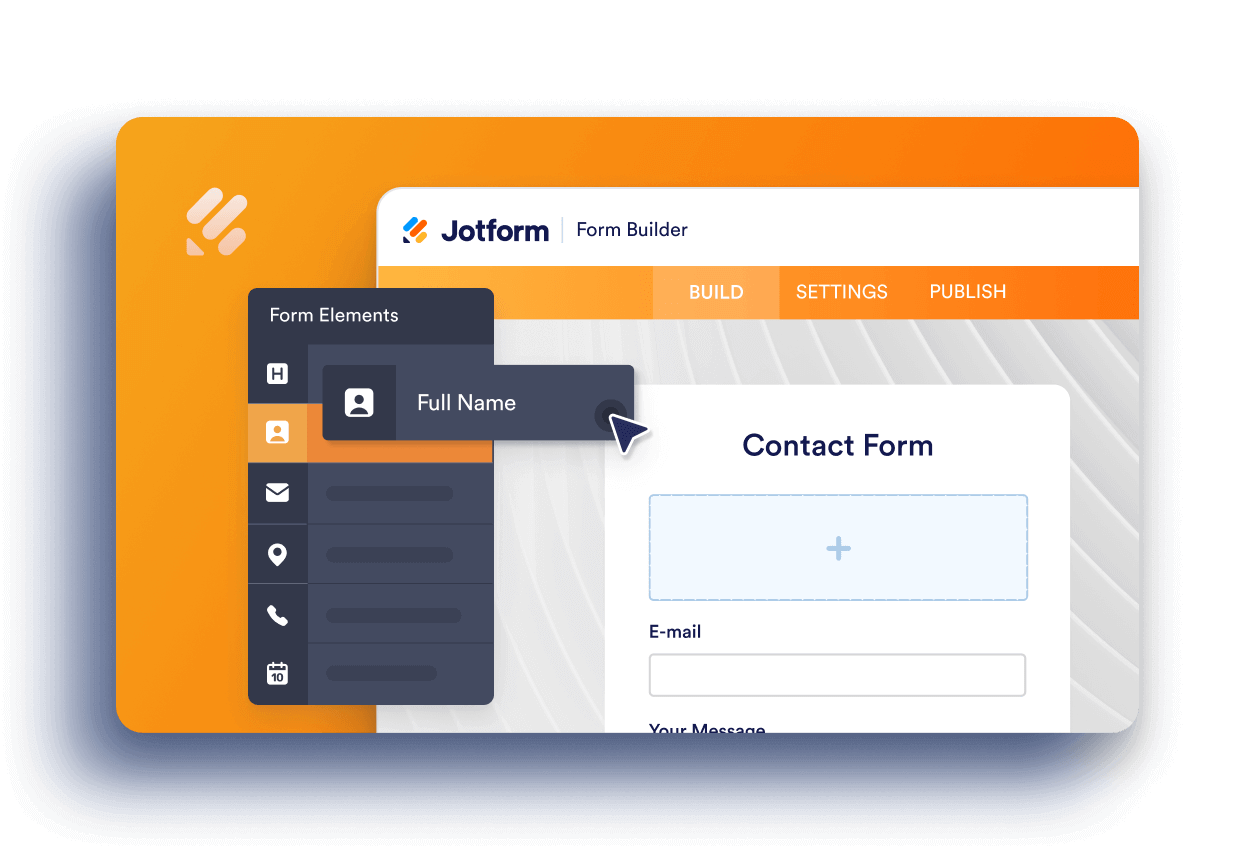
While many use the Short Text element for customer names, Jotform’s Full Name element, found under the Basic Elements tab, integrates more smoothly with Salesforce. And you can easily toggle on additional options like Prefix, Middle Name, and Suffix when needed.

The Full Name element gives you several advantages:
- Complete Data Mapping — All the name components can be passed directly to Salesforce.
- Responsive Design — The field adjusts perfectly on mobile and desktop.
- Organized Structure — It combines related fields into one element, simplifying data viewing, conditions, and integrations.
Jotform’s smart mapping system automatically matches the Full Name field with its Salesforce equivalent. During setup, you’ll typically just need to review and confirm the default mappings.
Address Element
Using the Address element instead of separate Short Text or Long Text fields ensures seamless integration with Salesforce, making data mapping and syncing much easier. In Address Properties, you can select which parts of the address to show or hide, such as the Street Address, City, State/Province, Postal Code, and Country, depending on what you need.

Email Element
Although you could use a Short Text element with email validation, we recommend using the Email element. It’s specifically designed for capturing email addresses, ensuring proper formatting and smoother integration with Salesforce.

Phone Element
Go with the Phone element for collecting phone numbers. It keeps everything formatted correctly and plays nicely with Salesforce, so you don’t have to worry about messy data.

Short Text Element for Custom Fields
Sometimes you may need to connect your Jotform fields to custom fields in Salesforce. The Short Text element is ideal for that.
For example, if you want to pass a custom field like:
<input type="hidden" value="Responded" name="member_status">Simply add a Short Text element, set the value you want in the Default Value field, and map it to the corresponding Salesforce field.

Try it out and see what it looks like on this Demo Form.
Salesforce Agent
Salesforce helps you manage customer relationships from the first interaction until you close the deal. Jotform, on the other hand, captures data and user interactions with ease. When combined with the Salesforce Agent, you can automate the way your AI Agent retrieves, uses, and shares Salesforce data—turning customer conversations into smarter, data-driven actions.
Here are a few ways your Salesforce Agent can enhance your workflow:
- Automate Updates — Let your Salesforce Agent create or update Salesforce records automatically.
- Access Knowledge Articles — Salesforce Agents can pull relevant Salesforce articles to answer customer questions accurately.
- Sync Data in Real Time — Keep Salesforce and Jotform data aligned without manual input.
- Improve Response Time — Use Salesforce data to provide instant, informed responses.
Connecting Your Salesforce Agent
Jotform makes it easy to connect your Salesforce Agent and control what data it can access. You can quickly link your agent to Salesforce and pick a template with the object types or articles that match your customer questions. Our guide on How to Connect Your Salesforce Agent to Salesforce is a great place to start.

Training Your Agent to Use Salesforce Knowledge Articles
Jotform lets you train your Salesforce Agent to answer customer questions accurately using templates you pick. You can pull in your Salesforce Knowledge Articles, relevant records, or even a pre-made Knowledge Base to get set up faster. This way, your agent focuses only on the info that matters for your workflow. Our guide on How to Train Your Agent to Use Salesforce Knowledge Articles walks you through everything.

Pro Tip
When selecting templates, choose those that match the most common customer questions or key records your team frequently accesses. This helps your Salesforce Agent provide accurate answers faster and reduces irrelevant responses.
Testing Your Salesforce Agent Before Going Live
Before deploying your Salesforce Agent, it’s important to test how it responds to what your customers ask. Use sample questions, verify answers against your Salesforce data or Knowledge Articles, and make adjustments as needed. Testing ensures your agent delivers accurate, helpful responses and avoids unexpected errors in real interactions. For a quick how-to, check out our guide on Testing Your Salesforce Agent Before Going Live.

Checking Integration Logs for Salesforce Agent
Jotform makes it easy to monitor your Salesforce Agent directly from the Conversation page. Here, you can review the data accessed, actions performed, and any errors encountered, helping you ensure your Agent is working correctly and securely. Want a step-by-step walkthrough? Our guide on How to Check Integration Logs of Your Salesforce Agent has you covered.

Understanding Field Fill Options in Salesforce Agent
Jotform’s Salesforce Agent offers multiple ways to map form data to your Salesforce fields. You can let the Agent ask for details in chat, generate responses using AI, use a static value, or fetch existing data through a lookup. Each method helps you control how your agent reads, writes, or updates information in Salesforce. Explore our guide on Understanding Field Fill Options in Salesforce Agent to dive in deeper.

And that’s it! With your Salesforce Agent connected, it can now act as a smart CRM assistant—syncing data, pulling records, and responding with Salesforce-backed information automatically.


Send Comment:
4 Comments:
November 1, 2023
We want clients to update some Salesforce fields but some of them are picklists. How do we get the picklists to populate in Jotform?
August 28, 2023
Does Jotform have ability to create multiple related record.
For example if Object A is created then there will be one or more records for object B. Consider Opportunity and Opportunity Line Item.
Can they be pushed all in one form submission.?
July 14, 2022
We are a Salesforce service cloud customer who uses both web to case and email to case. Does the Jot Form map fields to case object using Web to Case or Email to Case?
November 2, 2021
I've followed all the steps perfectly to integrate my form with Salesforce and it NEVER works. I get the submission email, but have yet to ever have any data get through to Salesforce.