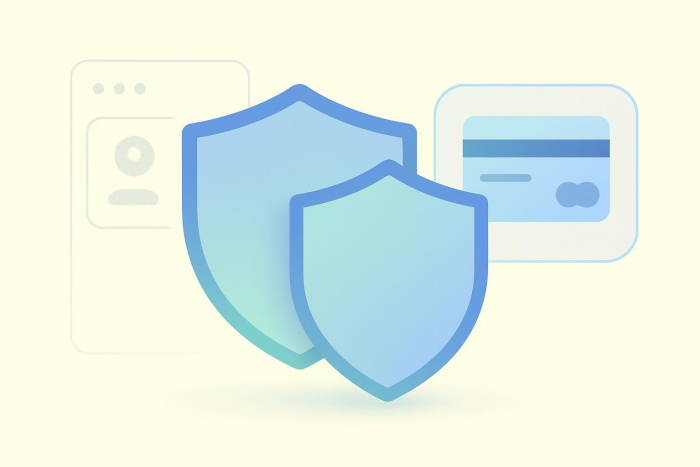
- PII (Personally Identifiable Information) is any data that can identify an individual, either on its own or when combined with other information, such as a name, email address, or phone number.
- PCI (Payment Card Information) refers specifically to credit and debit card data used to process payments, including card numbers, expiration dates, and CVV codes, and is regulated under the PCI DSS standard.
While both are sensitive, PCI data is subject to stricter security requirements because exposure can directly lead to payment fraud.
When building a single online form, you might collect a name, email, phone number, and a payment at the end. All of this information may seem like “user data.” But data security professionals and compliance officers know that there are two completely different types of sensitive data being collected here, each with its own set of rules.
The name, email, and phone number are considered personally identifiable information, or PII, which is data used to identify an individual. The credit card details at the end of the form are payment card information, or PCI, which is subject to strict industry security standards.
Treating these data types the same can lead to security gaps, compliance issues, and unnecessary exposure. Whether you’re managing patient intake forms, onboarding employees, or accepting online payments, understanding the difference between PII and PCI is the first step toward securely collecting and managing sensitive data.
Follow along to learn more about the meaning of PII and PCI, the difference between them, and how tools like Jotform help securely collect and manage both.
What counts as PII?
PII is considered to be any data used to recognize or identify a specific person. It can be something obvious, like a name or email address, or details that become identifiable when combined with other information, such as a job title paired with a company name or a ZIP code paired with a date of birth.
Organizations collect PII through everyday business activities, such as contact forms and employee onboarding, as well as in healthcare intake and customer support. Because this data is associated with real people, privacy laws like the General Data Protection Regulation (GDPR) and the Health Insurance Portability and Accountability Act (HIPAA) often require businesses to limit access, keep it secure, and be transparent about how it’s collected and used.
Common examples of PII
- Full name: First and last names are the most common identifiers on forms, which are often paired with other details to confirm who someone is.
- Email address: An email address is often required for communication and login access.
- Phone number: Phone numbers can be collected for verification, customer support, or notifications.
- Home or mailing address: An address is often required for billing, shipping, or verification purposes.
- Government-issued identification numbers: Highly sensitive Social Security numbers (SSNs) or national ID numbers can be required by an employer, bank, or medical provider.
A phone number or email on its own may not qualify as PII, but when paired with a full name and address, it can help to confirm someone’s identity.
What counts as PCI?
When comparing PII data and PCI data, PCI refers to any data that identifies a cardholder or account during credit and debit card payment processing. This includes the information you enter when making an online payment, as well as certain authentication details used to authorize that payment.
Common examples can include a credit or debit card number, the expiration date, or the card verification value (CVV). Even more sensitive information, like personal identification numbers (PINs) or full magnetic stripe data, also falls under PCI and is subject to stricter handling requirements. This data is heavily regulated because, if it were to land in the wrong hands, exposure could lead to fraud.
Businesses that accept credit card payments must comply with the Payment Card Industry Data Security Standard, or PCI DSS. Think of PCI DSS as a global rulebook for protecting payment data; it covers requirements for using encryption, limiting who can access card data, and avoiding storage of sensitive authentication data whenever possible.
Managing this information alone can get complex, especially for small businesses. That’s why many business owners simplify compliance by using secure payment processors, like Stripe and PayPal, which handle card data for them. Processors take care of the most sensitive parts of a transaction, so you don’t have to store or manage credit card details, therefore reducing both risk and administrative burden.
Common examples of PCI
- Credit or debit card number: Located on the back of a credit or debit card, this 15- or 16-digit number is often needed to complete a transaction.
- Expiration date: Also found on the back of a credit or debit card, the expiration date includes a month and year, formatted as MM/YY.
- CVV: This is a three- or four-digit security code on the back of a credit or debit card that’s also needed to make purchases online or over the phone.
- PINs: These codes are created by the cardholder and used to authorize transactions, such as an ATM withdrawal.
Keep in mind that PCI data is highly sensitive and requires protections that exceed those for general personal information.
Comparison table: PII vs PCI
This side-by-side comparison breaks down PII vs PCI to show you how they differ in scope, regulation, and risk.
| Aspects | PII | PCI |
|---|---|---|
Definition |
Any information that identifies a specific person, either on its own or when combined with other data |
Payment-related data that processes credit or debit card transactions |
Examples |
Name, email address, phone number, home address, date of birth, SSN |
Credit or debit card number, expiration date, CVV code, PIN |
Regulations |
Protected under privacy laws like GDPR, HIPAA, and California Consumer Privacy Act (CCPA), depending on how and where it’s used |
Regulated by PCI DSS |
Risk |
Can lead to identity theft, privacy violations, and damaged customer trust if breached |
Can result in payment fraud, chargebacks, fines, and the loss of card processing privileges if exposed |
Compliance focus |
Limiting access, secureing stored data, and being transparent about how personal information is collected and used |
Avoiding storage of sensitive card data, encrypting payment info, and using compliant payment processors |
Key differences between PII and PCI data
When comparing the difference between PII and PCI, it all comes down to scope. PII covers a wide range of personal information, including full names, contact information (e.g., phone numbers, addresses, emails), and government-issued IDs. Meanwhile, PCI applies to payment data used to process credit and debit card transactions.
The rules are also different, with privacy laws shifting by region and industry. PII can fall under privacy regulations such as GDPR, HIPAA, and CCPA. PCI data is governed by PCI DSS, a global data security standard enforced by major card networks. PCI DSS applies to any company that accepts card payments, no matter where it’s based.
Unlike a system outage or a broken form, a data breach cannot be undone. When PII gets exposed, it can lead to identity theft, privacy violations, or misuse of personal details. PCI breaches could result in payment fraud, chargebacks, and hefty fines, with card companies able to impose penalties ranging from thousands to millions of dollars, depending on the scope of the breach. Businesses may also face monthly noncompliance fees until they restore PCI DSS compliance.
In some cases, businesses can lose their card processing capabilities altogether. According to the Identity Theft Resource Center, millions of personal and financial records are compromised every year, underscoring the seriousness of mishandling this data. This raises an important question: What can an organization do to keep its data safe?
Knowing which category your data falls into and how it needs to be protected are important, but they’re only part of the equation. None of it matters if you don’t put an actual plan into place. And that starts with finding the right tools to support your security and compliance.
A secure way to collect PII and PCI: Jotform
Collecting PII and PCI data is unavoidable for many businesses. From intake forms and onboarding paperwork to payments and donations, sensitive information often lives in the same workflow. What’s important is that your team is adequately equipped to handle each data type correctly without the process slowing them down or introducing unnecessary risk.
That’s where tools like Jotform come in. Because of the security protocols Jotform follows, businesses can build secure forms and compliant workflows for collecting both personal and payment data, with data security built into every step. This makes it easier for teams to stay compliant without needing extensive data protection expertise.
HIPAA and PII collection via Jotform Form Builder
Collecting personal information is part of everyday business, especially in industries like human resources and insurance. The challenge is doing so in a way that feels simple for users while still meeting strict privacy requirements behind the scenes.
Jotform’s HIPAA-friendly form builder makes it easier to collect and manage PII without overcomplicating the process. Whenever you create a patient intake form, onboard new employees, or gather insurance claim details, you can create forms quickly with a drag-and-drop builder. Each question field is added with a single click, making it easy to customize forms based on your workflow without starting from scratch.
Jotform’s key features for compliant PII collection include
- Data encryption to help protect information while it’s being transmitted and stored
- Access controls that limit who can view or manage sensitive data
- Password protection for forms and submissions, adding an extra layer of security
- Secure cloud storage to keep collected data protected and organized
Together, these features help teams simplify how they collect sensitive information while maintaining the privacy and trust users expect.
PCI-compliant payments with Jotform
Collecting payments online requires a higher level of security than gathering most basic personal information. The PCI DSS governs the processing and collection of credit and debit card data to prevent identity theft and payment fraud from happening.
Jotform supports PCI-compliant payments by integrating with trusted payment processors such as Stripe, PayPal, and Square. Instead of storing full credit card numbers or security codes, payment information is sent directly to the processor handling the transaction, reducing the sensitive payment data a business needs to manage.
This approach makes it easier to accept payments while minimizing risk. It works across use cases such as donations, telehealth billing, and e-commerce, where secure and compliant payment collection is essential.
Why understanding PII and PCI matters
PII and PCI are two very different types of sensitive data that both require careful handling, which is why businesses that treat them as if they’re the same could face not only organizational challenges but also compliance and legal risks. Using tools built for secure data handling, like Jotform’s HIPAA-friendly form builder and PCI-compliant payment integrations, helps businesses collect personal and payment data in a single workflow without introducing unnecessary risk.
FAQ
A SSN is considered PII because it uniquely identifies an individual and is not related to payment information, such as a credit or debit card number, which is considered PCI.
PII refers to information that can be used to identify a person. It can do so on its own or when combined with other details, such as a full name, email address, phone number, and home address.
This article is for data security professionals, compliance officers, digital form builders, and anyone who wants to understand the difference between PII and PCI data to ensure proper handling and regulatory compliance.





















Send Comment: