

Task List Templates

Employee Task List Template
Assign tasks to your employees and monitor progress with a free Employee Task List Template. Easy to customize. Available in spreadsheet or calendar view.
Go to Category:Human Resources Templates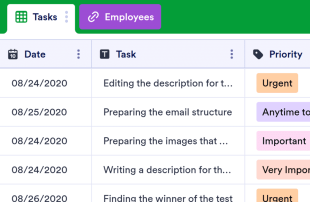
Prioritized Daily Task List
Prioritize your tasks with an online Prioritized Daily Task list. Switch between spreadsheet, calendar, or card view. Customize and update on any device.
Go to Category:List Templates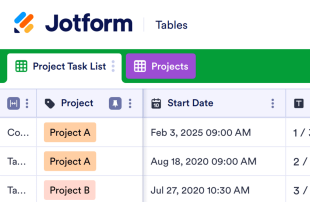
Task Tracker
Stay on track with your tasks using our free online Task Tracker. View info in the calendar or spreadsheet format. Easy to customize, download, and share.
Go to Category:Task List Templates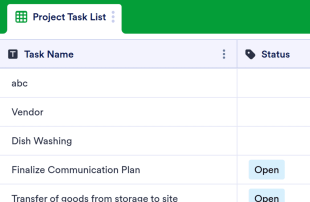
Project Task List Template
Manage your work tasks in a professional online spreadsheet. Auto-populates via a shareable online form. View in spreadsheet, card, or calendar format.
Go to Category:List Templates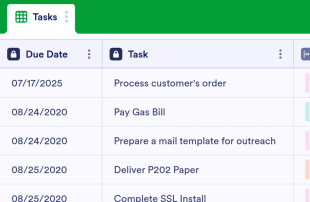
Daily Task List Template
Track daily tasks with this free online spreadsheet. Easy to view and fill out on any device. Customize, download, share, and print in seconds. No coding.
Go to Category:List Templates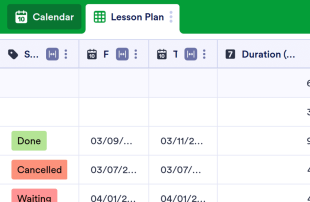
Yearly Lesson Plan Template
Create and track your yearly lesson plan with Jotform. Great for teachers and professors. View information in a spreadsheet or calendar. Customize without coding.
Go to Category:Education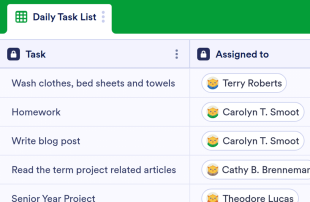
Task Checklist Template
Keep track of your tasks with this free task checklist template. Easy to customize and share. Works great on any device. No coding required.
Go to Category:Checklist Templates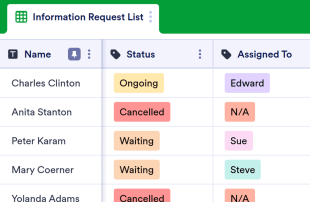
Information Request Tracker
Store and manage information requests easily and online. Use advanced filtering and labeling capabilities. Customizable without coding.
Go to Category:Task List Templates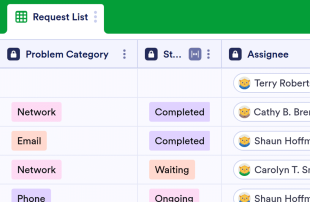
IT Service Request Tracker
Store and manage IT requests to better manage your tasks. Don’t miss any important task. Customizable and free. Accessible on all devices.
Go to Category:Task List Templates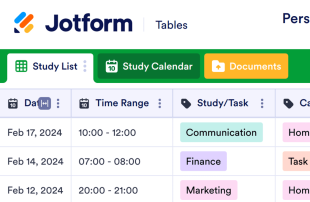
Personal Study Plan Template
Keep track of your educational milestones with a personal study plan. Easy to customize and share. Great for schools or educational programs. Store data.
Go to Category:EducationAbout Task List Templates
Task List Templates in Jotform Tables serve as customizable table templates specifically designed for organizing and managing records collected via Jotform Forms. These templates are crucial for collecting and handling category-specific information such as project requests, employee evaluations, customer feedback, or product orders. Form owners in various industries like education, healthcare, or business management find these templates invaluable for systematically managing submissions. By automatically organizing information collected through Jotform Forms, these tables ensure that form owners and their teams can efficiently review and act upon the data, all within a structured and easily accessible format.
Jotform Tables is the central hub where submissions from connected Jotform Forms automatically appear, enabling seamless management of each response. Each submission is transformed into an entry, typically displayed as a row in Table View or examined in Detail View. Users benefit from a variety of organizational tools such as search functions, filters, and data grouping, as well as different viewing options like Calendar View and Report View to enhance the review process. While manual entry and CSV or Excel import are available, the primary narrative focuses on the automated form-to-table submission workflow, which is integral to the efficient management of incoming data.
Why Use Task List Templates?
- Streamlining the management of form submissions is a key benefit, as Task List Templates eliminate the need for manual data transfer from forms to tables, ensuring all responses are captured in one centralized location.
- By utilizing these templates, form owners can keep all collected responses organized, making it easier to find and access records quickly when needed, which enhances efficiency and productivity.
- Task List Templates allow for comprehensive review and analysis of submission details, enabling users to coordinate follow-up actions effectively and maintain continuity in workflows.
- With the ability to track changes and report on collected data, these tables provide form owners with the tools needed to monitor trends and make informed decisions based on real-time information.
- The capability to search and filter submissions by specific criteria means that users can quickly locate specific entries, reducing the time spent sifting through large volumes of data.
Common Problems Solved by Task List Templates
- Many users struggle with manually copying submissions from forms into spreadsheets, a time-consuming process that Task List Templates resolve by automatically capturing responses in the connected table.
- Responses scattered across different systems or documents can lead to inefficiencies, which these tables address by centralizing all incoming data in one accessible location.
- Locating specific records can be challenging when dealing with a high volume of submissions, but the search and filter capabilities in Jotform Tables make this task straightforward and efficient.
- Inconsistent review processes can lead to errors or overlooked information. Task List Templates provide a structured format for reviewing each submission, ensuring thorough and consistent evaluation.
- Submissions that include uploads can be difficult to review without the proper tools, but with Uploads View, users can easily manage and access attached files alongside other submission data.
Matching Form Submission Use Cases to Jotform Tables Features
- When form owners collect data through Jotform Forms, the responses automatically populate the connected table, streamlining data entry and ensuring that all submissions are captured efficiently.
- Reviewing and organizing submissions is made simple with Table View and Detail View, allowing users to examine each entry thoroughly and categorize data using column types or grouping.
- For teams managing shared responsibilities, access settings and assignees enable effective collaboration, ensuring that each team member can contribute to the workflow while maintaining data integrity.
- Reporting on collected data is facilitated by Report View, which allows users to generate insights and share findings, enhancing decision-making processes based on analyzed data.
- Utilizing search and filter functions, form owners can efficiently sift through submissions to identify specific entries, reducing the time spent managing large datasets and improving overall productivity.
How to Use Task List Templates with Jotform Forms
- Begin by selecting a category-relevant Jotform Tables template, a blank table, or the table connected to an existing Jotform Form. The Jotform Form will collect the necessary category-specific information, and new responses will automatically appear in the connected table.
- Configure the table for submission review by naming columns, choosing appropriate column types, and selecting relevant views such as Table View, Detail View, Calendar View, or Uploads View to suit the specific data management needs.
- Manage submissions effectively using search, filters, data grouping, formulas, access settings, and assignees. Use revision history to track changes and linked tables or action buttons for advanced data management tasks.
Top Use Cases for Task List Templates
- For Form Owners: Form owners play a crucial role in reviewing incoming responses collected via Jotform Forms. They utilize Jotform Tables to edit submission data, check detailed information or uploads, and ensure that records remain organized. By leveraging the various views and organizational tools available, form owners can maintain an efficient workflow and ensure that all submissions are accurately processed and stored.
- For Teams: Authorized team members benefit from the collaborative features within Jotform Tables, allowing them to find and maintain entries effectively. With access settings and assignees, teams can coordinate responsibilities and ensure that all members are working from the same set of data. Revision history supports shared work by providing a clear record of changes, enabling teams to track progress and maintain consistency.
- For Managers: Managers use Jotform Tables to monitor collected data and review category-specific patterns. They can check the progress of submissions and ownership using real-time tracking and access various views like Report View for oversight. This allows managers to make informed decisions based on comprehensive and up-to-date information, enhancing overall organizational efficiency.
Summarizing Task List Templates
Task List Templates in Jotform Tables provide a robust solution for collecting and managing category-specific information through Jotform Forms. By automatically capturing and organizing submissions in one central location, these tables facilitate efficient review and data management. Jotform Tables empower form owners, teams, and managers to collaborate effectively, gain insights, and take action based on reliable data, making them an essential tool for various professional settings.
Frequently Asked Questions
1) Is it free to use Task List Templates with Jotform Tables?
Jotform offers a Starter plan that provides access to Task List Templates and Jotform Tables. This plan allows users to explore the features and capabilities of Jotform Tables without an initial investment. It is a useful option for those who want to test the waters and see how these templates can benefit their workflow.
2) How do submissions from Jotform Forms appear in Task List Templates?
Submissions from Jotform Forms automatically appear in Task List Templates through a connected process. Once a respondent submits a form, the data becomes an entry in the linked table, typically as a row in Table View. This auto-population ensures that future responses will continue to populate the table seamlessly.
3) Can I edit, search, filter, group, and calculate data in Task List Templates?
Yes, you can edit submissions, search through entries, apply filters, group data, and perform calculations within Task List Templates. Each column can be customized with various column types to organize data effectively. These capabilities allow users to manage and analyze their data thoroughly without relying on external systems.
4) Can I export the data inside the tables as CSV or Excel?
Data from Task List Templates can be exported as CSV or Excel files, which is particularly useful for adding existing information alongside connected-form submissions. This feature allows users to integrate their data with other systems or create backups for offline analysis, enhancing data accessibility and flexibility.
5) Which Jotform Tables views can I use with Task List Templates?
Task List Templates support several views, including Table View, Detail View, Calendar View, and Report View. Table View provides an overarching look at all entries, while Detail View allows for in-depth examination of each submission. Calendar View is ideal for date-specific tracking, and Report View aids in creating visual representations of collected data.
6) Can teams collaborate on submissions in Task List Templates?
Teams can collaborate effectively using Task List Templates through features like access settings and assignees. Real-time tracking ensures that team members can monitor changes and progress, while revision history allows for a clear view of all modifications. This collaborative environment supports efficient teamwork and data management.
7) Can I connect Task List Templates to related data or other applications?
Task List Templates can be connected to related data through linked tables and integrated with other applications using action buttons. This connectivity allows users to streamline workflows and ensure that all necessary information is available within the Jotform Tables ecosystem, enhancing operational efficiency.
8) Can I create reports, PDFs, and manage files from Task List Templates?
Yes, you can create reports and PDFs from Task List Templates, as well as manage files using Uploads View. These features enable users to document and share their findings, ensuring that all data is effectively communicated and stored. Signed documents can also be associated with table data when relevant to the category.