

Formulare für Models

TFP Modell Vertrag Form
TFP-Modelvertrag Formular für Fotograf:innen und Models, um TFP-Absprachen, Termin- und Projektdetails sowie Freigaben zur Nutzung und Veröffentlichung von Fotos online zu erfassen und als Formularantworten in Jotform zu verwalten.
Zur Kategorie:Formulare für Models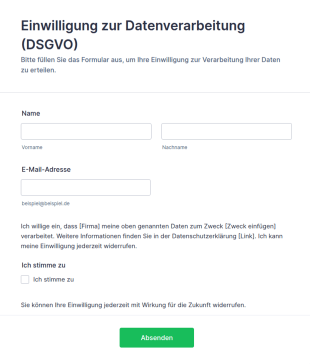
Vorlage Einwilligung Zur Datenverarbeitung (DSGVO)
DSGVO-konforme Einwilligungsformular-Vorlage für Jotform: Opt-in-Checkbox, Widerrufshinweis und Datenschutz-Platzhalter – direkt anpassbar und einsatzbereit.
Zur Kategorie:Werbeformulare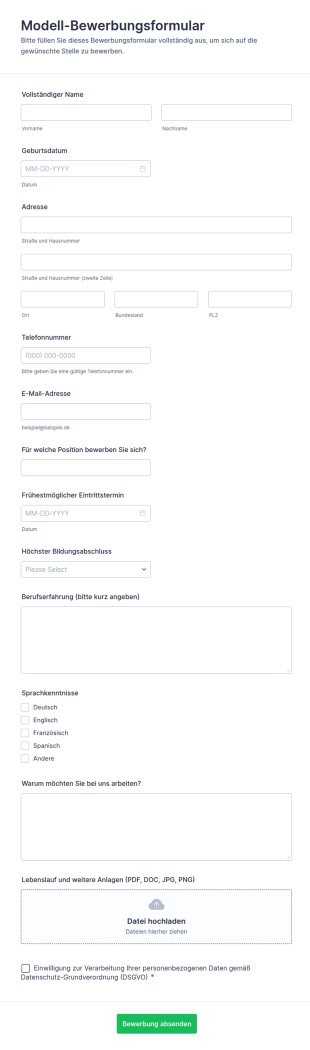
Modell Bewerbungsformular
Sammeln Sie mit dem Modellbewerbungsformular Bewerbungen für Modeljobs online und bündeln Sie Datenerfassung und Formulareinsendungen für Agenturen, Fotografen und Marken übersichtlich an einem Ort.
Zur Kategorie:Bewerbungsformulare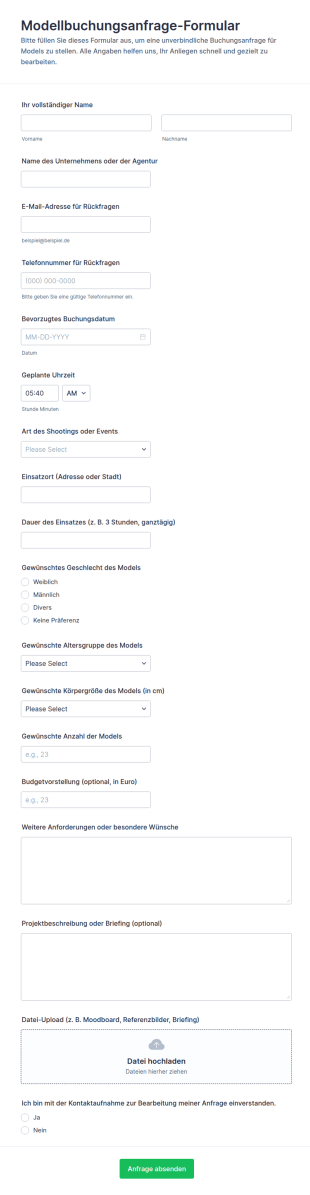
Anfrageformular Zur Modellbuchung
Das Modellbuchungsanfrage-Formular unterstützt Agenturen und Unternehmen bei der digitalen Datenerfassung von Buchungsanfragen für Models und hilft, jede Formularantwort in Jotform übersichtlich zu sammeln und weiterzubearbeiten.
Zur Kategorie:Buchungsformulare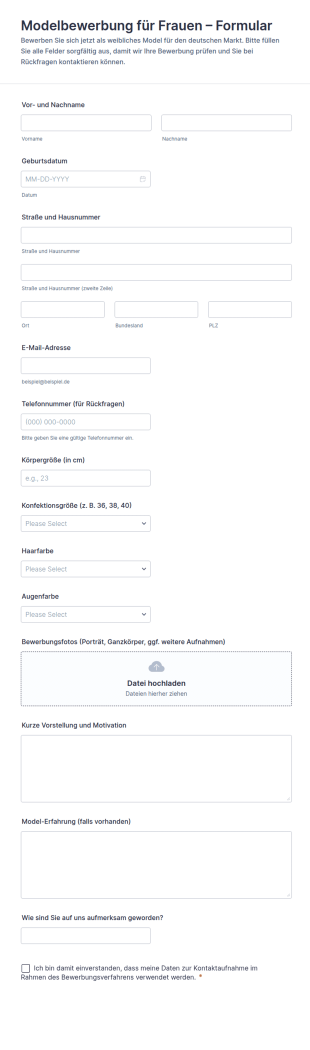
Bewerbungsformular Für Modelaufträge
Sammeln Sie Bewerbungen für weibliche Models online mit dem Modelbewerbung für Frauen Formular und erleichtern Sie Agenturen, Castings und Marken die Datenerfassung und Sichtung der Formularantworten mit Jotform.
Zur Kategorie:Bewerbungsformulare
Modellauftrags Fragebogen
Sammeln und prüfen Sie Bewerbungen für Castings mit dem Model-Call-Formular, ideal für Agenturen, Fotostudios und Marken zur schnellen Vorauswahl inklusive digitaler Datenerfassung und übersichtlicher Formularantworten in Jotform.
Zur Kategorie:Formulare für Models
Model Und Talentbewerbungsformular
Erfassen Sie Bewerbungen von Models und Talenten online mit dem Model- und Talentbewerbungsformular und sammeln Sie Datenerfassung, Bildmaterial und Einverständnisse an einem Ort für Agenturen, Produktionen und Castings.
Zur Kategorie:Bewerbungsformulare
Einwilligungsformular Für Boudoir Fotos
Das Boudoir-Modellfreigabeformular erleichtert Fotograf:innen und Studios die Datenerfassung und Dokumentation von Einwilligungen zur Bildnutzung, inklusive Veröffentlichungshinweisen, über eine anpassbare Formularvorlage in Jotform.
Zur Kategorie:Einverständniserklärungen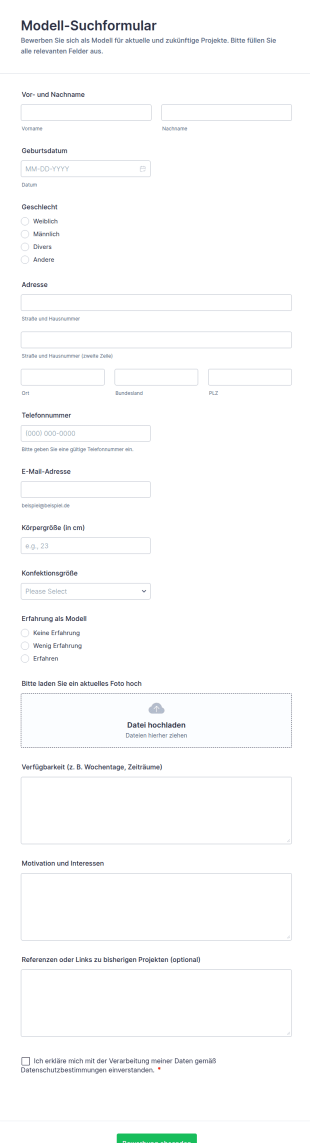
Model Suchformular
Sammeln Sie mit dem Modell-Suchformular Bewerbungen für Foto-, Werbe- und Laufstegprojekte, inklusive Datenerfassung und Foto-Upload, ideal für Agenturen, Fotografen und Marken, die Talente zentral sichten und verwalten möchten.
Zur Kategorie:BewerbungsformulareÜber Formulare für Models
Model Forms are specialized online forms designed to streamline and optimize various operational workflows across different industries. These forms are utilized in a myriad of scenarios, such as capturing data efficiently in research projects, gathering customer feedback in retail sectors, or processing applications in educational institutions. They are critical in environments where precise data collection and efficient management are paramount, allowing professionals to handle tasks such as order processing, inventory management, and client onboarding with ease and accuracy. By leveraging Model Forms, businesses can ensure that they capture data in a structured and reliable manner, minimizing errors and maximizing the value of the information collected.
Jotform stands as the leading online form builder for creating and managing Model Forms, offering a seamless and intuitive platform for professionals seeking to enhance their data collection processes. With Jotform, users can effortlessly customize their forms to meet specific requirements, thanks to its robust drag-and-drop capabilities. The platform also supports automation in data collection, which significantly reduces manual effort and improves efficiency. Moreover, Jotform Tables offers centralized data management, providing users with a secure and organized environment to store and analyze collected data. This ensures that businesses can focus on decision-making and strategy rather than being bogged down by administrative tasks.
Why Use Model Forms?
- Model Forms are essential for ensuring accuracy in data collection. By providing structured fields and validation options, these forms help minimize errors that often occur with manual data entry, thereby ensuring that the data collected is reliable and actionable.
- The speed of data capture is significantly enhanced with Model Forms. Unlike traditional methods, these digital forms allow for rapid data entry and instantaneous submission, which is crucial in time-sensitive environments such as customer service and logistics.
- Professional data handling is a cornerstone of Model Forms. They offer secure data transmission and storage solutions, ensuring that sensitive information is protected at all times. This is particularly important in industries such as healthcare and finance, where data security is a top priority.
- The customization options available in Model Forms make them incredibly versatile. Users can tailor forms to suit specific operational needs, incorporating branding elements and unique fields to ensure consistency and professionalism across all communications.
- Model Forms facilitate seamless integration with various platforms and services, enabling businesses to automate data workflows and reduce the burden of manual data processing. This integration capability is crucial for maintaining efficiency and consistency in data management.
Common Problems Solved by Model Forms
- One of the most significant challenges in many industries is the excessive reliance on paperwork, which can be cumbersome and prone to errors. Model Forms eliminate the need for physical documents, offering a digital solution that is both efficient and environmentally friendly.
- Manual data entry not only consumes valuable time but is also susceptible to human error. Model Forms streamline data capture processes, ensuring that information is entered correctly the first time and reducing the need for time-consuming data verification.
- Lost data can be a significant setback for any organization. Model Forms ensure that all collected data is automatically saved and securely stored, minimizing the risk of loss and ensuring that vital information is always accessible when needed.
- The lack of standardization in data collection processes can lead to inconsistencies and inefficiencies. Model Forms provide a structured framework for data collection, ensuring uniformity and consistency in how data is gathered and processed across various departments and functions.
Passende Anwendungsfälle für Features
- For scenarios requiring quick and efficient form creation, the Drag-and-Drop Form Builder is invaluable. It allows users to construct and modify forms with ease, ensuring that the forms meet specific business needs without the need for extensive technical expertise.
- Businesses that need to process payments directly through their forms can leverage the 30+ Payment Gateways integration. This feature supports seamless transactions, enabling companies to offer their customers a variety of payment options, thereby enhancing user experience and satisfaction.
- Conditional Logic is particularly beneficial for creating dynamic forms that adapt based on user input. This feature ensures that respondents only see questions relevant to them, streamlining the data collection process and improving the quality of the data gathered.
- Jotform's capability for Electronic Signatures (Jotform Sign) is crucial in industries where document authorization is required. This feature allows for the secure collection of approvals and signatures, eliminating the need for physical paperwork and expediting the approval process.
- For teams that rely on data analysis and reporting, the Report Builder feature provides a powerful tool for transforming raw data into insightful reports. This enables businesses to make informed decisions based on real-time data analysis and visualization.
- Offline Data Collection is a critical feature for field-based operations where internet connectivity may be inconsistent. This ensures that data collection can continue uninterrupted, and information can be uploaded once connectivity is restored.
How to Create a Model Form
- Begin by browsing the Template List for a suitable Models template or initiate the creation process from a blank form to meet your specific needs.
- Customize the design and fields using the Drag-and-Drop Form Builder, ensuring the form aligns with your operational requirements and branding guidelines.
- Publish the form and share it with your audience via Direct Link, Email, or Website Embed, making it accessible and easy to use for all respondents.
Top Use Cases for Model Forms
- For Managers: Model Forms provide managers with the tools to streamline administrative processes, such as performance evaluations and project tracking. They can quickly gather and analyze data, which aids in making informed decisions that drive business growth. By automating routine tasks, managers can focus more on strategic activities that enhance team productivity and company performance.
- For Teams: Teams benefit from Model Forms by having a standardized method for submitting reports, feedback, and requests. This uniformity ensures that all team members are on the same page, promoting collaboration and reducing misunderstandings. The ability to integrate these forms with other platforms further enhances team workflow efficiency, making it easier to manage projects and achieve collective goals.
- For Customers: Model Forms enhance the customer experience by providing easy-to-use interfaces for feedback submission, inquiries, and service requests. Customers appreciate the convenience and speed of digital forms, which contribute to higher satisfaction levels. By facilitating seamless communication, businesses can better understand and respond to customer needs, fostering loyalty and long-term relationships.
Summarizing Model Forms
Model Forms are indispensable for organizations seeking to improve their data collection processes and operational efficiency. By leveraging Jotform’s online form builder, businesses can create customizable and secure digital forms that cater to their specific needs. The integration capabilities and automation features provided by Jotform further enhance the value of Model Forms, enabling seamless data workflows and informed decision-making. Ultimately, Model Forms empower organizations to capture, manage, and utilize data effectively, driving success and growth across various industries.
Häufig gestellte Fragen
1) Ist die Erstellung von Modeling-Formularen auf Jotform kostenlos?
Ja, Jotform bietet ein kostenloses Abo an. Damit erstellen und verwalten Nutzer eine begrenzte Anzahl von Formularen, darunter auch Modeling-Formulars. Für erweiterte Funktionen und höhere Limite stehen verschiedene Premium-Tarife zur Verfügung.
2) Sind die Formulare und die übermittelten Daten sicher?
Jotform wendet strenge Sicherheitsmaßnahmen an. Dazu gehören SSL-Verschlüsselung und die DSGVO-Compliance. So bleiben alle Formulare und Datenübermittlungen sicher und vor unbefugtem Zugriff geschützt.
3) Brauche ich Programmierkenntnisse, um ein Modeling-Formular zu erstellen?
Nein, der Drag-and-Drop-Formulargenerator von Jotform ist benutzerfreundlich gestaltet und erfordert keinerlei Programmierkenntnisse. So erstellen Nutzer aller Kenntnisstufen mühelos professionelle und funktionale Formulare.
4) Kann ich Zahlungen direkt über meine Formulare erfassen?
Ja, Sie können Zahlungen direkt über Ihre Formulare erfassen. Integrieren Sie eines der über 30 verfügbaren Zahlungsportale wie Stripe, PayPal und Square. So gewinnen Sie Flexibilität und Komfort bei Transaktionen.
5) Können diese Formulare auf mobilen Geräten verwendet werden?
Ja, Jotform-Formulare sind vollständig responsiv und können auf jedem Gerät genutzt werden, einschließlich Smartphones und Tablets. Mit Jotform Mobile Formularen erfassen Sie Daten offline und synchronisieren sie später, sobald eine Internetverbindung besteht.
6) Kann ich Formularantworten in professionelle PDF-Dokumente umwandeln?
Ja, mit dem PDF Editor von Jotform können Sie aus Formularantworten automatisch professionelle PDF-Dokumente erstellen. Sie passen diese Dokumente an Ihr Branding und Ihre Formatierungsvorlieben an.
7) Wie verbessern Modeling-Formulare die Datengenauigkeit in meiner Organisation?
Modellformulare verbessern die Datengenauigkeit. Sie bieten strukturierte Felder, Validierungsregeln und bedingte Logik, die Benutzer bei der Eingabe korrekter Informationen unterstützen und die Fehlerwahrscheinlichkeit bei der Dateneingabe verringern.
8) Gibt es Funktionen für die Zusammenarbeit, die Teams nutzen können, die mit Modeling-Formularen arbeiten?
Ja, Jotform bietet Funktionen wie Workflows und sichere Datenweitergabe. Damit bearbeiten Teams Formularantworten, Überprüfungsprozesse und Datenanalysen gemeinsam und produktiv.