

Formulare für Ingenieure

Vorlage Antrag Auf Einsatz Eines Neuen Gefahrstoffs
Freigabeantrag für neue Gefahrstoffe mit Substitutionsprüfung, Schutzmaßnahmen und Checkliste für Betriebsanweisung und Unterweisung.
Zur Kategorie:Geschäftsformulare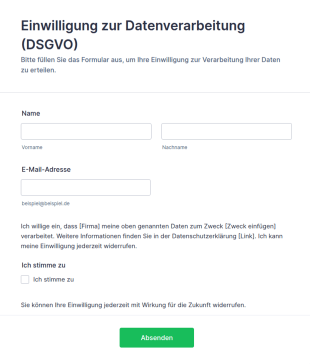
Vorlage Einwilligung Zur Datenverarbeitung (DSGVO)
DSGVO-konforme Einwilligungsformular-Vorlage für Jotform: Opt-in-Checkbox, Widerrufshinweis und Datenschutz-Platzhalter – direkt anpassbar und einsatzbereit.
Zur Kategorie:Werbeformulare
Elektrische Lastberechnung Formular
Erfassen Sie mit dem Formular für elektrische Lastberechnung Projektdaten, Nutzungsprofile und Netzanforderungen, damit Elektroplanung und Auslegung für Neubau, Umbau oder Erweiterungen nachvollziehbar vorbereitet werden können.
Zur Kategorie:Formulare für Berechnungen
Vorlage Gefahrstoffverzeichnis: Eintrag Erfassen
Führen Sie Ihr Gefahrstoffverzeichnis dort, wo Sie es filtern und exportieren können — statt in einer Excel-Liste auf einem Laufwerk.
Zur Kategorie:Geschäftsformulare
Vorlage Kalibrierauftrag
Ein Formular für alle Geräte, die zur Kalibrierung müssen: Kalibrierart, Justierung, Abholung und Termin auf einen Schlag geklärt.
Zur Kategorie:Geschäftsformulare
Vorlage Kalibrierprotokoll Für Prüfmittel
Protokoll für die betriebsinterne Kalibrierung: Prüfmittel, Normal, fünf Messpunkte, Bewertung und nächster Termin. Ohne Toleranzvorgaben.
Zur Kategorie:Geschäftsformulare
Vorlage Gefährdungsbeurteilung
Kostenlose Jotform-Vorlage für Gefährdungsbeurteilungen: Risikomatrix mit Score-Berechnung, STOP-Maßnahmen, Wirksamkeitskontrolle und digitale Freigabe.
Zur Kategorie:Bewertungsformulare
Ingenieurmeeting Agenda Formular
Dokumentieren Sie technische Besprechungen mit dem Ingenieurmeeting-Agenda Formular, bündeln Sie Themen, Entscheidungen und Aufgaben an einem Ort und erleichtern Sie die Abstimmung in Ingenieur- und Projektteams.
Zur Kategorie:Meeting Formulare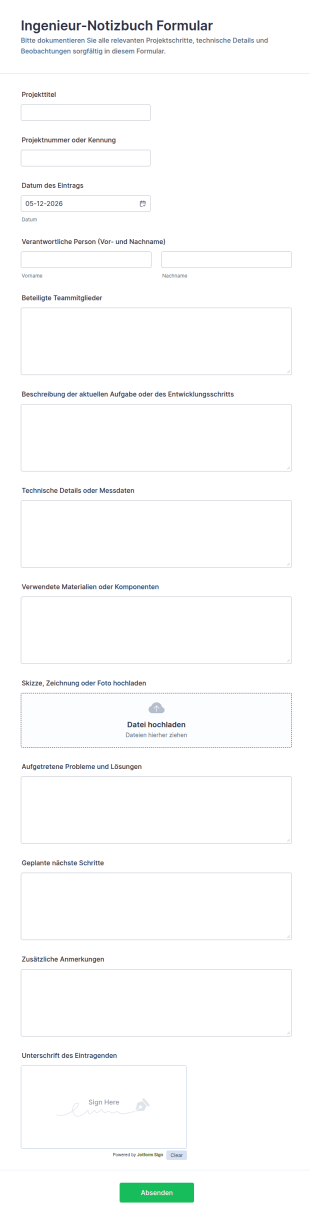
Ingenieur Notizbuch Formular
Dokumentieren Sie Entwicklungsstände, Entscheidungen und Nachweise in Projekten mit dem Ingenieur-Notizbuch Formular und nutzen Sie es in Teams aus Technik, Labor und Projektleitung für konsistente digitale Datenerfassung.
Zur Kategorie:Formulare für IngenieureÜber Formulare für Ingenieure
Ingenieurformulare sind spezialisierte digitale Formulare, die darauf ausgelegt sind, die Datenerfassungsprozesse im ingenieurtechnischen Umfeld zu optimieren und zu verbessern. Diese Formulare erleichtern eine Vielzahl von Vorgängen, von der Nachverfolgung von Projektmilestones über die Verwaltung des Gerätebestands bis hin zur Dokumentation von Inspektionen vor Ort. In der Welt des Ingenieurwesens ist eine genaue und zeitnahe Datenerfassung entscheidend für den erfolgreichen Abschluss von Projekten, die Compliance mit gesetzlichen Vorschriften und die Optimierung der Ressourcenzuweisung. Ingenieure nutzen diese Formulare häufig, um die Dateneingabe zu standardisieren. Dadurch minimieren sie Fehler und gewährleisten Konsistenz über verschiedene Projektphasen hinweg. Ob zur Meldung von Sicherheitsvorfällen, zur Erfassung technischer Spezifikationen oder zur Einreichung von Projektvorschlägen – Ingenieurformulare sind unverzichtbare Assets für die effiziente Verwaltung ingenieurtechnischer Aufgaben.
Jotform stands out as the premier online form builder for Engineer Forms, offering an intuitive, web-based Drag-and-Drop Form Builder that simplifies the creation and customization of forms. Professionals can effortlessly tailor these forms to fit their specific requirements, enabling seamless integration into their existing workflows. Jotform’s platform not only enhances the ease of customization but also excels in automating data collection processes, thereby reducing manual effort and increasing operational efficiency. With Jotform Tables, all data collected through these forms is managed centrally, allowing for secure and organized data handling. This streamlined data management system ensures that engineering teams can access and utilize information quickly and effectively, leading to more informed decision-making and improved project outcomes.
Why Use Engineer Forms?
- Engineer Forms are essential for ensuring data accuracy across projects, as they provide structured fields that reduce the likelihood of errors during data entry. This is particularly important in engineering, where precise measurements and specifications are critical to project success and safety compliance.
- Speed is a significant advantage of using Engineer Forms. By digitizing data collection, these forms eliminate the delays associated with manual paperwork, enabling faster processing and analysis of information. This efficiency is crucial when engineers are working against tight deadlines.
- Professional data handling is another key benefit, as Engineer Forms support the secure collection and storage of sensitive information. With secure data management features like Jotform Tables, engineers can trust that their data is protected and accessible only to authorized personnel.
- Engineer Forms facilitate seamless collaboration among team members by enabling real-time data sharing. This ensures that all stakeholders have access to the most up-to-date information, fostering better communication and coordination across different departments and project sites.
- These forms are highly customizable, allowing engineers to tailor them according to project-specific needs. With Jotform’s Drag-and-Drop Form Builder, users can easily add or modify fields, integrate conditional logic, and incorporate various data types to suit their unique requirements.
Common Problems Solved by Engineer Forms
- One major issue in engineering is the cumbersome nature of paper-based documentation, which Engineer Forms effectively address by digitizing the entire process. This transition reduces the physical storage requirements and minimizes the risk of lost or misplaced documents.
- Manual data entry is prone to errors, which can lead to costly mistakes in project execution. Engineer Forms mitigate this risk by providing structured fields and automated calculations, ensuring that the data entered is both accurate and consistent.
- Engineers often face challenges with data accessibility, especially when working in remote locations. Engineer Forms can be accessed and submitted offline using Jotform Mobile Forms, ensuring that data collection is uninterrupted regardless of internet connectivity.
- Lost or incomplete data can significantly hamper project progress and lead to compliance issues. By utilizing Engineer Forms, engineers can ensure that all necessary information is captured and stored securely, with automated backups and retrieval options available through Jotform’s platform.
Passende Anwendungsfälle für Features
- For engineers needing to create detailed project reports, the Report Builder feature allows for the generation of comprehensive reports that summarize collected data, enabling clear and informed communication of project status to stakeholders.
- Conditional Logic is particularly useful in instances where form fields need to adapt based on previous responses. This feature helps engineers create dynamic forms that guide users through complex workflows, ensuring that only relevant information is collected.
- The integration of Electronic Signatures (Jotform Sign) is critical for forms that require official approvals, such as safety compliance documents or engineering proposals. This feature streamlines the authorization process, allowing engineers to obtain necessary signatures quickly and securely.
- For projects that involve financial transactions, the 30+ Payment Gateways supported by Jotform, including Stripe and PayPal, facilitate secure and efficient payment collection directly through the forms, simplifying the billing process for engineering services.
- Engineer Forms can be seamlessly integrated with 100+ third-party applications like Google Sheets and Salesforce, allowing for automatic data synchronization and enhanced workflow automation. This integration capability ensures that data collected through forms can be easily transferred to other platforms used by engineering teams.
- The PDF Editor feature is invaluable for generating standardized documents such as contracts and technical specifications. Engineers can automatically convert form submissions into professionally formatted PDFs, which can then be shared or archived as needed.
- Approval Workflows support the structured review and approval of engineering documents, ensuring that all necessary checks are completed before a form is finalized. This feature helps maintain quality control and regulatory compliance in engineering processes.
How to Create a Engineer Form
- Browse the Template List for a Engineers template or start from a blank form. This allows you to either leverage pre-existing template structures or create a custom form tailored to your project’s specific needs.
- Customize the design and fields using the Drag-and-Drop Form Builder. This step enables you to add, remove, or rearrange form elements as required, ensuring that the form collects all necessary information in an intuitive and user-friendly manner.
- Publish and share via Direct Link, Email, or Website Embed. These sharing options provide flexibility in how you distribute your forms, making it easy to reach your intended audience and collect responses efficiently.
Top Use Cases for Engineer Forms
- For Managers: Engineer Forms are instrumental for managers who need to oversee multiple projects simultaneously. These forms provide a centralized platform for monitoring project progress, resource allocation, and compliance with safety regulations. By utilizing real-time data collected from forms, managers can make informed decisions, allocate resources more effectively, and ensure that projects remain on track and within budget.
- For Teams: Team collaboration is significantly enhanced when using Engineer Forms. These forms enable team members to share critical information quickly and accurately, reducing the chances of miscommunication. Engineer Forms also support the assignment of tasks and tracking of project milestones, which fosters a more organized and efficient workflow where every team member is aligned with project objectives.
- For Customers: Customers benefit from using Engineer Forms through improved communication and transparency. These forms can be used to gather customer feedback, manage service requests, and provide updates on project progress. By having a structured way to interact with engineering teams, customers can receive timely responses to their inquiries and gain a clearer understanding of how their projects are progressing.
Summarizing Engineer Forms
Engineer Forms are an invaluable asset for professionals in the engineering industry, addressing the critical need for accurate, efficient, and secure data collection. By leveraging Jotform’s advanced features, engineering teams can streamline their workflows, reduce manual errors, and enhance collaboration across projects. The ability to customize forms to fit specific project needs, coupled with the robust data management capabilities of Jotform Tables, ensures that engineers have all the tools they need to succeed. Ultimately, Engineer Forms empower engineering professionals to focus on what they do best—designing and executing projects with precision and excellence.
Häufig gestellte Fragen
1) Ist die Erstellung von Formularen für Ingenieure auf Jotform kostenlos?
Ja, Jotform bietet ein kostenloses Abo an, mit dem Nutzer Formulare erstellen und freigeben können. Es stehen auch Premium-Tarife zur Verfügung, die Zugriff auf erweiterte Funktionen und höhere Limite bieten.
2) Sind die Formulare und die übermittelten Daten sicher?
Alle Formulare und Antworten auf Jotform sind durch branchenübliche Sicherheitsmaßnahmen geschützt. Dazu gehören SSL-Verschlüsselung und DSGVO-Compliance. So bleiben Ihre Daten sicher und vertraulich.
3) Brauche ich Programmierkenntnisse, um ein Ingenieurformular zu erstellen?
Nein, der Drag-and-Drop-Formulargenerator von Jotform ist benutzerfreundlich gestaltet und erfordert keinerlei Programmierkenntnisse. So erstellen Nutzer einfach angepasste Formulare.
4) Kann ich Zahlungen direkt über meine Formulare erfassen?
Ja, Sie können die Integration von Jotform mit über 30 Zahlungsportalen wie Stripe und PayPal nutzen, um Zahlungen direkt über Ihre Engineer-Formulare zu erfassen. So optimieren Sie den Abrechnungsprozess für erbrachte Dienstleistungen.
5) Können diese Formulare auf mobilen Geräten verwendet werden?
Ja, Ingenieurformulare lassen sich auf mobilen Geräten über Jotform Mobile Formulare aufrufen und übermitteln. So erfassen Sie Daten auch im Offline-Modus oder an abgelegenen Orten.
6) Kann ich Formularantworten in professionelle PDF-Dokumente umwandeln?
Selbstverständlich wandeln Sie mit dem PDF Editor von Jotform Formularantworten automatisch in professionell formatierte PDF-Dokumente um. Anschließend geben Sie die Dokumente weiter oder speichern sie für die spätere Verwendung.
7) Wie verbessern technische Formulare die Compliance mit Sicherheitsvorschriften?
Mit den Formularen für Ingenieure erfassen Sie sicherheitsrelevante Daten systematisch. So dokumentieren und berichten Sie die Compliance mit Branchenstandards und Vorschriften einfach. Dadurch befolgen Sie die Sicherheitsvorschriften konsequent.
8) Gibt es Vorlagen, die speziell für Use Cases im Ingenieurwesen vorgesehen sind?
Ja, Jotform bietet eine Vielzahl von Vorlagen an, die speziell für Anwendungen im Ingenieurwesen entwickelt wurden. Sie passen diese Vorlagen an unterschiedliche Projektanforderungen an und optimieren so die Datenerfassung.