

Mitarbeiterbeurteilung Formulare
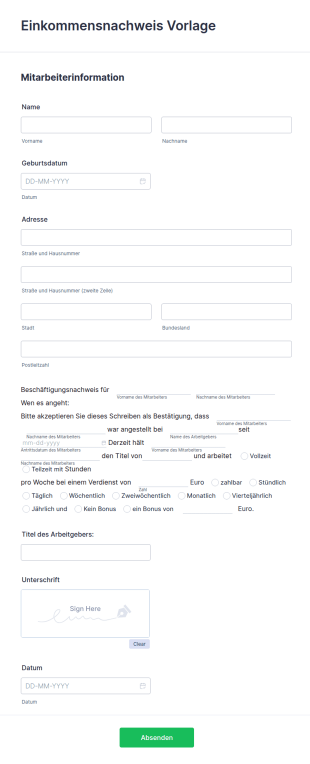
Einkommensnachweis Vorlage
Eine Einkommensnachweis Vorlage wird von Banken und anderen Finanzinstituten verwendet, um das Einkommen eines potenziellen Kunden zu überprüfen.
Zur Kategorie:Mitarbeiterbeurteilung Formulare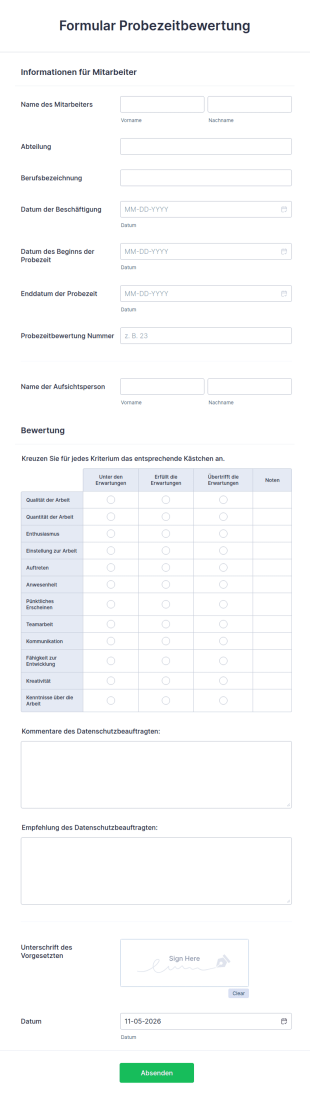
Formular Probezeitbewertung
Ein Probezeitbeurteilungsformular ist ein Fragebogen, der von Arbeitgebern verwendet wird, um herauszufinden, wie sich neue Mitarbeiter an einen neuen Arbeitsplatz und eine neue Arbeitsumgebung anpassen.
Zur Kategorie:Mitarbeiterbeurteilung Formulare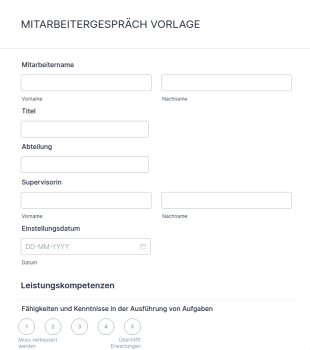
Mitarbeitergespräch Vorlage
Ein Mitarbeitergespräch Vorlage ist ein Tool, das von Arbeitgebern verwendet wird, um Feedback von Mitarbeitern zu sammeln.
Zur Kategorie:Mitarbeiterbeurteilung Formulare
Formular Für Die Selbstbeurteilung Von Mitarbeitern
Ein Mitarbeiterbeurteilungsformular ist eine Art Selbstbeurteilungsformular, das von Managern, Vorgesetzten und Teamleitern verwendet wird, um die Leistung der Mitarbeiter zu verfolgen und zu bewerten.
Zur Kategorie:Mitarbeiterbeurteilung Formulare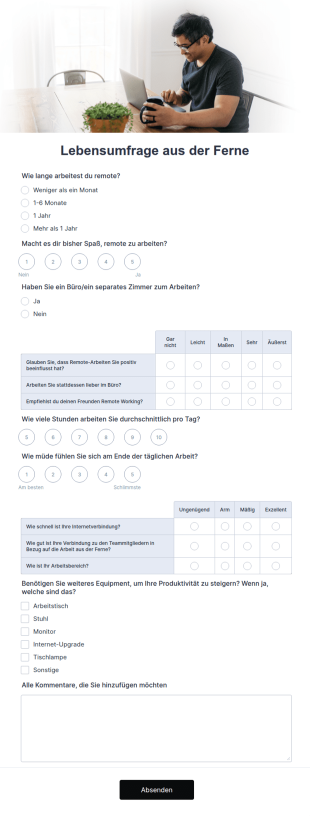
Umfrage Zur Fernarbeit
Eine Umfrage zur Fernarbeit wird verwendet, um die Wirksamkeit der Home-Office-Richtlinie eines Unternehmens zu messen und zu analysieren.
Zur Kategorie:Mitarbeiterbeurteilung Formulare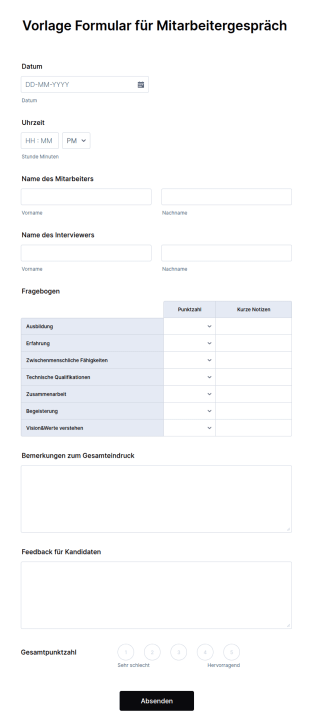
Vorlage Formular Für Mitarbeitergespräch
Das Formular für Mitarbeitergespräch ist ein Fragebogen, der von Unternehmen verwendet wird, um potenzielle Mitarbeiter während des Einstellungsprozesses zu bewerten.
Zur Kategorie:Mitarbeiterbeurteilung Formulare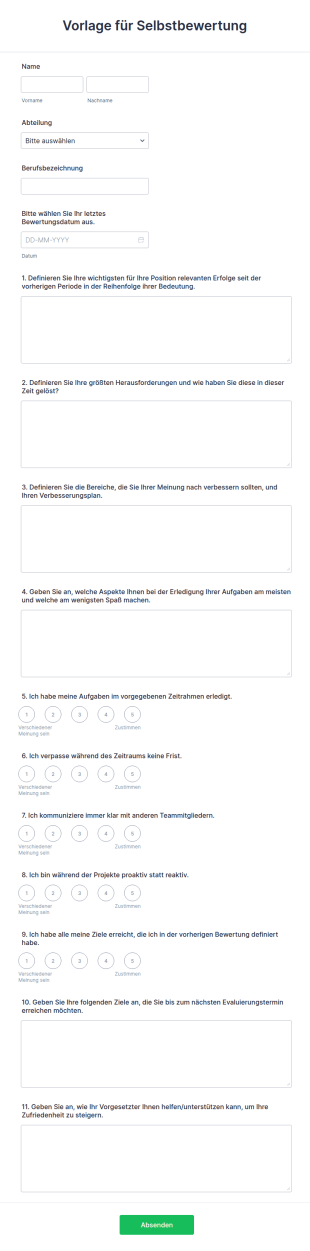
Vorlage Für Selbstbewertung
Ein Formular zur Selbstbewertung von Mitarbeitern ist ein äußerst effektives Instrument zur Leistungsbeurteilung, mit dem Sie verstehen können, wie Mitarbeiter sich selbst und ihre Beiträge bei der Arbeit sehen. Erstellen Sie Online-Formulare zur Selbstbewertung Ihrer Mitarbeiter mit unserer kostenlosen Vorlage zur Selbstbewertung!
Zur Kategorie:Mitarbeiterbeurteilung Formulare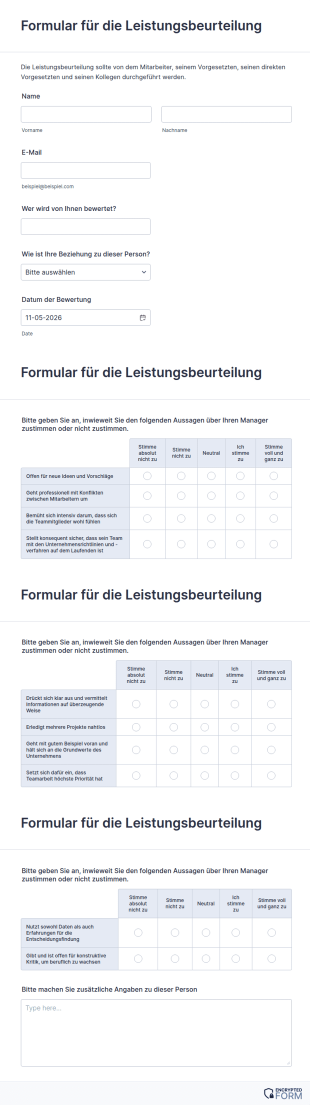
Formular Für Die Leistungsbeurteilung
Ein Formular für die Leistungsbeurteilung wird verwendet, um die Arbeitsleistung von Mitarbeitern zu bewerten, um zu sehen, was sie gut machen und was sie verbessern müssen. Mit einem kostenlosen Online-Formular für Leistungsbeurteilungen können Sie oder Ihre Mitarbeiter Leistungsbeurteilungen auf jedem beliebigen Gerät ausfüllen und direkt an ein sicheres Online-Konto von Jotform senden. Die Antworten können von jedem Computer, Tablet oder Mobiltelefon aus eingesehen, bearbeitet oder weitergegeben werden, so dass Sie Ihren Mitarbeitern leichter Feedback geben und ihre Leistung verbessern können. In dieser kostenlosen Vorlage für Leistungsbeurteilungsformulare können Sie bereits Bewertungsskalen und Textfelder verwenden, um Ihre Beurteilungen zu vervollständigen. Sie können aber auch zusätzliche Fragen und Formularfelder hinzufügen und das Design mit dem Drag & Drop Umfragenersteller von Jotform anpassen. Und wenn Sie Bewertungen mit anderen Konten synchronisieren möchten - wie Google Drive, Dropbox, Google Tabellen und mehr - tun Sie dies automatisch mit unseren über 100 kostenlosen Formularintegrationen. Seien Sie effizienter und führen Sie Mitarbeiterbeurteilungen nahtlos online durch - mit einem kostenlosen Formular für Leistungsbeurteilungen.
Zur Kategorie:Mitarbeiterbeurteilung Formulare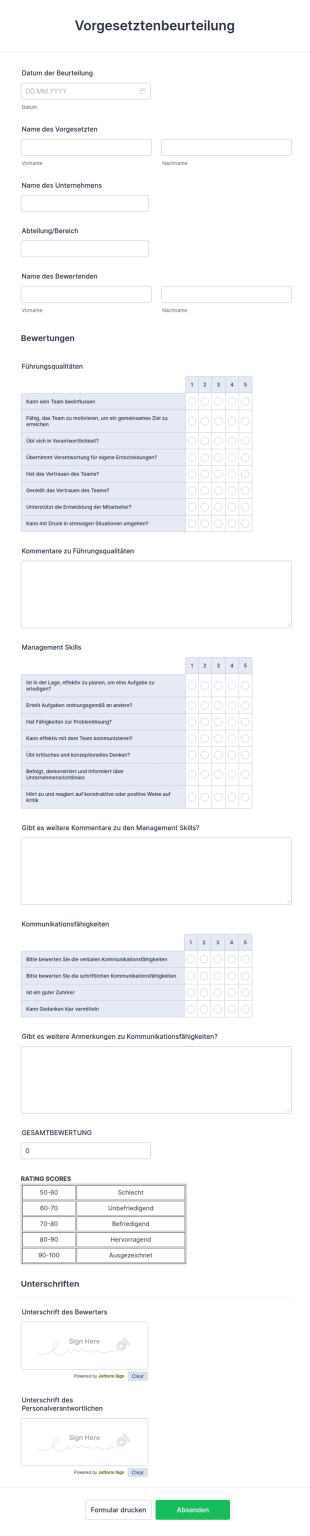
Vorgesetztenbeurteilung
Bewerten Sie Führungskräfte mit einer Vorgesetztenbeurteilung Fragebogenvorlage. Erfassen Sie Führungs- und Kommunikationsfähigkeiten sowie Leistungsbeurteilungen — einfach und effektiv.
Zur Kategorie:Personalformulare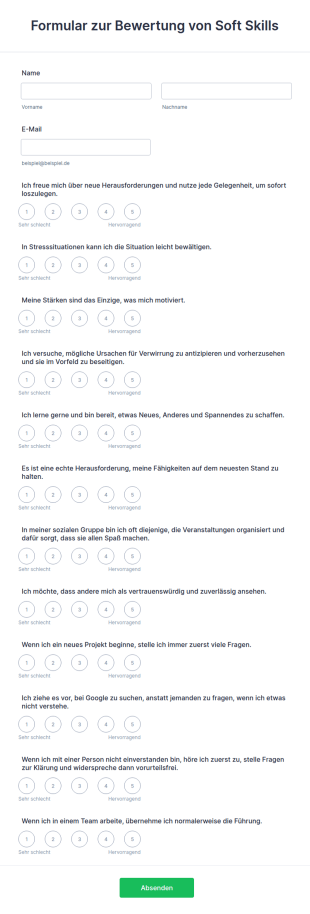
Formular Zur Bewertung Von Soft Skills
Ein Beurteilungsformular für Soft Skills ist ein Dokument, das Führungskräften Hinweise auf die Stärken und Schwächen ihrer Mitarbeiter gibt.
Zur Kategorie:Mitarbeiterbeurteilung Formulare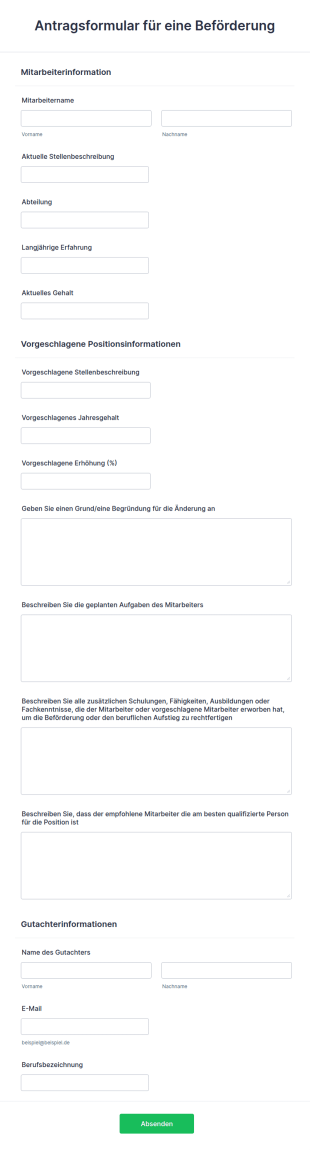
Antragsformular Für Eine Beförderung
Bei einem Beförderungsantragsformular handelt es sich um eine Beförderungsanfrage, die ein Mitarbeiter an seinen Vorgesetzten sendet.
Zur Kategorie:Mitarbeiterbeurteilung Formulare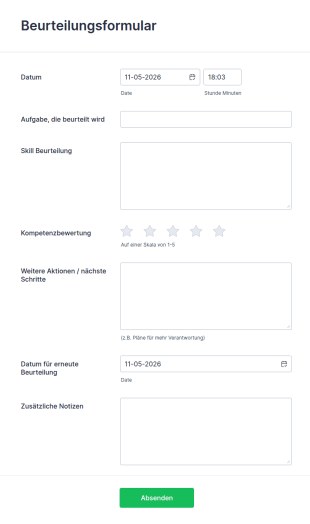
Beurteilungsformular
Ein Beurteilungsformular ist ein Fragebogen, der von Arbeitgebern verwendet wird, um die Leistung eines Mitarbeiters zu bewerten. Ganz gleich, ob Sie ein Unternehme n leiten oder die Arbeit Ihrer Mitarbeiter beaufsichtigen, mit unserem Beurteilungsformular können Sie herausfinden, wie es um die Leistung Ihrer Mitarbeiter bestellt ist. Personalisieren Sie Ihr Beurteilungsformular mit Ihrem Firmenlogo und Ihren Farben oder passen Sie die Fragen Ihren Bedürfnissen an. Sie können dieses Formular auch verwenden, um Ihre Studenten oder Teammitglieder zu bewerten und die Fragen entsprechend anzupassen. Mit dem Formulargenerator von Jotform können Sie ganz einfach den Wortlaut und die Reihenfolge der Fragen aktualisieren, einen Fortschrittsbalken hinzufügen, um die Antworten zu verfolgen, ein Unterschriftsfeld hinzufügen, um die Online-Übermittlung sicherer zu machen, und sogar Felder deaktivieren, wenn Sie keine Informationen erfassen müssen oder das Formular kürzer gestalten möchten! Wenn Sie kein Papierformular benötigen und ein Online-Bewertungsformular haben, können Sie sich die Zwischenablage sparen und die Bewertungen online erfassen - worauf warten Sie noch?
Zur Kategorie:Mitarbeiterbeurteilung Formulare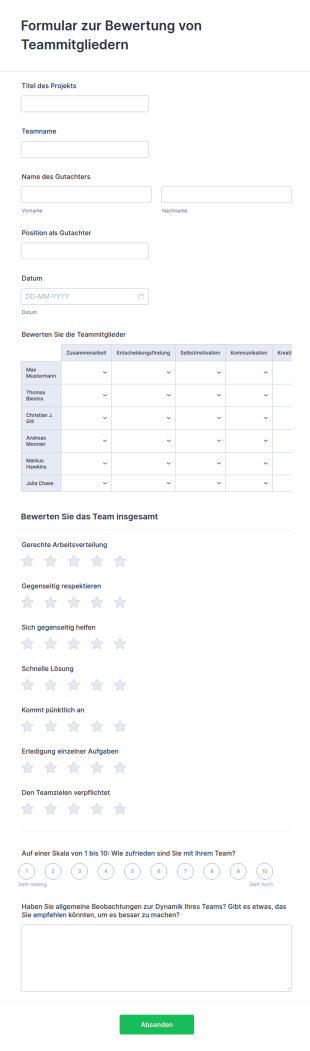
Formular Zur Bewertung Von Teammitgliedern
Ein Peer-Bewertungsformular ist eine Online-Umfrage, die es Teammitgliedern ermöglicht, die Leistung von Kollegen zu bewerten. Dies wird häufig in Schulen verwendet, um den Fortschritt von Schülern zu bewerten, oder von Personalabteilungen, um den Fortschritt der Mitarbeiter zu verfolgen. Verwenden Sie dieses Formular, um eine Bestandsaufnahme der Fähigkeiten, Gewohnheiten und Leistungen jedes Teammitglieds im Team vorzunehmen.
Zur Kategorie:Mitarbeiterbeurteilung Formulare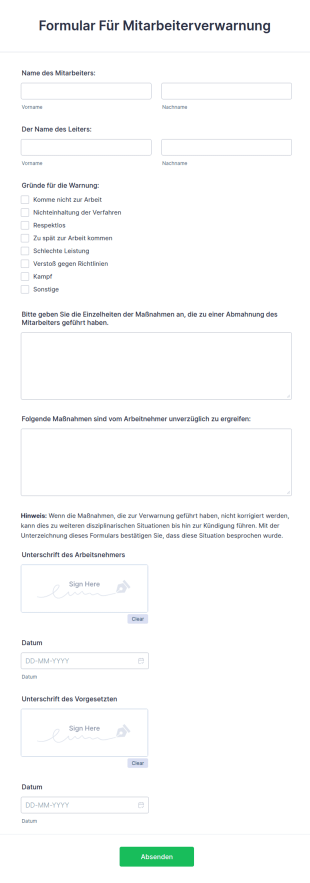
Formular Für Mitarbeiterverwarnung
Manchmal sind Disziplinarmaßnahmen wirksam, um die Ordnung innerhalb einer Organisation aufrechtzuerhalten.
Zur Kategorie:Mitarbeiterbeurteilung Formulare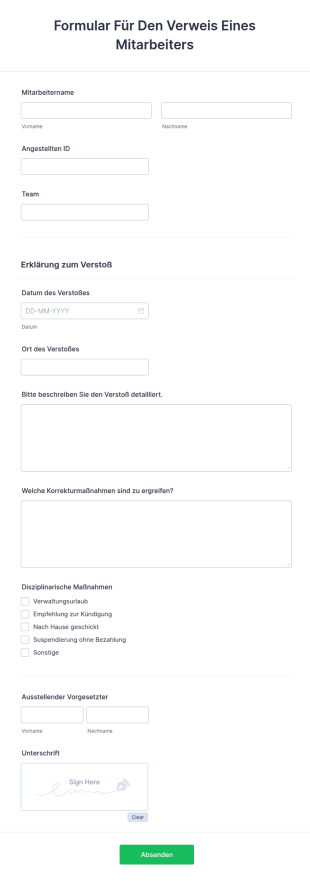
Formular Für Den Verweis Eines Mitarbeiters
Ein Arbeitnehmerverwarnungsformular ist ein Formular, das von einem Arbeitgeber ausgefüllt wird, um einen Arbeitnehmer wegen arbeitsbezogener Probleme zu rügen.
Zur Kategorie:Mitarbeiterbeurteilung Formulare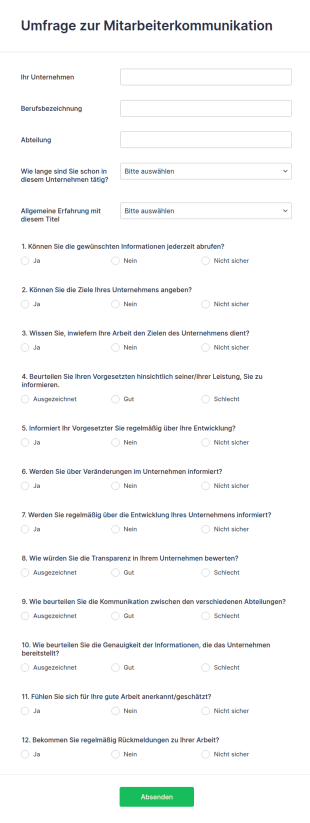
Umfrage Zur Mitarbeiterkommunikation
Eine Umfrage zur Mitarbeiterkommunikation ist ein Fragebogen, der in Unternehmen eingesetzt wird, um zu verstehen, wie die Mitarbeiter miteinander kommunizieren.
Zur Kategorie:Mitarbeiterbeurteilung Formulare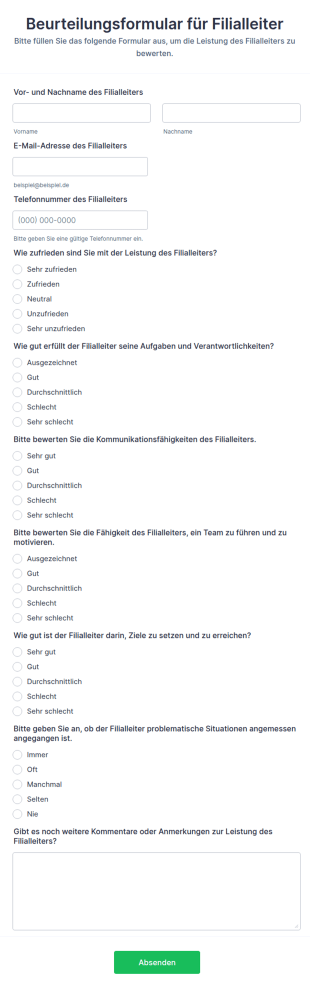
Beurteilungsformular Für Filialleiter
Der Fragebogen zur Beurteilung des Filialleiters ist ein Fragebogen, der sowohl von den Geschäftsinhabern als auch von den Filialleitern selbst ausgefüllt werden kann.
Zur Kategorie:Mitarbeiterbeurteilung Formulare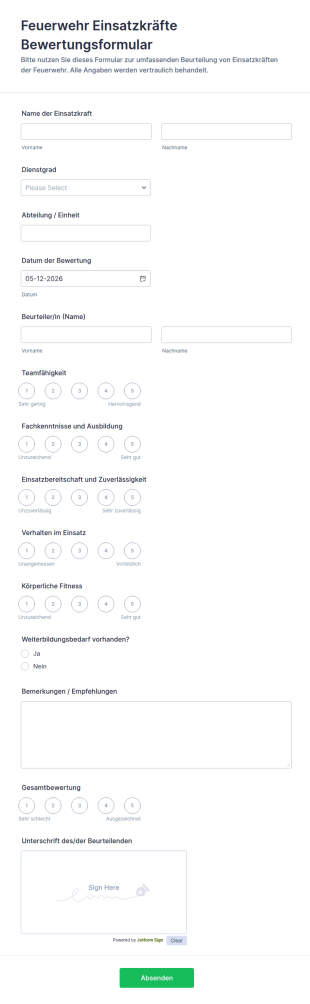
Feuerwehr Einsatzkräfte Bewertungsformular
Feuerwehr-Einsatzkräfte-Bewertungsformular erleichtert die digitale Datenerfassung von Leistungsbeurteilungen im Einsatzdienst für Feuerwehren, Einheitsleitungen und Beurteilende, inklusive zentraler Auswertung der Formularantworten in Jotform.
Zur Kategorie:Formulare für Feuerwehren
Bewertung Des Geschäftsführers
Ein Formular zur Bewertung des Geschäftsführers ist ein Fragebogen, der von gemeinnützigen Organisationen verwendet wird, um Feedback von Mitarbeitern einzuholen. Verwenden Sie diese Vorlage für die Bewertung des Geschäftsführers, um Feedback von den Verwaltungsangestellten in Ihrer Organisation einzuholen! Mit einem kostenlosen Online-Formular zur Bewertung des Geschäftsführers können Sie die Informationen sammeln, die Sie von Ihren Mitarbeitern benötigen, um Ihre Organisation zu verbessern. Passen Sie das Formular einfach an Ihre Bedürfnisse an und betten Sie es in Ihre gemeinnützige Website ein, geben Sie es über einen Link weiter, oder lassen Sie es von Ihren Mitarbeitern persönlich auf dem Tablet oder Computer Ihres Büros ausfüllen. Egal, wie Sie es versenden, Sie erhalten die benötigten Informationen in wenigen Sekunden.
Zur Kategorie:Mitarbeiterbeurteilung Formulare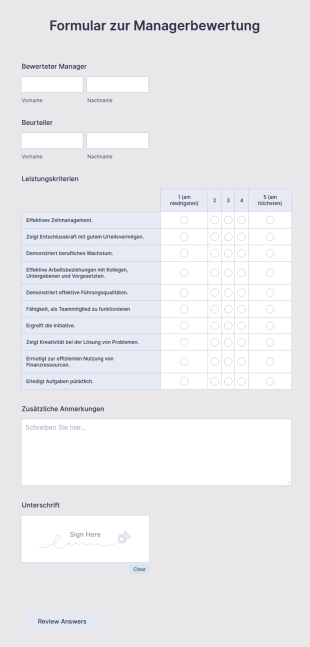
Formular Zur Managerbewertung
Ein Beurteilungsformular für Manager ist ein Fragebogen, der Managern hilft, die Leistung ihrer Mitarbeiter zu bewerten. Verwenden Sie dieses Formular zur Managerbewertung, um Ihre Mitarbeiter um Feedback zu ihrer Arbeit zu bitten und sie zu fragen, wie sie ihre Arbeit verbessern können. Mit einem kostenlosen Online-Formular zur Managerbewertung geht Ihnen nie wieder die Arbeit aus - ein kostenloses Online-Formular zur Managerbewertung hilft Ihnen, das gesamte Feedback Ihrer Mitarbeiter zu erfassen und es sicher aufzubewahren. Mit Jotform können Sie Antworten an Ihre anderen Konten senden, die Kommunikation mit Ihren Mitarbeitern optimieren und sogar verfolgen, wie diese auf die von Ihnen gestellten Fragen reagieren. Und wenn Sie einmal Folgeumfragen verschicken müssen, können Sie die Antworten der letzten Umfrage automatisieren, E-Mails an die Mitarbeiter senden und sogar die Antworten der letzten Umfrage in den nächsten Fragebogen einfügen.
Zur Kategorie:Personalformulare
Admin Assistent Beurteilungsformular
Ein Admin-Assistent Beurteilungsformular ist ein Fragebogen, der dazu dient, die Leistung eines Verwaltungsassistenten zu bewerten und gleichzeitig die Eigenschaften des Assistenten für zukünftige Referenzen zu dokumentieren. Diese kostenlose Vorlage für ein Admin-Assistent Beurteilungsformular ist ideal für jedes kleine Unternehmen, das einen Admin-Assistenten beschäftigt. Sie können nicht nur die Felder an Ihre Bedürfnisse anpassen, sondern auch das Design dieser Vorlage aktualisieren. Passen Sie diese Formularvorlage mit unserem Drag & Drop-Generator an, einschließlich des Hinzufügens Ihres Logos, der Diversifizierung der Fragen, um besser zu den Antworten zu passen, nach denen Sie suchen, und der Auswahl neuer Farben oder Schriftarten für eine persönliche Note. Sie brauchen keine unordentlichen Papierformulare mehr - steigen Sie auf Online-Formulare um und sparen Sie Zeit mit Jotform. Und das alles ohne Programmierkenntnisse!
Zur Kategorie:Mitarbeiterbeurteilung Formulare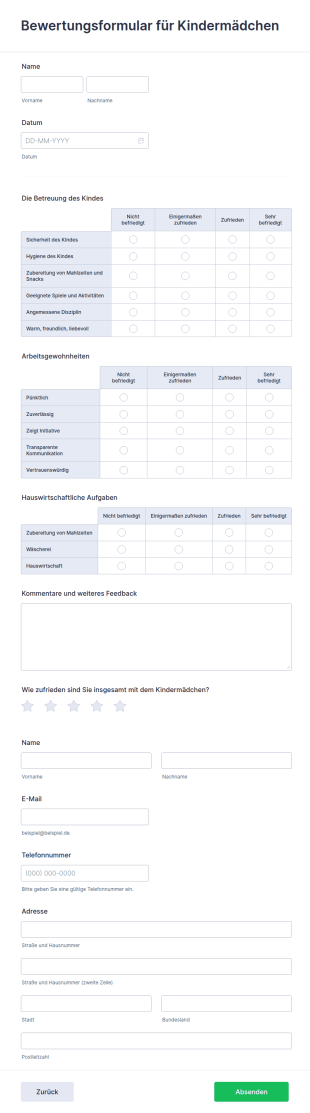
Bewertungsformular Für Kindermädchen
Ein Bewertungsformular für Kindermädchen ist ein Dokument, mit dem Familien ihr Kindermädchen bewerten können. Diese Formulare können verwendet werden, um Beobachtungen zu Verhalten, Fähigkeiten und mehr festzuhalten.
Zur Kategorie:Mitarbeiterbeurteilung Formulare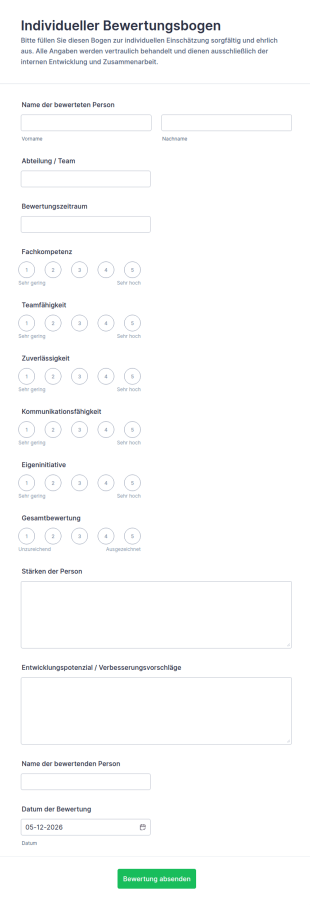
Individuelles Bewertungsformular
Individueller Bewertungsbogen Formular für Teams, Führungskräfte und die Personalabteilung zur einheitlichen Leistungsbeurteilung über definierte Zeiträume, inklusive digitaler Datenerfassung und einfacher Auswertung in Jotform.
Zur Kategorie:Mitarbeiterbeurteilung Formulare
Formular Zur Vertriebsbewertung
Ein Formular zur Vertriebsbewertung wird in Unternehmen verwendet, um die Leistung der Vertriebsmitarbeiter zu bewerten. Diese kostenlose Vorlage für ein Formular zur Verkaufsbewertung ist eine großartige Möglichkeit, ehrliches Feedback von Ihrem Team zu erhalten! Mit ein paar Klicks können Sie das Formular anpassen, Ihr Logo hinzufügen, das Hintergrundbild aktualisieren und das Formular so gestalten, wie Sie es wünschen. Sie können sogar den kostenlosen Formular Generator verwenden, um Daten aus diesem Formular in Ihre anderen Konten wie Dropbox, Google Drive, Box oder Google Tabellen zu übertragen. Erfassen und verfolgen Sie die Verkaufszahlen Ihres Unternehmens mit einem Verkaufsbewertungsformular - und setzen Sie Ihre Verkaufsziele in die Tat um! Laden Sie das Formular einfach herunter und passen Sie es an Ihr Unternehmen an. Behalten Sie die Leistung Ihrer Mitarbeiter mit genauen Daten im Auge, sehen Sie Verkaufsberichte sofort ein und halten Sie alle Mitarbeiter mit einem Verkaufsbewertungsformular in der Verantwortung.
Zur Kategorie:PersonalformulareÜber Mitarbeiterbeurteilung Formulare
Mitarbeiterbeurteilungsformulare sind digitale Formulare, die Organisationen nutzen, um die Leistung und den Entwicklungsbedarf ihrer Mitarbeiter zu beurteilen. Diese Formulare können verschiedene Kennzahlen zur Bewertung von Kompetenzen, Leistungen und Verbesserungsmöglichkeiten enthalten. Sie bilden häufig die Grundlage für Feedbackgespräche und Entwicklungspläne. In Workflows optimieren diese Formulare den Prozess der Erfassung einheitlicher Daten abteilungsübergreifend. So bleiben Beurteilungen fair, transparent und auf die Unternehmensziele abgestimmt. Sie eignen sich außerdem für 360-Grad-Feedback-Prozesse, Selbstbeurteilungen und Peer-Reviews. Dadurch gewinnen Sie ein klares Verständnis der Mitarbeiterleistung.
Jotform ist die erste Wahl für die Erstellung von Mitarbeiterbeurteilungsformularen und bietet einen leistungsstarken Online-Formulargenerator, der die Anpassung vereinfacht. Mit Jotform entwerfen Organisationen mühelos Formulare. Diese Formulare erfassen und analysieren Bewertungsdaten automatisch und sorgen so für mehr Effizienz und Genauigkeit. Die Benutzerfreundlichkeit der Plattform und das zentrale Datenmanagement über Jotform Tabellen ermöglichen es Unternehmen, ein sicheres und übersichtliches Archiv mit Leistungsdaten ihrer Mitarbeiter zu führen. Dieser zentralisierte Ansatz spart Zeit. Er hilft Organisationen, datengestützte Entscheidungen zu treffen, die die Entwicklung der Mitarbeiter und den Erfolg der Organisation fördern.
Why Use Employee Evaluation Forms?
- Employee Evaluation Forms ensure accuracy in capturing employee performance metrics by providing standardized fields and formats, which reduce the likelihood of errors and discrepancies. This consistency is crucial for maintaining fairness and objectivity in evaluations across the organization.
- The speed at which Employee Evaluation Forms can be filled and processed significantly enhances the efficiency of the evaluation cycle. By digitizing the process, these forms eliminate the time-consuming nature of manual data entry, allowing HR teams to focus on more strategic tasks.
- Professional data handling is a hallmark of Employee Evaluation Forms, as they facilitate the secure collection, storage, and analysis of sensitive performance data. With features like encrypted submissions and access controls, organizations can ensure that employee information is protected.
- Employee Evaluation Forms promote transparency by allowing employees to see the criteria on which they are being evaluated. This openness encourages dialogue between managers and team members, fostering an environment of trust and continuous improvement.
- These forms support scalability, making it easy for organizations to extend their evaluation processes as they grow. Whether a company has 50 employees or 5,000, Employee Evaluation Forms can be adapted to meet changing needs without a hitch.
Common Problems Solved by Employee Evaluation Forms
- Traditional paper-based evaluations are prone to getting lost or misplaced, leading to incomplete records and potential disputes. Employee Evaluation Forms mitigate this risk by storing all data digitally, ensuring that records are easily accessible and well-organized.
- Manual data entry and processing can lead to errors and inconsistencies, which can skew performance results. By using Employee Evaluation Forms, organizations can automate data capture, reducing human error and ensuring that evaluations are precise and reliable.
- The time-intensive nature of traditional evaluation processes can delay feedback and hinder employee development. Digital forms accelerate the process, allowing for quicker turnaround times and more timely feedback, which is crucial for employee motivation and growth.
- Inconsistent evaluation criteria across departments can lead to unfair assessments. Employee Evaluation Forms standardize the evaluation process, ensuring that all employees are assessed using the same criteria and benchmarks, promoting equity and fairness.
Passende Anwendungsfälle für Features
- For organizations looking to customize their evaluation criteria, Jotform's Drag-and-Drop Form Builder allows for easy modification of form fields, enabling HR teams to tailor evaluations to specific roles or departments. This feature ensures that forms are relevant and aligned with business goals.
- Conditional Logic can be employed to create dynamic forms that adjust based on user inputs, streamlining the evaluation process by showing only relevant questions. This leads to a more efficient form-filling experience and reduces unnecessary data entry.
- With Jotform's Electronic Signatures feature, organizations can collect authenticated approvals from managers and employees, ensuring that evaluations are formally acknowledged and agreed upon. This feature adds a layer of accountability and officiality to the evaluation process.
- The integration with over 100 third-party platforms, such as Google Sheets and Salesforce, allows for seamless data transfer and synchronization. This connectivity ensures that evaluation data can be easily shared and analyzed alongside other business metrics.
- Jotform's Automated PDF Generation capability enables HR departments to automatically convert completed forms into professional PDF documents, which can be stored, shared, or printed as needed. This feature is invaluable for maintaining consistent documentation and record-keeping practices.
How to Create a Employee Evaluation Form
- Browse the Template List for an Employee Evaluations template or start from a blank form.
- Passen Sie das Design und die Felder mit dem Drag-and-Drop-Formulargenerator an.
- Veröffentlichen und teilen Sie den Inhalt über einen Direktlink, per E-Mail oder durch Einbettung in eine Website.
Top Use Cases for Employee Evaluation Forms
- For Managers: Employee Evaluation Forms provide managers with a structured approach to assessing employee performance. By using these forms, managers can ensure that evaluations are consistent, objective, and aligned with department goals. The forms facilitate meaningful conversations during performance reviews, allowing managers to provide constructive feedback and set clear expectations for future performance.
- For Teams: Teams can use Employee Evaluation Forms to gather peer feedback and self-assessments, contributing to a more holistic view of performance. This collaborative approach encourages team members to support each other's growth and fosters a culture of continuous improvement. The feedback collected can help identify strengths and areas for development, enhancing team dynamics and productivity.
- For Customers: While primarily used internally, Employee Evaluation Forms can also be adapted to gather customer feedback on employee interactions, particularly in service-oriented industries. This external feedback can provide valuable insights into employee performance from a customer's perspective, helping organizations to enhance customer satisfaction and service quality.
Summarizing Employee Evaluation Forms
Employee Evaluation Forms are a vital component of effective human resource management, offering a streamlined and standardized method for assessing employee performance. By leveraging Jotform's online form builder, organizations can create customized forms that facilitate accurate and efficient data collection, analysis, and feedback. The ability to integrate with existing systems and automate the evaluation process ensures that companies can focus on strategic decision-making and employee development. Overall, these forms play a crucial role in driving organizational success and fostering a culture of continuous improvement.
Häufig gestellte Fragen
1) Is it free to create Employee Evaluation Forms on Jotform?
Ja, Jotform bietet ein kostenloses Abo an. Damit erstellen, passen Sie Mitarbeiterbeurteilungsformulare an und nutzen sie, allerdings mit gewissen Einschränkungen. Zusätzliche Funktionen und höhere Limite stehen in den Premium-Tarifen zur Verfügung.
2) Sind die Formulare und die übermittelten Daten sicher?
Jotform legt großen Wert auf Datenschutz. Die Plattform bietet Funktionen wie SSL-Verschlüsselung, DSGVO-Compliance und erweiterte Zugriffskontrollen, damit alle Formulare und übermittelten Daten vertraulich und geschützt bleiben.
3) Do I need coding knowledge to build a Employee Evaluation Form?
Nein, Sie benötigen keine Programmierkenntnisse, um ein Mitarbeiterbeurteilungsformular auf Jotform zu erstellen. Mit dem intuitiven Drag-and-Drop-Formulargenerator der Plattform erstellen und passen Sie Formulare ohne technische Vorkenntnisse an.
4) Kann ich Zahlungen direkt über meine Formulare erfassen?
Ja, Jotform unterstützt die Integration mit über 30 Zahlungsportalen, darunter Stripe, PayPal und Square. So erfassen Sie Zahlungen bei Bedarf direkt über Ihre Formulare.
5) Können diese Formulare auf mobilen Geräten verwendet werden?
Ja, Jotform-Formulare sind vollständig responsiv. Nutzer können sie auf jedem mobilen Gerät aufrufen und ausfüllen. So arbeiten Nutzer auch unterwegs bequem.
6) Kann ich Formularantworten in professionelle PDF-Dokumente umwandeln?
Ja, Jotform bietet eine Funktion zur automatischen PDF-Erstellung. Sie wandelt Formularantworten automatisch in professionell formatierte PDF-Dokumente um. Sie können diese Dokumente je nach Bedarf herunterladen, ausdrucken oder weitergeben.
7) Can Employee Evaluation Forms be integrated with HR systems?
Ja, Jotform bietet Integrationsmöglichkeiten mit zahlreichen Drittanbieterplattformen. So verknüpfen Sie Ihre Mitarbeiterbeurteilungsformulare mit bestehenden HR-Systemen, um Daten direkt zu übertragen und zu verwalten.
8) How can Employee Evaluation Forms support remote teams?
Mitarbeiterbeurteilungsformulare lassen sich problemlos online teilen und abrufen, wodurch sie sich ideal für Teams eignen, die aus der Ferne arbeiten. So beurteilen Sie die Leistung einheitlich, unabhängig vom Standort. So erhalten alle Teammitglieder das für ihre berufliche Weiterentwicklung notwendige Feedback.