Jotform’s questionnaire form generator is an AI-powered tool that creates custom questionnaires from your research needs. This questionnaire form generator produces a ready-to-use form with multiple question types, rating scales, and logic branching, so you can collect responses for research questionnaires, customer surveys, health assessments, and market research without templates or complicated software.
Jotform ChatGPT App
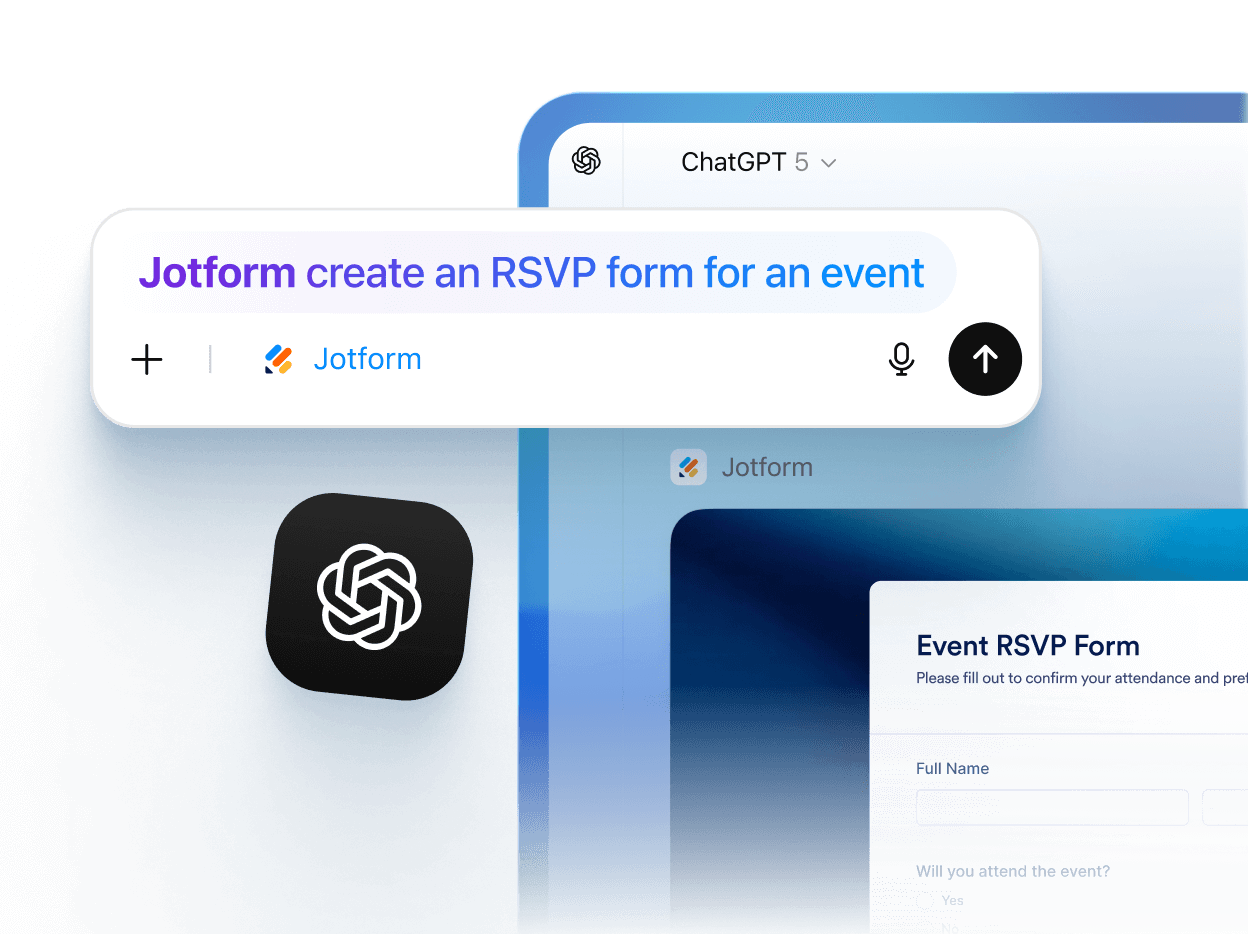
Create forms in seconds inside ChatGPT, refine them through conversation, and turn submissions into clear insights without switching tabs.
Benefits
Describe your questionnaire needs in plain language like "customer satisfaction questionnaire with product quality and service ratings" and Jotform's questionnaire form generator builds a complete form instantly. Use Jotform's Form Copilot to refine your form through conversational commands such as "add demographic questions" or "include a Net Promoter Score question."
Include multiple choice questions, Likert scales, matrix tables, ranking questions, and open-ended text fields in your questionnaires. Set up conditional logic that shows different questions based on previous answers, creating personalized question paths for different respondent types. Add required field validation, answer piping, and skip patterns to gather accurate data efficiently.
Transform questionnaire data into visual dashboards with Report Builder that displays charts, graphs, and statistical summaries automatically. View response distributions, calculate average scores, and identify trends across time periods. Export reports to PDF format for presentations or share interactive dashboards with team members for real-time data access.
Schedule recurring questionnaire distribution through Jotform Workflows that send forms to targeted audiences at specific intervals. Set up automatic notifications when responses meet certain criteria or thresholds are reached. Connect submissions to Jotform Tables where you can segment responses, filter by demographics, and export data for statistical analysis software.

Ask Jotform questionnaire form generator to create a form for you. Begin the form-building process with one simple inquiry.

Chat with the Form Copilot to make any content or design changes you need.

Satisfied with your AI-generated form? Share or embed it to collect responses.
All your questions about Jotform — answered. Check out our FAQs for answers to common questions, or contact our support team for further information.
A questionnaire form generator is a tool that creates customized forms for collecting structured data, opinions, and information from respondents. Jotform's generator uses artificial intelligence to build questionnaires based on your research objectives, automatically including appropriate question types, response scales, and logic branching. The generator adapts to different questionnaire purposes including customer research, health assessments, academic studies, market analysis, and employee surveys. You receive a professional questionnaire in seconds that would otherwise require extensive time to design, test, and structure for optimal response quality.
Begin by accessing the questionnaire form generator and typing your requirements, such as "patient health questionnaire with symptom severity ratings." The questionnaire form generator builds your form with appropriate question types and response options. Customize the generated form using Form Copilot by requesting changes like "add questions about sleep quality" or "include a pain scale question." Review the form preview to ensure questions flow logically and appear correctly on mobile devices, then publish to receive shareable links, QR codes, and embed options for your website or email campaigns.
Researchers collect data for academic studies, clinical trials, and social science investigations through structured questionnaires. Healthcare providers assess patient symptoms, treatment outcomes, and quality of life measurements. Market researchers gather consumer preferences, brand perceptions, and product feedback to inform business strategies. HR departments measure employee satisfaction, workplace culture, and training effectiveness. Educational institutions evaluate course quality, student experiences, and program outcomes. Non-profit organizations assess community needs, program impact, and donor satisfaction. Any organization requiring systematic data collection benefits from structured questionnaire generation.
Use clear, unambiguous question wording that respondents can understand easily without specialized knowledge. Include balanced response options covering the full range of possible answers without leading respondents toward specific choices. Test your questionnaire with a small group before full distribution to identify confusing questions or technical issues. Use validated scales like Likert scales or NPS when measuring subjective constructs for consistency with research standards. Avoid double-barreled questions asking about multiple topics simultaneously. Add progress indicators in Jotform showing respondents how much remains to maintain completion rates. Consider questionnaire length carefully as longer forms typically see higher abandonment rates.
Use conditional logic in Jotform to show or hide questions based on previous answers, creating personalized questionnaire paths for different respondent types. Display follow-up questions only when relevant based on initial responses, reducing questionnaire length for participants. Branch respondents to different question sets based on demographics, experience levels, or screening criteria. Set up skip patterns that move respondents past irrelevant sections automatically. Create complex decision trees with multiple branching points for sophisticated data collection needs. For organizations requiring advanced questionnaire applications, Jotform Apps lets you build custom interfaces that guide respondents through multi-stage assessments with integrated scoring and feedback.
Organize all responses in Jotform Tables where you can sort, filter, and segment data by demographics, response dates, or answer patterns. Use Report Builder to generate visual summaries showing response distributions, average scores, and trends over time. Set up automated reports through Jotform Workflows that generate and email summary statistics on regular schedules. Calculate response rates, completion times, and data quality metrics to assess questionnaire performance.
Include closed-ended questions like multiple choice, rating scales, and yes/no options that generate quantifiable data for statistical analysis. Add Likert scale questions measuring agreement, frequency, or satisfaction levels using standard 5-point or 7-point scales. Use matrix questions when asking the same rating scale for multiple items to reduce visual clutter and improve completion rates. Include at least one open-ended question allowing respondents to provide detailed feedback in their own words. Add demographic questions collecting age, gender, location, or other segmentation variables when analysis will compare different groups. Place sensitive or demographic questions at the end after building respondent engagement with easier questions at the beginning.
Create customer satisfaction questionnaires measuring service quality, product performance, and overall experience. Generate employee engagement questionnaires assessing workplace culture, management effectiveness, and job satisfaction. Build health assessment questionnaires covering symptoms, risk factors, and quality of life measurements. Design market research questionnaires gathering consumer preferences, brand awareness, and purchase intentions. Make academic research questionnaires for psychological studies, social science investigations, and educational research. Produce needs assessment questionnaires identifying community priorities, program requirements, and resource gaps. The questionnaire form generator adapts to any research scenario by including relevant question types and measurement scales based on your specific description.