
The use of artificial intelligence (AI) in education is becoming more prevalent each year. Adopting AI technologies is now non-negotiable for institutions that want to provide students with the best learning experience possible. However, integrating these tools into education also raises practical and ethical questions.
In this guide, you’ll learn how to create an AI policy for schools that protects students and faculty while simultaneously paving the way for a more engaging and immersive learning journey.
What is an AI policy for schools?
An AI policy for schools is a formal set of guidelines that outlines how students, faculty, and staff can responsibly use AI technologies. These rules define acceptable use, clarify ethical boundaries, and ensure compliance with privacy laws like FERPA.
The reality is that AI in the classroom is the new normal. Teachers are using it for grading, lesson planning, and administrative support. Students turn to it for help with writing, tutoring, and problem-solving. And the adoption rate isn’t going to slow down — if anything, it’ll accelerate in the coming years.
A sound AI policy for schools can ensure that this process is ethical, logical, and supportive of your students’ overall educational experience.
Common components of school AI policies
For effective AI governance, your school policy must include the following factors.
Definition of AI
Start with a basic definition of what counts as artificial intelligence. Your definition should also include emerging technology, such as education AI agents. For example, you may want to define innovations such as
- Generative AI
- Adaptive learning systems
- Plagiarism detectors
- Predictive analytics
Don’t leave anything to chance. If you don’t include a specific tool or solution in your definition, it’ll be difficult to enforce your policy.
List of approved and restricted tools
School AI policy guidelines should also list tools that are allowed and tools that aren’t. Create a mechanism for adding new tools to the list as the school or district adopts them. You should also have a list of restricted tools that raise concerns about data privacy or age appropriateness.
Acceptable use guidelines
A student AI usage policy outlines when and how learners can use artificial intelligence in classwork, homework, and projects. Schools often distinguish between using AI as a learning aid versus replacing essential student skills. For example, many districts adopt a 30 percent rule, meaning no more than 30 percent of any assignment should rely on AI-generated content.
To enforce this rule, consider adopting an AI detector. Note that the same tool needs to be used across the entire district. Make sure students have access to it as well, so they and their parents can review their work before submitting it.
Disclosure rules
Transparent disclosures are a critical component of AI ethics for education. These policies require students to cite or acknowledge when they’ve used artificial intelligence tools to complete an assignment. Disclosure helps teachers assess the originality of the work and encourages students to practice proper academic transparency.
Faculty/staff guidance
When creating an AI policy for schools, it’s easy to become hyper-focused on student-facing rules. However, your faculty members are also using artificial intelligence — which means they need guidance, too.
Your policy for staff members should cover
- Grading with AI tools
- Using AI for lesson planning
- Giving feedback with AI
- Scanning student assignments for plagiarism or AI usage
Emphasize that teachers remain responsible for instructional quality and student evaluation.
Data privacy and security
What can an organization do to keep its data safe? That’s where the data privacy and security sections of your policy come into play. Your AI tools must comply with FERPA, COPPA, and district-specific data protection requirements. You should also add an artificial intelligence component to your school’s data privacy and security training.
Keep your faculty members informed of the latest threats and their role in keeping data safe. They’re your best defense against breaches and compliance violations. By contrast, unaware staff members can be a major liability that exposes the district to fines and other penalties.
Misconduct and consequences
Enforcing AI restrictions in schools requires consistency. Your policy should outline the consequences for both unintentional and egregious behavior. Lay out what happens when specific violations occur and what’s expected of your employees.
Ongoing education
Responsible AI use in classrooms requires ongoing training for students, parents, teachers, and administrators. The district needs to provide tutorials, workshops, and up-to-date resources to enable everyone to keep pace with the rapidly changing technology.
Pro Tip
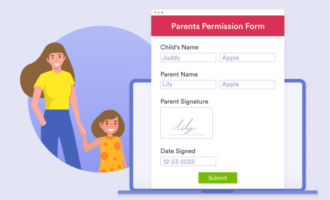
With the AI Policy Template for Schools from Jotform, you can effortlessly draft artificial intelligence guidelines — as well as document acknowledgments from students, parents, teachers, and school administrators.Use our fillable form to protect yourself from the liabilities associated with AI adoption while encouraging individuals to use this technology to enhance educational quality.
How to draft and launch your AI policy
Now that you know what your policy needs to include, it’s time to draft a comprehensive framework for governance and adoption.
This process must be both transparent and collaborative. Your policy also needs to be agile as AI tools are evolving quickly. Create a rule set that’s firm enough to guide conduct while offering enough flexibility to adapt to new tech.
The following step-by-step framework is designed for K–12 environments. It’ll help administrators, faculty, parents, and students embrace artificial intelligence technologies without compromising the learning process.
Define objectives
Start by giving your team a clear sense of purpose. State why you need an AI policy in the first place. Common reasons include
- Protecting academic integrity
- Ensuring equitable access to learning technologies
- Safeguarding student data and privacy
- Supporting educators
- Reducing the administrative burden on staff
- Promoting responsible digital citizenship
Consider which of these objectives align with your vision. As you begin creating rules and provisions for your AI policy, make sure they support one or more of your stated objectives. That way, you can minimize the risk of policy sprawl. Bloated policies can cause more confusion than they clear up.
Form a cross-functional task force
AI touches every part of school life and impacts every employee. As such, a single department can’t create a well-rounded policy on its own. Instead, you’ll need to involve individuals from all spheres throughout the district, such as
- IT leaders
- Board members
- Curriculum directors
- Principals and assistant principals
- Deans
- Student representatives
- School safety staff
- Parents
- Teachers
Counselors and librarians should be involved as well. The goal is to obtain input from multiple levels of the institution so you can minimize the risk of blind spots or gaps in your policy.
Review current academic integrity and technology policies
Using AI in higher education is a matter of academic integrity. Introducing artificial intelligence to the mix also has an impact on your existing technology infrastructure. That’s why creating a new policy isn’t enough — you need to review both of those existing policies too. These documents should complement rather than contradict one another.
You should also seek to minimize overlap and redundancy. Many elements of your current policies may simply need to be expanded to account for artificial intelligence. Building on sound existing policies will save you time and ensure that students receive a consistent message from the administration.
Study policy examples from other schools and associations
Before drafting policy language, give your task force time to explore the AI policies of peer institutions and other respected associations. Consult with the state department of education as well. Studying external examples will provide inspiration for your task force and shed light on challenges they may not have considered on their own.
Encourage the task force to examine both strict and flexible models and adopt an approach that best fits the needs of the school and its students. Many institutions find that there’s a happy middle ground.
Set practical guidelines
Once your task force has done its homework, it’s time to build the foundation of the AI policy. Outline what qualifies as AI use and what types of tools fall under the policy. Then, address what’s expected of students and faculty in different scenarios.
Your guidelines should include
- Approved tools
- Prohibited technologies
- Applications requiring additional review
Your list of tools doesn’t have to be exhaustive, but it should be detailed enough to get across what users can and can’t do when it comes to artificial intelligence.
The objective is to allow AI use to support learning while keeping it from replacing human learning activities. For example, students shouldn’t be allowed to draft full essays or complete math problems with AI.
Include ethical use parameters
Ethics is central to any AI policy for schools. This related section of your policy should address
- Citation rules
- Disclosure requirements
- Transparency expectations
- Bias awareness
- Specific guardrails, such as the 30 percent rule
These parameters reinforce that students must remain the primary creators of their work. Setting clear ethical expectations will help students learn how to use AI responsibly while growing as individuals.
Conduct surveys on current AI use
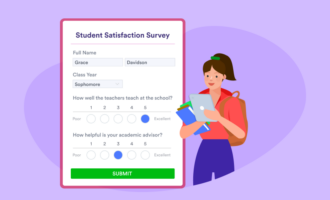
Find out what AI tools for education students and faculty are already relying on via surveys. Keep them anonymous to encourage participation. Ask what tools people are using and for what tasks. Once you know these patterns, you’ll be able to set rules that are realistic and supportive rather than overly restrictive.
Draft the policy and circulate for review
Once you’ve defined these core elements, your task force should prepare a polished draft. Share it among experienced faculty members and administrators, and encourage them to provide honest feedback and flag unclear language. This feedback loop will improve accuracy and alleviate change resistance.
Launch publicly with training and frequently asked questions (FAQs)
Your policy is more likely to be well received if you communicate it effectively. With that in mind, plan on launching it during formal sessions that encourage participants to ask questions, such as faculty training sessions and parent communications. It may be useful to provide one-page summaries and FAQ sheets, as well as real-world examples.
Monitor and review your plan
AI in education is continually evolving, which means your policy should as well. Decide how often you’ll review and modify your plan, such as once a quarter, semiannually, or annually. Choose a strategy that best aligns with the needs of your district.
Building a responsible AI future
Artificial intelligence is here to stay, and the schools that lean into it most effectively will give their students a decisive edge.
As an educator or administrator, it’s up to you to prepare students for the world of tomorrow by providing engaging learning opportunities. AI holds the key to meeting these objectives — but only if used correctly. A sound AI policy for schools can help preserve the ethics of the educational community and guide the use of new technologies rather than simply restricting them.
Take advantage of resources like Jotform’s AI Policy Template for Schools to draft a comprehensive ruleset. With proper governance and close oversight, your district can build a responsible artificial intelligence culture that supports students at every grade level.
This article is for school administrators, IT coordinators, educators, and education policy makers who want to create responsible, transparent, and enforceable AI policies that balance innovation with academic integrity and data privacy in K–12 environments.



































































































Send Comment: