Key Takeaways
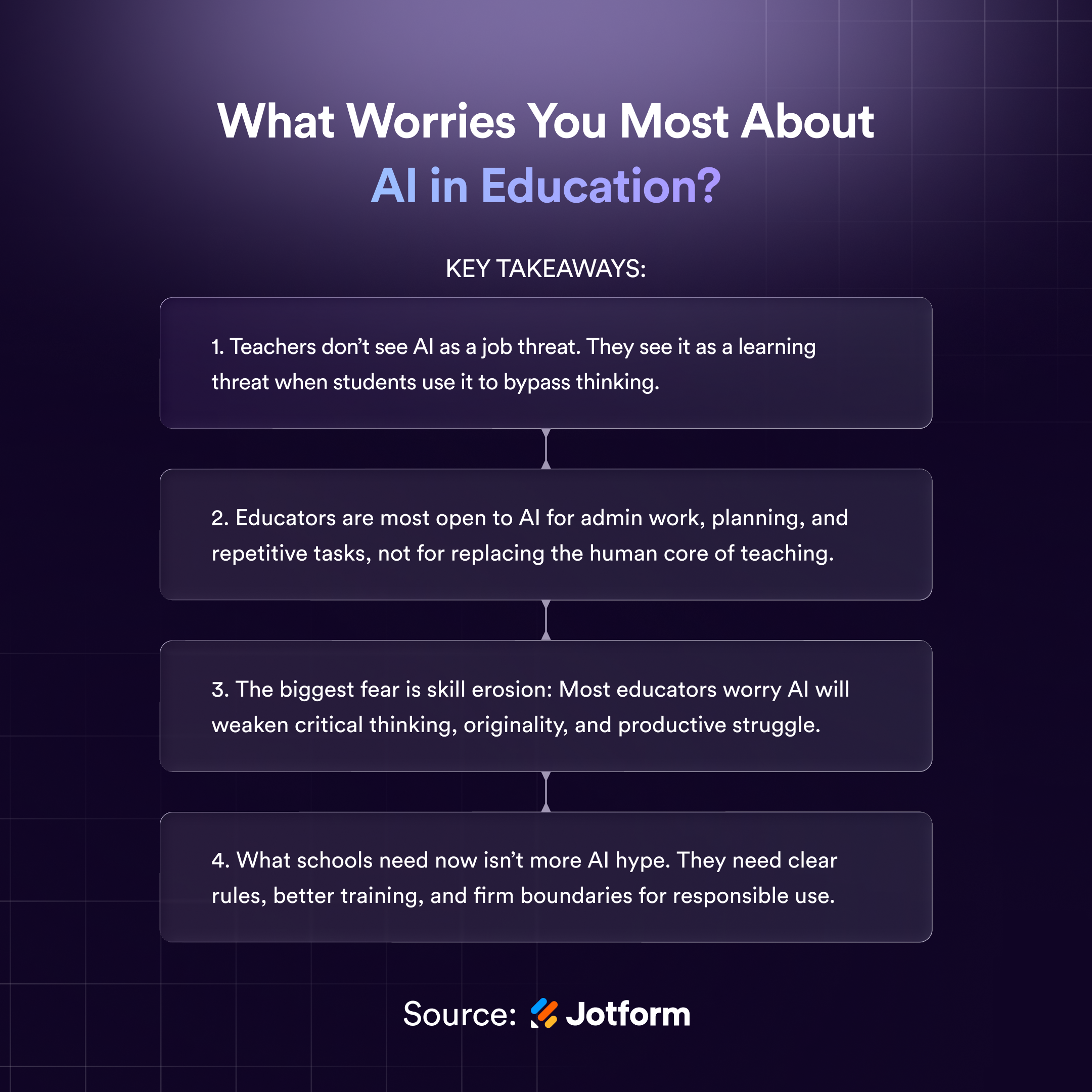
- Teachers don’t see AI as a job threat. They see it as a learning threat when students use it to bypass thinking.
- Educators are most open to AI for admin work, planning, and repetitive tasks, not for replacing the human core of teaching.
- The biggest fear is skill erosion: Most educators worry AI will weaken critical thinking, originality, and productive struggle.
- What schools need now isn’t more AI hype. They need clear rules, better training, and firm boundaries for responsible use.
Let me tell you something I’ve noticed in conversations about AI in education.
I often speak directly with educators, including those who use Jotform’s AI tools. And when the conversation starts, it’s optimistic. They’ll tell me how AI is saving hours on administrative work — automating data intake, answering FAQs, and cutting through busywork that used to take up entire afternoons.
The excitement is real. But the conversation almost always turns to a different question: What happens when students use AI?
That tension showed up clearly in our recent survey of 70 U.S. educators. While many of the respondents see real value in AI, especially for administrative tasks, a large percentage say they’re worried AI could erode students’ skills.
And that concern isn’t isolated. The American Association of Colleges & Universities (AAC&U) partnered with Elon University to survey more than 1,000 faculty about their thoughts on AI. Ninety percent of faculty said they think AI will diminish students’ critical thinking skills.
So while the public conversation often focuses on whether AI will replace teachers, that’s not the question educators are asking.
The real question is harder and more important: How do you use AI in education without undermining how students actually learn?
What Worries You Most About AI in Education?
Optimism, curiosity, and concern
The educators we surveyed included classroom teachers, school administrators, college faculty, and student support staff. Respondents represented public, private, and charter institutions across all four regions — Northeast, Midwest, West, and South — and brought deep experience to the conversation. Nearly two-thirds reported having more than 10 years in education.
Alongside structured survey questions, 56 educators shared open-ended reflections on their biggest fears and hopes for AI in education.
On the whole, the responses reveal a nuanced picture.
Educators are paying close attention to AI, but their reactions don’t fall into a single camp. Instead, they reflect a mix of cautious optimism, practical curiosity, and real concern about how this technology will shape student learning.
A few findings stood out immediately.
Eighty-four percent of teachers worry AI could erode students’ skills; however, nearly two in three don’t expect it to reduce the need for educators anytime soon. At the same time, 82 percent of early-career educators say they avoid AI due to fear of potential consequences, and the presence of a formal AI policy doesn’t appear to ease those concerns.
Taken together, these results point to a clear pattern. The biggest concern isn’t whether AI will replace educators. It’s whether it will change how students learn, and not for the better.
Even more interesting, those who spend the most time in the classroom tend to be the most cautious.
Let’s take a closer look at how that divide plays out.
Educators more cautious than fearful
Despite the public debate about AI in education, the overall sentiment of the educators who responded to this survey is measured. They’re watching closely as AI evolves.
In our survey, 39 percent of educators described themselves as optimistic about AI’s role in education, while 33 percent reported mixed or neutral feelings. Another 29 percent said they feel anxious.
That distribution is significant. It suggests the education sector isn’t overwhelmed by fear — it’s divided. There’s a mix of curiosity, caution, and concern rather than a single dominant reaction.
But when we look into the data further, a clearer pattern emerges.
Classroom educators tend to be the most cautious. Anxiety is higher among K–12 teachers, while optimism rises among school administrators (48 percent) and college faculty (55 percent). The difference reflects how each group experiences AI.
For administrators and faculty, AI often shows up as a productivity tool: something that can streamline operations or support research. For teachers, it shows up in the classroom itself, where the stakes feel more immediate.
That dynamic shows up beyond our survey too. As noted earlier, a study by AAC&U and Elon University found that 90 percent of instructors say AI will diminish students’ critical thinking skills. Many respondents also reported increased concerns about academic integrity, namely, whether the work students turn in is actually theirs. The closer the work is to student learning, the harder it is to ignore those tradeoffs.
Role Type × Overall AI Sentiment
| Role | Neutral/Mixed | Optimistic | Anxious | n |
|---|---|---|---|---|
| School administrator | 33.3% | 47.6% | 19.0% | 21 |
| High school teacher | 30.0% | 20.0% | 50.5% | 10 |
| College/Univ. instructor | 27.3% | 54.5% | 18.2% | 11 |
| Middle school teacher | 50.0% | 37.5% | 12.5% | 8 |
| Student support staff | 0.0% | 33.3% | 66.7% | 9 |
| Elementary teacher | 71.4% | 14.3% | 14.3% | 7 |
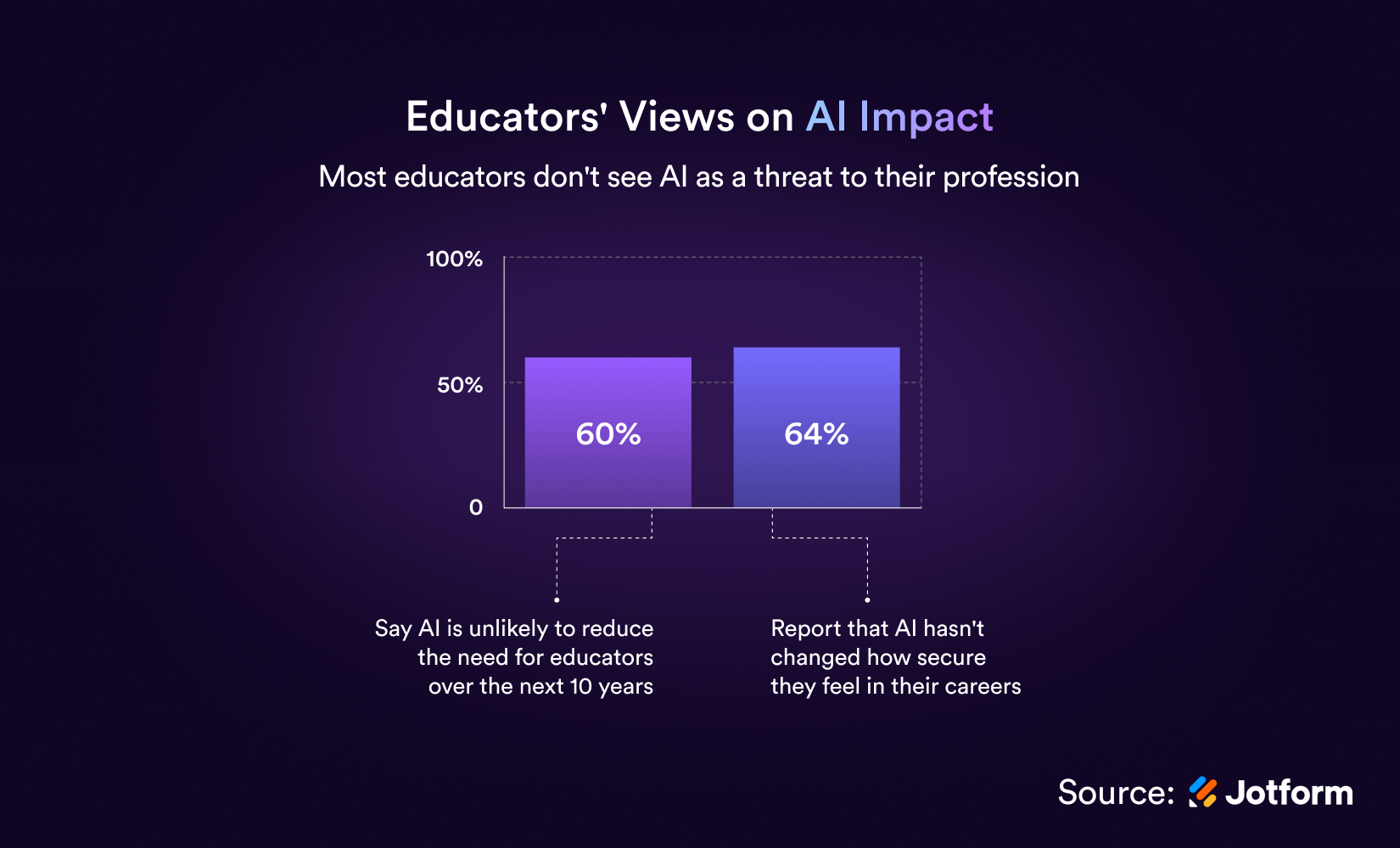



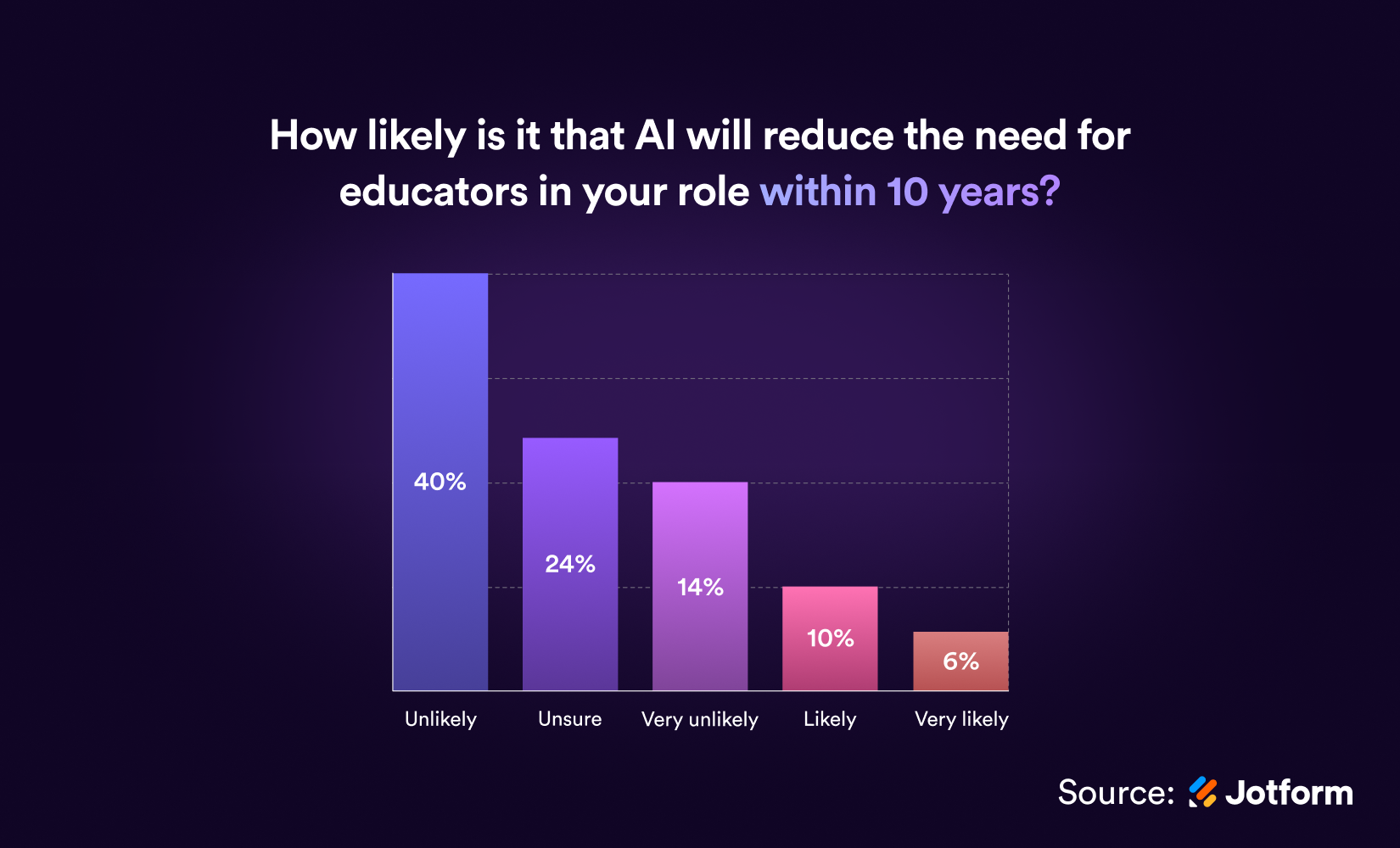
At the same time, most educators don’t see AI as a threat to their profession. 60 percent of respondents said AI is unlikely to reduce the need for educators over the next 10 years, and 64 percent reported that AI hasn’t changed how secure they feel in their careers.
Likelihood AI Reduces Need for Educators (10-Year Horizon)


Career Security Change Due to AI
Q: Has AI changed how secure you feel about your long-term career in education?
| Response | Percentage | Count |
|---|---|---|
| No change | 64% | n=45 |
| Less secure (slightly + much less) | 28% | n=19 |
| More secure (slightly + much more) | 8% | n=6 |
The data points to a clear conclusion: Educators aren’t worried about becoming obsolete because of AI. They’re trying to understand how to use AI without compromising what matters most.
What teachers think AI will actually take over
When educators imagine AI taking over part of their role, classroom instruction is far from top of mind. Instead, they see a future with less busywork and more time for students.
More than half of respondents ranked administrative tasks as the most likely area AI will take over. Lesson planning followed closely behind at 49 percent. Far fewer pointed to grading and feedback (29 percent), and 23 percent said that no part of their role feels vulnerable to AI at all.
Which Parts of Your Job Might AI Take Over?
Q: Which part of your job might AI take over? (Select up to 3)
| Response | Percentage | Count |
|---|---|---|
| Administrative tasks | 54.3% | n=38 |
| Lesson planning | 47.1% | n=34 |
| Grading and feedback | 28.6% | n=20 |
| None of my role feels vulnerable | 22.9% | n=16 |
| Content delivery | 21.4% | n=15 |
| Student support and advising | 14.3% | n=10 |
The pattern is consistent. The tasks educators are most willing to hand off are the ones that take time away from students.
By contrast, the human side of teaching feels far less replaceable. Only 21 percent of respondents identified content delivery as something AI might take over, and just 14 percent pointed to student support and advising.
That gap is telling. The areas educators see as most likely to be automated are the same ones they often describe as the most time-consuming and burdensome. Meanwhile, the parts of the job built on relationships — guiding students, responding to their needs, facilitating learning in real time — remain firmly human in their eyes.
What this looks like in practice
In my conversations with educators, this pattern shows up clearly. The most enthusiastic use cases for AI aren’t about replacing teaching. They’re about saving time so teachers can focus on students.
At McMinn County Schools, Elementary Education Supervisor and District Testing Coordinator Steven Brady used a Jotform AI Agent to answer repetitive questions during state-mandated testing. Instead of answering the same questions over and over, he trained the agent on a testing manual and used it as a reference point for staff.
“I was surprised at how many people used the AI agent to ask questions and get quick answers,” Brady said. “That was pretty awesome.”
The impact was immediate and practical. It saved time while maintaining accuracy and consistency, and Brady could focus on his core responsibilities at the school district.
These are the kinds of use cases educators are leaning into. AI supports the work around learning, not the learning itself.
The real fear isn’t job loss; it’s learning loss
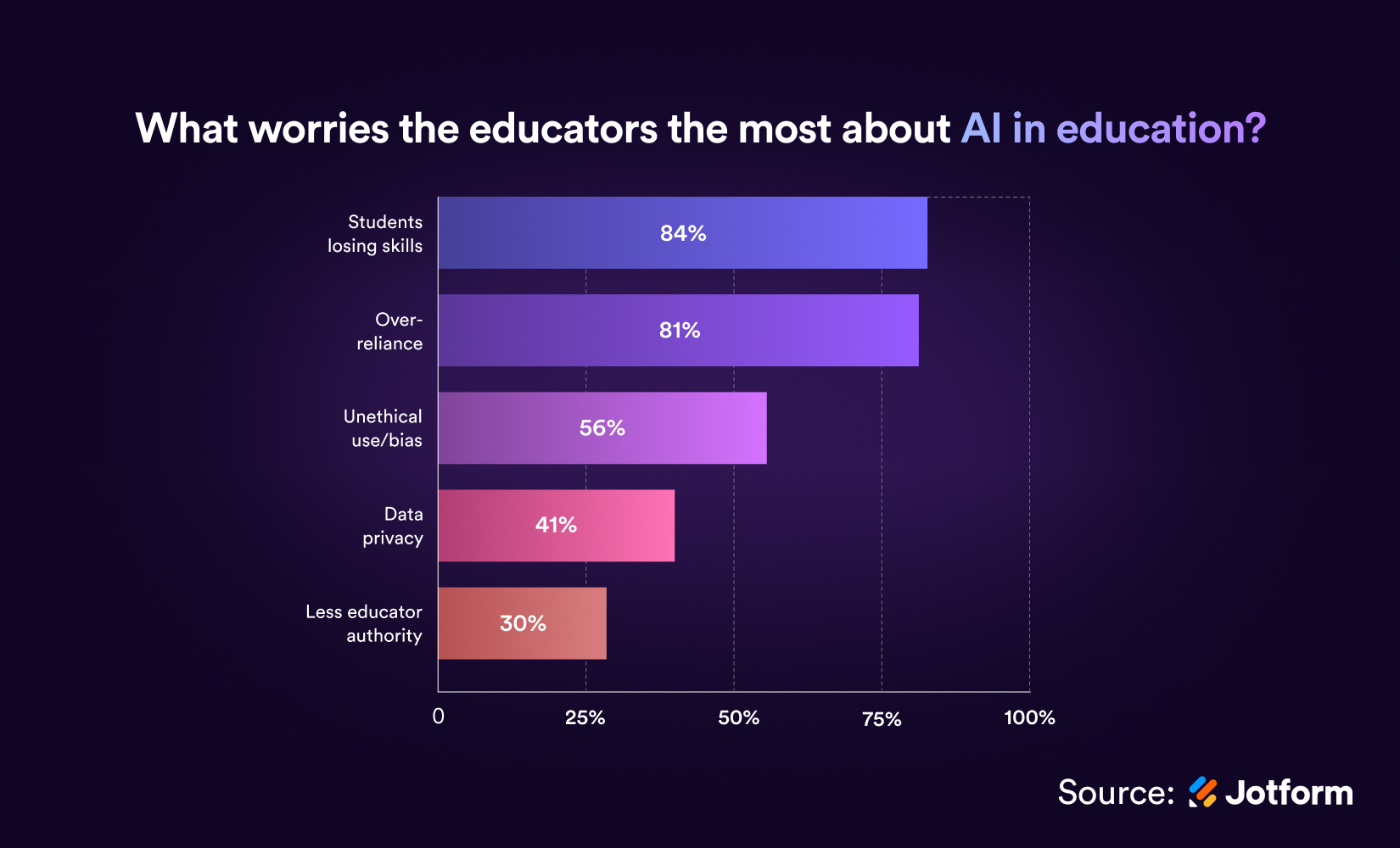
Educators’ concerns about student learning show up clearly in the data. No other issue comes close, as 84 percent say students may lose important skills if they rely on AI, and 81 percent point to overreliance as a major concern.
And this isn’t just perception. It’s a pattern emerging across education. The concern isn’t hypothetical — it’s already here.
The open-ended responses in our survey reinforce that point. Concerns about critical thinking and skill erosion were the most common theme, appearing in nearly a quarter of all written responses. And unlike other topics, the tone here was almost entirely negative.
Several educators described a fear that AI could short-circuit the learning process itself, especially the kind of trial and error that helps students develop deeper understanding.
“It’s taking away the opportunity for students to learn through struggle.” — high school teacher
For some, the concern isn’t just about shortcuts. It’s about whether authentic learning can still happen.
“Can you really trust that this is the student’s original work? Was this thought really theirs — and did they actually learn it?” — student support staff
Others framed it more fundamentally:
“Students need to become okay with the idea that trying on the page is the key way to grow and mature. Outcomes — the paper itself — are never the point; we desperately need thinkers.” — high school teacher
These concerns go beyond academic integrity. They point to something deeper: the possibility that AI could remove the very friction that learning depends on.
For many educators, struggle isn’t a flaw in learning. It’s how learning happens.
The same technology that can save hours of administrative work and even support personalized learning, can also make it easier for students to bypass the effort required to actually understand something. And for educators working directly with students, that tradeoff is hard to ignore.
Even educators who are excited about AI’s potential draw that line. The question isn’t whether AI can produce answers. It’s whether students still learn how to find them.
Newer teachers more likely to avoid AI
Not all educators are approaching AI the same way. Experience plays a significant role in how comfortable they feel using it.
Overall, 21 percent of respondents said they’ve avoided using AI due to fear of potential consequences. But that number changes dramatically when you look at early-career educators.
Among those with five or fewer years of experience, 82 percent reported avoiding AI. For educators with more than a decade in the profession, that number drops to 60 percent.
Years of Experience × AI Avoidance Behavior
| Years of Experience | No | Yes | n |
|---|---|---|---|
| 0–5 years | 18.2% | 81.8% | 11 |
| 6–10 years | 28.6% | 71.4% | 14 |
| +10 years | 40.0% | 60.0% | 45 |
That gap is striking, and it points to something deeper than simple skepticism.
Less experienced educators aren’t necessarily more resistant to technology. In many cases, they’re more familiar with it. What they lack is institutional clarity. Without clear guidelines on how AI should be used, the people with the least job security are the most likely to avoid it altogether.
This pattern shows up beyond our survey. According to Education Week’s Research Center, a majority of teachers say they haven’t received meaningful training on how to use AI in the classroom. When expectations are unclear and support is limited, caution becomes the default — especially for those still establishing themselves in the profession.
What would actually reduce anxiety
If educators are hesitant about AI, the solution isn’t more tools — it’s more clarity.
When we asked what would reduce their anxiety, educators pointed to a consistent set of needs. The most common response was clear institutional guidelines, followed by professional training and stronger ethical frameworks. A smaller group emphasized the importance of being involved in decision-making, while some said nothing would meaningfully reduce their concerns.
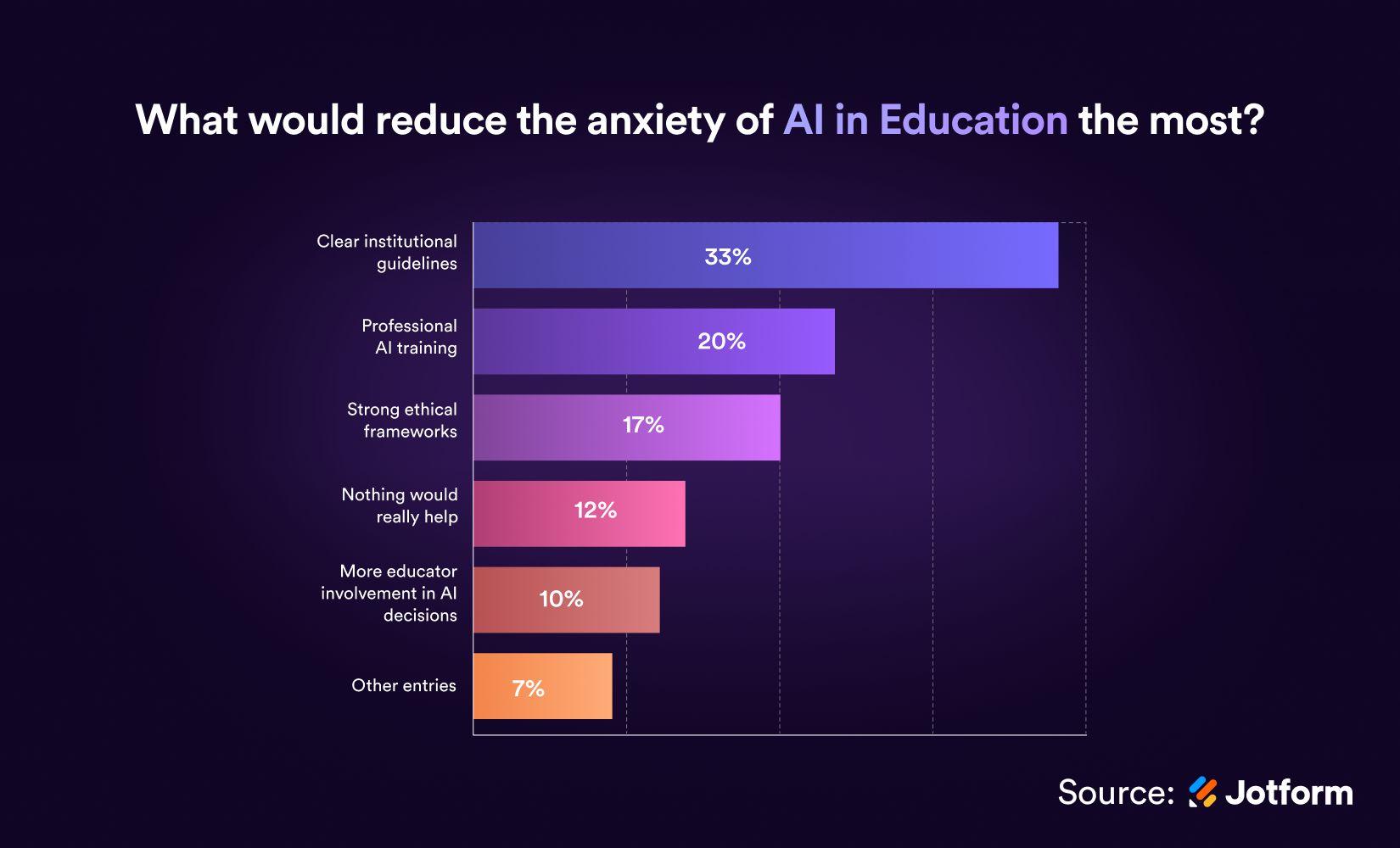


But one finding stands out when you look at the data more closely.
Whether or not a formal AI policy for schools exists, educator sentiment remains largely unchanged. Among those who reported having a policy, 30 percent felt neutral, 40 percent optimistic, and 30 percent anxious. The numbers are nearly identical for those without a policy.
4.5 AI Policy Existence × Overall AI Sentiment
| Policy Status | Neutral/Mixed | Optimistic | Anxious | n |
|---|---|---|---|---|
| Policy exists (Yes) | 30.0% | 40.0% | 30.0% | 30 |
| No policy (No) | 27.3% | 40.9% | 31.8% | 22 |
| Don’t know | 44.4% | 33.3% | 22.2% | 18 |
In other words, the presence of a policy doesn’t seem to reduce uncertainty.
That gap between policy and practice helps explain why hesitation persists. A document may exist, but the day-to-day guidance educators need often doesn’t. What does this actually look like in a classroom? When is AI appropriate, and when does it cross a line? Those questions are still largely unanswered.
External research points to the same conclusion. According to Education Week’s Research Center, a majority of teachers say they haven’t received meaningful training on how to use AI in the classroom. Without that support, even well-intentioned policies can feel abstract.
What educators are asking for isn’t just permission to use AI. They’re asking for a shared understanding of how to use it responsibly and where its limits should be.
Until that clarity exists, hesitation isn’t just expected. It’s rational.
What teachers actually say (and why they disagree)
The open-ended responses in the survey make one thing clear: educators are far from unified in their views of AI.
Overall, 55 percent of responses were negative, 25 percent were mixed, 18 percent were positive, and roughly 2 percent were neutral. The tone leans skeptical, but the positive responses aren’t random. They tend to cluster around specific roles and experiences within education.
Sentiment Distribution
| Sentiment | Count (n) | % of Responses |
|---|---|---|
| Negative | 31 | 55.4% |
| Mixed | 14 | 25.0% |
| Positive | 10 | 17.9% |
| Neutral | 1 | 1.8% |
Much of the optimism came from administrators and college faculty, who are more likely to see AI as a practical tool rather than a classroom disruption.
“My hope is AI takes away the boring, dull, repetitive administrative parts of teaching and gives teachers more freedom to be creative and engaging — more human — with their students.” — school administrator
“It’s like being able to talk to thousands of other educators about how they approach teaching.” — college/university instructor
But the concerns voiced elsewhere are just as strong and often more immediate.
“AI will create an even bigger socioeconomic gap, with resources further concentrated in the hands of the people who own AI/tech.” — school administrator
“It has zero ethical guardrails. It is driven by profit motives. Its use actively destroys the environment.” — IT staff
Between these two perspectives sits another, quieter concern that reflects uncertainty more than outright resistance.
“My anxiety is only around how people rush to use a tool they don’t know how to, and wind up making bad decisions on poor [information] or misinformation.” — school administrator
Taken together, these responses reveal a pattern behind the disagreement. The educators most optimistic about AI tend to occupy roles further from daily classroom instruction, where the technology shows up primarily as a productivity tool. Those expressing the most concern are typically closer to students, where the consequences for learning, equity, and academic integrity feel more immediate.
The divide in educator opinion isn’t really about whether AI is good or bad. It’s about where someone sits within the education system — and how directly they experience its impact on students.
So, what does this all mean?


When I think back to my conversations with educators and compare them to our survey, one thing stands out.
Educators are excited about AI’s potential. But they also understand how powerful it is, and there’s hesitation.
And when you step back and look at the data, the pattern starts to make sense. Educators aren’t worried about being replaced. They’re worried about what students might lose in the process. Those concerns show up again and again in how they talk about AI in their classrooms.
At the same time, the uncertainty they feel isn’t coming from the technology alone. It’s coming from a lack of clarity around how it should be used. Our data shows that having a policy in place doesn’t meaningfully reduce anxiety, and many educators, especially those earlier in their careers, are stepping back from AI altogether when expectations aren’t clear.
That combination creates a difficult position for schools and institutions. The tools are moving quickly, but the guidance around them isn’t keeping pace.
So the challenge isn’t whether to adopt AI. It’s how to adopt it responsibly.
Right now, the most widely accepted path forward is also the most practical one. Educators are most comfortable using AI to reduce administrative burden, streamline workflows, and create more time for meaningful interaction with students. That’s where the value is immediate, and where the risks to learning are lowest.
Where things get more complicated is in the classroom itself. That’s where questions about critical thinking, academic integrity, and equity become harder to answer — and harder to ignore.
Taken together, these findings point to a shift in how we should be thinking about AI in education. The conversation shouldn’t start with what AI can do. It should start with what we want students to learn — and work backward from there.
Because the real question educators are asking isn’t whether AI belongs in education.
It’s how to use it in a way that preserves the parts of learning that make it meaningful.




















































































Send Comment: