

Top class registration software
Let’s say your class registration process runs on emailed forms, phone calls, and manually updated spreadsheets. Every time someone pays for a spot, you match the transfer receipt to the applicant’s name, send a confirmation, and add the student to your roster, one registration after another. Imagine how many hours that costs you every day.
Class registration software replaces that manual work with an automated system. It gives applicants a straightforward way to sign up through an online form or portal, pay at checkout, and get a confirmation right away. Depending on the platform, the software can also cap enrollments, move people off a waitlist when spots open, and send reminders before each session. It also gives tutors and administrators a clear record of payments, a live roster without manual data entry, and an easier way to run their programs.
But with dozens of class registration software options on the market, choosing the right one can be challenging. To make things easier, I’ve compiled a list of the best class registration software for children’s programs, adult classes, and even training providers. This breakdown covers each tool’s strengths, drawbacks, and pricing.
| Tool | Best for | Standout feature | Pricing |
|---|---|---|---|
 Jotform |
Running class registration end-to-end |
Submissions build a self-updating roster in Jotform Tables |
Free; paid from $34/month |
 Regpack |
Collecting tuition in installments |
Automatic retries on declined cards |
Custom quote |
 CourseStorm |
Filling community and art classes |
Abandoned-cart emails that recover unfinished signups |
From $99/month |
 Jumbula |
After-school, childcare, and camp programs |
Staff and parent apps for attendance and pickup |
From $12/month |
 Pike13 |
Recurring tuition and memberships |
Parent accounts linked to individual child profiles |
From $139/month |
 Arlo |
Organizations offering professional training |
Organization portals where employers register and manage staff |
From $121/license/month |
 Enrollware |
CPR and first-aid training centers |
American Heart Association (AHA)-compliant rosters with eCard issuance |
From $119/month |
 Canvas |
Teaching the course after enrollment |
Canvas Catalog storefront with self-enrollment |
Custom quote |
1. Jotform
Why it made the list: Jotform covers the full class registration process, from enrollment forms to payment collection, student database organization, and even learning materials.
Key strengths
- More than 20,000 form templates covering class registration across all education and training levels
- Over 40 payment gateway integrations for collecting tuition and membership fees directly through forms
- A spreadsheet-style database that organizes student records automatically from form submissions
Key drawback
- Monthly submission limits on lower-tier plans can push busy programs to upgrade.
Whether you’re a teacher or a school administrator, Jotform’s class registration software lets you manage classes, organize learning resources, and streamline day-to-day operations with its suite of educational technology tools. It offers 5,000-plus education form templates across student enrollment, class quizzes, corporate training, course evaluations, and more. These smart registration forms come with prefill, data validation, and conditional logic to help you collect relevant, accurate data. Once your forms are ready, Jotform Apps makes it easy to distribute them to students and parents. You can bundle multiple registration forms into a branded, mobile-friendly app and share them through a single link or QR code. For a head start, you can use the Class Sign Up App template.
Your forms can cap enrollments, collect payments via more than 40 payment gateways, collect consent forms and waivers, and trigger follow-up actions like emails, reminders, approvals, or even access to learning materials once someone clicks Submit. As students sign up, their data lands in Jotform Tables and automatically creates a spreadsheet-style roster that updates with every submission. With student data organized in a database, you can track registrations without manual effort, filter student data however you prefer, and share the database with other tutors and staff members. Jotform integrates with Google Calendar, Zoom, and Mailchimp to connect registrations to the tools you use for scheduling, virtual classes, and marketing.
Beyond classroom registration and organization, Jotform Education tools can make teaching sessions even more impactful. For instance, Jotform Presentation Agents can turn learning materials into interactive slides, walk students through course materials, and answer questions in real time during a presentation. Jotform is built to handle serious volume, from virtual class registrations to school-wide student enrollments. Jotform also offers educational institutions a 50 percent discount on paid plans and a 30 percent discount on Jotform Enterprise.
Jotform pricing
- Starter: $0
- Bronze: $34 per month (billed annually), $17 for educational institutions
- Silver: $39 per month (billed annually), $19.50 for educational institutions
- Gold: $99 per month (billed annually), $49.50 for educational institutions
- Enterprise: Custom, 30 percent discount for educational institutions
Pro Tip
Our guide to educational technology covers how schools are using digital tools for assessments, lesson planning, and paperless classrooms.
2. Regpack
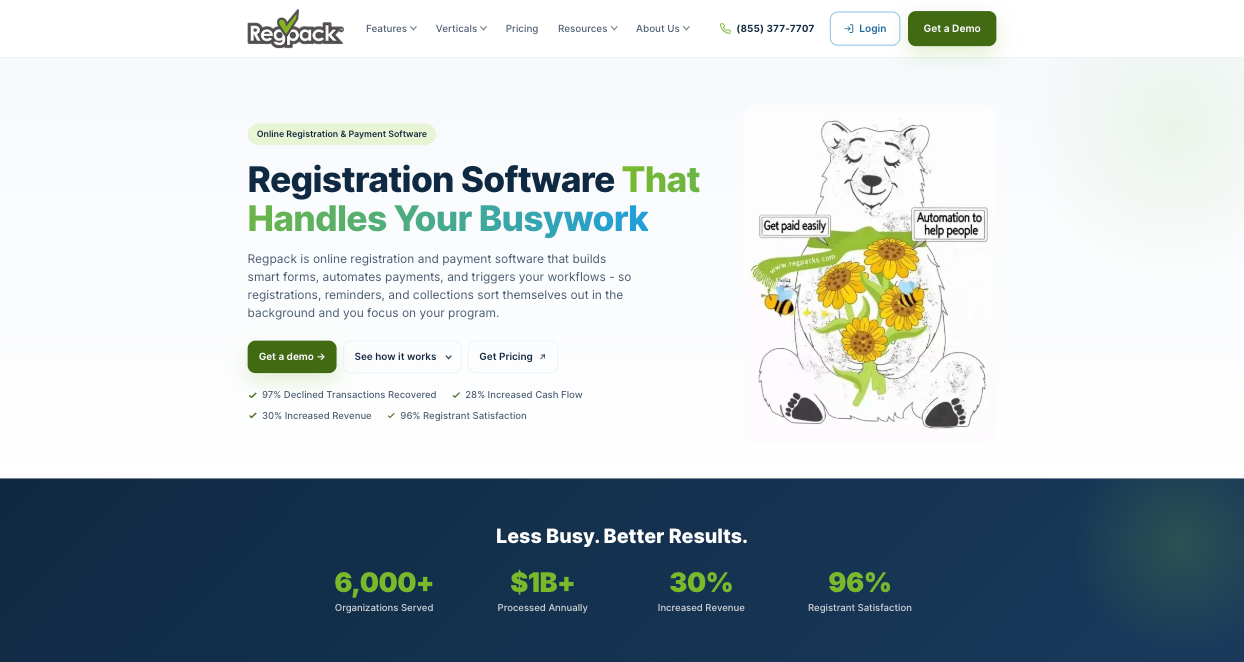
Why it made the list: Regpack handles the payment aspect of class registration with billing schedules, installments, and failed payment retries.
Key strengths
- Smart forms that support all payment types, including Automated Clearing House (ACH) bank transfers
- Supports payment plans, autopay, and automatic retries on declined cards
- Real-time reporting on sales, financials, and forms
Key drawback
- Pricing isn’t published, so you must book a demo before you can start.
Regpack is a registration software for classes, after-school programs, events, and camps that run multisession courses on recurring payments. It gives you smart registration forms that use conditional logic to show each registrant only the questions that apply to them, keeping the forms short and relevant to each visitor. You can cap seats per class, and once a class fills, extra registrants roll onto a waitlist that fills automatically when someone drops.
Where Regpack really shines is payments. It removes the need to chase tuition manually by letting you set a billing schedule. Then it charges cards on time, retries declined payments, and emails registrants when a charge fails. For family and group registrations, registrants can spread cost over installments and apply discounts automatically at checkout. Its historical billing analytics cover financial records, so you can track payments and registrations across past seasons, manage user access through role-based permissions, and sync financial records with QuickBooks, Xero, or Sage.
Beyond registration, Regpack offers automated workflows that handle the manual work that usually follows new registrations. So, a form submission can trigger a confirmation email, reminders, and follow-ups without anyone sending them. You can also manage enrollment, class attendance, and session capacity in place, though attendance tracking is reserved for higher-tier plans.
Regpack pricing: All Regpack pricing is custom and based on your organization’s needs. Payment processing starts at 1.5 percent per transaction, depending on your volume, card mix, and plan tier.
3. CourseStorm
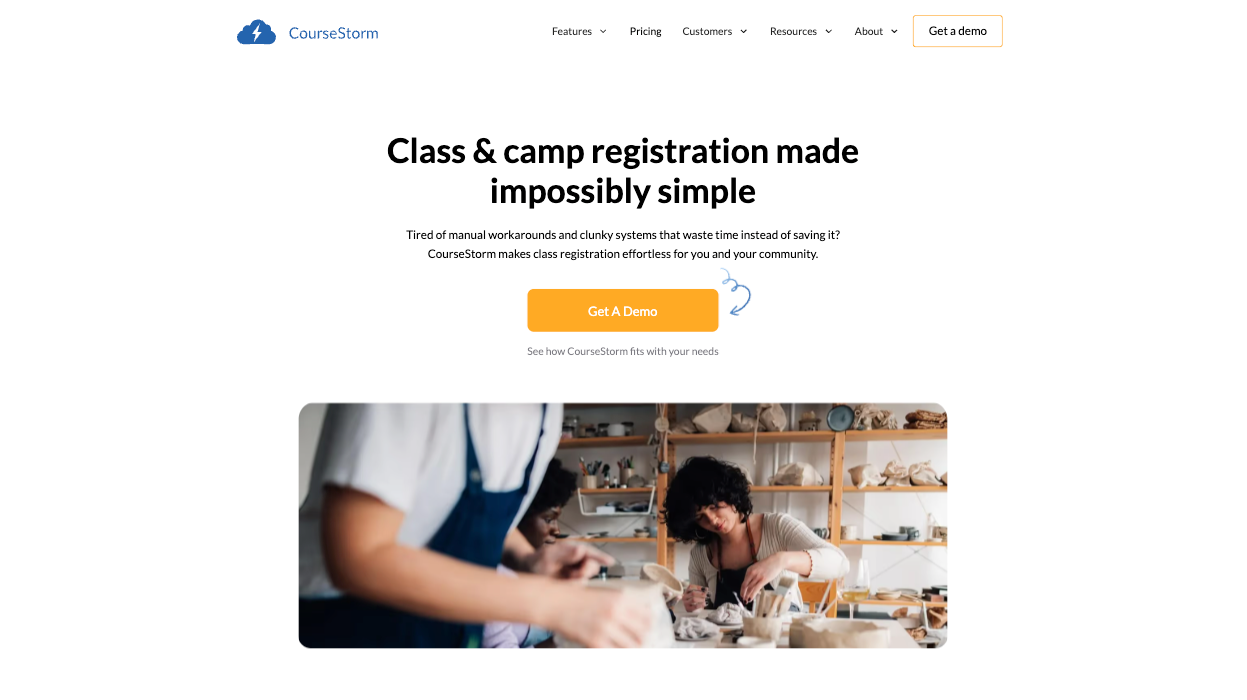
Why it made the list: CourseStorm simplifies registration for children’s group classes.
Key strengths
- Web-based catalog interface where students and parents can sign up for classes
- Automated waitlists that notify registrants when a new seat opens up in a class
- Built-in marketing with automated email and personalized recommendations for students to increase class signups
Key drawback
- Registrations carry a $2.49 fee on top of Stripe’s processing fee.
CourseStorm is one of the best class registration software options for art organizations, community education programs, workforce training, and kids’ camps. It gives you a hosted catalog site where you can list your classes and pull that catalog into your own website with an embeddable widget.
CourseStorm makes filling your classes easy. With registration launch control, you can schedule the exact moment registration opens and build anticipation before it does. When you’re ready to launch, registrants can purchase classes directly from registration forms and sign up multiple people across different classes in one transaction. CourseStorm creates automated waitlists when a class reaches capacity. As more seats open up, it automatically notifies the next person in line. Low enrollment alerts prompt registered students to share classes that need more signups, and abandoned cart emails follow up with parents who started registering but stopped halfway.
In addition to registration, the class booking software handles payment processing, refunds, payouts, and financial reporting. That said, CourseStorm isn’t suitable for programs that mainly run private lessons; residential schools; or programs with prerequisites, applications, or auditions.
CourseStorm pricing
- Starter: $99 per month (billed annually)
- Core: $169 per month (billed annually)
- Pro: $269 per month (billed annually)
- All Access: from $399 per month (billed annually)
4. Jumbula
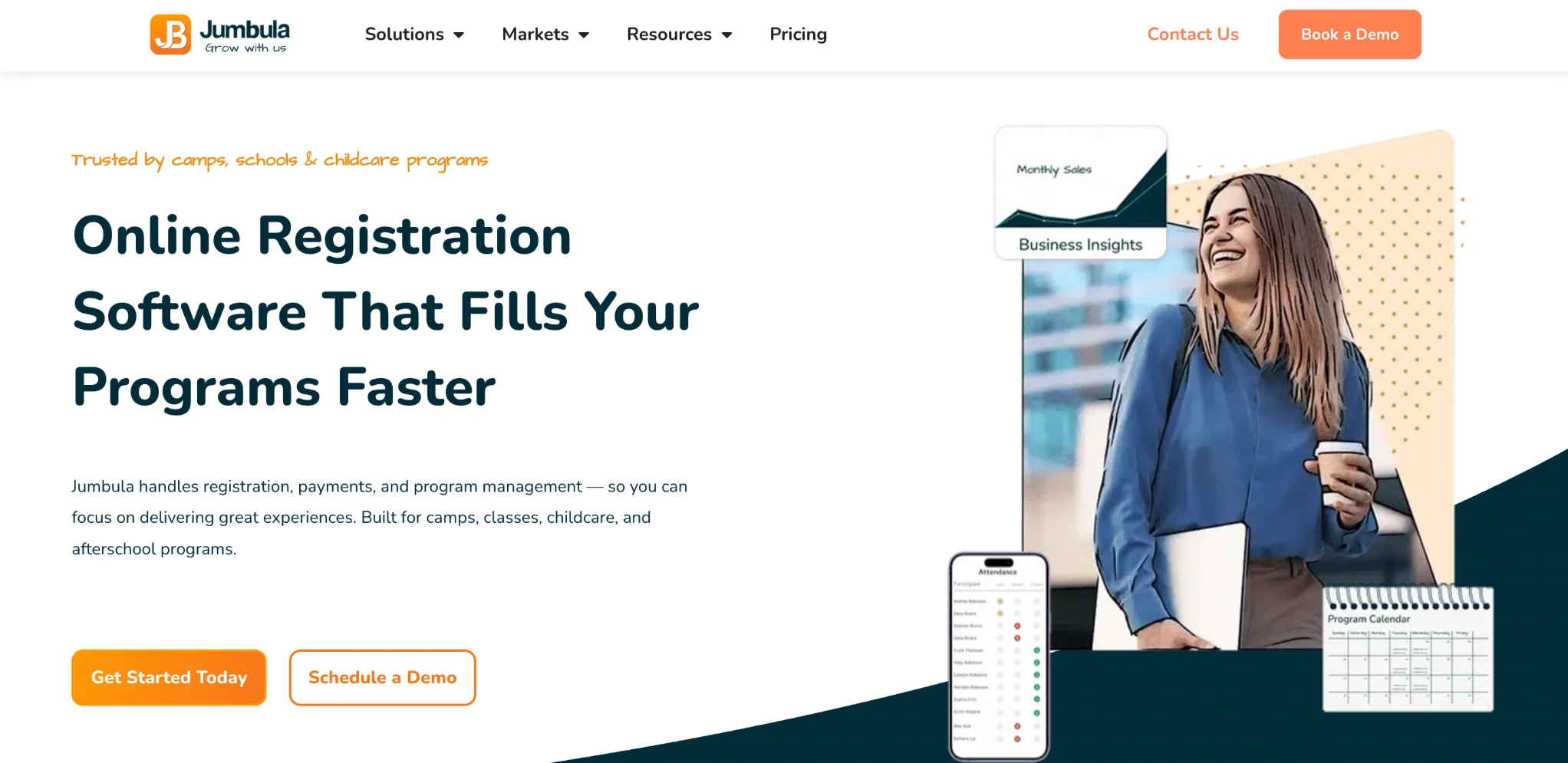
Why it made the list: Jumbula supports a wide range of class formats and adds the program management that most other registration tools leave out.
Key strengths
- Customizable registration forms with coupons, discounts, waivers, and capacity management
- Mobile apps for staff to run sessions and for parents to stay connected to their children’s programs
- Flexible pricing, including a pay-as-you-go plan and usage-based add-ons
Key drawback
- Many users describe a learning curve with the admin dashboard.
Jumbula is the class registration and program management software for after-school programs, childcare, camps, school districts, and parent-teacher associations. It offers customizable registration forms for collecting student and parent information. You can add capacity limits and e-signature waivers to forms, and parents can upload important documents, such as their child’s immunization records, when submitting. After registration and enrollment, the platform shifts into program management. Teachers use the Jumbula Business App to take attendance; check who is authorized to collect each student before releasing them; and search across participants, families, and programs from one screen. Parents use the My Jumbula app to authorize pickups, view their children’s schedule, and access details about upcoming programs.
On the payment side, Jumbula allows you to collect one-time and recurring payments securely through Stripe, PayPal, Authorize.net, or Jumbula Pay. Families can pay by card, ACH, or Venmo, and you can record offline payments like cash, checks, and scholarships without leaving the system.
Jumbula pricing:
- Pay As You Go: $12 per month (billed annually)
- Rise: $120 per month (billed annually)
- Ascend: $228 per month (billed annually)
5. Pike13
Why it made the list: Pike13 is built for programs that run on recurring tuition, memberships, and class packs.
Key strengths
- Courses enroll a student in every session at once and collect the full fee up front
- Flexible scheduling features for managing calendars, recurring appointments, and more
- Unlimited staff seats and client profiles to help keep costs manageable
Key drawback
- Many users describe reporting as cumbersome and difficult to customize.
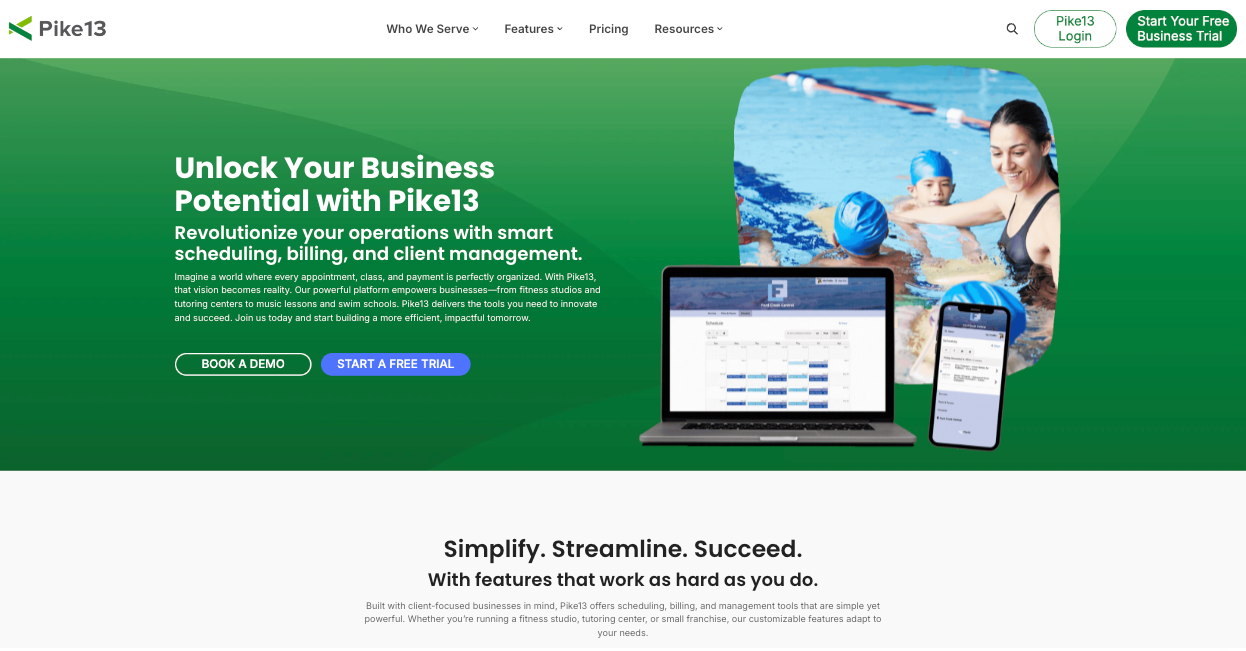
Pike13 is enrollment management software for tutoring centers; swim schools; music, dance, and art schools; and other client-based businesses. It offers self-service and on-the-spot booking for group classes, private lessons, workshops, or one-time events, which students or parents can complete through a client app or a front-desk kiosk. The platform suits programs with recurring enrollments, where the same students return week after week and the schedule repeats across a term. You set up ongoing classes and weekly lessons once, then built-in conflict detection catches double-booked instructors and rooms, and waitlists fill open slots as cancellations come in.
For multisession programs, Pike13’s course format enrolls the student in the full run at once and collects the whole fee at checkout to keep your revenue predictable. Families can create parent accounts that link to individual child profiles, keeping each child’s schedule and attendance separate while the parent sees and pays for all of them in one place. The class scheduling and registration software supports weekly, monthly, or custom billing; discounts for groups and siblings; gift cards; and the option to pass credit card fees to payers through its surcharging gateway.
Pike13 pricing: All plans include unlimited staff seats and client profiles, plus a seven-day free trial.
- Essential: $139 per month (billed annually)
- Advanced: $195 per month (billed annually)
- Premium: $249 per month (billed annually)
6. Arlo
Why it made the list: Arlo is built for organizations that sell training, to enable them to handle registration, invoicing, and certifications in one system.
Key strengths
- Organization portals let employers register and manage multiple staff across courses
- Invoicing with deposits, partial payments, and accounting sync to Xero or QuickBooks
- Certification, continuing professional development (CPD), and continuing education points tracked against attendance and issued automatically
Key drawback
- Registration fees apply on top of license costs, charged on every signup whether the course is paid or free.
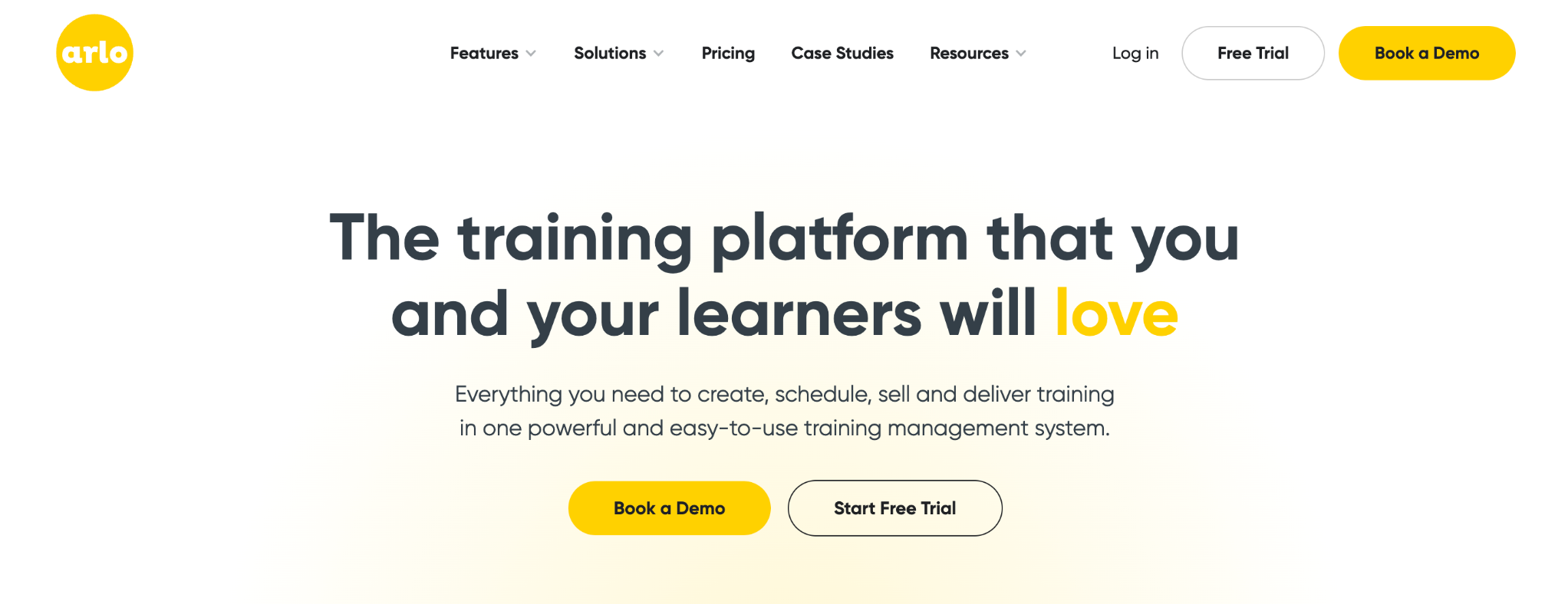
Arlo is training management software for professional training providers, continuing education teams, associations, and universities running instructor-led, online, and blended courses. It offers registration forms that you can connect to your website through a WordPress plug-in or host on an Arlo-built site. Once you set it up, every registration becomes or updates a CRM record; an applicant can register multiple people for several courses in a single order, and you can use registration rules to add screening questions, apply capacity limits, and move people to a waitlist when spots fill up.
Arlo also gives learners a branded portal where they can view upcoming and completed courses, download certificates, and check their accumulated CPD or continuing legal education points. Instructors can mark attendance and record grades from a mobile app, and those completions feed back into certifications and license records. The training registration software accepts payment by card, invoice, or bank transfer, and it issues credit notes when an order changes. Every transfer, cancellation, and refund updates the order, invoice, and course roster automatically. Arlo integrates with Xero and QuickBooks to keep your financial records synced and connects with the learning platforms, marketing tools, and communication tools you already use.
Arlo pricing: Prices are per administrator license with tiered discounts as you add licenses. Registration fees apply separately at $2.15 per paid registration and $1.07 per free registration.
- Simple: $121 per license per month (billed annually)
- Professional: $207 per license per month (billed annually)
- Enterprise: $278 per license per month (billed annually)
- Scale: Custom pricing
7. Enrollware
Why it made the list: Enrollware handles class registrations for CPR and first-aid training centers.
Key strengths
- AHA-compliant rosters built from registration data, with eCards issued through AHA Direct Connect
- Instructor certification and expiration tracking across unlimited instructors and locations
- Affiliate instructors and training sites submit rosters and pay fees in their own secure areas
Key drawback
- It’s built around certification training, so programs outside CPR, first aid, and similar disciplines get little use from its core features.
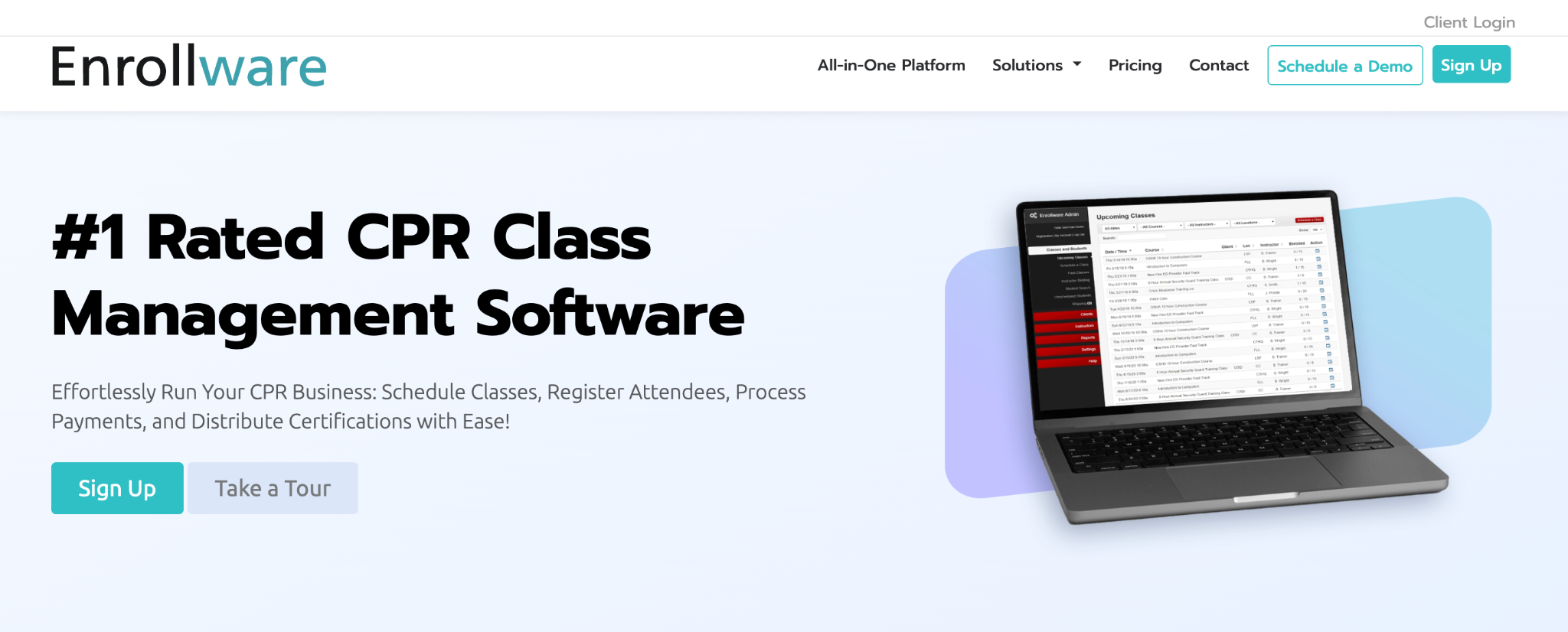
Enrollware is class management software for CPR and first-aid training centers and healthcare educators. It lets you build classes from reusable course templates and then publish them to a hosted schedule page or a calendar view on your site. Once built, the schedule maintains itself. Past classes drop off, and classes that hit their registration limit close to new signups. Students can enroll through single-page forms, pay by card through EnrollwarePay, and get immediate confirmation.
After registration, Enrollware uses registrant information to generate rosters and print cards and certifications, eliminating manual reentry. Students can check into classes using a custom check-in page, and instructors can manage rosters, update student status, and enter test scores from a single portal. The course registration software also serves training centers running a network of affiliate instructors and training sites. Instructors get their own secure private areas to submit rosters, pay dues and roster fees, and order eCards and supplies. Meanwhile, administrators can track instructors’ certifications and teaching history by class or discipline, flag expirations, and run the whole network’s records in one place.
Enrollware pricing: Price plans are tiered by monthly student registrations.
- Up to 100 registrations: $119 per month
- 101 to 200 registrations: $179 per month
- More than 201 registrations: $299 per month
- Premium: $449 per month for unlimited registrations
8. Canvas
Why it made the list: Canvas runs coursework so registration doesn’t stop at the roster stage.

Key strengths
- Canvas Catalog turns course listings into a branded storefront with self-registration and payment
- Free student, teacher, and parent mobile apps covering coursework, grading, and progress
- Over 1,000 integrations plus an open API for feeding registration data in from other tools
Key drawback
- Canvas is a learning management system (LMS) first, so public signups and payments require Canvas Catalog, which costs extra.
Canvas is learning management software used by K–12 and higher education teams. It gives every class a course space where instructors post materials, set assignments, run quizzes, and grade submissions. But class registrations run through Canvas Catalog, a storefront where your courses and programs are publicly listed. Learners can create an account, enroll in open courses, and pay through gateways like Authorize.net, TouchNet, CashNet, or PayPal. The catalog handles enrollment caps, promo codes, and course bundles, and issues certificates automatically upon completion. Organizations can use subcatalogs to give each department or team its own branding and listing under one account.
If you want more control over registration itself, you can integrate Jotform with Canvas. The integration lets you connect your registration forms directly to Canvas so every submission can automatically create or update a student record and enroll that student in the right course or course section. Setup requires your Canvas domain, a Client ID, and a client secret, all generated from a developer key in your Canvas admin settings. This Jotform Canvas integration gives you Jotform’s conditional logic, payment fields, and consent collection at the front end, with Canvas managing coursework behind it.
Canvas pricing
Instructure doesn’t publish pricing information publicly, so you have to request a quote.
Pro Tip
Once students are enrolled, the next admin job is usually planning what you’ll teach them. Our roundup of the best online lesson planners compares six tools to make lesson planning easier.
So, which class registration software should you choose?
Ultimately, the best class registration software for you depends on what your registration process really looks like. As you evaluate the tools mentioned here, consider how each platform’s features handle your enrollment needs and day-to-day operations. Here’s a quick decision guide:
- Class formats: Whether you’re running a multiweek course, a weekly class, or a drop-in, check that the format you provide is supported. Tools built for one-time signups rarely support recurring enrollment well.
- Waitlist and capacity: Most tools cap enrollment. Choose the one that saves time by notifying the next person automatically when a seat opens.
- Payment needs: Choose a tool that lets you collect one fee at checkout or manage tuition over time using installment plans, automatic retries on declined cards, and invoicing for employer-paid registrations.
- Post-registration operations: Choose a tool that sends reminders before each session, syncs schedules to the calendars your instructors already use, and lets staff take attendance from a phone.
- Total costs: Class registration software can quickly become expensive when you add payment processing, registration fees, implementation packages, and user licenses. So, work out what a busy month might cost you in full with the platform you’re considering and check that the figure still makes sense against the cost of your classes.
- LMS needs: If your classes involve assignments, grades, and course materials, choose a tool that connects to your learning management system rather than one that expects you to move students across manually. Our guide to the best software for teachers compares the main LMS options.
- Reporting and integration: Choose a tool that reports on critical metrics and connects to the accounting, email, and marketing tools you already use so your registration data flows smoothly without manual intervention.
Jotform covers all these capabilities, and that’s why it leads this list. With it, you’ll get customizable registration forms for every kind of class registration. Whether it’s kids’ classes, adult training programs, or corporate or government courses, you can customize forms with conditional logic and waivers, collect class payments, and manage the whole program with self-updating rosters, branded portals, and automated workflows. Start by building your first class registration form for free and then take advantage of Jotform’s 50 percent discount for educational institutions on paid plans.
FAQ about class registration software
Prices differ depending on the platform. Some platforms bill a flat subscription; others meter registrations and charge per signup, enrollment volume, or administrator licenses. Some platforms also charge processing and implementation fees.
Yes, most class registration software collects payments. Some take single card payments at checkout, while others handle installment plans, deposits, and invoices for employer-paid registrations. Jotform supports payments through 40-plus gateways, including Stripe, PayPal, and Square, and doesn’t charge extra transaction fees of its own on top of what your provider charges.
At minimum, class registration software should include a customizable form, enrollment caps, payment collection, and a roster you can share with instructors. Beyond that, the features worth having depend on your programs. Recurring classes need payment plans and attendance tracking. Programs for kids need waivers, medical information, and family accounts. Corporate training needs invoicing and certification records.
Yes, Jotform integrates directly with Canvas LMS, so a registration form can instantly create a new student record and enroll that student in the right course or course section without manual effort.
This article is for schools, training providers, continuing education teams, studios, tutors, recreation departments, and program administrators who need to collect class signups, manage rosters, accept payments, send reminders, and keep registration data organized.


































































































Send Comment:
1 Comment:
December 28, 2021
Hi guys, Alex here at Ubindi. We're honored to be included in your list of possible class registration systems for instructors... but might it be possible you link to our homepage like you do for most of the other products? We're at — thank you :)