
Can you add a signature to a Microsoft Form?
- Microsoft Forms doesn’t have a native electronic signature question type.
- You can use several workarounds to document basic acknowledgment in Microsoft Forms, such as using a typed-name field, a “file upload” question type, or a Power Automate flow.
- These workarounds don’t produce a dedicated electronic signature field, but they do add friction and administrative effort.
- Jotform provides a dedicated signature field for forms, and Jotform Sign supports the full e-signature experience when you need it.
Microsoft Forms doesn’t have a native field for drawing or adding electronic signatures. However, you can use workarounds to simulate signatures or acknowledgments in Microsoft Forms.
In this article, we show you how to add a signature in Microsoft Forms in three different ways. We’ll also discuss the limitations and use cases of these workarounds. And for those who want a dedicated e-signature field or a complete signing experience, we’ll introduce you to Jotform — a sophisticated form builder that lets you draw or type your signature.
Pro Tip
Trying to collect e-signatures in Microsoft Forms adds friction to the signee’s experience. Some workarounds also separate the signed record from the form response, which puts the integrity of the document at risk. For waivers, consent forms, contracts, permission slips, and other important documents that require signatures, choose a leading Microsoft Forms alternative instead: Jotform.

Migrate existing forms instantly
There’s no need to rebuild your online forms from scratch. Instead, migrate existing forms and submission data into your Jotform account in one click — so you can collect data without skipping a beat.
Your form can not be migrated.
Please ensure that your form URL is correct and that your form is set to “public” before attempting to migrate it again.
1. Add a typed-name acknowledgment
The fastest, simplest way to work around the lack of a Microsoft Forms signature field is to use a typed-name acknowledgment instead of a signature. This approach is acceptable for simple internal acknowledgments, but it does not capture a drawn signature within a form.
Here’s how to use this Microsoft Forms signature workaround:
- Open the relevant Microsoft Form.
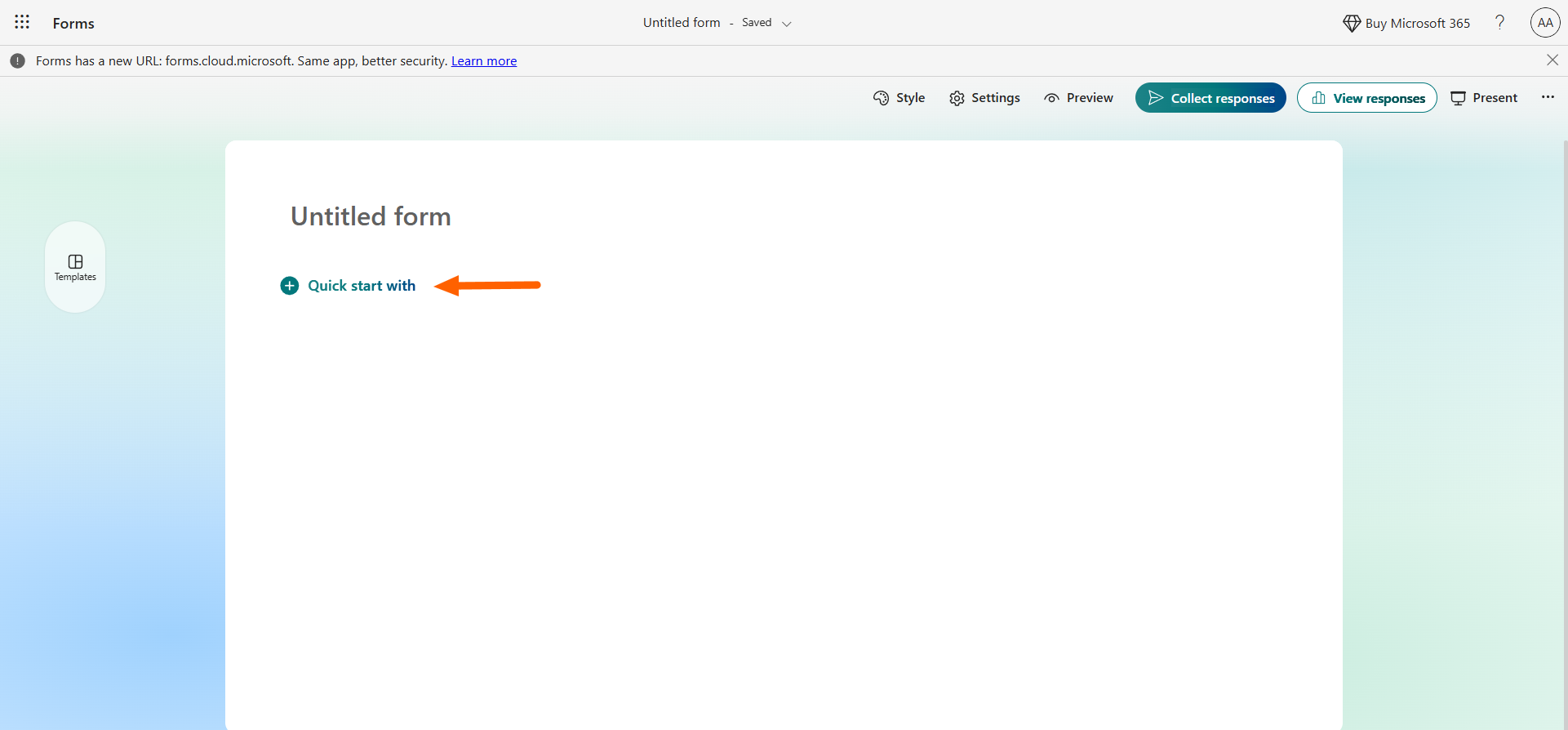
- Click + Quick start with.
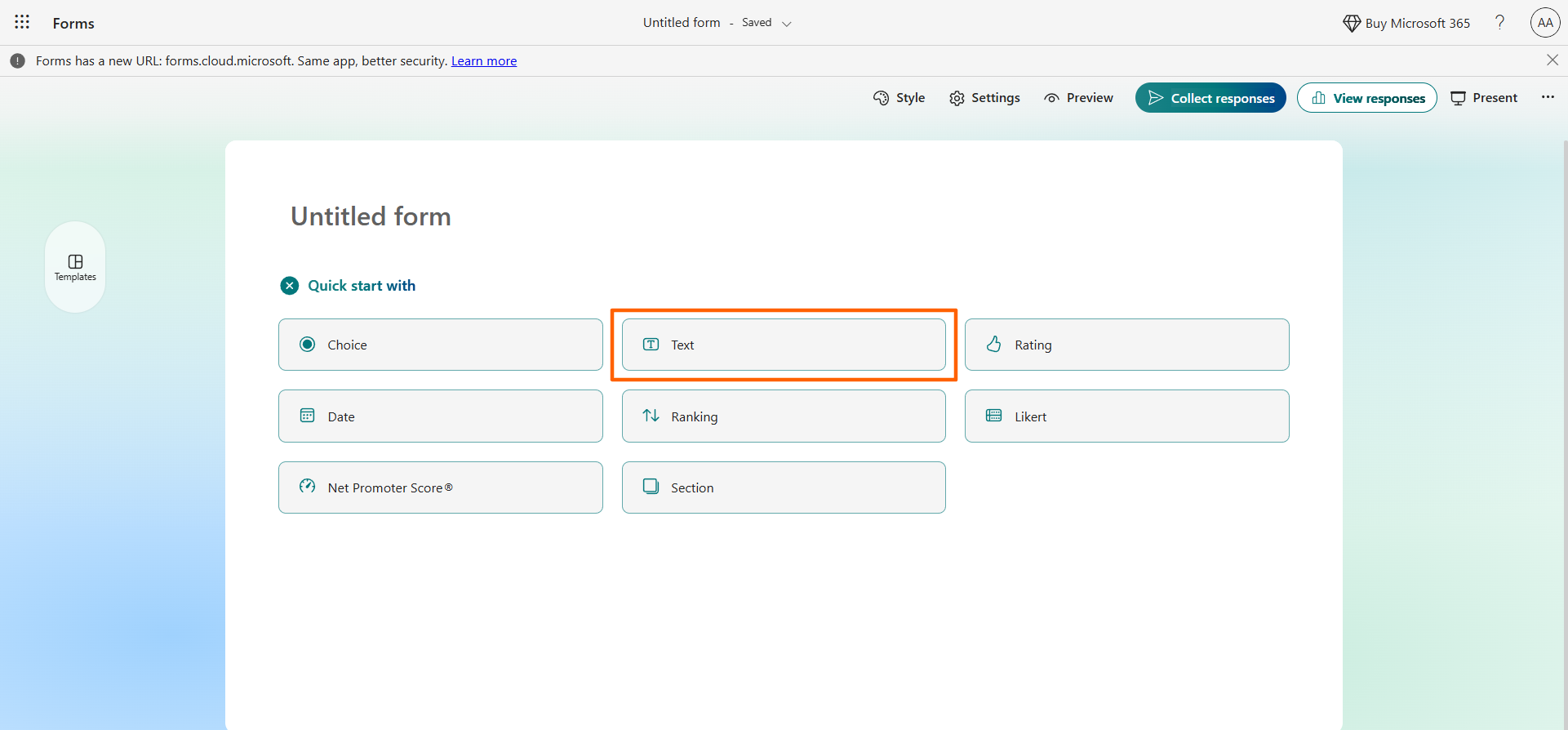
- Select Text.
- Add an instruction in the question field that directs the respondent to type in their full name as a digital acknowledgment. Toggle the Required setting on.
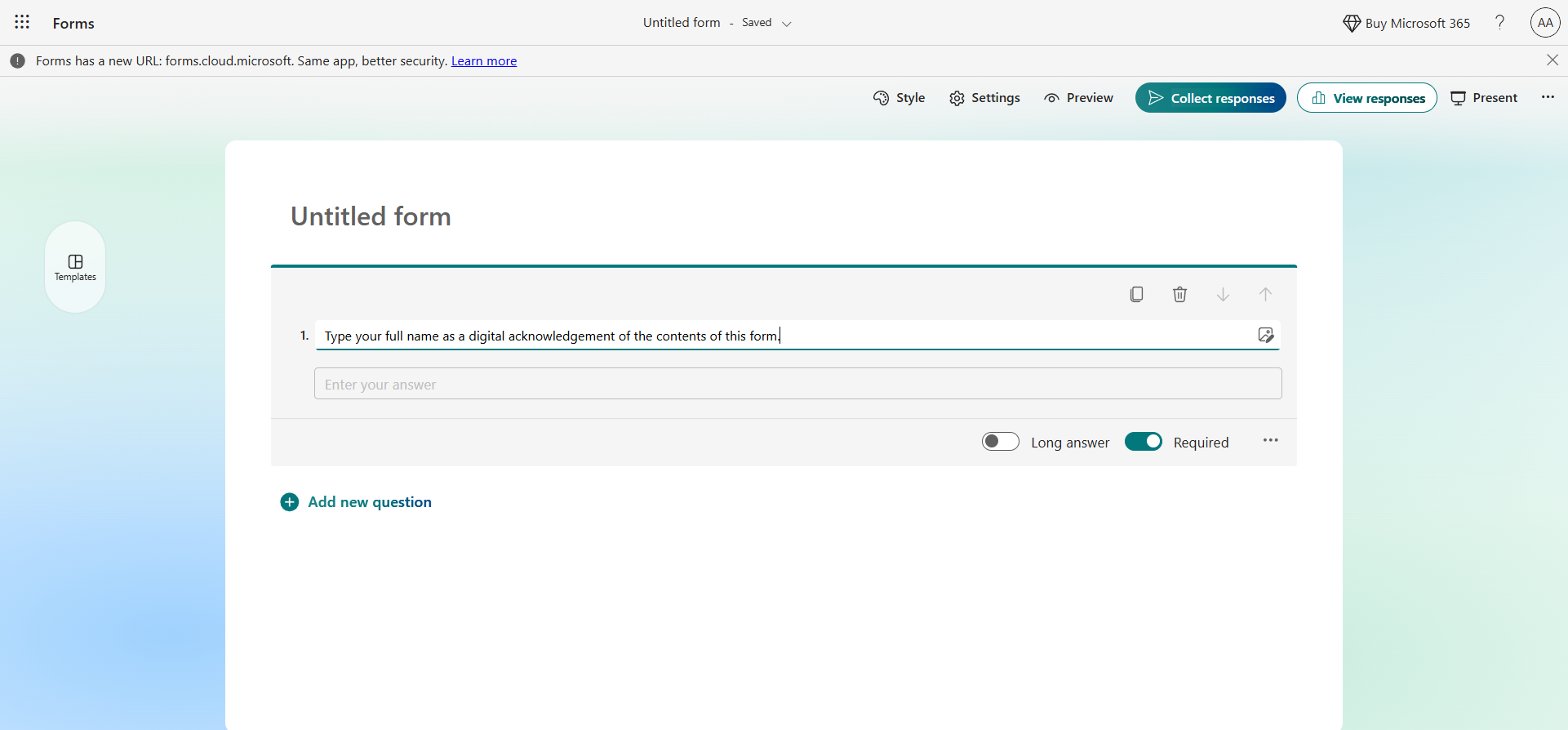
Form respondents can then type in their name, which you can consider a digital acknowledgment in place of an electronic signature.
Pro Tip
Creating engaging, relevant forms in Microsoft Forms is no easy task. For expert tips on selecting question types, form formatting, and more, check out our detailed guide on how to use Microsoft Forms.
2. Ask respondents to upload an image of their signature
Another workaround for a digital signature in Microsoft Forms is to ask respondents to upload an image of their signature. You can do this by using a “file upload” question type. Note that while this approach can work in some instances, it does come with several limitations:
- This question type isn’t available in the free plan: The file upload question type is only included in paid Microsoft 365 business, education, or enterprise licenses.
- It works for internal use only: The file upload question type requires form settings to be set to “Only people in my organization can respond.” This means you can’t use this workaround for public-facing or external forms.
- It adds an administrative burden: This workaround requires the respondent to take extra steps to convert their electronic signature into an image file that can be uploaded. It adds a considerable amount of friction to the process.
What’s more, there’s no way to verify whether the form respondent is uploading their own signature. That makes this Microsoft Forms signature workaround problematic in many use cases.
3. Send a follow-up approval with Power Automate
If all you need is a mechanism for internal approvals, you can try using Power Automate, a cloud-based low-code platform, together with Microsoft Forms to enable a user to approve or deny a specific request. Power Automate has an approval flow that can be used to create an internal workflow for routing, recording, and acting on approvals. Note that it doesn’t add an actual signature field to the form.
This approach works well for internal processes that require sign-offs, such as leave requests, expense reports, or other business processes.
Here’s an overview of how to do it:
- Create a Microsoft Form: Build your form to collect the information you need reviewed or approved.
- Create a flow in Power Automate: Set up a workflow that automatically starts when someone submits your form. Configure it to retrieve the submitted information.
- Add an approval step: In the workflow, add an approval step based on the form details. For example, you can require one person or a sequence of people to approve or decline the request.
- Determine next steps after the decision: Choose what happens when a person approves or declines the request. For example, Power Automate can send a confirmation email or notify the form respondent of the rejection.
This workaround does require some technical knowledge and needs to be maintained on a regular basis to ensure it continues to work correctly.
Collect signatures with Jotform instead — no workarounds needed
Adding an electronic signature to Microsoft Forms isn’t easy because the basic form builder doesn’t come with any native e-signature functionality. Good thing Microsoft Forms isn’t your only option!
Jotform is an excellent form builder that offers the dedicated signature experience you need. Whether you’re working on contracts, applications, online waiver forms, or something else, use Jotform to collect signatures directly on your form.
Here’s what you get when you use Jotform:
- Dedicated signature fields for online forms: With Jotform, you can easily add a signature field to any form you’re working on. Simply select the signature field in the form builder and drag and drop it where you want.
- Mobile-friendly signing: Form respondents can sign using a signature field on any device using a mouse or touchscreen. There’s no need to build a separate signature upload workaround as with Microsoft Forms.
- Electronic signature workflow tool: Use Jotform Sign to route documents for signature. You can automate the process to collect signatures without slowing down the pace of business.
- 20,000-plus free form templates: Jotform offers templates for waivers, consent forms, and other signed documents and workflows, so you don’t ever have to build a form from scratch. You can also convert any form to a PDF to lock everything in place.
- Multiple e-signature widgets: Add a Jotform signature widget or a signature widget from another business tool like Adobe or Docusign. There are plenty of ways to collect signatures on your forms with Jotform.
When it comes to Jotform vs Microsoft Forms, there’s no contest. Jotform offers multiple ways to collect electronic signatures on forms, route forms to others for signature, and complete dedicated signature workflows.
Send my document for signature
File type is not allowed.
Maximum file size limit exceeded. (5MB)
Something went wrong.
Explore Jotform and Jotform Sign today, and see how easy it is to add a signature to your forms and documents.
FAQs about signatures in Microsoft Forms
You can’t add an electronic signature in Microsoft Forms as it doesn’t have the native functionality to do so. Instead, use a sophisticated form builder like Jotform, which has a signature field available for use in all forms and a dedicated e-signature tool, Jotform Sign.
Yes, form respondents can upload a signature to Microsoft Forms in response to a “file upload” question in your form. This question type is only available in paid plans and only works with users inside your organization.
For signature forms, one of the best alternatives to Microsoft Forms is Jotform. It comes with a signature field for all forms as well as electronic signature widgets and a dedicated electronic signature tool, Jotform Sign.
This article is for Microsoft 365 users, HR teams, school administrators, and small-business operators who need a signed consent form, waiver, approval, or agreement but have discovered that Microsoft Forms does not include a native signature field.
AS ALWAYS, CONSULT AN ATTORNEY AND/OR OTHER APPLICABLE PROFESSIONALS BEFORE RELYING ON ANY INFORMATION ON THIS PAGE. THE CONTENT ABOVE IS FOR INFORMATIONAL PURPOSES ONLY. JOTFORM IS NOT PROVIDING LEGAL, TAX, FINANCIAL OR OTHER ADVICE.









































































Send Comment: