
Key takeaways
- Microsoft Forms lets users review response summaries, check individual answers, share summary links, and export results to Excel.
- It works well for lightweight reporting, but reporting becomes more limited when teams need better collaboration, live dashboards, or branded reports.
- Jotform is a better fit for teams that want more flexible reporting, shareable dashboards, and real-time visual reports.
Microsoft Forms makes it quick and easy to review responses, share summary links, and export data to Excel. While the process is efficient, especially for Microsoft 365 users, many face challenges related to sharing results with others; digging into individual responses; or using Microsoft Forms for reporting and creating professional, presentation-ready documents for interested parties.
This guide walks through core Microsoft Forms reporting workflows, including how to check Microsoft Form responses, view individual answers, share results with your team, and export to Excel.
If you need more visual, shareable, and customizable reporting, including shareable dashboards and real-time reports, I’ve also mentioned an alternative: Jotform offers a simple workflow, with no Microsoft 365 subscription required.
How to check Microsoft Forms results
Microsoft Forms includes built-in reporting that updates in real time, so you can review responses as soon as they come in.
The following sections include workflows and annotated screenshots showing you how to view response summaries and check individual responses.
For a more detailed workflow of Microsoft Forms, read how to use Microsoft Forms.
How to view response summaries
In Microsoft Forms, you can view response summaries in real time, anytime. As recipients populate the form, their responses will appear on the View Responses dashboard.
Here’s how you find it:
Open the form you want to analyze and click on the View Responses tab.
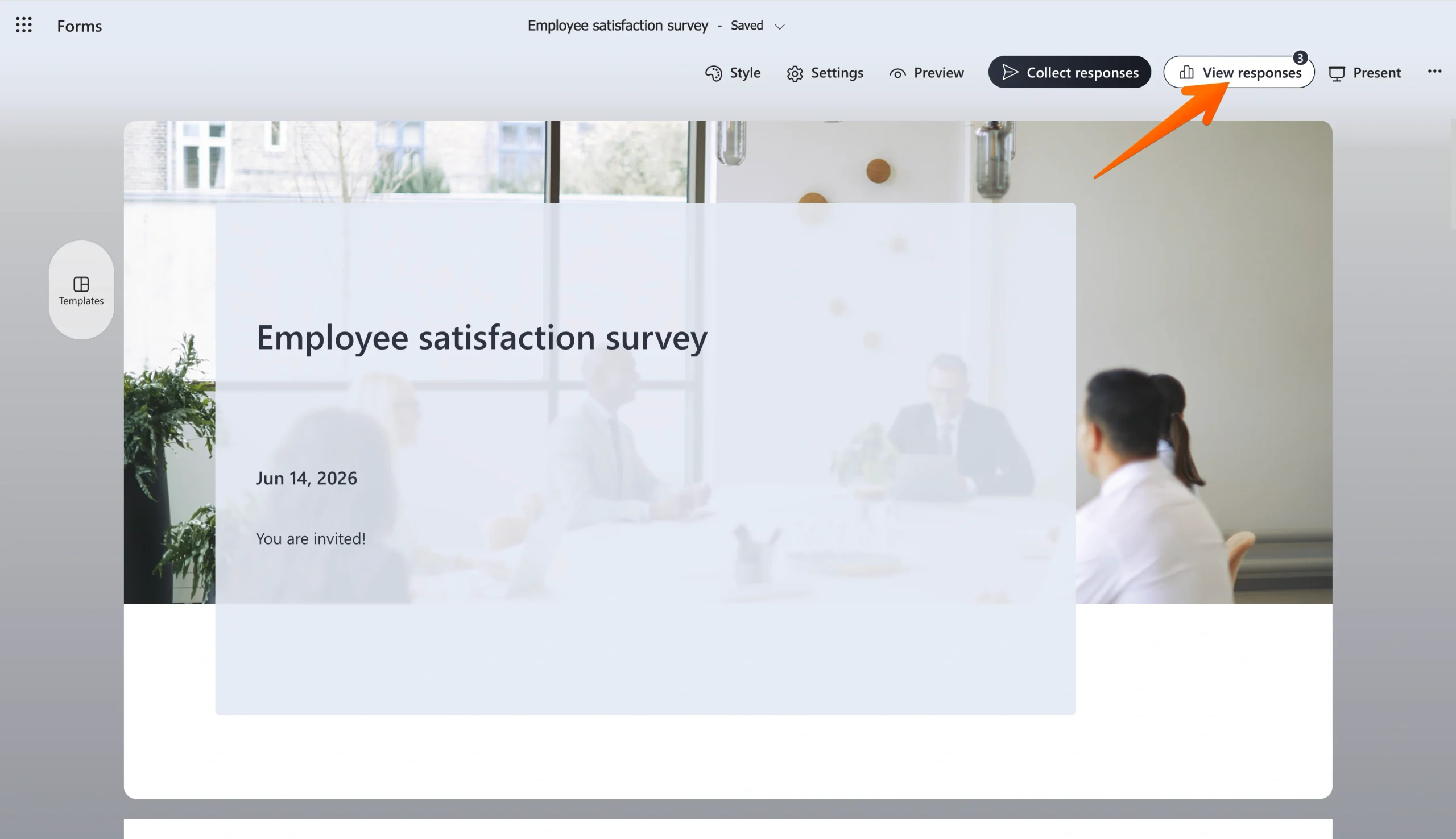
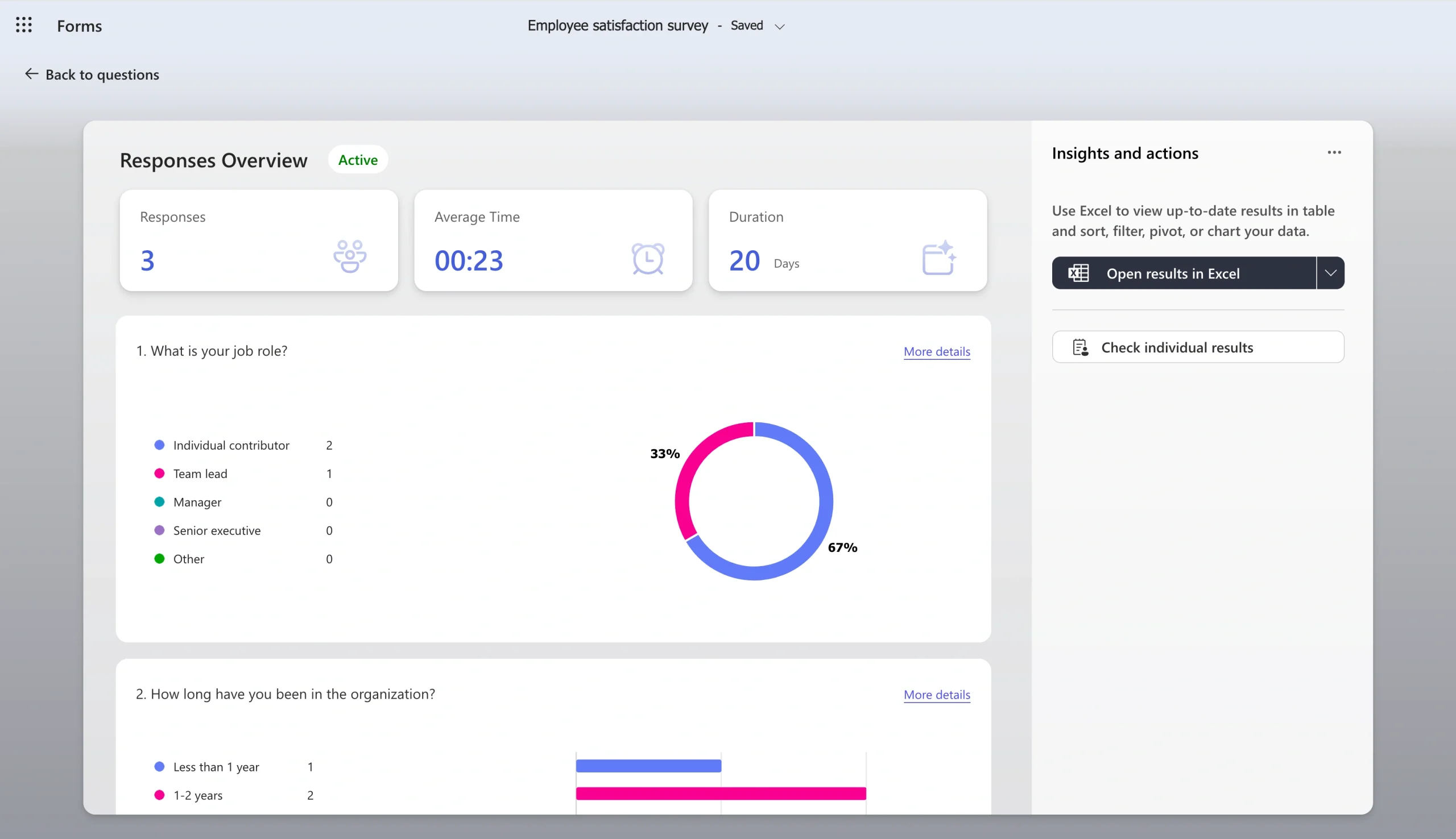
You’ll see a snapshot of key information, including
- Total number of responses
- Average time it took respondents to complete the form
- Duration (the time limit for form completions), if one is set
Once you’ve navigated to the dashboard, here’s what the reporting on Microsoft Forms looks like:
How to check individual responses
When you’re on the View Responses dashboard, you can see a summary of all recipient responses. If you want to drill down to see individual responses on Microsoft Forms, here’s how:
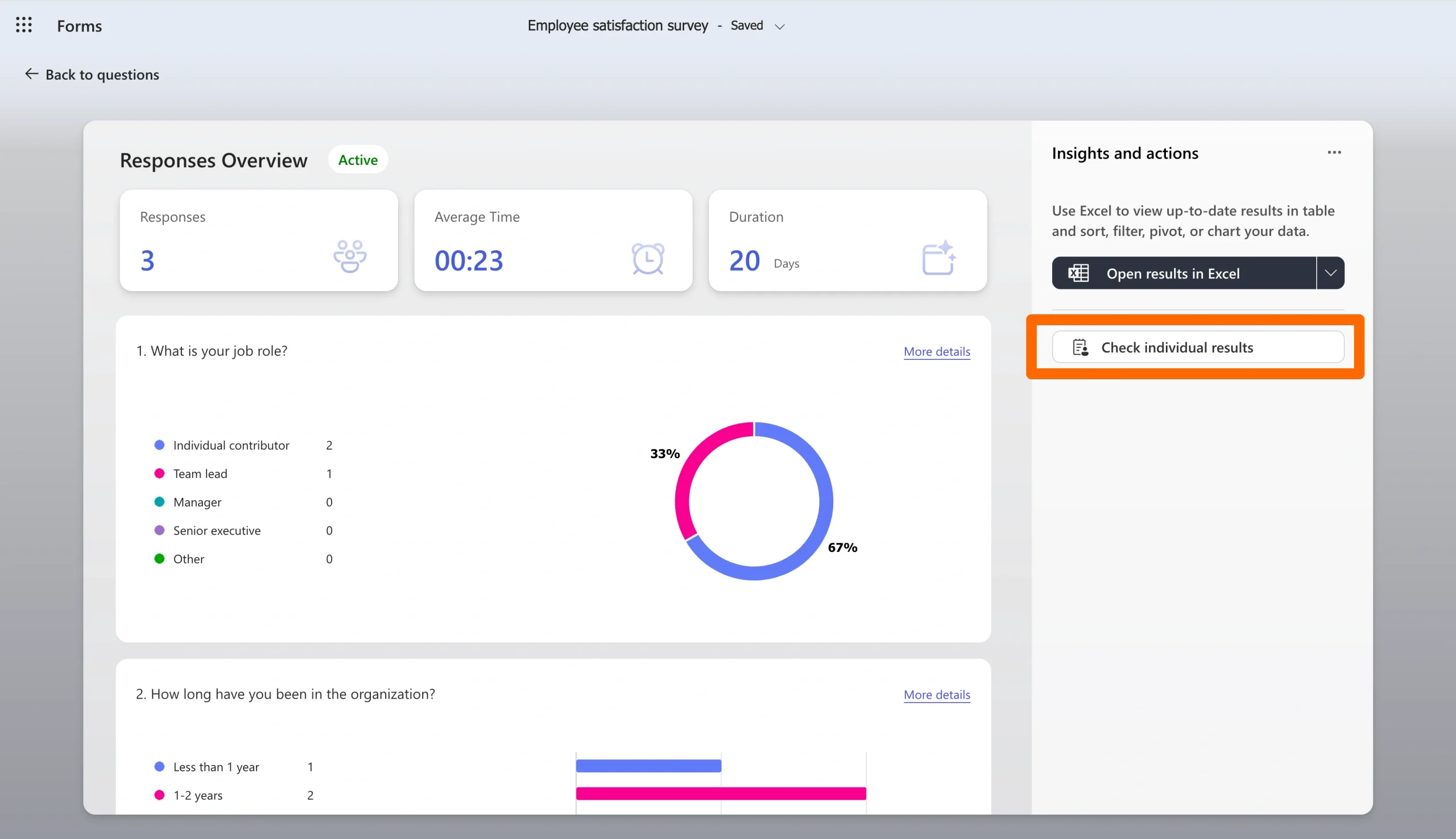
Click Check Individual Results from the dashboard. It’s in the right-hand menu.
You’ll go to a new page that shows each submission one at a time, so you can view exactly what a specific respondent entered for every question.
Here’s what that looks like:
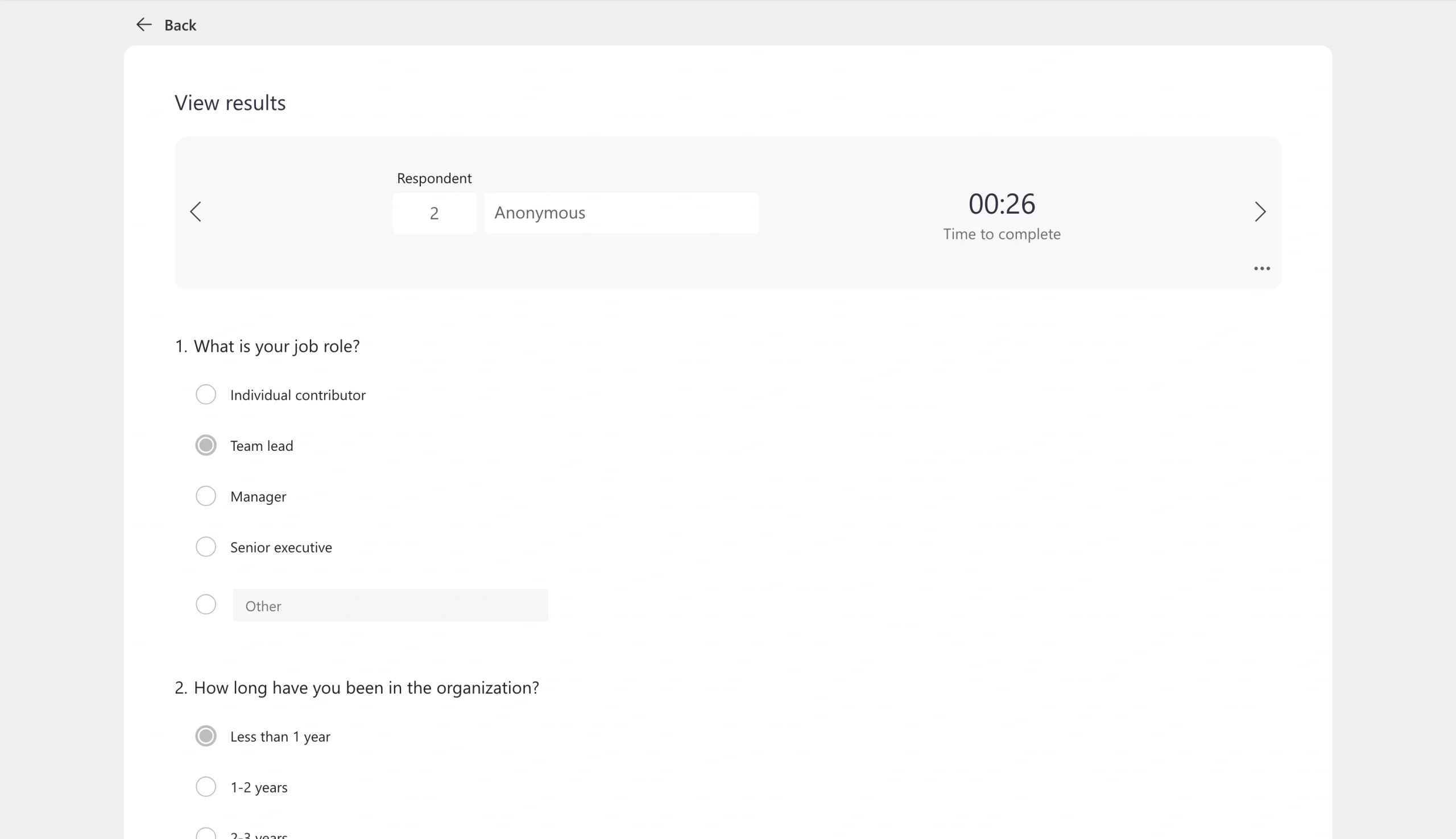
If you’re looking for a particular submission, enter the respondent number into the search bar at the top to jump straight to it.
How to share Microsoft Forms results with others
Sharing Microsoft Forms results with colleagues or external parties is straightforward, once you know where to look. Here’s how to get your response data in front of the right people.
How to share a summary link
To share responses from Microsoft Forms, click the View Responses tab.
Click the three dots at the top right of the dashboard to reveal more options, then select Share a Summary Link.
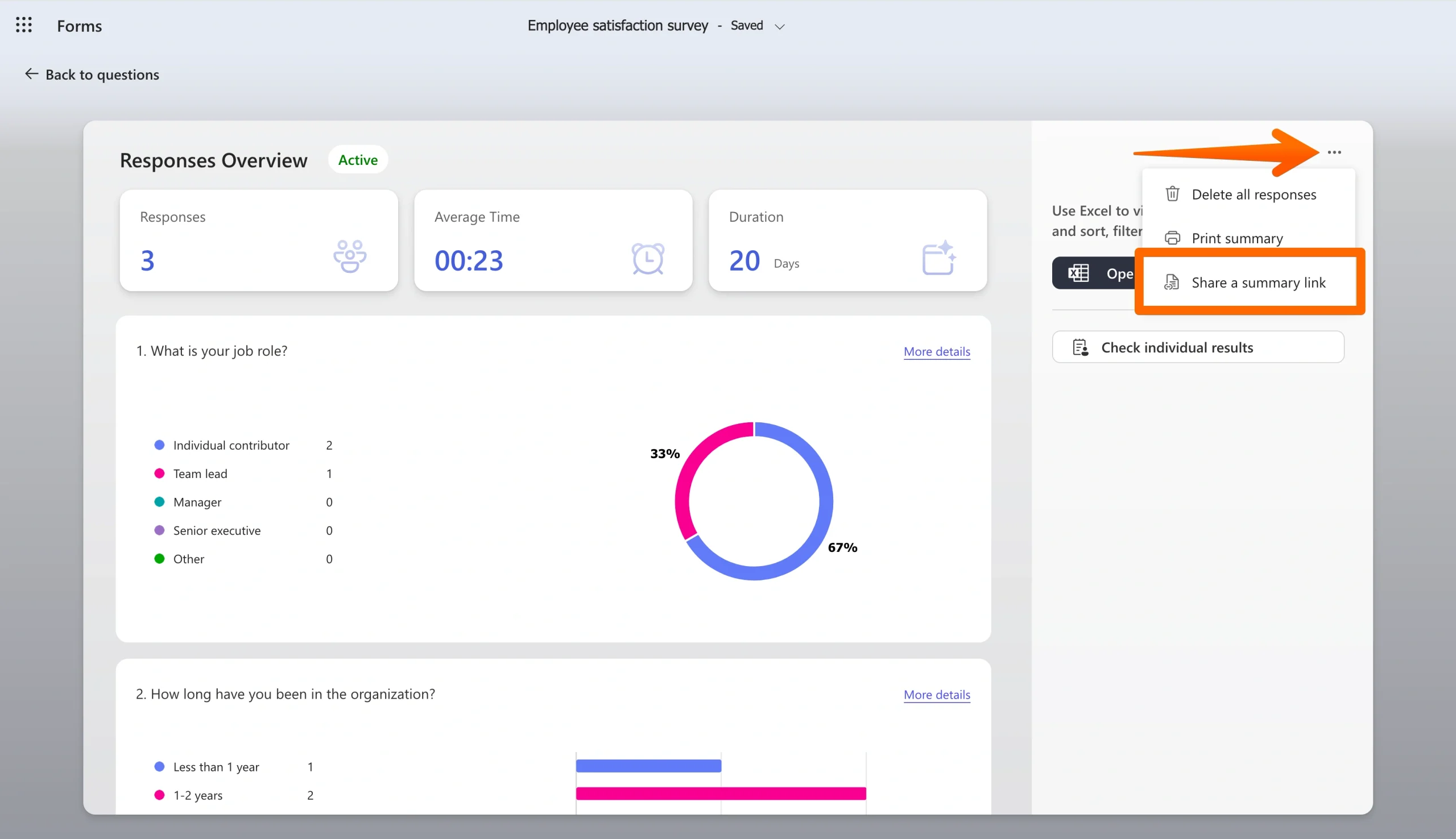
This generates a link you can copy and distribute via email, Slack, text, or any other channel.
The link appears in a popup, as shown in the following screenshot:
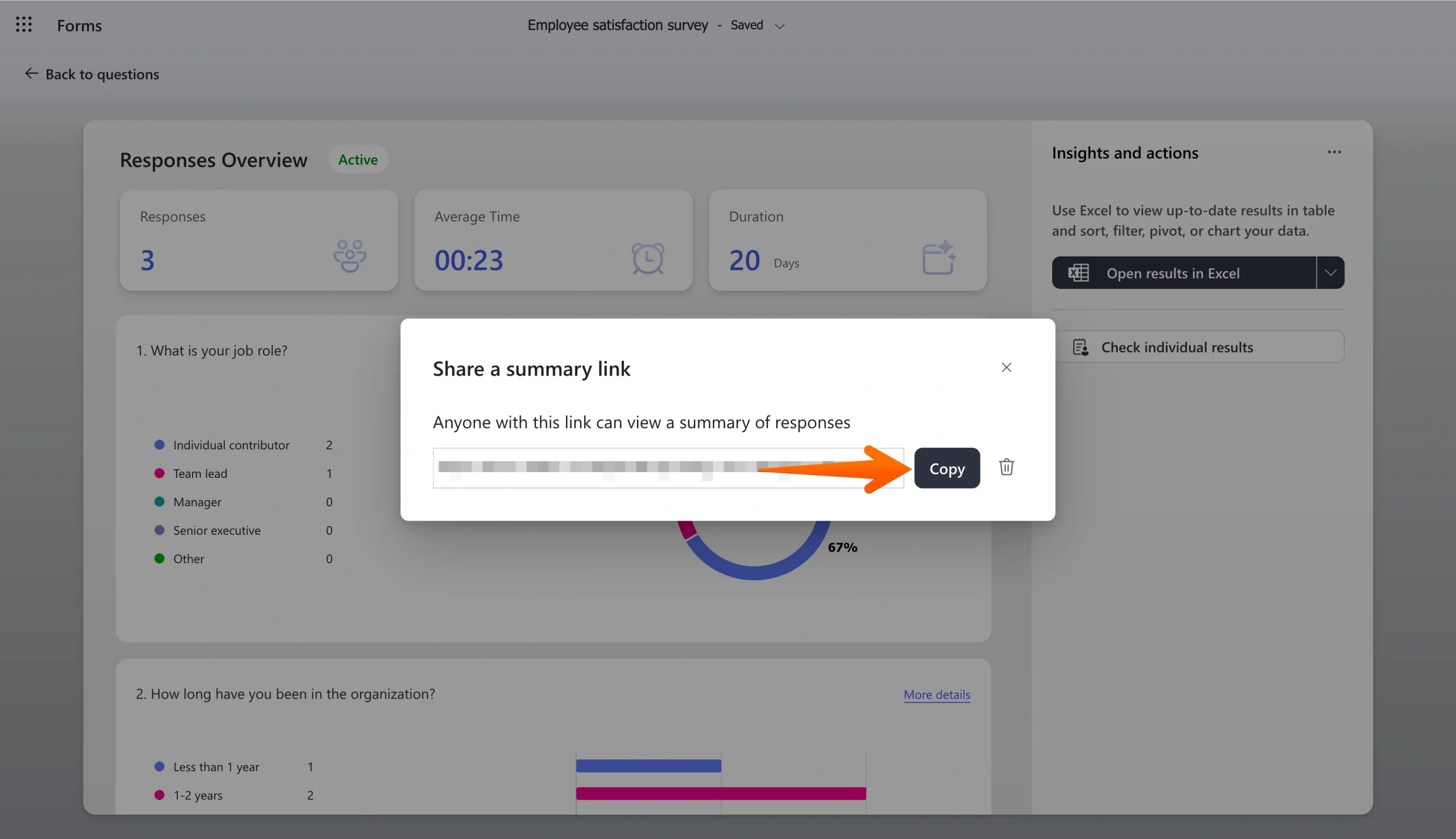
Common reasons why people share form links include
- To send results to a manager or partner after a survey closes
- To send feedback data with a wider team via a Slack channel
- To include a results link in a report or presentation
What people can and cannot see
It’s worth being clear on what a shared summary link actually gives people access to.
Viewers can see
- Total response counts and average completion times
- Question-by-question summary data and charts
Viewers cannot see
- Individual respondent answers or identities
- Raw response data
Anyone you’ve shared survey results with cannot see form settings. They don’t have any backend access and therefore have no edit access whatsoever.
If you need to share individual responses or raw data, you’ll need to export it to Excel and share that file separately.
Tip: To view exactly what an outside viewer will see when clicking on your shared survey link, copy the link and paste it into an incognito browser (don’t log into your Microsoft account).
How to export Microsoft Forms results to Excel
The built-in Microsoft Forms reporting view is useful for a quick overview, but many users export their results to Excel. Exporting gives you the raw data in a structured format you can filter, sort, and analyze however you need.
How to open results in Excel
To export your results, open your form and click the View Responses tab.
You can do one of the following:
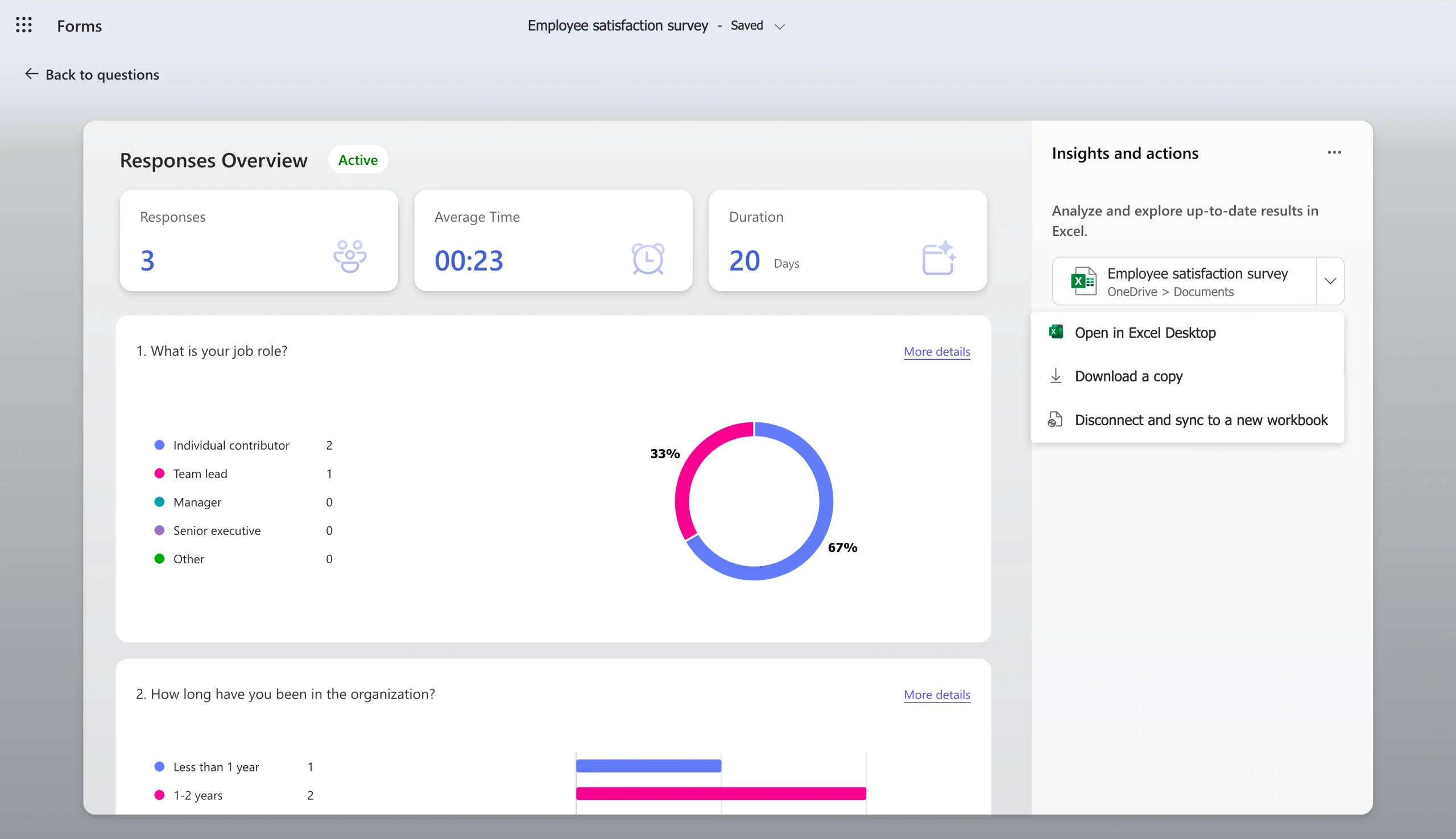
- Click the Open in Excel button in the top right of the responses panel, which opens the file on OneDrive in the browser.
- Click the arrow next to the button and select Open in Excel Desktop to open the file in Excel on your PC.
- Click the arrow, then choose Download a Copy to export the file to the Downloads folder on your PC.
Inside the spreadsheet, each question appears as a column header, and each row represents an individual respondent’s answers.
Here’s what the export looks like:
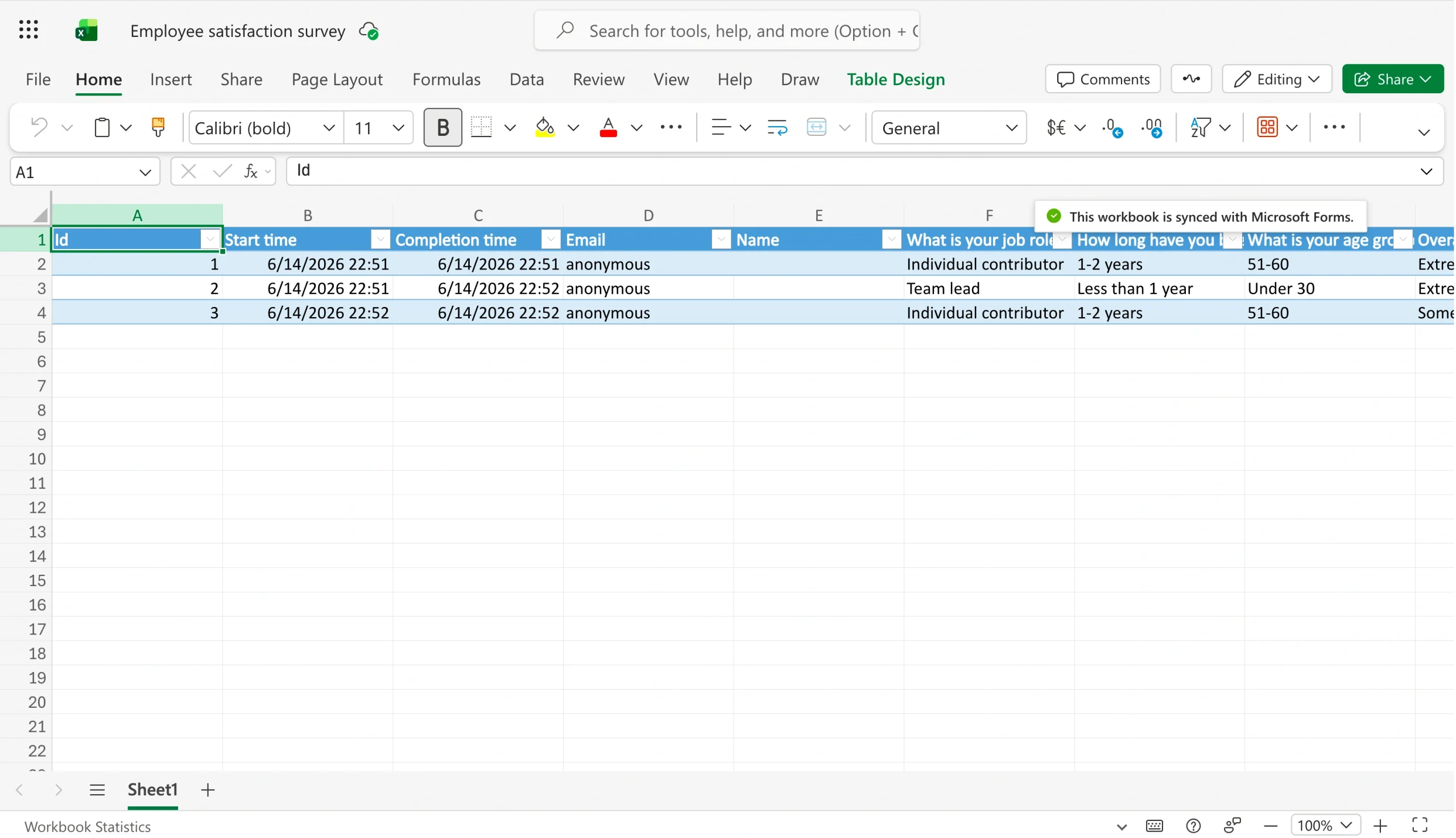
The export includes submission time stamps, which makes it easy to track when responses came in.
When Excel is better for analysis
The built-in Microsoft Forms reporting dashboard is designed for simple, at-a-glance summaries. You’ll likely want to move to Excel when you need to
- Filter or segment responses by specific answers or demographics
- Cross-reference data across multiple questions
- Create custom charts beyond what Microsoft Forms generates automatically
- Share raw data with colleagues or others who need the full picture
- Combine form data with data from other sources
Pro Tip
Microsoft Forms reporting works, but it is built for basics. Microsoft Forms makes it easy to review responses, share a summary, and export data to Excel. But if your team needs branded reports, live dashboards, deeper collaboration, or more flexible ways to present results, the built-in reporting tools can feel limiting. That is where Jotform makes more sense.
Better reporting starts with Jotform
Microsoft Forms covers the basics, but its reporting tools weren’t built for teams that need to do more with their data. If you’ve found yourself exporting to Excel just to get a clearer picture of your results, or struggling to share findings in a way that looks polished and professional, you may find that Jotform offers a more complete reporting workflow.
Here’s how Jotform makes things easier:
Organize and analyze submissions with Jotform Tables
Every response collected through Jotform is automatically stored in Jotform Tables, a live, organized view of your submission data that updates in real time.
Unlike the flat Excel exports that Microsoft Forms relies on, Jotform Tables lets you filter, sort, and collaborate on response data directly, without downloading anything or leaving the platform.
Jotform is a better fit for teams who need to stay on top of incoming submissions together without passing spreadsheets back and forth.
Turn responses into shareable reports with Jotform Report Builder
Where Jotform really pulls ahead on reporting is with Jotform Report Builder. Report Builder lets you turn form responses into fully visual, branded reports, complete with charts, graphs, and your own logo.


Reports update automatically with every new submission, so no manual refresh or re-export is needed.
You can
- Share results via a live link
- Embed them in another page
- Download them as a PDF for presentations and updates
For teams who regularly need to present Microsoft Forms surveys in a clear, professional format, this is a significant step up from anything built into Microsoft Forms. It’s available through Jotform’s Microsoft Excel integration, so your existing workflows don’t have to change.
For more details about how Jotform compares to Microsoft Forms, read Jotform vs Microsoft Forms.
Pro Tip
The Jotform download submissions feature gives you more flexibility when working with form data, letting you export responses as CSV, Excel, or PDF files and filter submissions before downloading only the data you need.
Use Microsoft Forms for basics, Jotform for better reporting
If you need to quickly check response summaries, share a link with your team, or pull data into Excel for a closer look, Microsoft Forms gets the job done. For lightweight, occasional reporting, it’s a perfectly reasonable tool.
But for teams who regularly need to share results with other parties, present data in a branded format, or collaborate on responses in real time, the limitations become clear quickly. There’s no live dashboard, no customizable report layout, and no way to share individual responses without exporting a spreadsheet.

Migrate existing forms instantly
There’s no need to rebuild your online forms from scratch. Instead, migrate existing forms and submission data into your Jotform account in one click — so you can collect data without skipping a beat.
Your form can not be migrated.
Please ensure that your form URL is correct and that your form is set to “public” before attempting to migrate it again.
Jotform offers a more complete solution. Use Jotform Tables to keep your team aligned on incoming submissions without the back-and-forth of shared Excel files. Use Jotform Report Builder to turn those submissions into polished, presentation-ready reports that update automatically and can be shared with anyone in seconds.
If your reporting needs are basic, Microsoft Forms will serve you well. If you need something more, Jotform is the stronger choice, and you can get started for free, with no Microsoft 365 subscription needed.
FAQs about Microsoft Forms reporting
Yes. From the View Responses tab, click Open in Excel to download a spreadsheet of your results. Each question appears as a column, and each row represents an individual respondent. This is the most practical option when you need to filter, sort, or analyze your Microsoft Forms survey results in more depth than the built-in view allows.
To check Microsoft Form responses individually, go to the View Responses tab and click Check Individual Results. This lets you step through each submission one at a time. If you’re looking for a specific respondent, you can use the search bar to find them by respondent number rather than scrolling through all submissions manually.
Yes, Microsoft Forms reporting includes a dashboard that shows response counts, average completion times, and question-level summaries. It’s useful for quick overviews but limited for anything more advanced. Teams that need live dashboards, branded reports, or deeper collaboration will find tools such as Jotform Report Builder a more capable alternative.
This article is for operations teams, small business owners, project managers, marketers, admins, and growing teams looking for an alternative to Google Sheets for organizing data, collaborating, automating workflows, and reducing manual spreadsheet work.






































































Send Comment: