
Your email marketing platform can make or break your campaigns. But with so many out there—all with varying features, pricing, and specialties—how do you find the best platform for your email marketing?
If you’ve started the research process, you’ve probably already come across two big players: Klaviyo and Mailchimp.
Both are heavy hitters in email marketing, but they approach the job from very different angles. I spent time with each tool to understand how they work, what they offer, and which best serves different business needs.
In this article, I break down how they compare across several dimensions:
- Features
- Pricing
- Deliverability and performance
- Reporting and analytics
- Integrations
- Pros and cons
- Real-world use cases
Klaviyo vs Mailchimp
The choice between Klaviyo and Mailchimp comes down to more than features and pricing. Both are email service providers, but they’re built differently to serve different business needs.
- Klaviyo positions itself as the go-to solution for e-commerce businesses that need deep data integration and sophisticated automation.
- Mailchimp has built its reputation as an accessible, all-in-one marketing platform that works for just about anyone, from solopreneurs to established brands.
That’s why it’s crucial to begin your evaluation with a solid understanding of what your business needs from an email marketing tool. Then you can determine which platform delivers your requirements.
Klaviyo vs Mailchimp: Features
When looking at the features of Klaviyo and Mailchimp, their differences become clear pretty quickly.
Klaviyo’s features are laser-focused on e-commerce. Klaviyo offers native integrations with platforms Shopify, WooCommerce, BigCommerce, and others that go beyond simple email list syncing. The platform automatically pulls in product catalogs, purchase history, browsing behavior, and customer lifetime value.
This means you can build hyper-targeted behavioral segments based on what customers do, not just who they are. For example, you can target customers who browsed a specific product category but didn’t buy, or you can send personalized product recommendations based on past purchases.
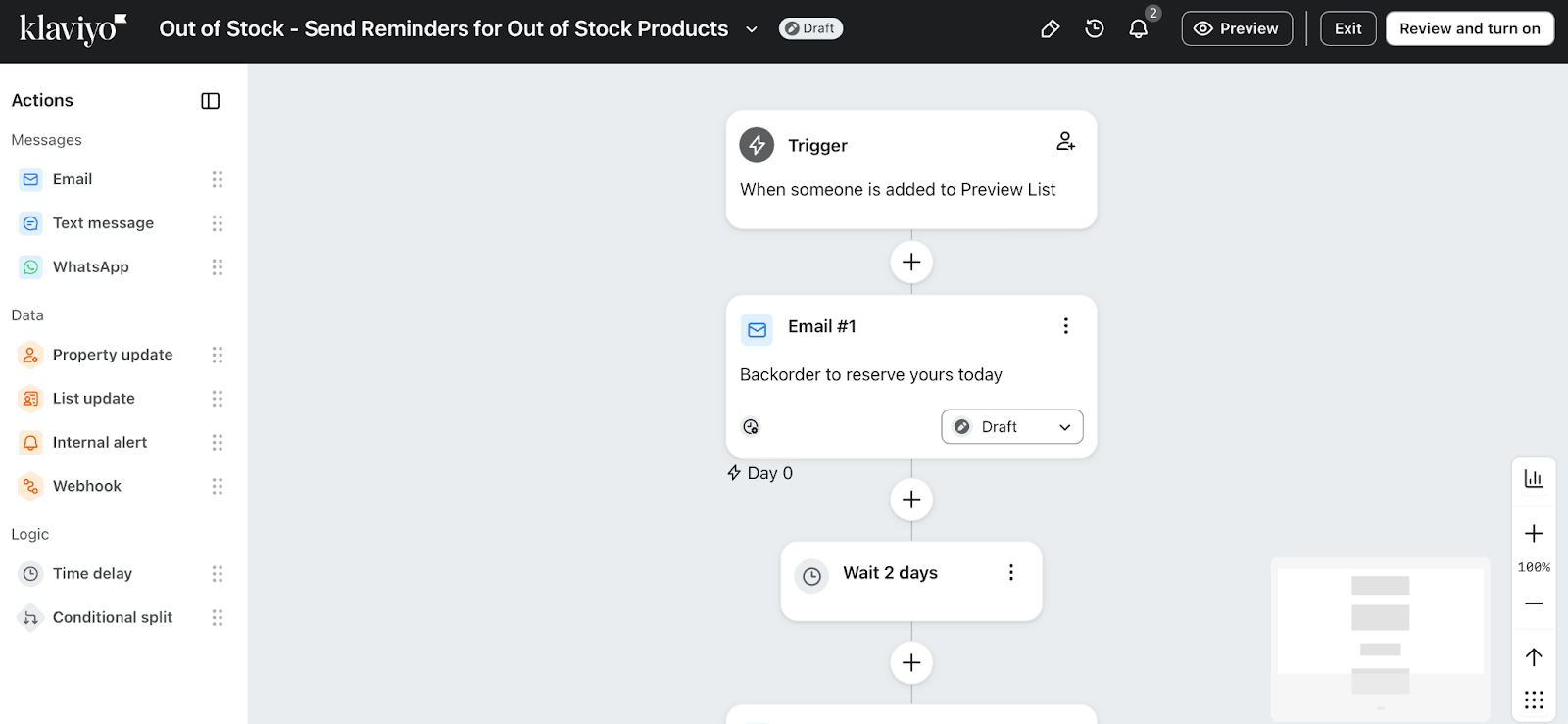
The automation capabilities in Klaviyo are particularly impressive. I found the process of setting up abandoned-cart emails, post-purchase follow-ups, and win-back campaigns straightforward. The platform’s flow builder made it easy to add conditional splits, time delays, and trigger filters to create targeted customer journeys.
I found the predictive analytics particularly useful: Klaviyo can forecast customer lifetime value and churn risk, which helps prioritize both high-value and at-risk segments. You can identify customers who aren’t predicted to order again, add them to a segment, and craft a win-back campaign designed to boost sales.
Klaviyo also integrates tightly with apps such as AfterShip for post-purchase activities. By connecting these tools, you can use email and SMS to contact customers with real-time delivery updates, reach out with personalized messages when orders are delayed, and request product reviews a defined number of days after delivery is confirmed.
Mailchimp’s features reflect a broader approach. Like Klaviyo, today’s Mailchimp offers more than email marketing. It includes landing pages, social media ads, SMS, and even basic website building. For businesses that want everything under one roof, this makes sense.
The interface is clean and beginner friendly, and you can get your first campaign out the door in just a few minutes. I found Mailchimp’s drag-and-drop email builder supremely intuitive, and the template library is extensive (though you’ll need a paid plan to use the vast majority of templates).
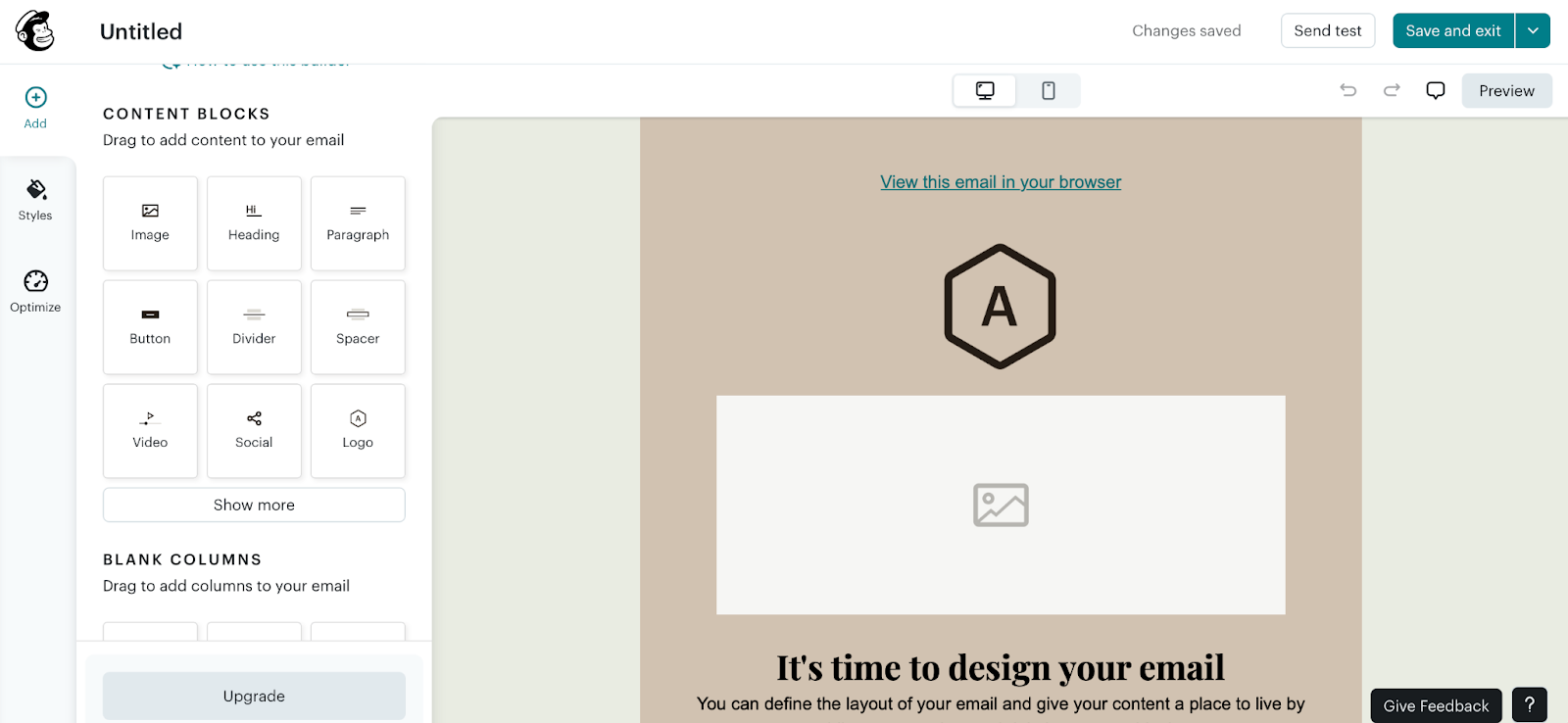
The platform also offers a solid email marketing automation tool, though it’s not as granular as Klaviyo’s. You can set up welcome series, birthday emails, and abandoned cart flows, but the conditional logic and behavioral triggers I saw weren’t as in-depth.
Klaviyo vs Mailchimp for e-commerce
Klaviyo has the edge when it comes to e-commerce. Its revenue attribution tracking shows exactly which emails and automations drive sales, making it easier to calculate ROI. The platform also offers dozens of prebuilt reporting options, covering everything from revenue-per-recipient to review sentiment analysis. You can even compare your brand’s performance with that of other organizations in your niche using Klaviyo’s benchmarks report.
Mailchimp can integrate with e-commerce platforms, but the connection isn’t as smooth. For example, the Shopify integration requires a third-party connector, and syncing can be less reliable compared to Klaviyo’s native connection. That said, if you’re not running an online store or your email needs are more general, Mailchimp’s broader feature set and multichannel capabilities might serve you better.
Klaviyo vs Mailchimp: Pricing models
Klaviyo pricing is based on active profiles. These are contacts you can actually email.
- The free plan covers up to 250 active profiles and 500 monthly email sends, which is great for testing the platform or running a very small operation.
- Email plans start at $20 per month for 251–500 profiles and 5,000 emails per month, and pricing scales up from there.
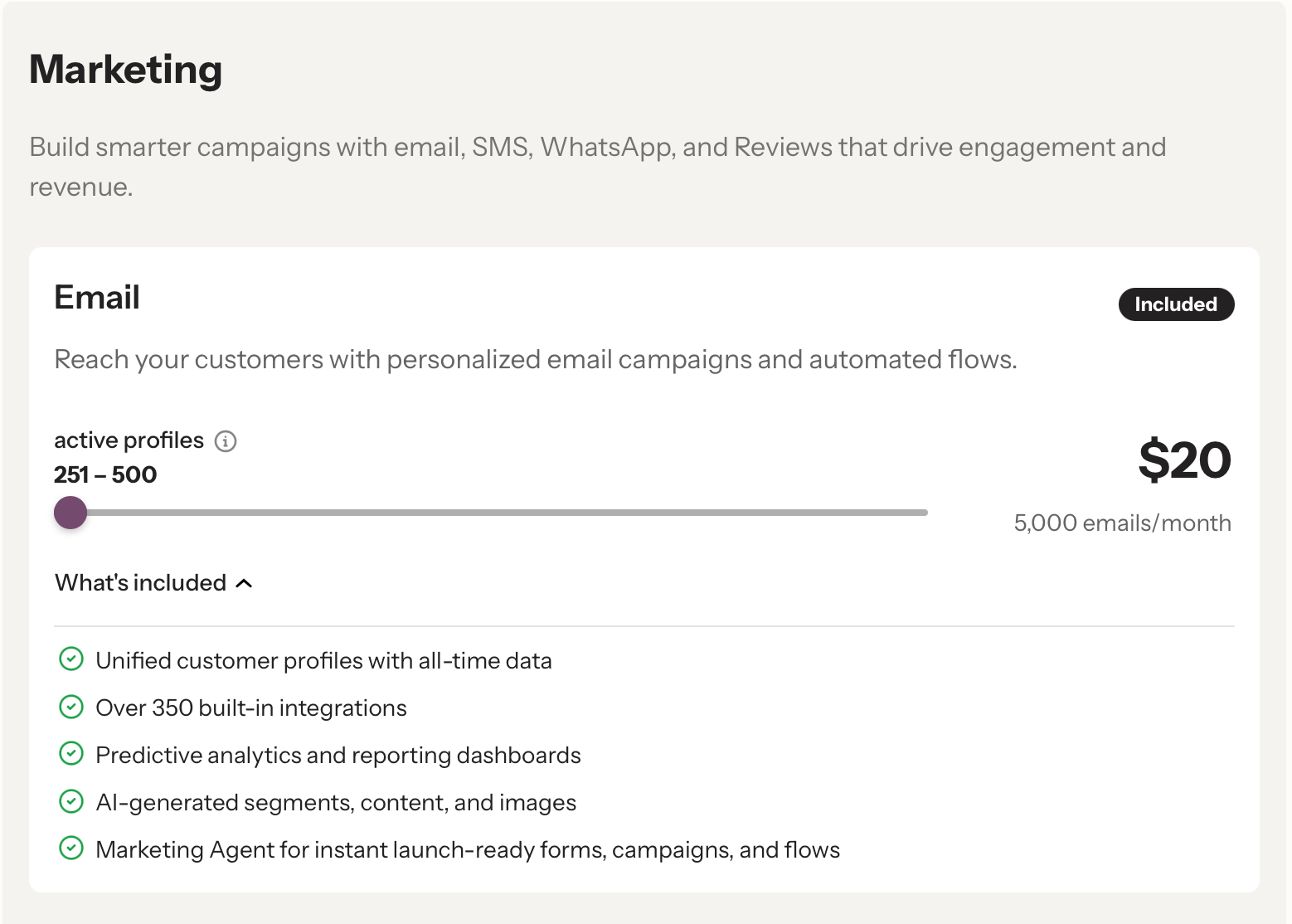
It’s important to note that Klaviyo can get expensive quickly if you have a large list. For 10,000 active profiles, for example, you’re looking at around $150 per month for marketing features alone.
The great thing about Klaviyo’s pricing is that all marketing features are available on all paid plans. You’re never locked out of advanced segmentation, predictive analytics, integrations, or automation workflows just because you’re on a lower tier. The only variables are the number of contacts and monthly email sends.
Mailchimp’s pricing is structured by tiers:
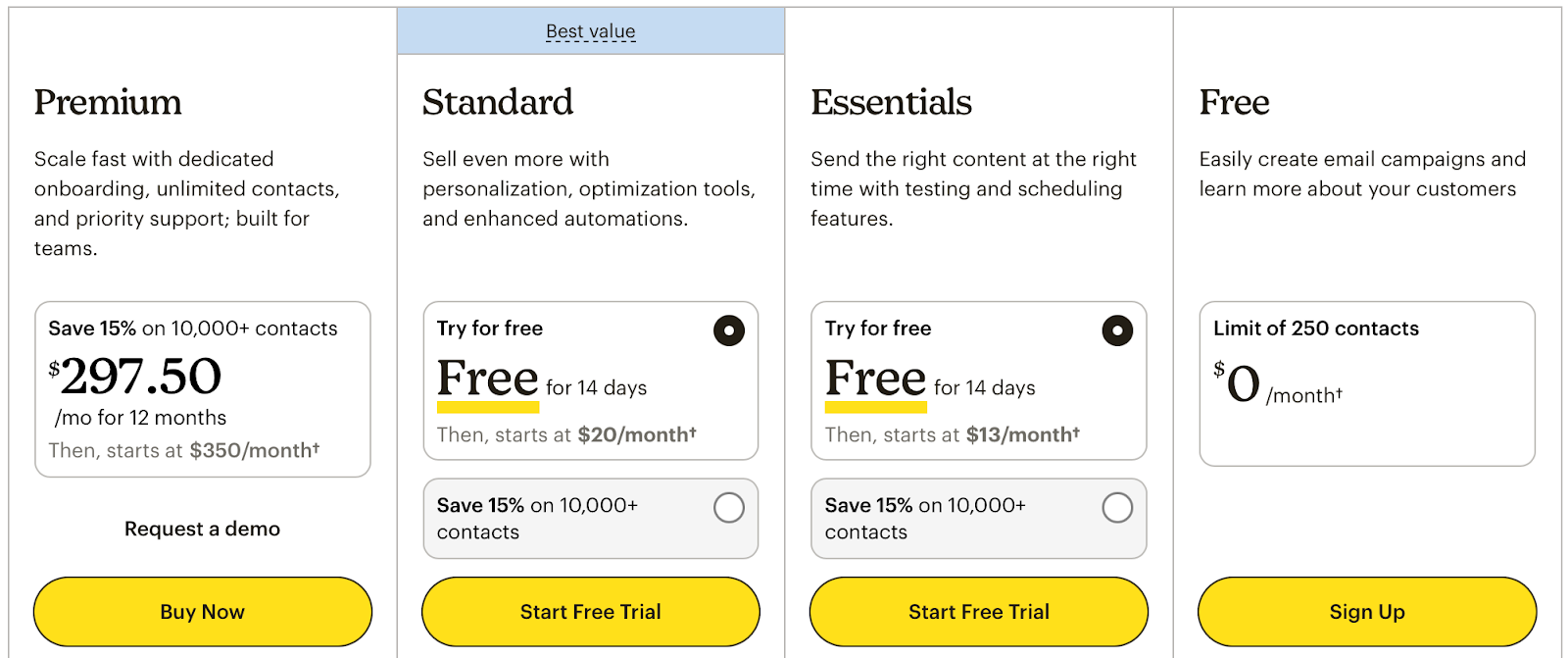
- The Free plan allows up to 250 contacts and 500 monthly sends (with a daily limit of 250). It’s on par with Klaviyo’s free offering in terms of contacts, but Mailchimp’s free plan lacks key features including automation, A/B testing, and email scheduling.
- Essentials plans start at $13 per month for 500 contacts and 5,000 emails per month, along with full access to email templates, the option to remove Mailchimp’s branding from your emails, basic automation, and A/B testing.
- Standard plans begin at $20 per month for the same contact count and email send volume, plus advanced automation, dynamic content, and better reporting.
- Premium plans start at $350 per month and are designed for large enterprise teams that need high contact and email allowances, priority phone support, and unlimited users.
The challenge with Mailchimp is that certain features are gated behind plan tiers. So even if your list or send volume is small, you may still need to upgrade to access particular features. If you need multistep automations, for example, or detailed analytics, you’ll need at least the Standard plan.
As your contact list grows, prices increase across all tiers. For 10,000 contacts, the Standard plan runs around $135 per month. That’s a bit less expensive than Klaviyo at that scale, but you still don’t get all the marketing features unless you upgrade to Premium.
Pricing by total contacts vs unique active subscribers
Another critical difference to note: Mailchimp charges based on total contacts across all your lists. So if you add the same subscriber to three different lists, you pay for that same contact three times.
To compare, Klaviyo charges for unique active subscribers, which can save money if you organize contacts across multiple lists. You pay for each contact once, regardless of how many lists you add them to.
Klaviyo vs Mailchimp: Deliverability and performance
For an effective email marketing operation, deliverability is crucial. While both platforms maintain strong sender reputations, there are differences in how they handle email delivery and the tools they provide to optimize it.
Both platforms include list cleaning features to remove invalid addresses and reduce bounce rates, which is essential for maintaining good deliverability.
Klaviyo gives you granular control over sending. You can use a dedicated sending domain, which helps build your own sender reputation over time. After I sent a few test campaigns, the platform provided detailed deliverability reports showing bounce rates, spam complaints, and inbox placement estimates. The real-time data is especially useful for troubleshooting issues quickly.
Mailchimp also supports custom domains and offers inbox insights, though the data isn’t as detailed. One thing Mailchimp does well is its built-in domain authentication tools: Setting up SPF, DKIM, and DMARC records is straightforward, even if you’re not technically savvy.
Klaviyo vs Mailchimp: Reporting and analytics
On the analytics front, Klaviyo is built for revenue tracking. The platform shows not just open rates and click rates but also how much money each campaign and automation flow generates.
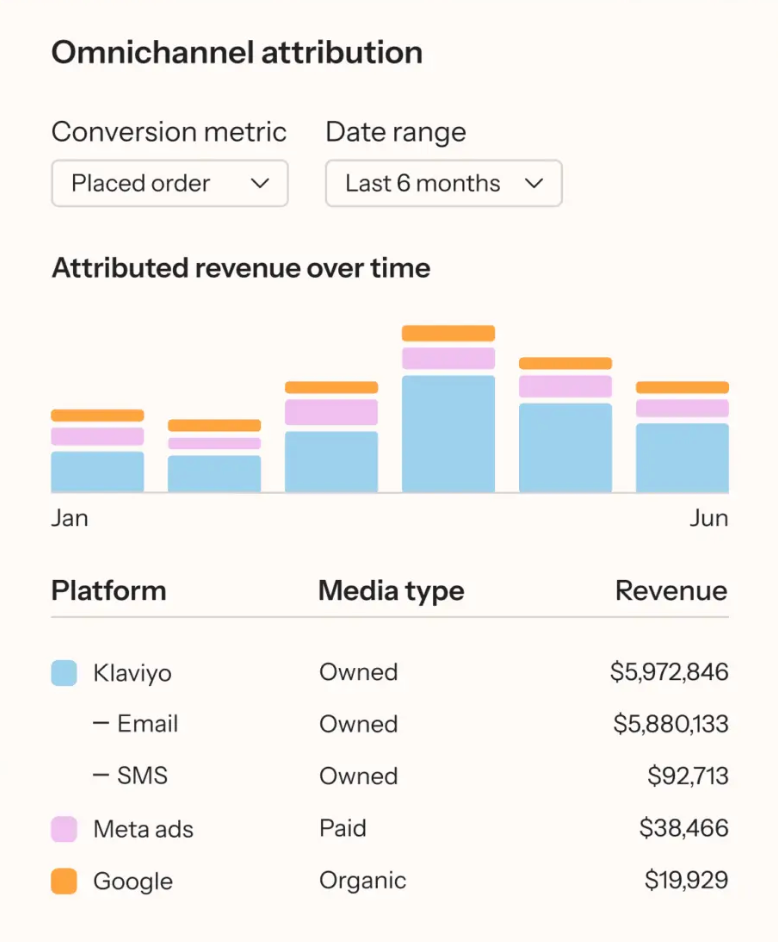
You can see which segments drive the most sales and which products get the most clicks, and you can even forecast future revenue based on customer behavior. Klaviyo’s predictive analytics can identify customers at risk of leaving and those most likely to make a repeat purchase. This level of detail is invaluable for e-commerce businesses trying to optimize ROI.
Mailchimp’s analytics are solid for general email marketing. You get open rates, click rates, geographic data, engagement timelines, and built-in click maps that show which parts of your email get the most attention. The platform offers engaging visualizations that make it easy to understand campaign performance at a glance. But it doesn’t tie revenue directly to campaigns unless you’re using an e-commerce integration, and even then, the reporting isn’t as robust as Klaviyo’s.
Klaviyo vs Mailchimp: Integrations and ecosystem
Both platforms offer hundreds of emailing integrations, but the focus is different. Both platforms also integrate with Zapier, which opens up thousands of additional connection possibilities.
Klaviyo has over 350 native integrations, and most of them are geared toward e-commerce. Shopify, Magento, BigCommerce, WooCommerce—the connections are deep and bidirectional. Product data, order history, and customer profiles sync automatically.
The platform also integrates with e-commerce-adjacent tools, including
- Customer review apps, like Yotpo
- Loyalty programs, like Smile.io
- Subscription tools, like Skio
If you’re running an online store, Klaviyo can plug right into your existing stack without much trouble.
A major advantage for Klaviyo is its direct Shopify integration. Unlike Mailchimp, which requires a third-party application, Klaviyo’s integration allows you to collect and store customer data directly from your Shopify store. This makes it easier to create sophisticated automations based on real-time shopping behavior.
Mailchimp’s integration library of more than 300 apps is broader in scope than Klaviyo’s. Mailchimp integrations are more versatile for businesses that aren’t purely e-commerce focused. It does include e-commerce platforms, but it also includes
- CRMs, like Salesforce
- Accounting software, like QuickBooks
- Content marketing
- Event management
Klaviyo vs Mailchimp: Pros and cons
Let’s look at a simplified breakdown of the strengths and weaknesses of each platform.
Klaviyo strengths
- Simpler pricing, with all features available at every price tier
- Unique-subscriber-only charging, so you don’t pay for duplicate contacts across lists
- Best-in-class e-commerce integrations and hyper-focused e-commerce-adjacent integrations
- Revenue attribution tracking that ties sales directly to email campaigns
- Superior automation capabilities with sophisticated conditional logic
Klaviyo weaknesses
- Steeper learning curve, so not as beginner-friendly for nontechnical users as Mailchimp
- Limited support for non-e-commerce businesses
- User interface that can be overwhelming if you’re new to email marketing
Mailchimp strengths
- Intuitive, user-friendly interface that works for beginners and advanced email marketers
- All-in-one marketing platform with landing pages, ads, social media tools, website building, and SMS
- Broader integration ecosystem beyond e-commerce
- 100-plus automation workflow templates
Mailchimp weaknesses
- Tiered pricing that locks key features such as automation and advanced segmentation behind higher-priced tiers
- Less seamless e-commerce integrations vs Klaviyo’s
- Total contact pricing that may lead to duplicate charges for contacts included in two or more lists
- Less direct revenue tracking and analytics than Klaviyo
Klaviyo vs Mailchimp: Real-world use cases
Klaviyo works best for e-commerce businesses of all sizes, from growing direct-to-consumer (DTC) brands to established online retailers. If your revenue depends on repeat purchases, upsells, and customer retention, Klaviyo’s data-driven approach pays off.
The platform excels when you need to create complex, behavior-triggered automations such as abandoned-cart recovery, post-purchase follow-ups, customer rewards, and product recommendations based on browsing history.
Klaviyo is also a solid choice for business-to-consumer subscription companies, digital product sellers, and any business that relies heavily on behavioral data to drive conversions.
Klaviyo works well for almost every stage of e-commerce:
- Large companies (like Unilever and Mattel) that sell both online and in-person
- High-growth DTC brands (like Glossier)
- Small Shopify-hosted e-commerce companies
While Klaviyo is the e-commerce sphere’s Mailchimp alternative, Mailchimp itself works for a broader swath of businesses. It offers basic email marketing for small businesses, freelancers, and solopreneurs who can get started quickly without a steep learning curve.
- Service-based businesses including consultants, coaches, and agencies benefit from Mailchimp’s multichannel tools: email, landing pages, and social ads, all in one place.
- Nonprofits and community organizations often choose Mailchimp because of its ease of use.
- Smaller e-commerce businesses that are just starting out or don’t need advanced segmentation can find value in Mailchimp’s straightforward approach.
Mailchimp is ideal for businesses that want one platform to handle multiple marketing channels. If you need to build your website, run Facebook and Instagram ads, and send email campaigns all from the same dashboard, Mailchimp delivers.
The bottom line on Klaviyo vs Mailchimp
An effective email marketing tools comparison comes down to knowing what you need to accomplish with email.
Neither Klaviyo nor Mailchimp’s platform is objectively the best email marketing software. When it comes to features, pricing, analytics, and integrations, they serve different types of companies with diverse needs. You need to find the one that aligns with your business model, technical comfort level, and marketing goals.
For e-commerce, Klaviyo is hard to beat:
- Revenue-focused analytics, advanced segmentation, and seamless integrations make it the clear choice for online retailers.
- The platform is built to help you understand customer behavior, automate personalized campaigns, and track ROI down to the individual email.
If you’re running an online store and email marketing is a core part of your growth strategy, Klaviyo is worth the investment.
Mailchimp makes sense for businesses that need a more general-purpose marketing platform:
- If you’re just getting started with email marketing, working across multiple channels, or running a business that isn’t e-commerce focused, Mailchimp’s ease of use and broad feature set are major advantages.
- The platform scales with you as your needs grow, though you’ll need to move to higher tiers to unlock advanced features.
Get the most out of both Klaviyo and Mailchimp with Jotform
Whether you choose Klaviyo or Mailchimp, you can do even more—extending features and automating workflows—when you connect your email marketing app with Jotform.
Jotform’s native Mailchimp integration makes it easy to add new subscribers to your email lists, update existing subscriber data, and add contacts automatically. You can update an existing Mailchimp contact based on Jotform form submissions, send form submissions to Mailchimp lists, and add tags to Mailchimp via form submissions.
For Klaviyo users, Jotform offers Klaviyo integration via Zapier. You can collect contact details through your online contact form or subscription form and automatically sync that data to Klaviyo.
Jotform also offers ready-made email marketing forms, contact forms, and newsletter sign-up forms to collect information from website visitors or targets of your email campaigns, so you can start building your list quickly and easily.
Manage your inbox smarter with Jotform Gmail Agent

Once your list is growing, managing the inbox that follows is a challenge in itself. That’s where Jotform Gmail Agent comes in.
When a new email arrives in your inbox, your Gmail Agent automatically creates a draft response. The agent learns from your email history to reflect your personal tone, protocol, and style — so there’s no worry about off-brand messages. And you stay in control the entire time: nothing is sent until you approve it.
Getting started takes just a few clicks — connect your Gmail account, allow the agent to analyze past emails to learn your context and style, and it’s ready to start creating drafts automatically.
From building your first signup form to managing every reply that follows, Jotform gives you the tools to run a smarter email marketing operation — end to end. Ready to take inbox management off your plate? Try Jotform Gmail Agent for free today.
This article is for businesses comparing email marketing platforms, evaluating e-commerce versus general-use features, and looking for practical ways to connect their marketing stack with forms, integrations, and audience management tools.







































Send Comment: