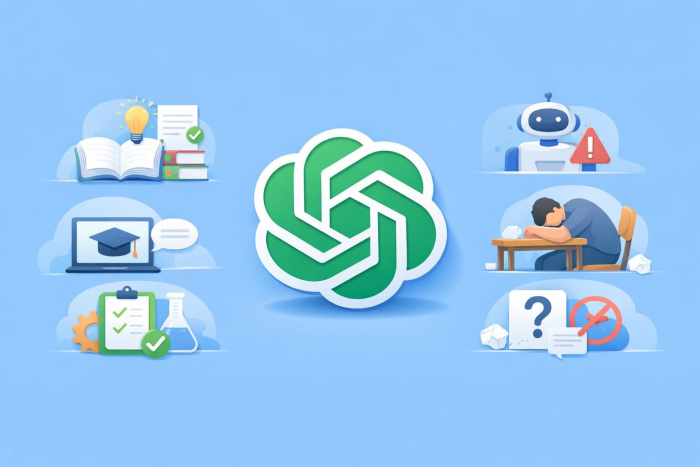
Artificial intelligence is becoming commonplace in the classroom, and, as the most popular Large Language Model (LLM), ChatGPT is at the center of this shift.
Educators, parents, and even some students are wondering if ChatGPT is a valuable tool that can elevate learning or if it’s a shortcut that will ultimately backfire.
Here’s a breakdown of the pros and cons of using ChatGPT in education.
The pros: How ChatGPT empowers learners
When used well, ChatGPT can help democratize learning and provide personalized support.
- A 24-7 virtual tutor: Unlike traditional classes and tutoring sessions, ChatGPT is available around the clock. Students can ask questions at midnight and get instant explanations for complex historical events, stubborn math equations, or intricate scientific concepts.
- A cowriter and brainstorming partner: Starting from a blank page is often the hardest part of writing. ChatGPT can help students brainstorm essay outlines, generate creative ideas, and offer real-time feedback on grammar and sentence structure.
- Leveling the playing field: For nonnative English speakers or students who struggle with dense text, ChatGPT acts as a translator and simplifier. It can rewrite a highly complex academic article at a more accessible reading level, ensuring no student is left behind.

The cons: The hidden risks to critical thinking
Despite its impressive capabilities, ChatGPT can pose significant risks to the actual process of learning.
- The tutor illusion: While ChatGPT can act like a tutor by providing answers, it lacks the training of a human teacher. It doesn’t know how to help students learn rather than doing the work for them.
- The threat to critical thinking: In a survey conducted by the American Association of Colleges and Universities and Elon University, 95% of faculty listed overreliance on AI as a major concern. If a tool always hands over the final answer, how will students actually learn?
- The accuracy problem (hallucinations): ChatGPT doesn’t think like a human; it predicts the next most likely word. Because of this, it’s prone to hallucinations — instances where the AI confidently makes up entirely false facts, citations, or data. Its training data can also be outdated. Most students lack the media literacy or fact-checking skills required to spot these issues.
- The crisis of academic integrity: It has never been easier to generate a full-length essay or a complete set of homework answers in seconds. When a student can bypass the struggle of research and drafting, they may get a passing grade, but they miss out on the actual education. And if a student isn’t learning, what’s the point?
The bottom line: It’s all about the guidance
ChatGPT isn’t inherently good or bad — it is simply a tool.
When used responsibly, it can spark creativity, clarify confusing topics, and offer a scaffold for students who need extra help. However, without clear boundaries and intentional guidance, it risks undermining the exact skills that education is meant to build.
The path forward isn’t to ban AI from the classroom, but rather to establish clear guidelines, teach AI literacy, and ensure that human teachers remain at the head of the journey.






































































Send Comment: