
A social media survey is a short, targeted set of questions distributed on or through a social channel to collect feedback directly from your audience, and collecting data in this way is now logistically easier than ever. Native polls, Story stickers, and linked survey forms can surface real insights in minutes, but getting honest audience feedback on social media is still a challenge.
Globally, we spent an average of 141 minutes per day on social media in 2025. That means your audience is reachable, but their attention is finite. Gathering honest, valuable feedback comes down to asking questions that are clear, focused, and built for the platform.
Here, you’ll find 30 ready-to-use social media survey question templates, grouped by use case and ready for you to copy and paste, plus guidance on when to use a native poll, a Story sticker, a DM, or a full, linked form.
How to write social media survey questions people will actually answer
A social media survey lives or dies by its questions. These five rules explain how to create a survey that will yield high-quality, usable data:
- Ask one thing at a time: Double-barreled questions (“How did you find us, and what made you follow?”) split the respondent’s focus and muddy your data. Always stick with one idea per question.
- Keep answer choices tight: For multiple-choice questions, three to five options is the sweet spot. More than that leads people to rush through or abandon the survey.
- Match the question to the platform: Instagram and TikTok favor binary or emoji-scale questions. LinkedIn can handle a short rating scale or a one-sentence open text box. X (formerly Twitter) polls have four options and 25 characters per choice, so plan accordingly.
- Avoid leading wording: “How much did you love our new product?” is not a neutral question. Strip out words that nudge respondents toward a particular answer.
- Keep it short enough for mobile users: Most social media usage questions get answered on a smartphone. If your social media survey questionnaire takes longer than two minutes to complete, expect drop-off. Response fatigue is real; trim anything that isn’t tied directly to a decision you’ll make.
Question types at a glance
- Multiple choice works for platform preference, format preference, and discovery habits.
- Rating scales (1–5 or 1–10) are best for satisfaction, likelihood, and perception questions.
- Yes/no questions are ideal for native platform polls and Story stickers.
- Open text is best reserved for the final question in a linked form, where committed respondents are more likely to elaborate.
Running a social media survey? Tell Jotform AI about it.
Visit Jotform AI, type ”I need a social media survey,” and get your social media survey in seconds.
Build faster with Jotform AIDescribe what you need, and let Jotform AI build it for you instantly.
Get Started Now
30 social media survey questions for better audience insights
Copy, customize, and trim this list based on your channel and audience. Pick the ones that match your goals.
Audience and platform usage questions
These social media usage questions help you understand where your audience lives online and how they behave there.
1. Which social media platform do you use most often?
- TikTok
- X (formerly Twitter)
- Other
2. On a typical day, how much time do you spend on social media?
- Less than 30 minutes
- 30 minutes to one hour
- One to two hours
- More than two hours
3. How do you most often discover new accounts or brands to follow?
- Suggested/recommended content
- A friend or colleague’s share
- Hashtags
- Paid ads
- Search
4. What device do you use most when browsing social media?
- Smartphone
- Tablet
- Desktop or laptop
- Smart TV
5. What’s the main reason you use social media?
- Entertainment and inspiration
- Staying informed about news or trends
- Connecting with people I know
- Researching products or brands
- Work or professional networking
Create a social media audience and platform usage survey preloaded with these 5 questions.
Content preference and engagement questions
These social media feedback questions reveal what earns attention and what gets scrolled past. Use them to shape your editorial calendar or test new formats.
6. What type of content do you engage with most on social media?
- Short-form video (Reels, TikToks, Shorts)
- Long-form video
- Static images or carousels
- Text-only posts
- Live video or live audio
7. How often would you like to see content from a brand you follow?
- A few times a day
- Once a day
- A few times a week
- Once a week or less
8. What makes you more likely to trust content from a brand?
- Customer reviews or testimonials
- Behind-the-scenes content
- Expert or third-party endorsements
- Consistent posting history
- User-generated content
9. Have you ever saved or bookmarked a brand’s post to come back to later?
- Yes, often
- Yes, occasionally
- No, never
10. What’s the most common reason you scroll past a brand’s content without engaging?
- It feels too promotional or salesy.
- It’s not relevant to my interests.
- The visual quality is low.
- I’ve seen the same type of post too many times.
- The caption is too long.
Create a social media content preferences and engagement survey preloaded with these 5 questions.
Brand awareness and perception questions
These are social media survey examples for gauging how people view your brand before, during, and after a campaign. Run them quarterly to track shifts in brand health.
11. How did you first hear about us?
- Social media post
- Word of mouth
- Search engine
- A blog or article
- Not sure
12. Without looking it up, can you describe what we do in one sentence?
(Open text; best suited to a linked survey form)
13. How would you describe the tone of our social media content?
- Professional and informative
- Friendly and approachable
- Witty or entertaining
- Inconsistent; I’m not sure what to expect
- Haven’t noticed a particular tone
14. Compared with similar brands you follow, how does our content rank?
- Among the best
- Above average
- About average
- Below average
15. How likely are you to continue following us over the next six months?
- Very likely
- Somewhat likely
- Somewhat unlikely
- Very unlikely
- Unsure
Create a social media brand awareness and perception survey preloaded with these 5 questions.
Product or service feedback questions
These social media marketing survey questions bridge the gap between content engagement and buying decisions. They’re useful for product teams validating new features before launch.
16. Which of our products or features are you most interested in learning more about?
(List your top three to five options, or use open text.)
17. What has held you back from trying our product or service?
- Price
- Unsure if it’s the right fit for me
- Not enough information
- Not ready to buy yet
- Unaware you had a relevant product
18. What price range feels right for a product like ours?
(List specific ranges relevant to your product.)
19. What’s one piece of information you wish you’d had before purchasing from us?
(Open text; works well at the end of a linked form.)
20. What kind of content would help you feel more confident about our product?
- Customer case studies or testimonials
- Product demos or walkthroughs
- Before-and-after comparisons
- FAQ or how-to content
- Live Q&A sessions
Create a social media product and service feedback survey preloaded with these 5 questions.
Customer service and support questions
This section of your social media questionnaire shows you whether your support experience matches your brand promises, and where the gaps are.
21. When you have a question or issue, which channel do you prefer to use for support?
- DMs on social media
- Live chat on a website
- Phone call
- Help center or FAQ page
22. How quickly do you expect a brand to respond to a support question on social media?
- Within one hour
- Within a few hours
- Within 24 hours
- Within a few days
23. Do you prefer to resolve support issues publicly (comments or replies) or privately (DMs)?
- Publicly; I like transparency.
- Privately; I’d rather keep it between us.
- I have no preference.
24. How satisfied were you the last time we resolved an issue for you on social media?
- Very satisfied
- Somewhat satisfied
- Neutral
- Somewhat unsatisfied
- Very unsatisfied
25. What makes a brand feel genuinely responsive on social media?
- Fast replies
- Personalized responses (not copy-paste)
- Follow-up to make sure the issue was resolved
- Acknowledging the problem publicly before moving to DMs
- A consistent presence, even outside support requests
Create a social media customer service and support survey preloaded with these 5 questions.
Purchase intent and loyalty questions
Close the loop between social engagement and revenue with these questions. They’re the backbone of any social media marketing automation workflow tied to retargeting or loyalty campaigns.
26. How close are you to making a purchase from us?
- Ready to buy now
- Considering it in the next month
- Just browsing for now
- Already purchased from you
27. Does receiving an exclusive discount or offer through social media make you more likely to buy?
- Yes, definitely.
- Sometimes, depending on the offer.
- No, price isn’t the deciding factor for me.
28. How likely are you to buy from us again?
- Very likely
- Somewhat likely
- Somewhat unlikely
- Very unlikely
- Haven’t purchased yet
29. Have you recommended us to a friend, family member, or colleague?
- Yes.
- Not yet, but I would.
- No, and I wouldn’t.
30. What would make you choose us over a competitor?
- Better pricing
- Stronger social proof (reviews, user-generated content)
- More helpful or educational content
- A better product or feature set
- Faster or more responsive support
Create a social media purchase intent and loyalty survey preloaded with these 5 questions.
Don’t start from scratch: Build your social media surveys with Jotform
Native social polls are quick, but they’re also limited: four options on X, a binary yes/no on Instagram Stories, and no way to export or analyze responses at scale. That’s where Jotform can fill the gap.
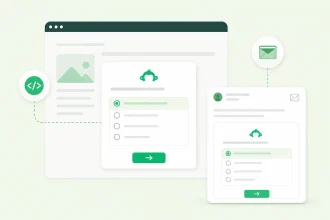
With Jotform, you can build a complete social media survey questionnaire, customize every question type, and share it anywhere, whether it’s linked in your bio, distributed via social media QR codes, embedded in a newsletter, or triggered through social media quizzes and landing pages.
Jotform’s 10,000-plus free survey templates include a ready-made Social Media Survey template. Survey data collection is handled automatically, with every submission flowing directly into Jotform Tables, where you can sort, filter, and share results with your team in real time.
For Instagram-heavy workflows, Jotform Instagram Agent lets you respond to DMs, comments, and Story replies automatically, then guide people to a linked form when you need deeper feedback. It’s a practical layer of automation that keeps the conversation going without adding manual work to your queue.
Better questions are the difference between data you can act on and a spreadsheet full of noise. Start with the Social Media Survey template, add the questions that match your goals, and let your audience tell you exactly what they need.
This article is for social media managers, marketers, small business owners, ecommerce teams, and researchers who want fast, practical ways to collect audience feedback on social platforms.





























































































Send Comment: