

On the surface, it seems simple: Write some business survey questions, ask your audience, and voilà — you have data to improve your organization. The reality is it’s never quite so straightforward as that.
It’s easier than you think to write a question that leads respondents to the wrong conclusion or comes across as vague, invasive, or poorly worded. Since you and the people you’re surveying don’t have time to waste, we’re here to help. This guide gives you 50 business survey questions grouped by goal, covering customer feedback, market research, product decisions, lead qualification, employee input, and retention.


What are business survey questions?
Put simply, business survey questions are structured prompts that a company uses to collect feedback or data from customers, prospects, employees, or other stakeholders. They rarely exist for their own sake. Each one should support a decision you’re trying to make, whether that’s improving a product or identifying internal process issues that slow your team down.
That’s the key to crafting a good survey question: Match the question types to the goal. If you ask questions without thought, you’re going to get responses that lead nowhere.
50 business survey questions by goal
All right, now we’re going to jump into the business survey questions, organized by goal. Each section opens with a brief overview and a few tips to adapt them to your own needs.
Create your business survey in seconds
Head to Jotform AI, type “create a business survey,” and watch the magic happen. Need changes? Just ask. Add questions, remove sections, or overhaul the design, all through a simple chat. It’s the fastest way to get the data you need.
Market research questions
Market research questions help businesses gather information about their customers, competitors, and market conditions. They turn broad goals like “understand our audience” or “validate this product” into concrete, answerable inquiries that surface usable data. Good questions are clear, unbiased, and tied to business decisions.
- What problem were you trying to solve when you first looked for a product like ours?
- Which alternatives or competitors did you consider before choosing us, and why?
- How would you describe our product to a colleague in your own words?
- How do you currently measure success when it comes to [problem]?
- What’s the biggest misconception people have about [category/product type]?
Create a market research survey preloaded with these 5 questions.
Product or service feedback questions
Product and service feedback questions ask about something the customer has actually used, so answers can point to specific features and moments rather than general impressions. Because the experience is real, the answers are more concrete than in market research. The main risks are recency bias and vague phrasing — which sharp, singular questions keep in check.
- Which feature do you find yourself using most often, and what makes it worth coming back to?
- Was there anything you expected [product] to do that it didn’t? (yes/no, plus comment)
- How much effort did it take to get [key task] done? (1–5, very low to very high)
- Thinking about your most recent use, how would you rate the quality of [product/output]? (very low to very high) What most influenced that rating?
- If you could change one thing about [product], what would it be?
Create a product feedback survey preloaded with these 5 questions.
Customer satisfaction questions
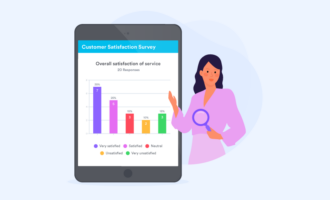
Customer satisfaction questions measure how a customer feels about your product or company as a whole: the overall relationship, the value, and whether they’d return. They run on a cadence rather than a single moment, pairing broad rating scales (often alongside NPS® survey questions) with open-ended follow-ups. A low score signals that something is wrong but not where, so the follow-up question explaining it matters as much as the number.
- Overall, how satisfied are you with [product/company]? (1–5, very dissatisfied to very satisfied)
- How likely are you to purchase from us again? (very unlikely to very likely)
- How would you rate the value you get for the price you pay? (very low to very high)
- Thinking about your experience over the past [period], how well has [product] met your expectations? (far below to far exceeded)
- What’s the main reason for your rating above?
Create a customer satisfaction survey preloaded with these 5 questions.
Customer service feedback questions
Customer service feedback questions zoom in on a single support interaction (whether that’s a ticket, call, or chat) and how well it was handled. They fire right after the interaction closes while details are fresh, and stay surgical in their approach to speed, resolution, clarity, and follow-up. The trap is letting the outcome color the rating, since a customer whose request was denied may still mark a fast, courteous agent poorly.
- How satisfied were you with how quickly your issue was addressed? (1–5, very dissatisfied to very satisfied)
- Was your issue fully resolved? (yes, partially, no)
- How helpful was the person who assisted you? (not at all to extremely)
- How clear and easy to understand was the communication you received? (not clear at all to very clear)
- Did we follow up appropriately after your issue was handled? (open-ended, or scale plus comment)
Create a customer service feedback survey preloaded with these 5 questions.
Brand awareness questions
Brand awareness questions measure whether people know you exist, what they associate with you, and whether they trust you enough to choose you over a competitor. They work best with a mix of unaided recall (naming brands unprompted) and aided recognition (picking yours from a list), since the gap between the two reveals how firmly you’ve landed in someone’s memory.
- When you think of [category], which companies come to mind first?
- Which of the following brands have you heard of? (select all that apply (include your brand in the list))
- What, if anything, do you associate [brand] with being especially good at?
- How much would you say you trust [brand] compared with others in the category? (1–5, much less to much more)
- If you were choosing between [brand] and a competitor, what would tip the decision?
Create a brand awareness survey preloaded with these 5 questions.
Lead capture questions
Lead capture questions qualify a prospect while the form still feels worth filling out, so you gather only what you need to route and prioritize the lead. The balance to strike is depth versus friction: Each added field costs you completions, so the strongest forms ask for fit and intent signals, saving the deeper qualifying for a real conversation.
- What best describes your role? (dropdown)
- How big is your team or company? (size ranges)
- What’s the main challenge you’re hoping to solve?
- What’s your timeline for making a decision? (exploring, next few months, actively evaluating)
- How would you prefer we follow up? (email, call, not yet)
Create a lead qualification survey preloaded with these 5 questions.
Employee and internal feedback questions
Employee and internal feedback questions surface how work happens and how it feels — from day-to-day workflow to team culture, support, and overall satisfaction. Candor is the whole game here, so the questions have to signal that honest answers are safe and wanted, and anonymity usually matters more than it does in any customer-facing survey.
- Where does your work most often get stuck?
- How clearly is information shared across the team when it affects your work? (1–5, not at all to very clearly)
- When you need support or a decision from leadership, how easy is it to get? (very difficult to very easy)
- What’s one skill or tool you wish you had more training on?
- If you could change one thing about how we work, what would it be?
Create an employee feedback survey preloaded with these 5 questions.
Customer effort questions
Customer effort questions measure how hard a customer had to work to get what they came for, from first click to final resolution. Effort is worth isolating from satisfaction because it predicts loyalty better: A high-effort experience quietly erodes retention even when the customer says they’re satisfied. These questions hunt for friction the customer might not otherwise volunteer.
- How much effort did it take to complete your purchase? (1–5, very low to very high)
- How easy was it to find what you were looking for on our site? (very difficult to very easy)
- How smooth was the checkout and payment process? (not smooth at all to very smooth)
- How clear was the information you needed to make your decision? (very unclear to very clear)
- When you ran into a problem, how easy was it to get it resolved? (very difficult to very easy)
Create a customer effort survey preloaded with these 5 questions.
Competitive analysis questions
Competitive analysis questions map how customers view you relative to alternatives, including those you might not consider direct rivals. The most useful signal is comparative rather than absolute, so these ask what else people considered, what made them choose, and where a competitor still looks stronger, since that gap is where you’re most exposed.
- What other options did you consider before choosing [brand]?
- Are there situations where you’d choose a competitor over us? What would those be?
- Is there anything a competitor does that you wish we did? (yes/no, plus comment)
- What do you think [competitor] does better than us, if anything?
- How would you rate our price against the value you get, compared with alternatives? (1–5, much worse to much better)
Create a competitive analysis survey preloaded with these 5 questions.
Customer retention questions
Customer retention questions gauge how likely a customer is to stay, leave, or come back, and why — which makes them the raw material for any effort to improve satisfaction and retention. Because the customers most at risk are often the quietest, these questions look for early churn signals rather than waiting for the cancellation, and they treat a departing customer as a source of insight rather than a lost cause.
- How likely are you to still be using [product] six months from now? (1–5, very unlikely to very likely)
- If you were to stop using [product], what would most likely be the reason?
- What’s one thing that would make you more likely to stay?
- If you’ve left before or are thinking about it, what would bring you back?
- Would you like to hear about updates and improvements we make in the future? (yes, no)
Create a customer retention survey preloaded with these 5 questions.
How to choose the right business survey questions
The list above gives you a deep well to draw from, but a strong survey uses only a fraction of it. The questions you leave out matter as much as the ones you keep, because every extra question you ask lowers the odds that someone finishes and raises the noise in your data. Use this sequence to narrow a long question list down to a survey worth sending.
- Choose one survey goal.
- Define the audience.
- Pick 5–10 questions.
- Mix rating, multiple-choice, and open-ended questions.
- Avoid leading or double-barreled wording.
- Use conditional logic for follow-up questions.
- Test the questions out on a colleague or friend.
Once your shortlist is set, our guide on how to create a survey walks through turning it into a published form.
Create your business survey with Jotform
Once you know which questions to ask, the fastest way to get a survey live is to start from one that already works. Jotform’s business survey templates provide a ready-made structure, and its drag-and-drop survey maker lets you add, edit, and rearrange questions without needing to know how to code. You simply swap in your own wording and reorder sections until the survey matches your goal.
From there, the platform handles the factors that slow down a typical survey. Conditional logic shows or hides questions based on respondents’ answers, so they see only what applies to them. Jotform Tables then organizes every submission in one place for sorting and filtering, while Report Builder turns responses into visual reports with charts and grids, giving you a head start on analyzing survey data. Integrations also push your results into the tools your team already uses.
Use Jotform to get started fast with a business survey template, customize the questions to fit your goal, and publish. That’s it. Focus only on which questions to ask, not on how to build the form. Get started for free today.
FAQs about business survey questions
Ask questions that serve one clear goal, whether that’s satisfaction, demand, or lead qualification. Pick the type that matches your objective, then choose five to ten questions from within it rather than mixing goals.
Five to ten works best: long enough to be useful, short enough that people finish. If a question doesn’t directly serve your goal, cut it rather than risk losing respondents partway through.
Common types include customer satisfaction, market research, product and service feedback, customer service, brand awareness, lead capture, customer effort, competitive analysis, retention, and employee feedback. Each serves a distinct goal and calls for its own question style.
Keep wording neutral, never bundle two questions into one, and anchor questions to real experience rather than hypotheticals. Testing the survey on a few people first catches bias you can’t see in your own writing, too.
This article is for small business owners, marketers, CX managers, product teams, HR teams, and operations leads who need practical survey questions they can copy, adapt, and turn into a working business survey quickly.




























































































Send Comment: