

Top workflow apps
Michael Gerber wrote in The E-Myth Revisited that “A business that looks orderly says to your customer that your people know what they’re doing.” That might mean leads get personalized responses within an hour of filling out a contact form, or that new customers don’t have to repeat info from sales calls during onboarding, or anything else that shows your team is prepared and organized. Workflow apps are what turn these plans into actions.
Even something as simple as onboarding a new client requires getting contracts signed, chasing down W-9s, setting up filesharing, and a dozen other routine checklist items. A workflow app makes sure that every form, document, email, confirmation, and record in a standard operating procedure is on rails, with as little manual work as possible.
Some platforms are little more than a form that triggers an email notification. Others are full no-code workflow apps capable of routing approvals, generating documents, syncing databases, and connecting a dozen different apps into one continuous process. For this roundup, the main requirement was that a recommended app needed to fit the workflows of startups and early-stage companies. Ultimately, I ended up settling on what I believe to be the eight best workflow apps for small businesses in 2026.
| App | Best for | Ease of use | Native integrations | Approval workflows | Starting price |
|---|---|---|---|---|---|
 Jotform Apps |
Building no-code workflows with data from forms and kanban boards |
Easy |
Google, HubSpot, Slack, Salesforce, and more |
Native support |
$34 per month |
 Zapier |
Moving data between the apps you already use, based on flexible triggers |
Somewhat hard |
More than 9,000 connectors |
Manual configuration |
$29.99 per month |
 Make |
Creating complex, branching automations with a lot of steps and conditional logic |
Hard |
More than 3,000 connectors |
Manual configuration |
$10.59 per month |
 Airtable |
Workflows based on data with complex dependencies and relationships |
Somewhat hard |
ChatGPT, Google, Jotform, Slack, and more |
Manual configuration |
$24 per month |
 monday.com |
Siloed workflows for teams with lots of projects |
Easy |
More than 850 connectors |
Native support |
$12 per seat per month, three-seat minimum |
 ClickUp |
Building cross-team workflows for large, complicated projects |
Somewhat easy |
Google, Slack, Microsoft, Intercom, and more |
Native support |
$10 per month |
 Asana |
Tracking workflow efficiency, goals, and objectives and key results (OKRs) with dashboards |
Somewhat easy |
Microsoft, Google, Claude, Canva, and more |
Native support |
$13.49 per month |
 Process Street |
Compliance workflows based on regulatory frameworks |
Somewhat hard |
Only via Zapier and Make |
Native support |
Requires sales call |
1. Jotform Apps
- Best for: Building no-code workflows with data from forms and kanban boards
- Key strengths: Dynamic and professional-looking apps and front ends are incredibly easy to create; the AI app builder can generate responsive, mobile-friendly interfaces from a plain language prompt; plenty of in-platform tools for keeping data in sync across your automations and apps
- Main limitations: No way to edit your app’s CSS and JavaScript, some company data will likely still need to be pulled in from external platforms
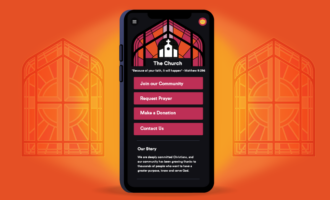
Most workflow apps are one piece of a larger puzzle: You have to connect a project management board to a form on your website, pulling in an automation tool to get all the different platforms sharing information with each other. With Jotform Apps, though, everything lives under a single platform. You can drag and drop forms, buttons, images, videos, animations, and widgets like countdowns or scrolling tickers onto a canvas — or simply describe what you want to the Jotform AI App Builder. Either way, virtually anything you add to your app can be synced to and from Jotform’s other workflow tools, including Jotform Boards (for managing projects and tasks), Jotform Reports (for dashboards and digests), and Jotform Tables (for building databases).
Once it’s finished, you can publish your workflow interface to a custom URL where anyone can interact with it. For that reason, Jotform Apps are great for small businesses that want to build e-commerce workflows, company portals, or event registrations.
If anything, Jotform Apps’ biggest downside is that creation is almost too easy, with limited options for customizing an app’s CSS or JavaScript. In most cases, however, the drag-and-drop approach saves a ton of time and resources — especially considering how much ground you can cover on Jotform’s liberal free plan.
- Jotform Apps pricing:
- Starter (free): All platform tools and features, with an allotment of up to five published forms, 100 submissions per month across all forms, and 10 payments collected by your forms per month
- Bronze ($34 per month, billed annually): Account limits are raised to up to 25 forms, 1,000 submissions per month, and 100 payment submissions per month; and includes the option to remove Jotform branding
- Silver ($39 per month, billed annually): Up to 50 forms, 2,500 submissions per month, and 250 payments per month
- Gold ($99 per month, billed annually): The limit on total number of forms jumps to 100, with up to 10,000 submissions per month, 1,000 payments submissions per month, and support for HIPAA-enabled forms
- Enterprise (custom pricing): Unlimited forms, submissions, and payments as well as enterprise-level security controls and higher-tier support, based on a conversation with sales
2. Zapier
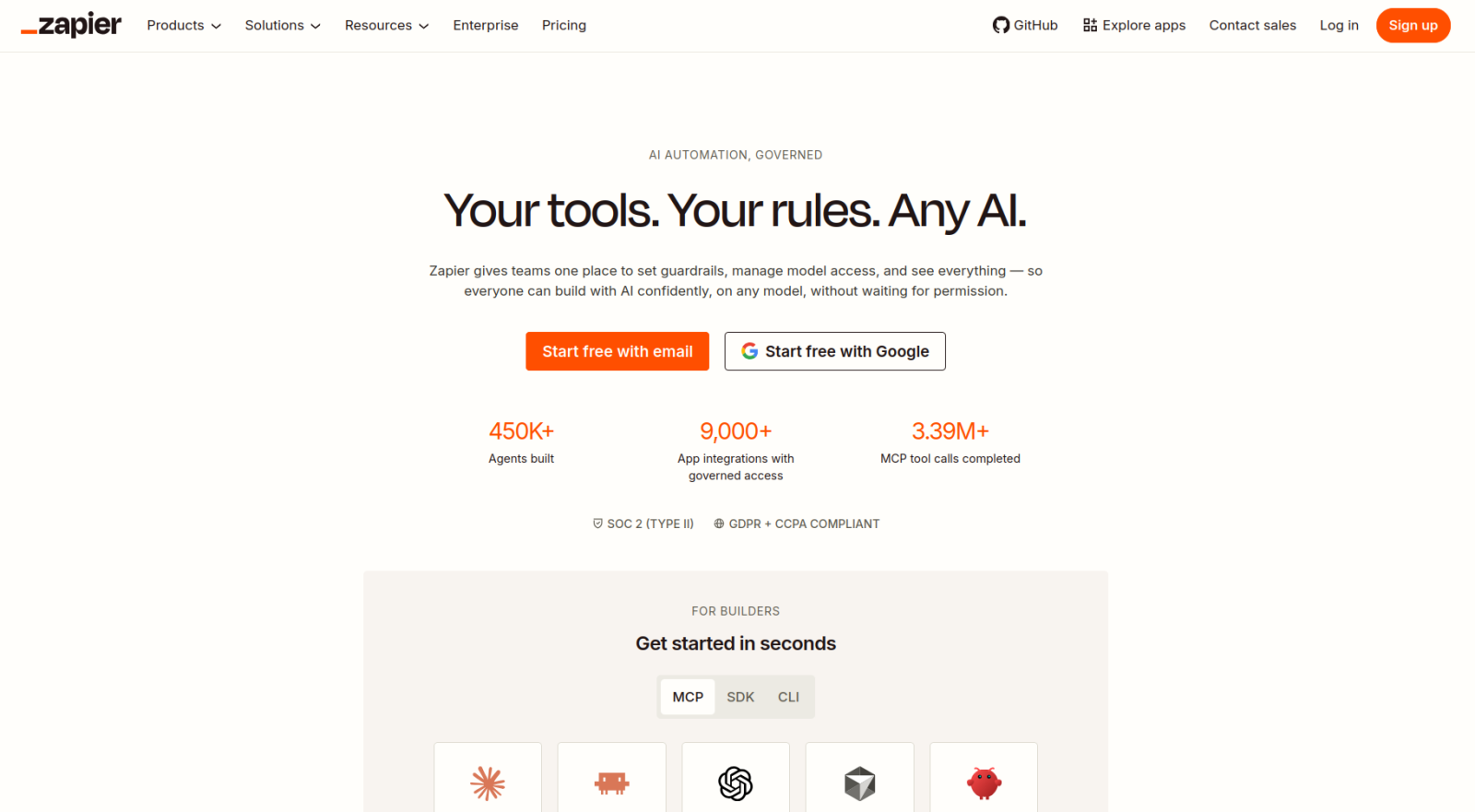
- Best for: Moving data between the apps you already use, based on flexible triggers
- Key strengths: Easily the largest automation and integration library on the internet; recently released AI tools speed up the creation of “Zaps”; decent in-platform web forms, page builders, and database storage
- Main limitations: Pricing can feel confusing and unclear at times, multi-step automations can be hard to maintain and keep from breaking
I’ve been using Zapier on and off for over a decade. It’s always been the simplest, most user-friendly way to set up automations where anytime something happens in one app, one or more other apps get updated. But over the last several years, Zapier has become even easier to use. It has added a number of in-house workflow tools so you can reduce the number of accounts and apps in your automation stack. The Canvas tool is a personal favorite, replacing Zapier’s old automation builder with flowchart-style diagramming for visualizing steps and branching conditional logic between triggers and actions.
The area where Zapier has always struggled the most, for me at least, is automation fragility. If something changes with one of the app accounts you’ve connected to a Zap (its password, permissions, etc.), there’s a domino effect and the whole automation breaks. The addition of Tables and Forms help reduce the number of external accounts, but it still feels weird to build entire workflows using only Zapier’s in-house tools. That, combined with some unwieldy pricing, is why I believe that Zapier is best for small businesses building relatively simple workflow automations between apps they already use.
- Zapier pricing:
- Free: Up to five active single-step Zaps, 100 tasks per month spread across them, and 15-minute update intervals
- Professional ($29.99 per month): 750 tasks per month, multi-step Zaps with conditional logic, access to premium app integrations like Salesforce and HubSpot, and faster update times
- Team ($103.50 per month): 2,000 tasks per month, shared folders and workspaces for team-wide collaboration, and access to live chat support
- Enterprise (custom pricing): Custom task limits, advanced security controls, and a dedicated technical account manager — all depending on a contract conversation with sales
3. Make
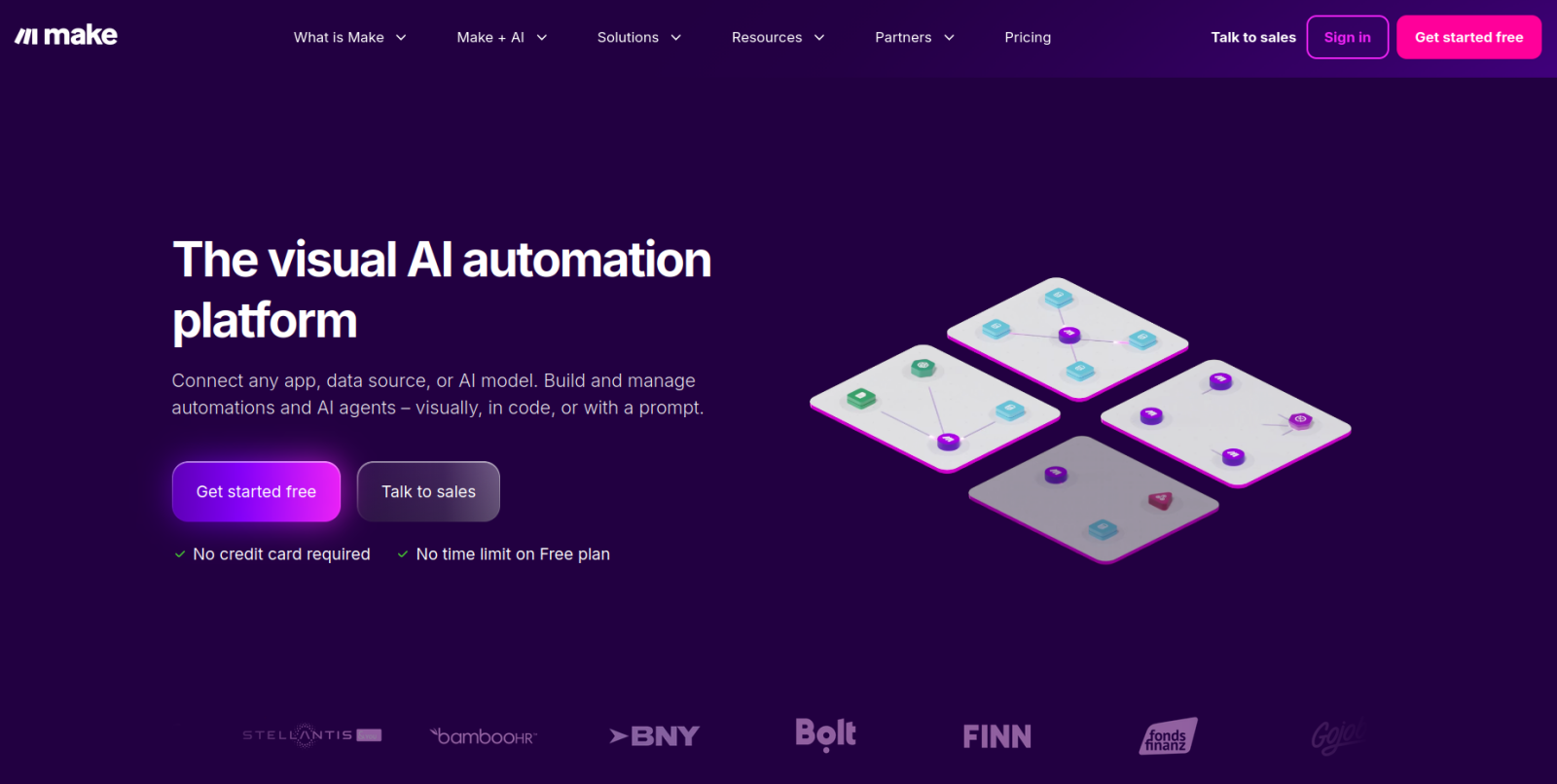
- Best for: Creating complex, branching automations with a lot of steps and conditional logic
- Key strengths: Visual automation builder is easy to learn and experiment with; built-in routers, iterators, and repeaters open up more advanced workflow control; significantly cheaper than Zapier without sacrificing much in the way of features
- Main limitations: More advanced workflow controls require a lot of getting used to, setting your own polling intervals can spike your credit usage unexpectedly
Even if I still prefer Zapier’s simpler approach to building bridges between my apps, Make has some very cool features. Every Make automation gets mapped out on an infinite canvas with arrows connecting each step. While it seems similar to Zapier’s Canvas tool at first, Make’s implementation shines in how it routes, iterates, and aggregates app data between steps. You might have a “scenario” that receives emails with multiple attachments, using an iterator to split each file into a different automation path. Or an automation that pulls customer data from several different platforms and aggregates it into a one-page report for support.
To be fair, I assume that all the fragility inherent to Zapier’s automations only gets magnified with Make’s more advanced features, although it was hard to confirm with tests. Still, the flexibility and customization will be well worth the tradeoff for anyone whose workflows require tall decision trees with lots of branches. And, as an added bonus, Make appears to be among the cheapest workflow automation software around.
- Make pricing:
- Free: 1,000 credits per month, two active scenarios, routers and filters, and a 15-minute minimum polling interval
- Core ($10.59 per month): 10,000 credits per month, unlimited active scenarios, scheduled scenarios, access to the API, and a one-minute minimum run interval
- Pro ($18.82 per month): Same 10,000 credits per month with the addition of custom variables, execution logs, and increased API rate limits
- Teams ($34.12 per month): Unlimited team roles and permissions for shared scenario templates, files up to 500 MB in scenarios, and increased API rate limits
- Enterprise (custom pricing): A call with sales will get you custom credit volumes, SSO and SCIM, audit logs, and overage protection
4. Airtable
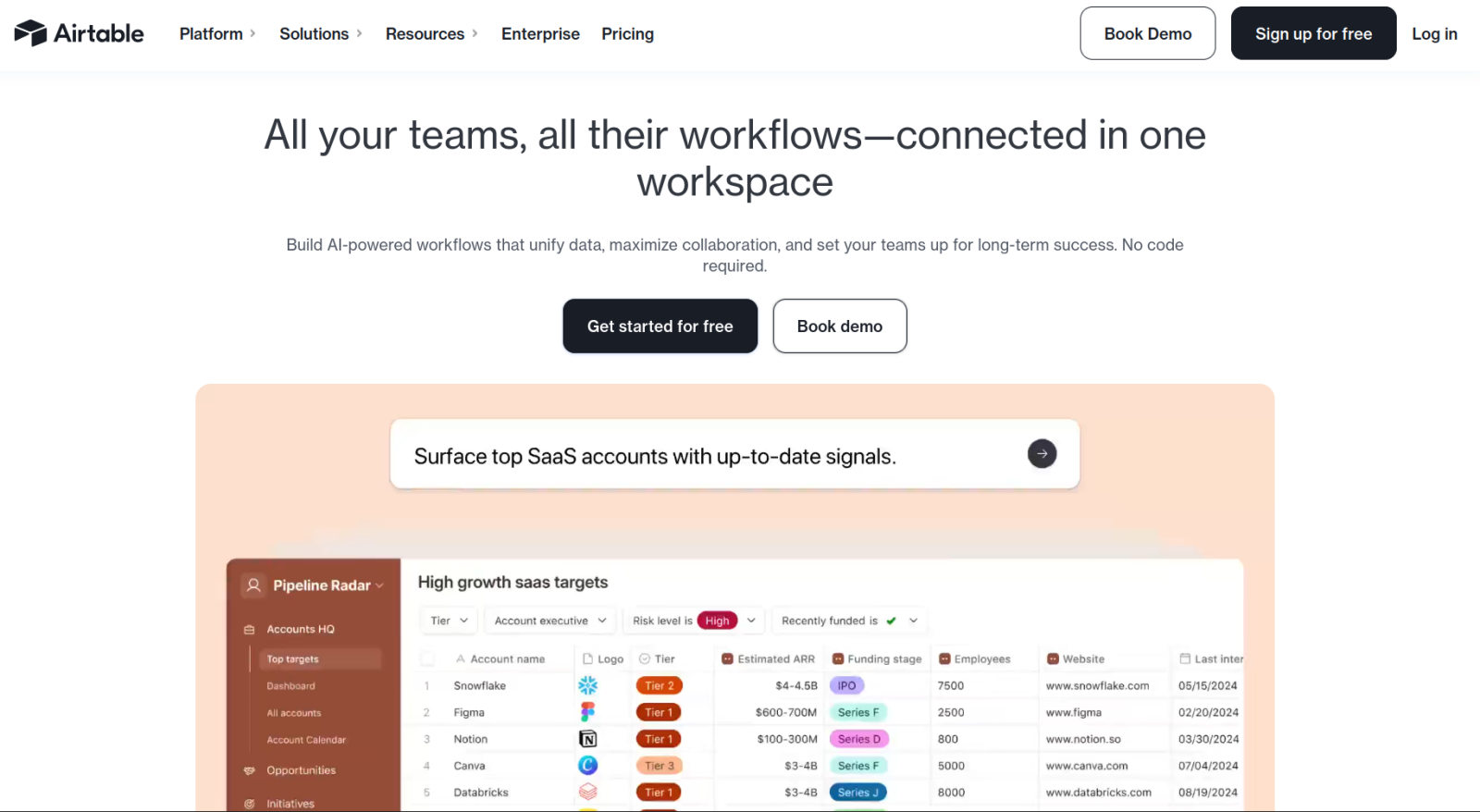
- Best for: Workflows based on data with complex dependencies and relationships
- Key strengths: AI app builder with personalized suggestions based on your existing workflows, interface builder is flexible enough for everything from dashboards to portals, data validation on form and interface fields makes it easy to keep information organized
- Main limitations: AI app builder can be painfully slow at times, database-driven workflows require more maintenance and troubleshooting
Airtable was one of the most popular platforms from the early days of no-code app builders. It was simpler and more intuitive than more traditional database tools while being far more powerful than basic spreadsheet apps.
Creating a sales pipeline workflow app is as easy as creating a new “base” and adding all the contact fields you’ll drag and drop onto the form builder in another tab. All that’s left is to pop over to the Automations tab to set up Slack notifications for new submissions and autoresponder emails that pull in data from your other bases.
For more app-like workflow experiences, you could spin up a few different Airtable Interfaces. You might create a page that shows the current list of unqualified leads so an SDR could add prospecting data to each, kicking off an automation that routes each lead to different salespeople based on a lead’s qualification. Or give each salesperson their own Interface with buttons and widgets for sending follow-up messages, call booking pages, or marking leads as no longer interested.
Although it’s similar to Jotform’s all-in-one approach to workflows, Airtable feels much more complex, which could be either a pro or a con depending on how comfortable you and your team are with relational databases.
- Airtable pricing:
- Free: Up to five editors, 1,000 records per base, 500 AI credits, 1 GB of attachments per base, and 100 automation runs per month
- Team ($24 per user per month): 50,000 records per base, 15,000 AI credits, 25,000 automation runs per month, custom branded forms, and Gantt and timeline views
- Business ($54 per user per month): 125,000 records per base, 20,000 AI credits, 100,000 automation runs, premium integrations, and SSO security
- Enterprise Scale (custom pricing): 25,000 AI credits per user, 500,000 records per base, 500,000 automation runs, enterprise integrations, and audit logs
5. monday.com
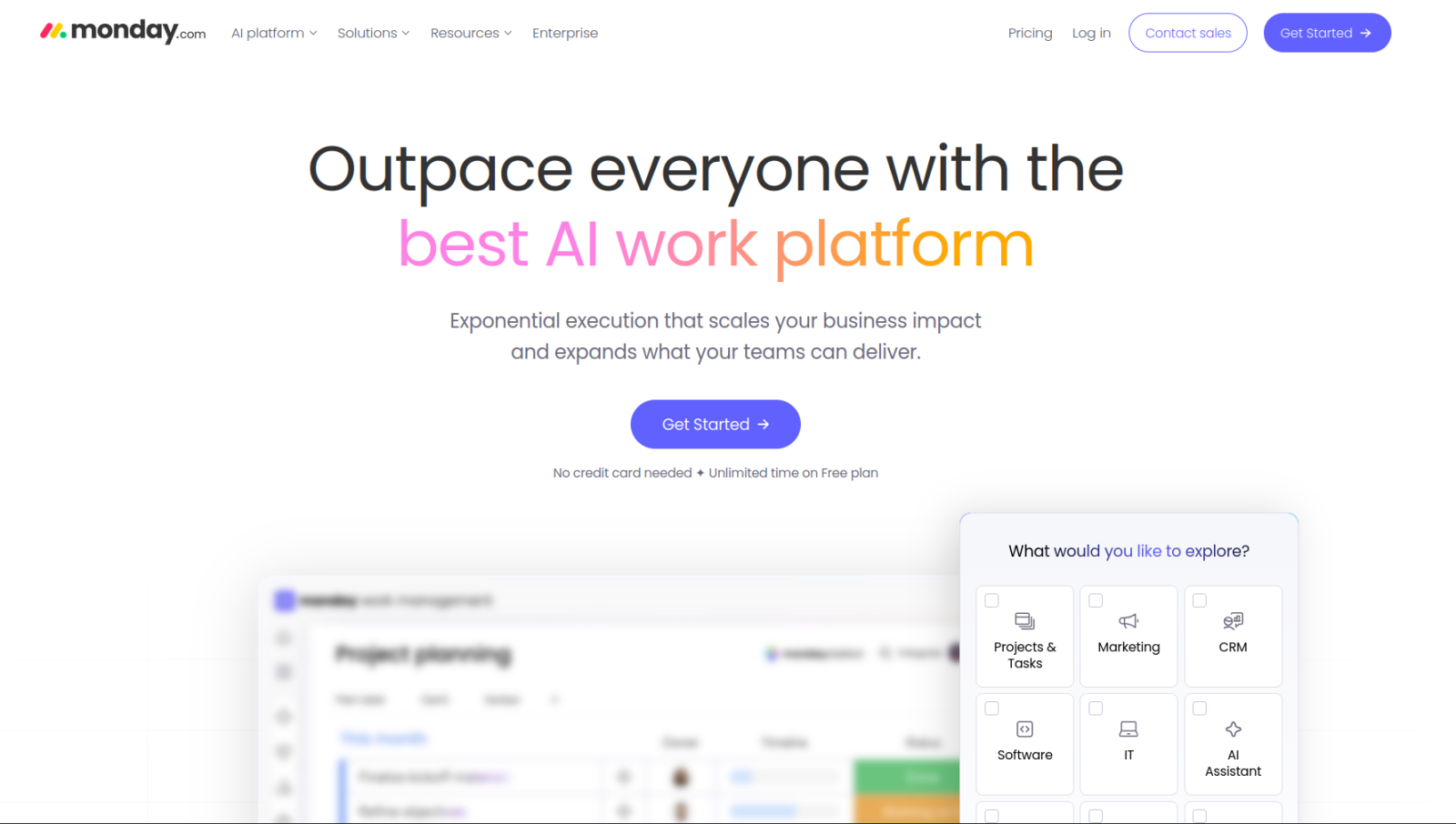
- Best for: Siloed workflows for teams with lots of projects
- Key strengths: Good selection of options to import project data from other tools; excellent template library for projects, dashboards, and apps; built-in AI notetaker helps track context from project calls and meetings
- Main limitations: Automations and integrations are only available on higher-tier plans, the app interface can get pretty cluttered and overwhelming
First and foremost, monday.com is a project management app. You create Workspaces, then nest Boards, Docs, Dashboards, and more recently Agents and Vibe apps inside them. Everything works in service of tracking tasks, people, deliverables, and whatever else your project needs to move to the next step. Then, once everything is documented and accounted for, you can create dependencies, timelines, and automations for all the data and relationships you want. While I found the look and feel of the app overwhelming at first, it ended up feeling less complicated than other workflow apps once I figured it out.
Technically, a small business could customize a Workspace for people outside the organization to submit, view, and update project data. You’d be fighting against an interface design that’s optimized primarily for internal team communication and collaboration, though. That’s why monday.com works best for approval workflows, time tracking, and client account management workflows — as long as you can justify the somewhat annoying three-seat minimum across all plans.
- monday.com pricing:
- Free: Up to two seats, limited to three boards, three documents, and eight column types
- Basic ($12 per seat per month, three-seat minimum): Unlimited boards and items, unlimited viewer seats, 5 GB of storage per seat, up to 20 AI agent tasks, and as many as 100 sidekick AI messages
- Standard ($14 per seat per month, three-seat minimum): Up to 250 automation actions per month; 250 integration actions per month; timeline, calendar, and Gantt views; 1,000 API calls per day; and double the AI limits included in Basic
- Pro ($24 per seat per month, three-seat minimum): Automation and integration limits jump up to 25,000 actions per month, 60 AI agent tasks, 30 AI notetaker hours, and 300 sidekick AI messages
- Enterprise (custom pricing): A call with sales unlocks unlimited automations and integrations, advanced security controls, multi-level permissions, and 250,000 API calls per day
6. ClickUp
- Best for: Building cross-team workflows for large, complicated projects
- Key strengths: Endlessly customizable workspaces and project databases, clean and legible interface relative to the platform’s scope, pricing is cheaper and easier to understand than other tools
- Main limitations: Some basic features are locked behind higher-tier plans, workflows can get messy if there’s no dedicated project manager
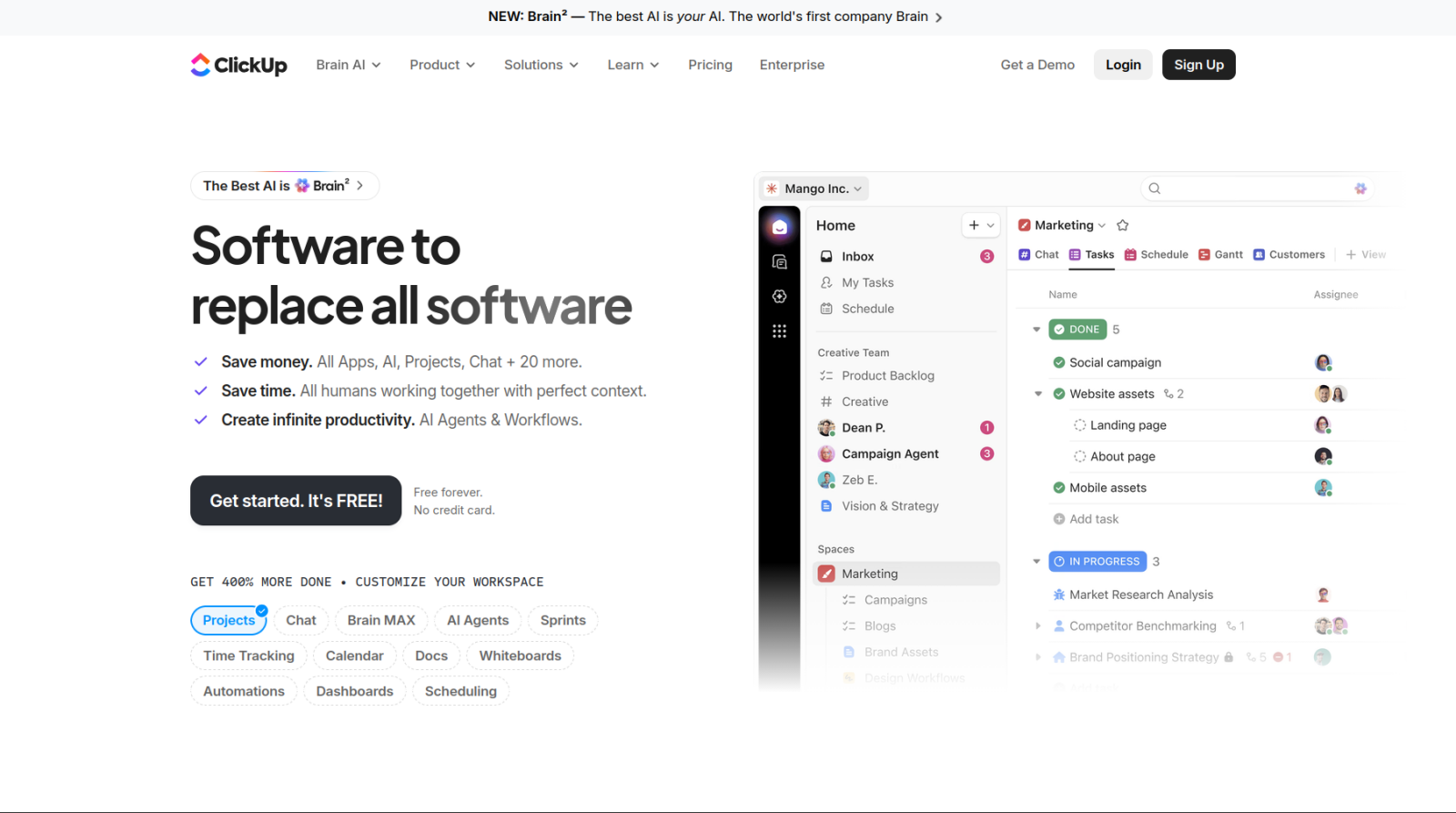
ClickUp is one of the more complex and customizable workflow apps on this list, with more layers of hierarchy to work with than something like monday.com. Despite that, ClickUp’s interface feels less busy than some tools with far fewer features — at least in the beginning. There are so many ways to customize and contribute to a Space that it’s not hard to imagine workflows snowballing into bloated messes. The basic automation tools can help find the signal in the noise, but I found ClickUp’s AI Brain and Super Agents better for generating summaries and progress updates. You even have the option to choose from a fairly long list of models to power your agents, which is something most of the other apps I tested didn’t do.
While it seems like the learning curve is one of the most common issues that teams have with ClickUp, the thing I’d be more worried about is feature availability. Email is listed as an “Advanced Automation” action and only available on the Business tier, conditional logic for forms is only on Enterprise plans, and AI features are a separate subscription entirely. This is a bummer since ClickUp wins in several other areas of its pricing. Still, it’s an option worth considering for businesses at the medium end of the SMB spectrum or those running big, complicated projects that need the extra structure.
- ClickUp pricing:
- Free: Unlimited tasks and members, collaborative docs, basic kanban boards, and a shared 60 MB across your whole workspace
- Unlimited ($10 per user per month): Unlimited Spaces, storage, forms, and custom fields; time tracking; integrations; a ClickUp email address; and 1,000 automation actions per month
- Business ($19 per user per month): Everything in Unlimited, plus up to 5,000 automation actions per month, advanced automations, no cap on message history, and mind-mapping tools
- Enterprise (custom pricing): White-labeling, advanced security, HIPAA compliance, and 250,000 automation actions per month
7. Asana
- Best for: Tracking workflow efficiency, goals, and OKRs with dashboards
- Key strengths: Goals and OKRs are baked into almost every part of the platform; unlimited automations on all paid plans, including a dedicated workflow builder; dashboards work really well for tracking the efficiency of repetitive tasks
- Main limitations: Workflow bundles are only available on Enterprise plans, a little less customizable and flexible compared to other apps
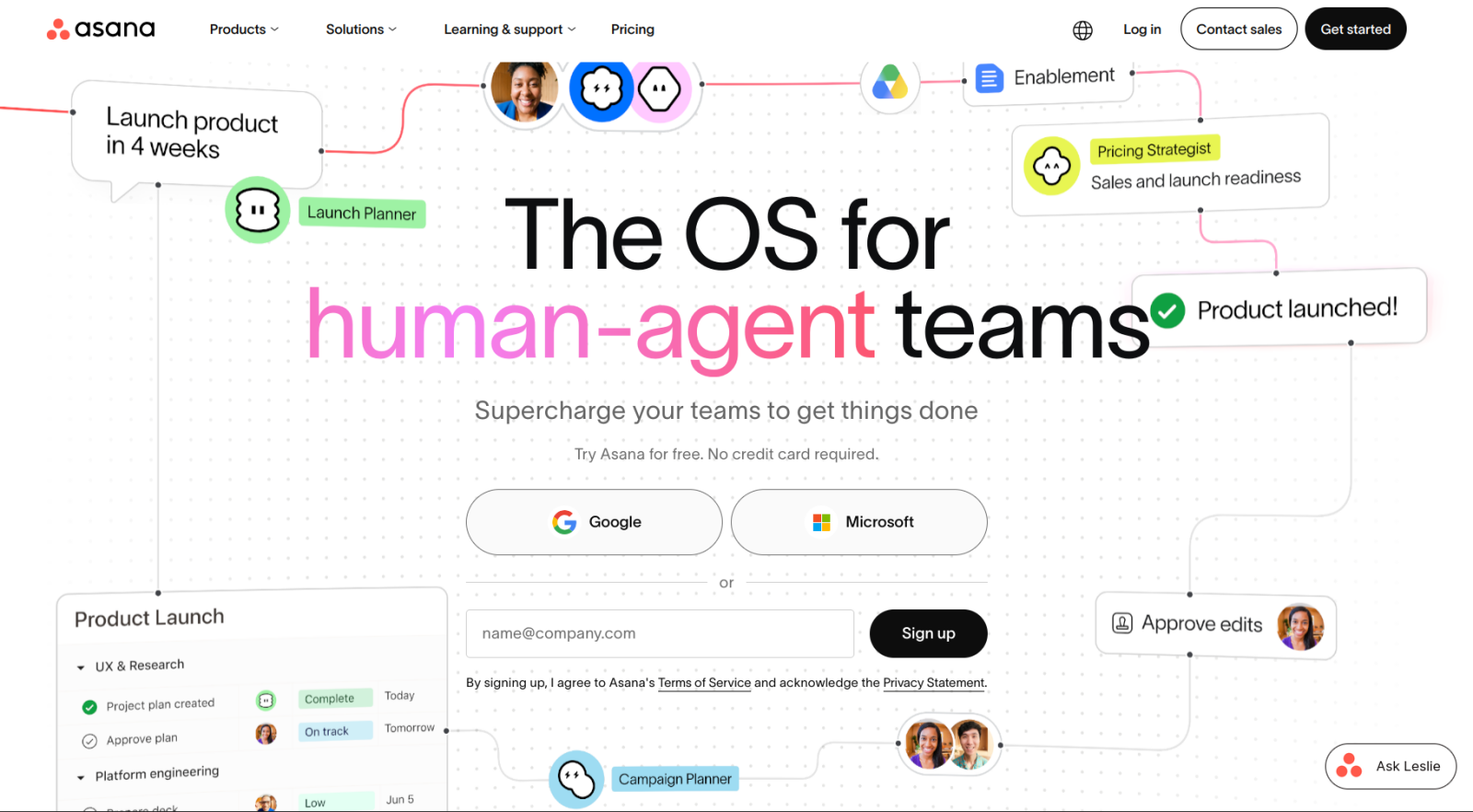
Every platform on this list lets you create and automate workflows. Asana is arguably the only one with features designed specifically for measuring how well your workflows are performing. First, you’d build out workflows in the Workflow tab of a project, kicking them off after a form submission or incoming data from an external app, then creating new tasks and notifying collaborators depending on what it is you need to do. With that set up, you could then open the Goals tab and create one based on the number of times a Workflow is completed in any of your open projects.
Every project also has a Dashboards tab, where you can create charts and visualizations to see how everything is progressing across teams and departments. You might, for example, tackle analyzing and improving workflows by measuring the average time at each step of a workflow — that will then identify bottlenecks or prompt you to collect feedback to compare different approaches to the same task.
Most of the apps on this list can get close to Asana’s workflow tracking. But in my tests, none of them were as polished or purpose-built for workflow optimization.
- Asana pricing:
- Personal (free): Up to two users; unlimited tasks, projects, and storage; and list, board, and calendar views
- Starter ($13.49 per user per month): AI Studio with 50,000 credits; timeline and Gantt views; and unlimited automations, forms, custom fields, and account guests
- Advanced ($30.49 per user per month): 75,000 AI Studio credits, approval workflows, advanced integrations, conditional logic and branching for forms, and formula fields
- Enterprise (custom pricing): 200,000 AI Studio credits, capacity planning, workflow bundles, and advanced security features
8. Process Street
- Best for: Compliance workflows based on regulatory frameworks
- Key strengths: Designed around the requirements of specific frameworks like HIPAA and PCI-DSS, more than 800 templated workflows designed for specific industries and departments, compliance-focused audit logs double as analytics tools
- Main limitations: Integrations are only possible through Zapier and Make, workflow creation and customization can be unavoidably technical
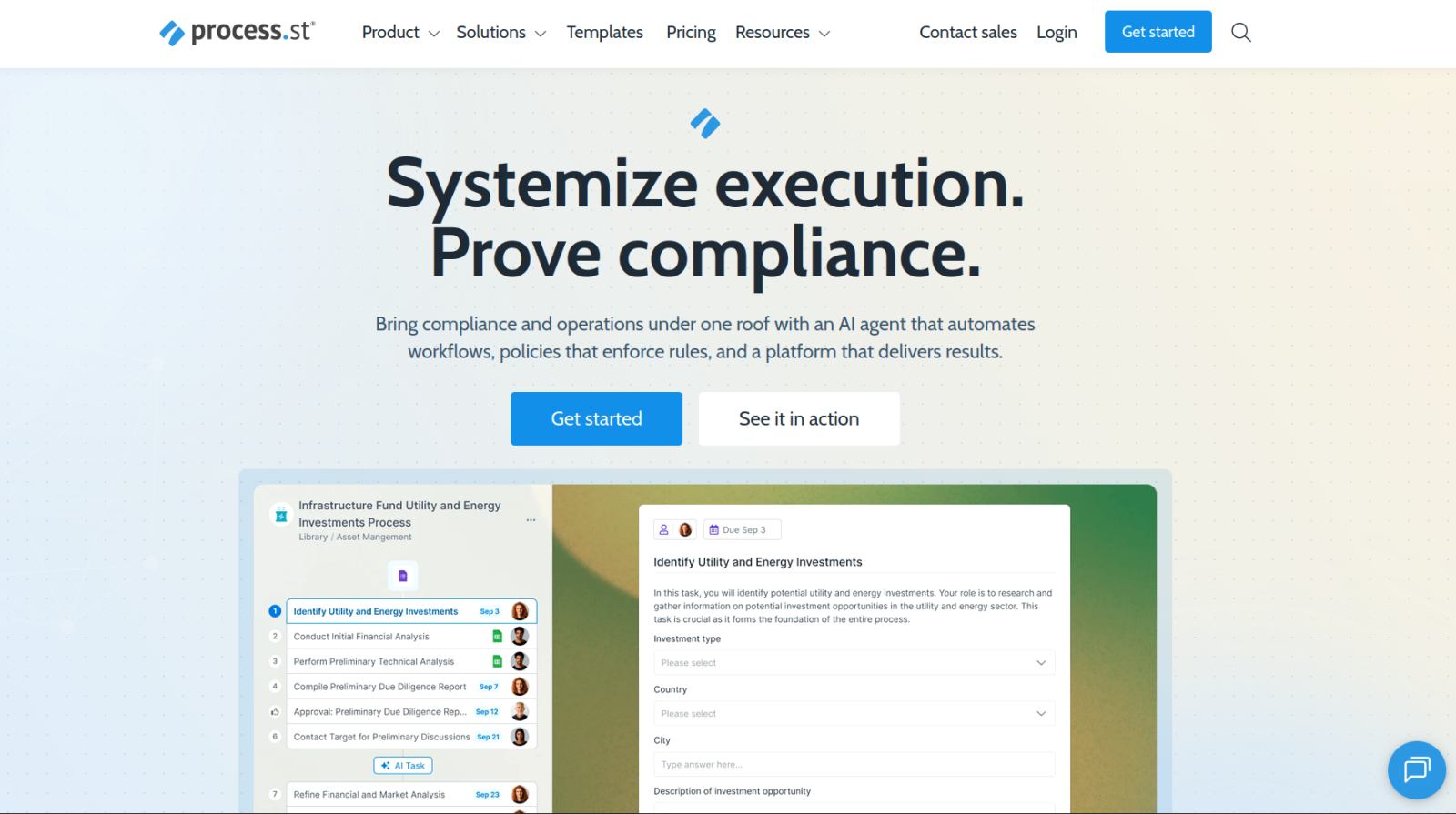
Compliance workflows are all about traceability. Process Street, with its regulation-specific templates and audit logs, wants to track and automate as much of your regulatory work as possible. You could create a workflow from scratch for HIPAA self-assessments and acknowledgment forms — routing them through IT, HR, and procurement, before submitting and storing them based on regulatory requirements. Or you could add Process Street’s 43-step templated HIPAA compliance workflow to your account, complete with pre-written notifications and citations.
For better and for worse, this is a deceptively complicated tool to use. Although it looks straightforward at first, you’ll quickly realize there are distinct settings menus and feature toggles on almost every screen. You might first tweak behavior across the entire workflow, then make changes to a specific step, followed by field- and item-level settings within that step. That, combined with PDF exports for audit trails, makes this the workflow tool for building apps for small businesses beholden to regulatory language.
- Process Street pricing: Each of Process Street’s three account tiers — Startup, Pro, and Enterprise — requires a sales call to receive a quote. They are very close to each other in terms of what’s included, with the main differences being the number of records you can store, file storage, and support levels.
How to choose the best workflow app for your small business
Each of the tools on this list brings its own brand of workflow automation and management to the table. And since workflows are often daily, sometimes hourly tasks, even the smallest annoyance or inconvenience will start to add up. It’s worth taking a step back and spending a little extra time thinking about which aspects of workflow automation are most important to you and your team.
Where do your workflows actually start?
If most of your processes begin with someone (a lead, an employee, etc.) submitting information, a form-native tool like Jotform Workflows is going to help keep as much of the process under the same roof as possible. If your workflows are more likely to start with a new CRM record, a calendar event, or an email, a connector-first tool like Zapier or Make might serve you better.
How technical is your team?
If you’re primarily interested in how to create an app without coding, platforms like monday.com, Asana, and Jotform Apps are built so that non-technical staff can set up and maintain workflows with almost zero training or onboarding necessary. Tools like ClickUp, Make, and Airtable are for people who are already comfortable thinking in terms of data structures, formulas, or branching logic.
How long are your workflow chains?
The more steps your workflows contain, the more important it is to have robust automation and conditional logic. Zapier and Make give you more freedom and flexibility for moving data between different platforms, but that comes at the cost of workflow durability and robustness. Tools with built-in automation, like Jotform, Asana, and ClickUp, are less prone to issues stemming from account changes and platform updates.
Do you need e-signatures in the workflow?
If a signature is part of your approval or intake workflow (e.g., contracts, policy acknowledgments, vendor agreements, etc.), Jotform is the only tool on this list with native e-signature compliance (through Jotform Sign). Other workflow apps will work but require third-party extensions and add-ons, adding to the complexity and cost of the project.
What’s your real budget?
Don’t just look at the entry-level cost — factor in your growth forecasts over the next few years, since several tools on this list scale aggressively in price. Jotform, Zapier, and Make are more closely aligned with platform activity, whereas monday.com, Asana, and ClickUp are more tied to the number of users you need.
The best workflow app is the one that covers the most ground with the least setup, especially for small businesses. And by that logic, you can’t go wrong starting with Jotform Apps. Its free tier is comfortably the most generous on this list, with paid plans that don’t have minimum user requirements. It includes everything you need to create, track, and optimize workflows under one roof with forms, native automations, e-signatures, reporting, and a massive list of integrations. Try Jotform Apps for free and see how much of your workflow you can automate without writing a line of code.
This article is for small business owners, operations managers, and team leads who are drowning in manual, repetitive tasks — approvals, follow-ups, data entry, notifications — and are looking for a tool to automate them without hiring a developer or paying enterprise prices.


































































































Send Comment: