
Top scheduling apps for small businesses


As a small-business owner, you’re likely already juggling a handful of apps for small businesses to keep things running, and you want to spend less time on admin and more on tasks that bring in revenue. If you depend on scheduled slots to deliver your services, the back-and-forth of finding a time can be complex.
Scheduling apps add structure to booking time with you. They combine clean user interfaces that display your availability, intuitive scheduling flows to help people pick a slot, and helpful features such as reminders and rescheduling and cancellation links. Read on for the six best small-business scheduling software options.
What is a scheduling app?
A scheduling app (also called appointment scheduling software for small businesses, online booking software, or a meeting scheduler) is a digital tool that lets clients browse your calendar availability in real time and book, reschedule, or cancel a meeting or appointment. All of this happens without back-and-forth emails or phone calls, and it includes confirmations and follow-up appointments and reminders to help reduce no-shows.
While scheduling apps can book for a whole team, these apps typically don’t have shift planning or workforce management features. If you’re looking for the best scheduling app for employees, including shift planning and workforce management, take a look at schedule apps for work, such as Connecteam, Deputy, and 7shifts.
Here’s a quick side-by-side look at six online booking apps for small businesses, followed by a deeper breakdown of each one.
The best scheduling apps for small businesses in 2026
| Tool | Best for | Key feature | Main limitation | Free plan? |
|---|---|---|---|---|
 Calendly |
Smart routing and Round Robin booking for teams |
Round Robin and Routing Forms auto-distribute and triage bookings. |
Routing features only on pricier Teams plan |
Yes, for one event type |
 Acuity Scheduling |
Selling packages and memberships to recurring clients |
Native package/membership tracking is tied to intake forms per appointment type. |
No free plan; email-only support |
No; seven-day trial only |
 Jotform Apps |
Businesses wanting a branded, installable booking mobile app |
AI App Builder generates a working app in minutes; push notifications are activated after install. |
No app store discovery; shareable only via link or QR code |
Yes, for five forms and 100 submissions/month) |
 Setmore |
Teams scheduling on a free plan |
Free plan covers four users, each with their own calendar and booking link. |
Double-booking risk with one-way Google Calendar sync on free plan |
Yes, for four users and 200 bookings/month |
 Square Appointments |
Businesses that also take in-person payments (retail, salons, storefronts) |
Every appointment has native checkout button; card-on-file no-show fees are an option. |
Payment processing via Square only |
Yes, for one location |
 YouCanBookMe |
Businesses seeking a fully brandable booking page |
You have full control over page colors, layout, background, and branding; it’s more customizable than Calendly. |
Price increases per connected calendar; dense settings and slow support |
Yes, for one page and one calendar |
1. Calendly
Best for: Smart routing and Round Robin booking for teams
Key strengths
- Round Robin distribution feature reads calendars in real time and assigns incoming bookings based on availability and customizable rules.
- You can set up screening questions in a routing form and send clients straight to the right person’s booking page.
- It has the broadest calendar and integration reach: two-way sync with Google, Outlook, and Exchange, plus 100-plus native integrations, including Zoom, Salesforce, and HubSpot.
Main limitations
- Round Robin and Routing Forms are gated behind the priciest plan, so you pay a per-seat premium to unlock the routing logic.
- Team setup is more complicated than Calendly’s famously quick solo experience, and support is email-only until you reach Enterprise.
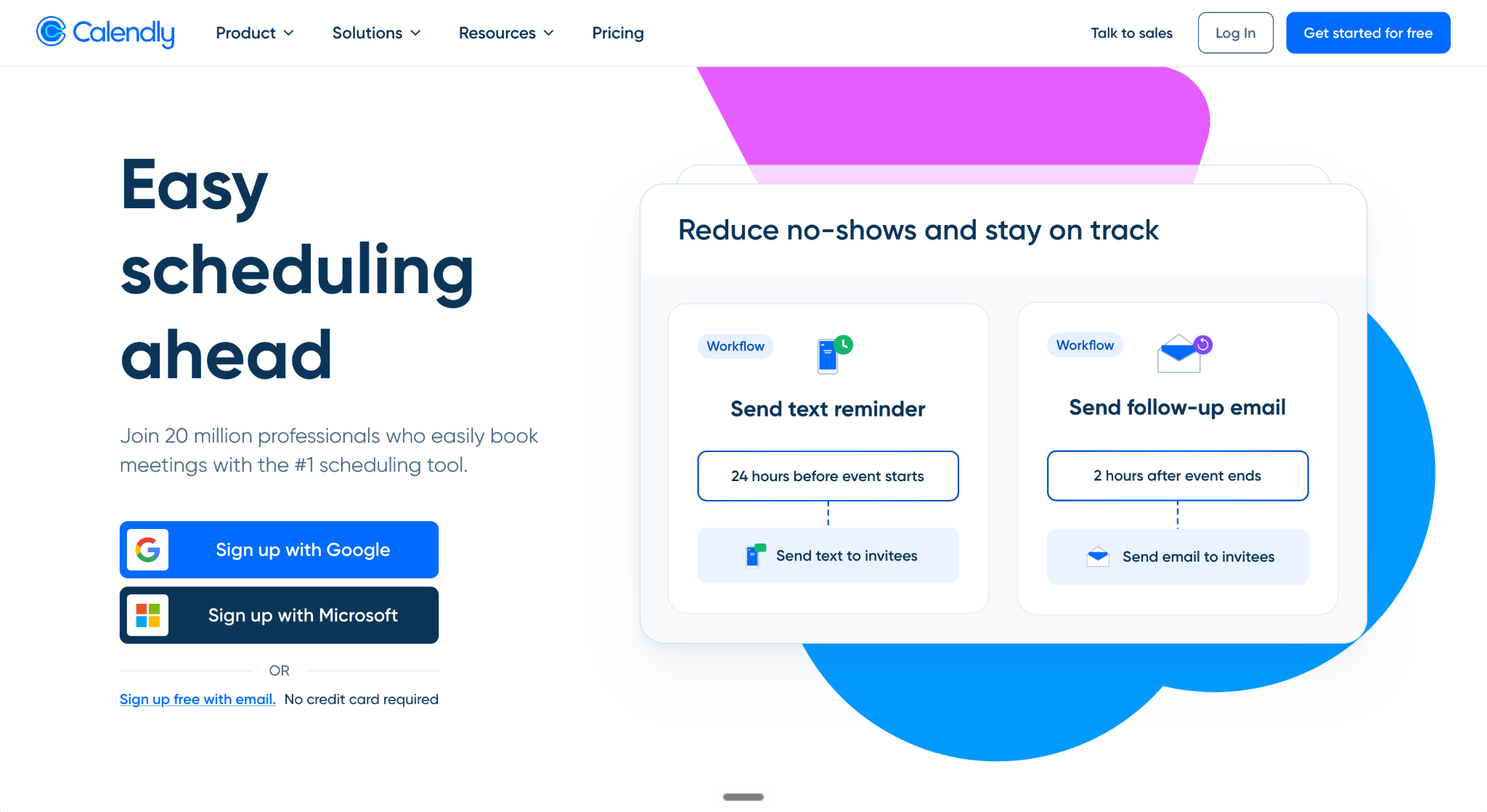
Calendly is one of the most popular scheduling apps. Companies of all sizes use it for its clean and intuitive booking experience, no matter the meeting type (such as in person or Zoom). Beyond its basic scheduling functionality, it stands out because you can set up custom logic to assign new meetings to your team.
When you enable Round Robin distribution, Calendly checks every team member’s calendar in real time. When a client books time, it routes the request to whoever’s available, and it can fairly distribute bookings among team members.
Routing Forms add another layer of custom logic: You can create a form to gather details from a client, such as the services they’re looking for or their budget, and then funnel them to the best team member for the job. For example, you can route VIP leads to top performers while leaving lower-ticket clients to less experienced employees. This matches client needs to your resources automatically.
But there’s a price: Calendly restricts this feature to its Teams plan, which is $16 per seat, per month. If you’re experiencing a lot of friction in scheduling, it can streamline your operations and justify the price; for young small businesses, it may be a barrier to entry, especially considering the team setup is more complex than it is for a single user. If this is you, check out the best Calendly alternatives to find something more appropriate for your needs.
Pricing
- Free plan: One event type, single calendar connection
- Standard plan: $10 per seat, per month (billed annually); unlimited event types, up to six calendar connections
- Teams plan: $16 per seat, per month (billed annually); unlocks Round Robin distribution and Routing Forms
2. Acuity Scheduling
Best for: Selling packages and memberships to recurring clients
Key strengths
- Native package, membership, and gift-certificate sales are tied to each appointment type; returning clients redeem a prepaid session on their own instead of paying and rebooking from scratch.
- Custom intake forms attach to a specific appointment type and send automatically, collecting health history, waivers, or consultation details before the visit and storing them on the client’s profile.
- In the client portal, clients can see package balances, past intake responses, and saved payment info, and reschedule or cancel without emailing you.
Main limitations
- Membership and subscription tools are inconsistent beyond a solo operator. Small-business owners on Reddit report package codes behaving unpredictably, and no way to gate content behind a subscription.
- There’s no permanent free plan (only a seven-day trial).
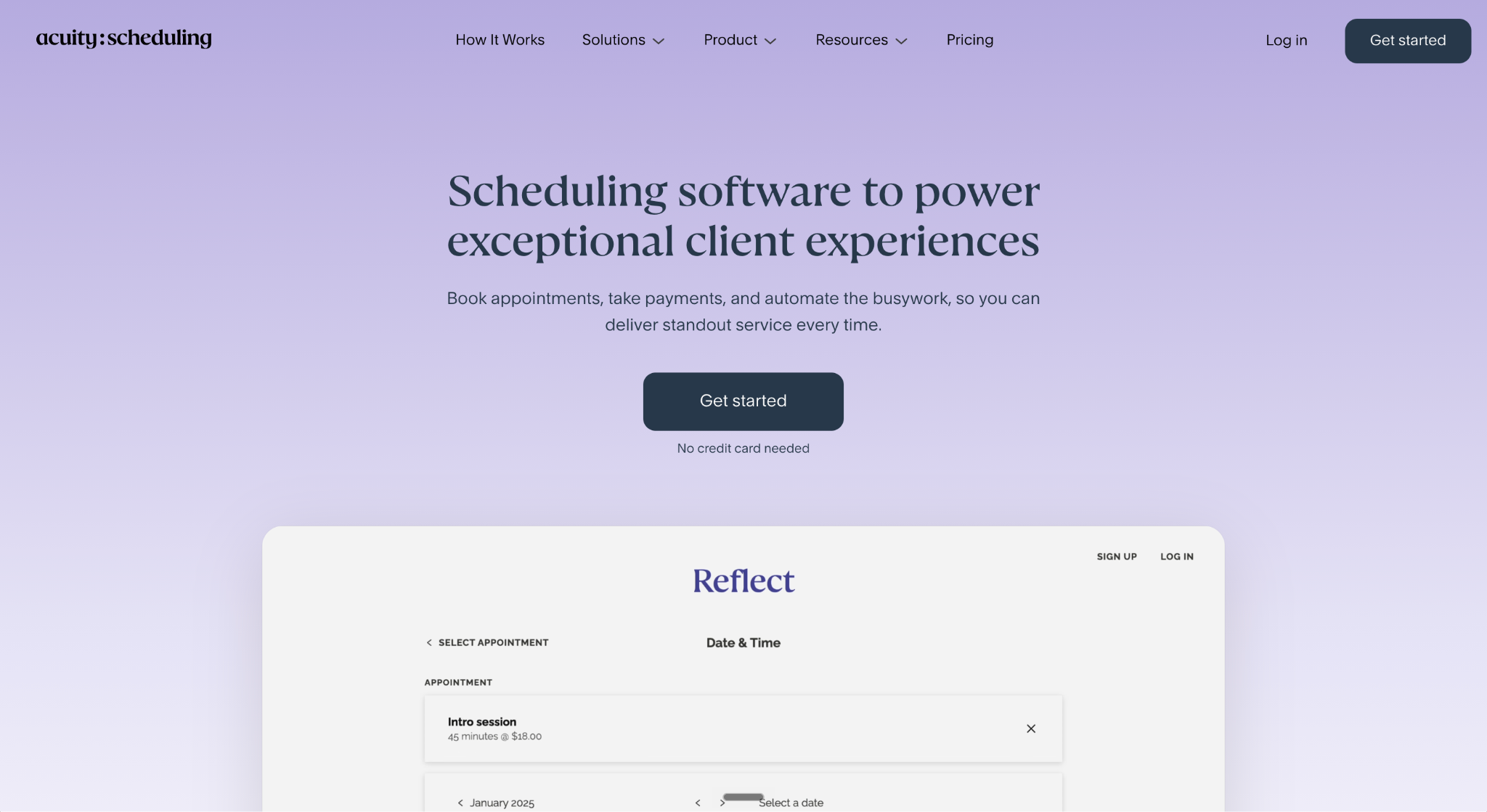
Most scheduling software on this list handle one-off bookings brilliantly. But for recurring clients that buy memberships, being sent to a form that doesn’t recognize them consistently is frustrating. This is the gap Acuity Scheduling addresses: It gives you the tools to set up anything from a monthly membership to a 10-session therapy program while making it easy for your clients to both buy and use your services.
Here’s how it works. First, you set up appointment types for each service, package, or membership you’re offering. These can have their own intake forms, which is useful for personalizing the service and conducting the first session faster. After your client purchases one of your services, they can track it in a dedicated client portal, seeing how many sessions or benefits they’ve already used and which are still available. They won’t have to reenter any data they’ve already shared.
If you’ve been handling loyalty or membership programs through spreadsheets or sticky notes, Acuity will feel like a massive upgrade by centralizing that information. However, if you offer complex subscription-based pricing with multiple tiers and rules, you’ll find it gets confusing fast, turning the app into a friction point. It also lacks a free plan, so if your budget is tight, you might be better served by one of these Acuity alternatives.
Pricing
- Seven-day free trial
- Starter plan: $16 per month (billed annually); one calendar, plus payments via Stripe, Square, or PayPal
- Standard plan: $27 per month (billed annually); up to six calendars; ability to sell memberships and packages
- Premium plan: $49 per month (billed annually); up to 36 calendars; ability to sell gift certificates and remove the Acuity logo
3. Jotform Apps
Best for: Businesses looking for a branded, installable booking mobile app
Key strengths
- The Jotform AI App Builder turns a plain-language prompt into a working app with pages, navigation, and a booking form already in place in about a minute, no developer or code required.
- The Appointment Slots widget lets clients pick a slot from your calendar with preconfigured slot duration, business hours, blackout days, and multiple services, each with their own price.
- Once a client installs the app, you can send native push notifications for reminders, last-minute openings, or promotions, which none of the other apps on this list offer.
Main limitations
- There’s no App Store listing to drive discovery. The only way to get the app onto a client’s phone is a shared link or QR code (though it installs equally well on Android and iOS because it runs through the browser).
- An active booking app hits free-tier submission caps quickly, and the jump to paid tiers is steep if you go over your monthly limit.
Jotform Apps goes one step beyond other booking software: Instead of just presenting a scheduling page to clients to open on a browser, you can build an app your clients can add to their phone’s home screen. Anytime they need you, they can simply tap the icon and begin the booking process. The app even includes a native push notification channel, so you can send reminders or new offers, a more direct nudge when compared with text or email.
You don’t need to know how to code to build your app: You only have to create the pages and assemble the interface components you want to include. Among these, the Appointment Slots widget offers plenty of settings for managing slot duration, business hours, and blackout days, with direct connections to your calendar to book only slots that are available.
The entire building process is even faster now with AI, because you can use the Jotform AI App Builder to start from a prompt or pick from ready-made options such as personal training app templates, which you can customize with your branding and the functionality you need. The app doesn’t get published to the App Store or Google Play; however, because both platforms charge a fee and sometimes reject submitted apps, this is a shortcut for delivering a polished mobile experience without added cost and complexity.
This advantage can also be its own drawback. Because the installation process is not familiar to most users, you may have to coach your clients on installing the app on their home screens. The process is intuitive: When your clients open your app in a browser, a popup asking to install the app on their phone appears at the top of the interface. Once they tap the install button, the app is easily accessible on their home screen.
Pricing
- Starter plan: Free; unlimited Jotform apps, five forms, 100 monthly submissions, 10 monthly payment submissions
- Bronze plan: $34 per month (billed annually); 25 forms, 1,000 monthly submissions, 100 monthly payment submissions
- Silver plan: $39 per month; 50 forms, 2,500 monthly submissions, 250 monthly payment submissions
- Gold plan: $99 per month (billed annually); 100 forms, 10,000 monthly submissions, 1,000 monthly payment submissions
Jotform: Appointment Scheduler app
While Jotform Apps can help you create fully custom apps that will fit your brand and help you manage your business better, you also can check out Jotform: Appointment Scheduler to manage your business’s appointments directly on your mobile device. Download it now!


4. Setmore
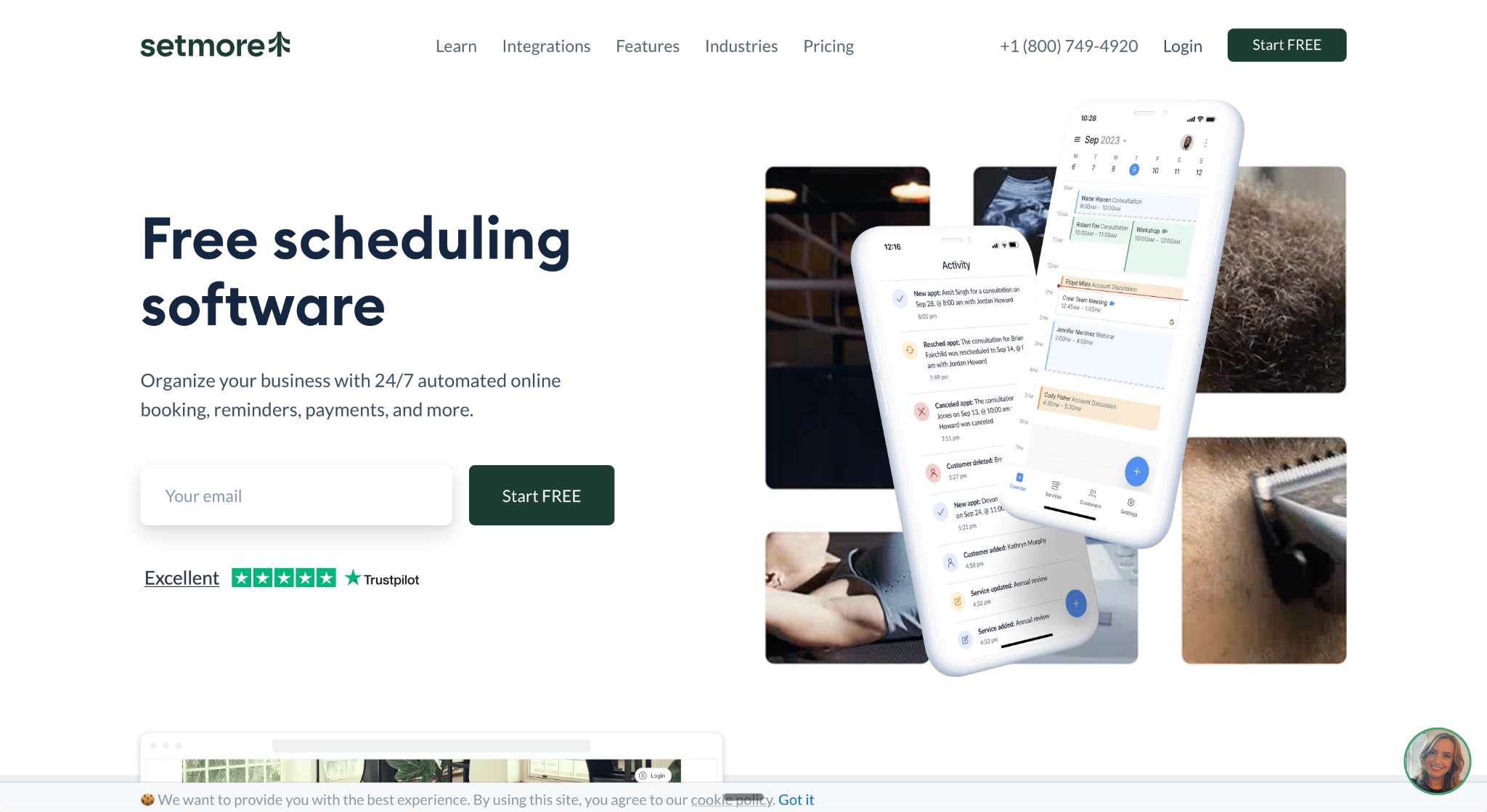
Best for: Teams that need a free scheduling app
Key strengths
- The free plan covers up to four users, each with their own calendar and individual booking link, plus 200 bookings per month and a branded booking page.
- The booking page can be embedded as a widget on a website or social page.
- Built-in online payments through Square, Stripe, or PayPal let clients pay or leave a deposit at booking time.
Main limitations
- Google Calendar sync is one-way on the free plan, which means there’s a risk of double booking.
- Brand customization on the booking page is limited.
Setmore is a free scheduling app for small-business teams that’s genuinely generous: You can set up a booking page and bring up to four members of your team onto it without breaking the bank.
To begin, you set up your client portal to show your services and your team, and you link your calendars to show real-time availability. Next, you can add your logos and branding. Last, add links to your site and social media channels so your clients can stay tuned and also book from your profile. Setmore offers most of these customizations on the free plan.
While the free plan is generous, offering up to 200 bookings per month, it doesn’t include a two-way calendar sync. Because data doesn’t update on both platforms at the same time, there’s a risk of double booking for the same slots, which might require manual changes in the app. The Pro plan seems economical at $5 per user, but make sure everyone is bringing in strong enough revenue to justify the cost. If these limitations are too tight for you, check out these Setmore alternatives to find a better option.
Pricing
- Free plan: Up to four users, 200 appointments per month, branded booking page, payment processing
- Pro plan: $5 per user, per month (billed annually); unlimited users and appointments, SMS reminders, two-way calendar sync, no Setmore branding
- Enterprise plan: Custom pricing for larger teams
5. Square Appointments
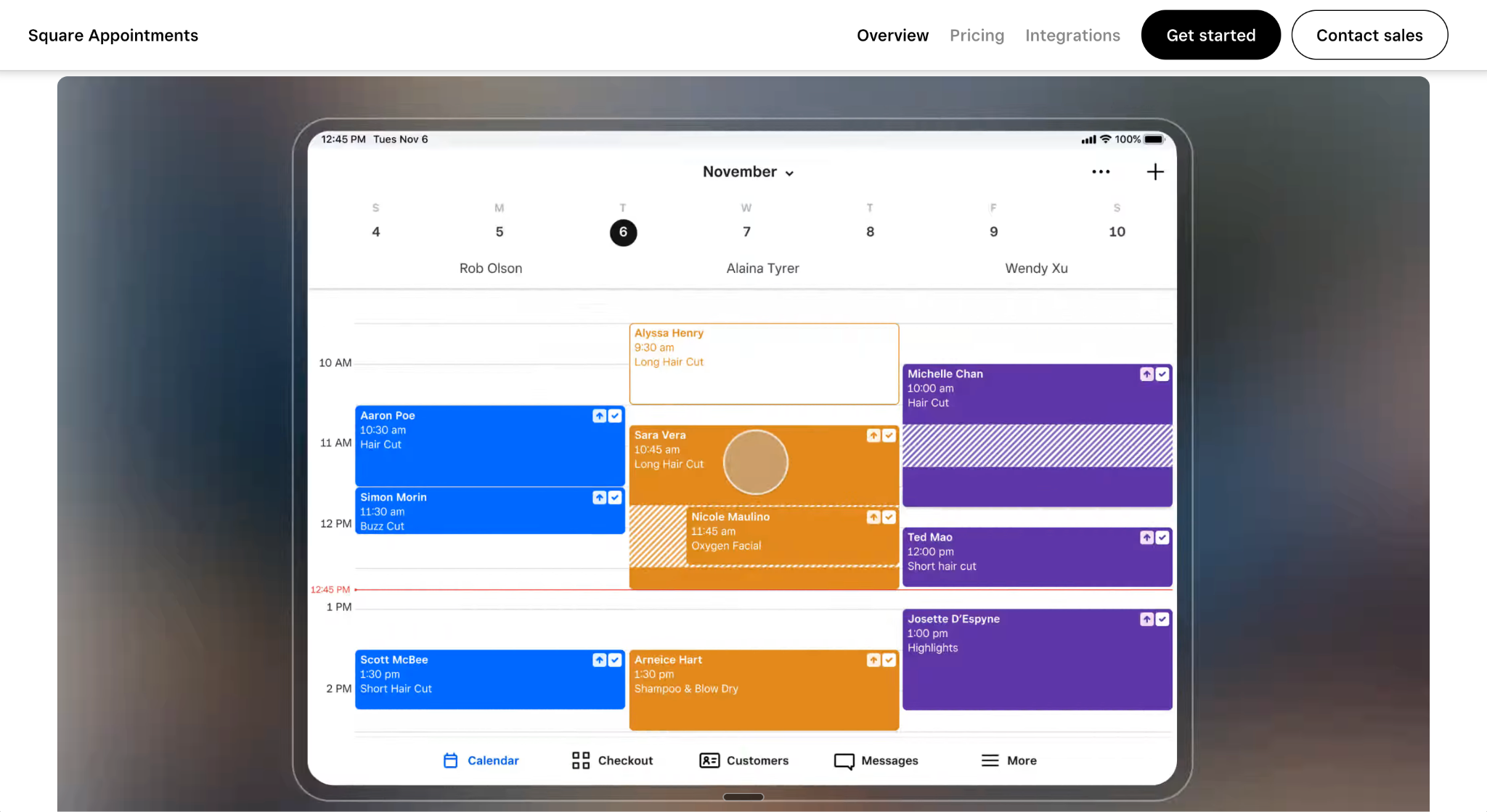
Best for: Businesses that take in-person payments (such as retail, salons, or storefronts)
Key strengths
- Booking and checkout live in the same account. Every appointment has a checkout button, so staff can charge for the service plus any add-ons and take payment without switching apps.
- Card-on-file no-show protection lets you charge a cancellation fee automatically when a client misses their slot or cancels late, saving you from chasing payments.
- The free plan gives a solo user the full booking-and-payments stack, with only processing costs per transaction.
Main limitations
- You’re locked into Square’s own payment processing to get the native checkout experience, so you can’t look for lower fees on other platforms.
- The scheduler isn’t flexible for irregular day-to-day availability.
Square began as a payment processing platform with a wide range of business tools. Instead of buying individual apps, you could solve a lot of problems in a single platform, with a bonus: Everything is integrated, so you can easily automate the manual work between each task.
So it’s no wonder that Square is focused on payments. It has its own point-of-sale systems and hardware, and it drives every booking straight to checkout. If you set up a cancellation policy, you can charge cards on file if clients cancel too late or don’t show up.
Its main drawback is that you can’t use another payment processor, such as Stripe or PayPal. This is by design; these platforms are Square’s direct competition. You won’t be able to shop around for the best payment processing fees, which may directly affect how much of your income goes out, especially if your clients pay with methods that are expensive to process.
Pricing
- Free plan: Single location, basic booking, calendar sync, reminders (processing fees: 2.6 percent plus $0.15 in person, 3.3% plus $0.30 online)
- Plus plan: $49 per month, per location; multiple staff calendars, class bookings, waitlist, cancellation policies (processing fees: 2.5% plus $0.15 in person, 2.9% plus $0.30 online)
- Premium plan: $149 per month, per location; advanced staff management, resource scheduling, time tracking, advanced reporting
6. YouCanBookMe
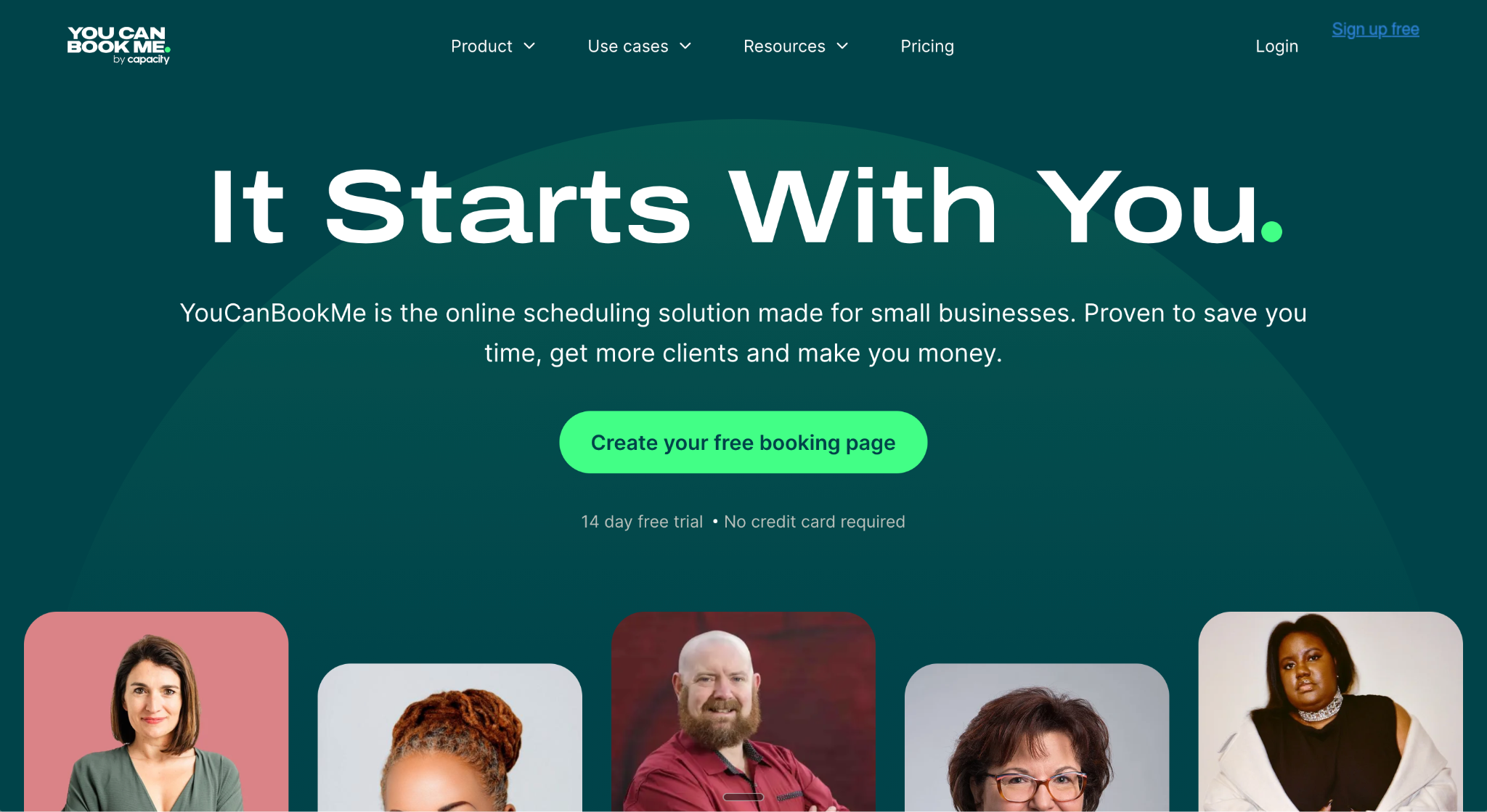
Best for: Businesses seeking a fully brandable booking page
Key strengths
- You have deep visual control over the booking page (colors, layout, background, and text), so it can be embedded on your site or shared as a link without looking like a third-party widget.
- It has two-way sync with Google, Microsoft/Outlook, Apple, and Fastmail calendars, plus buffer time, booking caps, and minimum/maximum notice rules to protect your schedule.
- With automatic time zone detection and support for more than 40 languages, the branded page works for clients booking from other regions.
Main limitations
- Full customization toolkit is available only on the more expensive plans.
- The depth of the branding settings add a learning curve to the platform.
If you want to customize every part of the scheduling experience, YouCanBookMe’s customization features will help you provide all the information your clients need and let your brand shine.
The design settings let you add your logo, custom text, page layout, background colors, and a page footer, which gives you room to fully articulate the value of your products and services. When your clients book, you can send them customized confirmation messages and calendar events. Beyond appealing visuals, YouCanBookMe has two-way sync with your calendar apps, so you can avoid double bookings and manual cleanups.
The free plan gets you far, but you can’t remove YouCanBookMe’s branding or access the full customization toolkit unless you choose the Professional plan, which is $11.70 per month (billed annually). This can be an obstacle if you’re just starting out or still growing. Customer support can be patchy, with users sometimes waiting for days or weeks until they hear back from YouCanBookMe’s team.
Pricing
- Free plan: One booking page, one calendar connection, core customization features such as logo, text, confirmation emails/SMS, calendar events
- Individual plan: $8.10 per month (billed annually); two calendars, two booking pages, custom colors, background image, footer, reminder emails, SMS
- Professional plan: $11.70 per month (billed annually); six calendars, 10 booking pages, automated workflows, analytics, removal of YouCanBookMe’s branding
- Team plan: $16.20 per user, per month (billed annually); 10 calendar connections and 15-plus booking pages per user, team admin tools, round robin assignment, centralized billing
3 steps for choosing the best scheduling app for your needs
With six solid app options available to you, you can narrow the field by working through these three steps in order.
Map your “must-haves.” Look for the core features you need, such as collecting payments at booking, automating reminders to cut no-shows, or being a true staff scheduling app for small-business teams that need multiple calendars under one account.
Determine the integrations you’ll actually use. A tool can have 100-plus integrations and still be the wrong pick if it doesn’t connect to the three or four you rely on daily. Among these, see if your calendar (Google, Outlook), your payment processor (Stripe, PayPal, Square), your CRM (Salesforce, HubSpot), or your POS are included. Also, confirm it has the specific two-way connection you need.
Decide who owns the process, and check permissions. Defining who is responsible for the platform ensures that the scheduling process runs smoothly and that everyone can see their upcoming appointments. In some cases, you might need to buy extra seats to access more features, so check if your business processes match what the app lets you do.
Pick the scheduling app that complements your business
All six appointment scheduling apps in this article solve the same core job: letting clients book time with you without back-and-forth. Each one specializes in a use case or feature, so the next step is taking a couple of apps on a test drive.
Pick one or two apps on this list and go through the setup process. For each one, configure the entire booking flow from beginning to end and schedule an appointment as a client would, taking notes on elements you’d like to change or improve. When you decide on a specific app, remember to disconnect your calendar from any other platforms you tried, just for extra safety.
It’s easy to stick around in limited free plans for a long time, even though paying for a plan could improve both your operations and your revenue. After you implement your booking app, take note of how much time it’s saving you and your team. Calculate how much money that free time is worth, then consider upgrading for advanced features so you can provide a better service to your clients and simplify your work even more.
This article is for small business owners, office managers, and operations leads at service businesses (salons, fitness, clinics, home services), along with managers of hourly teams (retail, restaurants, field teams) comparing appointment booking and staff scheduling tools.

































































































Send Comment: