
Every successful application needs an effective database as its backbone. How you structure and manage your data plays a key role in how well your software performs, scales, and meets compliance requirements. But not everyone has the time or expertise to build a data-centric application from scratch.
Database management platforms such as Caspio and Knack are popular among businesses looking for an accessible way to build applications and workflows for their operations. But these two solutions have distinct approaches and target audiences.
Caspio is a scalable, low-code database that blends a visual app builder with enterprise compliance and robust cloud hosting. Knack, on the other hand, is an entry-level, no-code platform built around visual data modeling, accessibility, and fast operational workflow tools.
To help you choose between Caspio and Knack, we’ve broken down the use cases, standout capabilities, workflow depth, and pricing approaches of these two tools.
 Caspio |  Knack | |
|---|---|---|
| Core architecture | Enterprise low-code and AI app platform built on AWS and Microsoft SQL | No-code and AI app builder centered around a proprietary database |
| Pricing structure | Flat platform pricing | Tiered, usage-based pricing |
| End user licensing | Unlimited app users | Unlimited app users |
| User interface & design control | Strong customization with combined visual and coding options | Strong no-code visual designer with prebuilt elements and AI |
| Enterprise governance | Strong enterprise security features: data encryption, SSO, role-based access, and more | Strong capabilities: roles/permissions, SSO, audit trails, and more |
| Automation engine | Native Caspio Automations workflow | Native Knack Flows with 500-plus integrations |
| Free access option | 14-day free trial | 14-day free trial |
Caspio
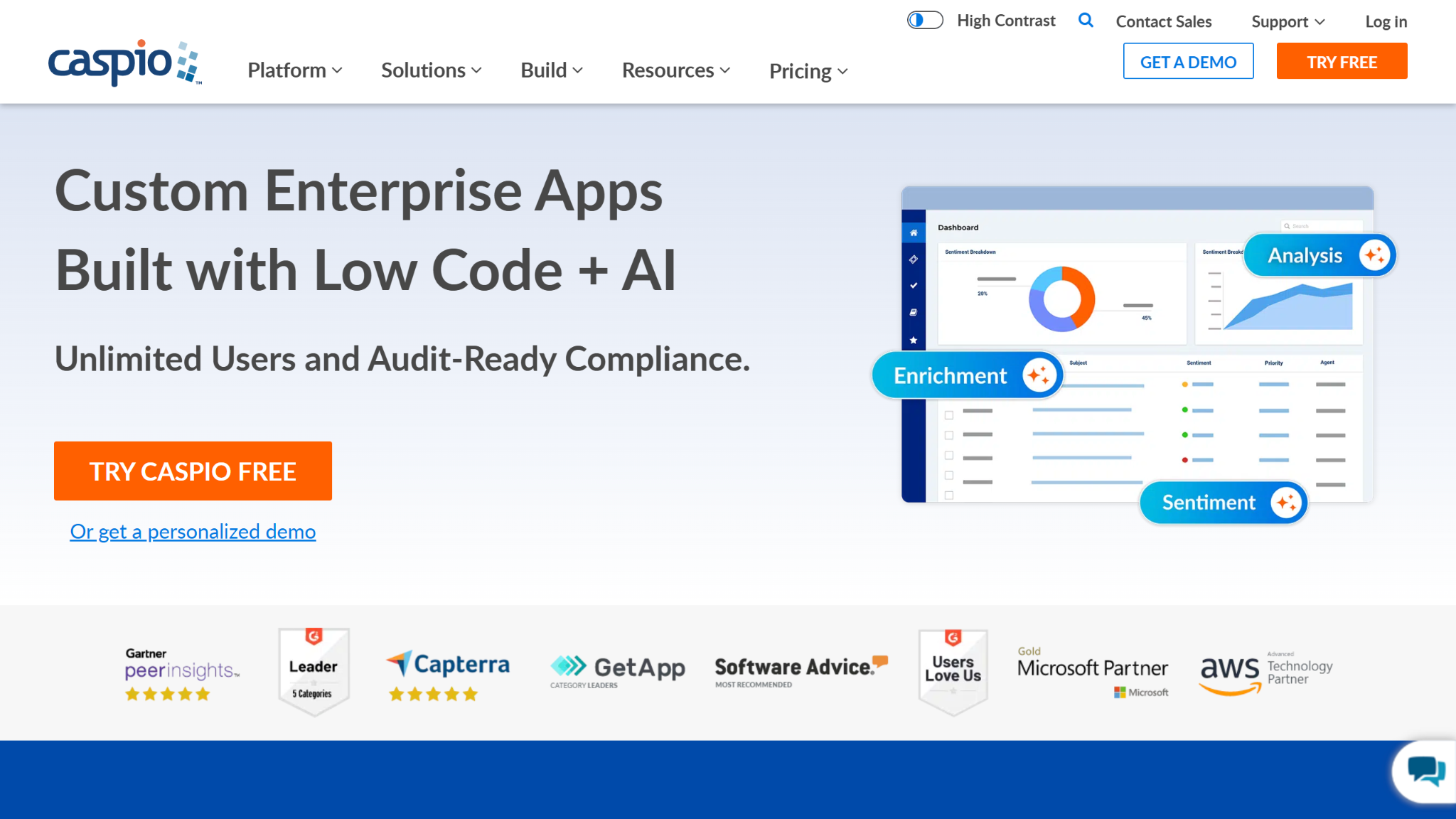
Caspio is a low-code, enterprise-level application-building platform that allows businesses to create effective, complex customer-facing and internal apps that meet security and compliance standards. Caspio targets large-scale organizations looking to create and launch data-backed apps without developing code from scratch.
Through Caspio’s low-code platform, users can prototype and launch apps with a visual app builder, then extend or customize these apps’ capabilities through coding. The platform is security-heavy, offering strong identity and access management tools essential for controlling who can view and edit information within an enterprise.
Caspio offers significant flexibility in how users build their digital ecosystem. Not only can Caspio connect with native integrations and third-party extensions, but it can work alongside external webhook automations, workflow platforms, and advanced integrations through REST API.
However, Caspio isn’t the best low-code development platform for users who need a basic solution. Although it has an extensive set of tools, it comes with a high starting price tag. Users looking for a straightforward business app builder may find Caspio overly complex.
Pro Tip
Looking for more low-code development platforms similar to Caspio? Check out our guide on Caspio alternatives for help finding the right fit.
What makes Caspio unique?
Where Caspio primarily separates itself from Knack is its enterprise- and compliance-oriented design. With its Microsoft SQL Server and Amazon Web Services (AWS) infrastructure, Caspio offers a stronger, more secure foundation for complex applications that handle sensitive data. It features a broad array of verified compliance credentials for frameworks such as HIPAA, SOC 2 Type II, GDPR, WCAG, and ADA.
Caspio also differentiates itself from Knack by offering developer-friendly editing options in standard programming languages such as HTML, CSS, JavaScript, SQL, and Python. Although users are not required to code, the option leaves room for IT teams to make advanced changes that may go beyond a visual app builder’s capabilities.
Knack
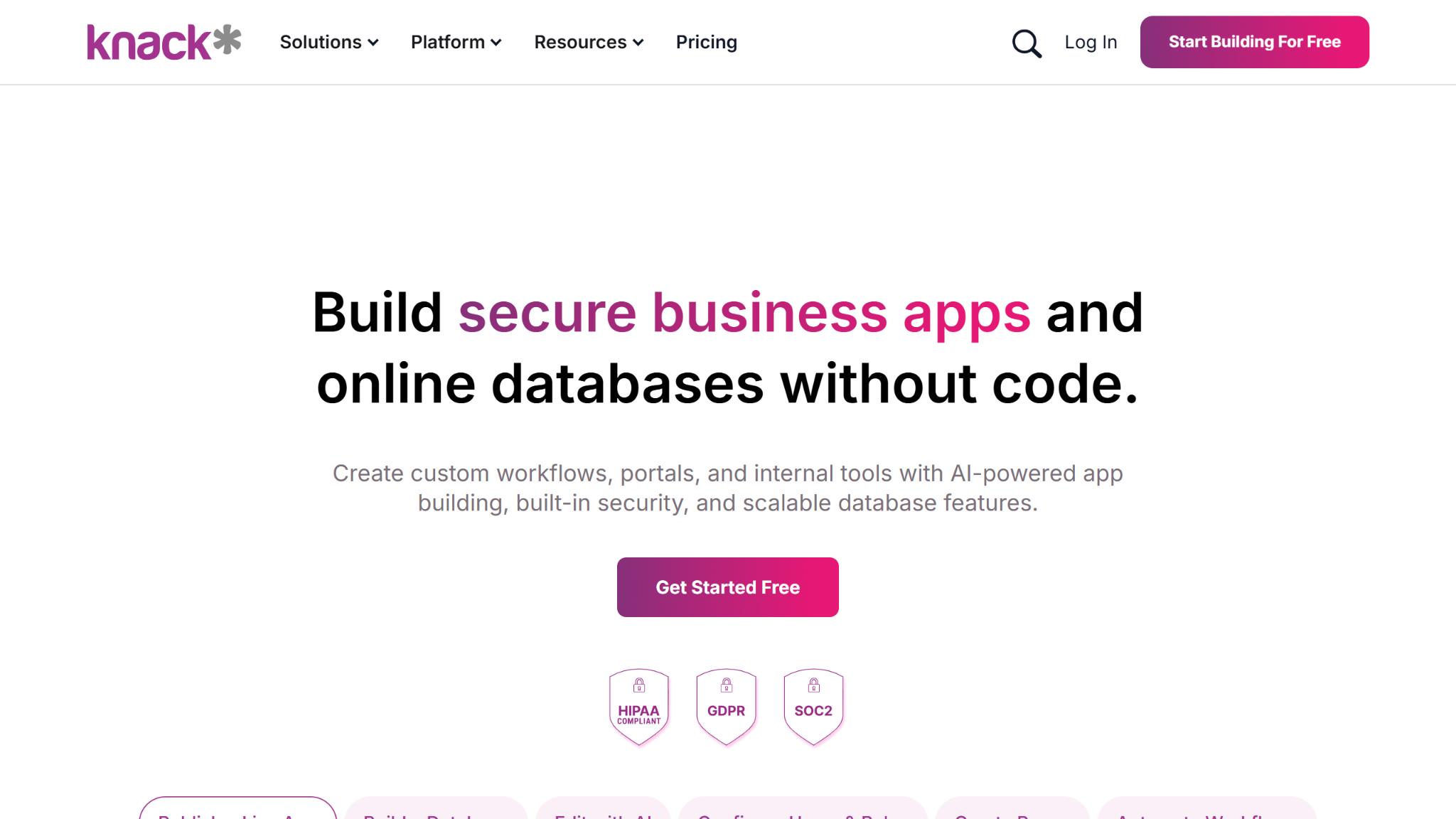
Knack is a no-code business application builder and data management software designed for entry-level users to create their own internal software without developers. Rather than focusing on enterprise-level capabilities, this solution positions itself as an accessible option that turns anyone into a citizen developer (a nontechnical employee who builds apps using visual builders).
Through Knack’s visual app-building system, users can connect data from spreadsheets and other sources to populate their app’s back end. From there, they can drag and drop the visual elements they want into their app design, adjust permissions, and launch with ease.
Knack also offers an AI-powered app-building option that simplifies the app creation process by requiring only a prompt. With conversational AI, anyone from students to small business owners can build a practical app using their data in minutes.
The trade-off for Knack’s ease of use is that some users may hit the end of its capabilities sooner than expected. Knack isn’t designed to support complex customizations or sophisticated features. It’s meant to be the quickest way for a nontechnical user to learn how to create an app without coding. While these apps are still effective and functional, they may not meet the requirements of a larger organization.
Pro Tip
Knack isn’t the only app builder made for small businesses. Take a deep dive into Knack alternatives with our guide.
What makes Knack unique?
Knack sets itself apart primarily through its Knack Flows workflow and integration system. Knack Flows makes it simple for nondevelopers to create internal automations without code. You can also easily connect these workflows to more than 500 integrations to create a cohesive automation system.
Beyond its user-friendly interface, Knack also makes it less expensive for businesses to start building internal apps. The starting price for Knack is significantly lower than Caspio. However, there are much stricter limits on the number of data records available to users.
Caspio vs Knack in 2026: Head-to-head comparison
For a true Caspio vs Knack comparison, it’s important to consider factors that will affect the value and usefulness of these tools for your business. Keep in mind how they’ll influence your day-to-day operations and how well they align with your business goals.
Ease of use and implementation
Knack’s usability is a major selling point for nontechnical users. Between its visual, drag-and-drop app builder and AI-powered app generation, Knack makes it simple for users to build effective business applications using their data.
Because Knack integrates databases, pages, user access, themes, and workflows into a visual builder, users have all the no-code tools necessary to complete their build in one location. Caspio has similar visual building options; however, it isn’t strictly no-code, like its competitor.
Caspio’s online database builder and app generation tools are low code, which offers developers more flexibility in how they approach their customization process. Inexperienced users can stick to the visual builders, but those with technical know-how can code to take their apps to the next level.
This low-code approach may increase the overall learning curve for Caspio, but this solution also offers strong onboarding and support resources, plus expert-led services as add-ons.
Application interface and user accessibility
Both Caspio and Knack offer excellent user accessibility. No matter which plan you choose, you will have access to unlimited users at no additional cost.
The key interface difference between Caspio and Knack is customization vs out-of-the-box readiness. While Knack may have a more user-friendly initial experience, what you see is what you get. This still means access to responsive pages, themes, dashboards, charts, calendars, maps, and other components.
However, with Caspio’s low-code approach, users have greater control over how they customize their interface, including visual components, styling, and localization. Caspio also offers much more flexibility in how users can deploy their apps: by embedding them in a website, CMS, or portal with low-code implementation options.
Data management and security governance
Caspio and Knack both offer distinct approaches to database creation and management. But where Caspio separates itself from Knack is through its use of Microsoft SQL Server, a much more powerful and enterprise-friendly option than Knack’s proprietary server.
Caspio also provides users with better data storage and audit log retention than Knack. Where Knack plans start with 20,000 database records and no audit logs, Caspio offers 250,000 records and logs with a one-year retention period. Even Knack’s highest tiers don’t come close to this retention period, which can be a major issue for regulated companies that need to keep a close eye on their data’s version history.
Caspio also places much more emphasis on compliance and security than Knack. In fact, Caspio offers a compliance- and HIPAA-specific package for users most concerned about regulatory alignment. Even in its standard version, Caspio comes out of the box with enterprise cloud security features, such as two-factor authentication, which are either unavailable or reserved for higher tiers on Knack’s platform.
Workflow automation and backend logic
Workflows are Knack’s specialty, thanks to its no-code Knack Flows system. With Knack Flows, you can build automated workflows, triggers, conditional logic, and more using a visual builder. All Knack Flows can connect to an extensive network of more than 500 app connectors.
Caspio offers workflow automation, but it’s not as extensive or user-friendly as in the Knack interface. However, users have much more control over the back end of their applications. This allows experienced technical users to build deeper and more applications in Caspio than with Knack’s visual builder alone.
Integrations and ecosystem fit
Both tools can act as central integration hubs for organizations looking to better manage their data across multiple systems. However, Knack achieves this through a straightforward, extensive plug-and-play third-party integration library. Caspio offers REST API, webhooks, native connectors, and extensions to provide a more flexible and customizable approach to integration.
Just as their approaches to app building and database management vary, Caspio and Knack also fit best into different ecosystems. Caspio’s low-code customization and enterprise features make it a better fit for a complex, IT-heavy corporate environment. Meanwhile, Knack fits well in fast-paced organizations that need automated processes and a dedicated, accessible database.
Best use cases
Although Caspio and Knack offer similar high-level services, their use cases are very different, particularly because of their target audiences. Before you choose one or the other, consider how these use cases align with your needs:
Caspio
- Regulated applications
- Complex customer-facing applications
- Enterprise workflow management
- Substantial long-term application projects
Knack
- Internal business applications
- Operational databases
- Streamlined workflow tools
- Replacing spreadsheets and connecting SaaS tools
These examples may not capture the entirety of each tool’s capabilities, but they do offer a glimpse into the utility you may be paying for each month.
Caspio vs Knack: Pricing comparison
Caspio | Knack | |
|---|---|---|
| Entry point | $270 per month | $49 per month |
| Higher tiers | $540 per month for Business plans; $800 per month for Compliance plans; custom enterprise pricing available | $110 per month for Pro plans; $250-plus per month for Corporate plans, depending on usage needs; custom enterprise pricing available |
| Free trial | 14-day free trial | 14-day free trial |
Caspio pricing is a straightforward tier system that includes a high initial storage cap for data, logs, and files. This is ideal for users looking for a predictable cost structure that won’t vary depending on their usage needs. As Caspio tiers increase, both storage and feature access increase as well, but only in three preset increments.
Caspio’s starting point of $270 per month (billed annually) may be unrealistic for a small business or individual looking to create a simple data-driven app. This price makes Caspio a better fit for enterprise-level users who need the platform’s extensive features and can justify its expense.
Knack is a more variable, usage-based system. Since it is positioned as an entry-level platform, pricing starts at a more affordable level. But the Knack pricing structure becomes expensive as your needs scale, and the limited storage included in its lower tiers may force you to move to a higher level sooner than expected.
Although your monthly bill will increase with your usage needs, higher tiers do not offer significant additional features. This makes Knack’s pricing structure ideal for individual users or small teams who are creating apps on their own and are more concerned with simplicity and affordability than advanced capabilities or coding.
If you need only specific capabilities, such as data intake, approval routing, e-signatures, form-based workflows, or internal request processes, either of these solutions may be excessive. For a more budget-friendly, streamlined solution, consider the Jotform AI App Builder.
Caspio or Knack: Which one should you choose?
Deciding between Knack and Caspio comes down to your organization’s operational needs.
Choose Caspio if you work with an enterprise team that has a strong IT infrastructure. Caspio’s high-volume web publishing, unlimited end-user scaling, and strict corporate compliance make it ideal for regulated organizations with high customization requirements and scaling goals.
Choose Knack if you’re looking for an accessible way to build data-backed internal tools without coding experience. Knack can help smaller organizations create custom relational databases, user portals, and quick visual layouts without extensive platform engineering.
However, if you’re just looking for the fastest way to build a functional business application, you can completely bypass costly data engineering options like Caspio and Knack. Free options such as Jotform Apps make it simple to create a custom form-based business app in seconds, using AI prompts and a user-friendly, drag-and-drop builder.
This article is for IT managers, operations leaders, compliance teams, and database-heavy organizations comparing Caspio with Knack for building custom business applications, database management, and workflow automation.


































































































Send Comment: