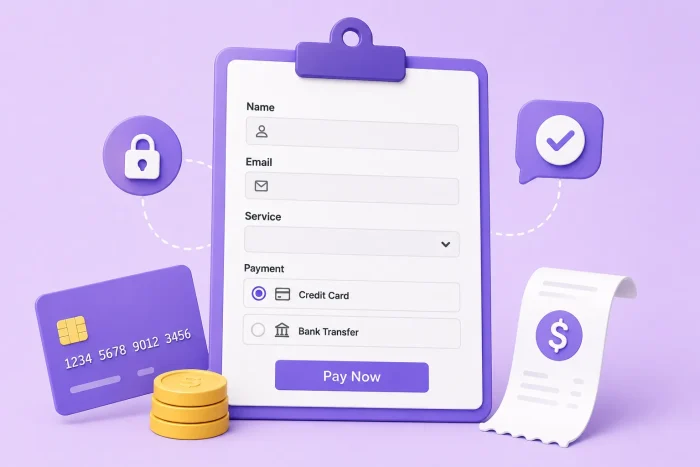
Google Forms may be free, familiar, and easy to use, but it can’t collect payments on its own. If you’re using Google Forms to build payment collection forms, you’ll need to rely on a third-party add-on to secure funds from your clients.
Two of the best Google Forms add-ons for accepting payments on Google Forms are Payable Forms and Neartail. Payable Forms offers simple payment collection tools, and Neartail provides a more sophisticated experience.
We’ve put together a comparison between the two solutions on features, pricing, and use cases. Use this guide to learn how to collect payments with these third-party tools and how a Neartail and Payable Forms alternative, Jotform, may be the better option for your organization.
 Payable Forms |  Nevertail |  Jotform | |
|---|---|---|---|
| Best for | Simple automated payments in existing Google Forms | Online order forms and advanced e-commerce payments | Adding native payment options to any form |
| Who should use it? | Event organizers, fundraisers, or businesses in need of automated payment calculation | Retailers taking complex online product orders or payments | Users who want native payment forms without add-ons |
| Unique features | Automatic payment calculator based on form responses | AI-assisted conversion of Google Forms to payment or order forms | Standalone solution with more than 40 built-in payment processors |
| Free plan | No, free trial only | ||
| Pricing | Free for payments under $5, or a $0.49 fixed fee for medium-sized payments of $5 to $50 and a 1% transaction fee for payments over $50 | $18 to $38 per month, billed annually for payment and order forms | Free, or $34 to $99 per month, billed annually for advanced paid tiers; custom enterprise pricing available |
| Try now! |
Pro Tip
Want to speed up your Google Forms creation process? Add the Jotform AI Form Builder add-on to your Google Workspace to import questions from other Google documents and generate questions with AI.
What is Payable Forms?
Payable Forms is a Google Workspace add-on that adds payment collection and calculation capabilities to Google Forms. This add-on automatically calculates payments based on user inputs.
Let’s say you’re running an event with a tiered ticket system. Attendees can choose from basic, plus, or VIP tickets. Depending on the tier they choose and how many tickets they’re purchasing, Payable Forms will calculate the cost of their tickets and send them to a checkout page to enter their payment information.
Checkout pages through Payable Forms can be branded to match the theme of your Google Forms. Payable Forms will also update payment status in any Google Sheets connected to your form once payments have been processed. This add-on offers several processor options, including PayPal, Square, and Stripe.
What makes Payable Forms unique?
The automatic conversion of Google Forms responses to payment details makes Payable Forms particularly useful for forms that use multiple-choice questions to separate out product or service options and build payment totals based on user selections. For businesses in need of a simple solution, this tool offers lightweight, user-friendly features that can streamline basic online transactions.
What is Neartail?
Neartail is a Google Forms add-on designed for powerful payment or order forms. Neartail fully converts your forms into true e-commerce documents. These forms can feature information not natively available in Google Forms, such as
- Product variants
- Quantity selectors
- Stock tracking
- Coupon codes
- Tax fields
Neartail also provides respondents with order summaries before checkout so they can review their selections. Using its AI-powered form converter, this add-on transforms any existing Google Form questions into detailed product listings with pricing information. Users can then submit payments through processing options such as credit card, PayPal, and Venmo.
What makes Neartail unique?
If you have existing Google Forms you plan to use for payment collection, Neartail is an effective addition to your toolbelt. It uses AI to convert your content into a practical e-commerce format.
This tool also offers in-depth business analytics. Neartail can produce aggregate sales reports based on product, customer, or time period. It pulls data directly from Google Sheets responses, making your form into a full, user-friendly order management system.
Payable Forms vs Neartail in 2026: A head-to-head comparison
If you’re searching for how to use Google Forms to accept payments, both add-ins offer the tools to do so. But their differences in approach and use cases are important to consider before you choose one.
Payment collection and checkout experience
Payable Forms offers a branded, in-form, and streamlined hosted checkout experience that automatically calculates totals based on your Google Forms responses. It uses popular payment processor options but is limited to the payment methods those tools support.
Neartail provides a more commerce-focused checkout experience, allowing customers to browse products, calculate totals, and make purchases in one place. Neartail offers peer-based payment options such as Venmo and Cash App in addition to traditional, card-based payment options.
Order management and reporting
Payable Forms does not offer advanced order management or reporting capabilities. Neartail gives businesses access to product catalogs, order tracking, inventory-friendly workflows, customer order summaries, and reporting features, all features best suited for product-based e-commerce.
Setup and ease of use
Because it adds complex features when converting Google Forms, Neartail requires more configuration. However, it can speed up some of this process through AI and templates. Payable Forms is easier to connect to your Google Forms: Choose your payment processor and pricing rules, and generate a payment link.
Payment security
Both solutions rely on the security of your chosen payment processor for protection. Since neither add-on processes payments, the security of your payments depends on the processor you use.
Payable Forms vs Neartail: Pricing
Here’s information on each of these add-ons’ pricing:
Payable Forms
Payable Forms’s pricing is centered around the size of your transactions. Personal businesses making sales under $5 each can avoid any fees outside of those issued by payment processors. However, anything above $5 will require you to pay either a percentage of the sale or a fixed per-sale fee.
| Tier | Pricing info |
|---|---|
| Free | No additional cost for sales $5 or less |
| Fixed | $0.49 per sale for sales from $5 to $50 |
| Percent | 1% of your final sale for any sales higher than $50 |
Neartail
Neartail requires a monthly fee for its services. It doesn’t offer a full free version for smaller businesses, only a free trial.
| Tier | Pricing info |
|---|---|
| Basic | $18/month, paid annually. 100 responses per month for up to five forms. |
| Premium | $28/month, paid annually. 250 responses per month for up to 10 forms. |
| Business | $38/month, paid annually. 500 responses per month for up to 15 forms. |
Pro Tip
Jotform’s free version offers advanced features at no additional cost, including payment form support and access to over 40 payment integrations natively (no add-on required).
Payable Forms or Neartail: Which one should you choose?
These tools may seem very similar, but you may find one more beneficial than the other based on how you’re using your forms. These factors may nudge you in one direction or another.
Choose Payable Forms if you
- Want to keep your users inside Google Forms
- Want a free solution for smaller transactions
- Are collecting event registrations, donations, application fees, or invoices
- Need the fastest setup possible for online payments
Choose Neartail if you
- Are performing complex online transactions
- Use peer-to-peer payment methods in your e-commerce
- Need advanced order management and analytics
- Want a full-service checkout experience for your customers
Both of these solutions are limited by Google Forms’s basic capabilities. This means no conditional logic, no standalone capabilities outside the Google Workspace, and no native automation. If you need these functions, it may be time to consider another alternative.
Your business shouldn’t be limited because of your forms. If you process payments regularly and are looking for a simple but capable solution, Jotform is one of the best online form builders that doesn’t require add-ons.


Switch to Jotform for collecting payments, free of charge
Jotform brings all the capabilities you need to run your online business in a single comprehensive suite of native digital tools. This solution not only gives users a wider selection of features, but also offers them for free.
These capabilities include
- 20,000-plus free form templates, including over 2,000 payment forms
- More than 40 payment processor integrations
- Native product and order form fields
- Conditional logic and multistep forms
- Data storage and organization with Jotform Tables
- More than 150 form integrations, including HubSpot, Mailchimp, and Google Sheets
- Default mobile-friendly design
The forms you already made in Google Forms won’t get left behind. Jotform lets you easily migrate your Google Forms to Jotform in three easy steps, so you can upgrade your old forms and build new ones without third-party add-ons.
This article is for small business owners, event organizers, and solopreneurs who are using Google Forms to collect orders or registrations and are evaluating payment add-ons to handle transactions without switching tools.































































































Send Comment: