
No-code software development is all the rage right now. Why spend money hiring a team of app developers who might take weeks or even months to build an app when you can make one in a day with a drag-and-drop builder? Softr and Bubble are some of the biggest names in no-code app development, with Softr boasting more than 1 million users worldwide and Bubble powering projects for more than 6 million builders. The two platforms let you build apps without writing code, but the better fit in a debate between Softr vs Bubble depends on the type of app you want to build.
If your focus is on building business portals, internal tools, and data-connected apps quickly and in addition to the tools you already use, you’ll appreciate Softr’s capabilities. Instead of making you start from square one, the platform lets you generate a working app from your existing data.
On the flip side, if you need a complex, fully customized web or mobile app with advanced logic, a built-in database, and total visual control over elements, Bubble would be a better fit. The platform trades speed for depth, giving you the tools to deeply customize your software. To help you make an informed choice, here’s a comparison of Bubble vs Softr.
 Softr |  Bubble |  Jotform Apps | |
|---|---|---|---|
| Who should use it? | Teams building portals, CRM systems, or internal tools on existing data | Founders and developers building complex, custom web or mobile apps | Anyone quickly turning forms and workflows into a shareable app |
| App customization | Pre-built blocks and layouts, moderate design flexibility | Full visual control over each element, layout, and interaction | Drag-and-drop customization with branding and templates |
| AI capabilities | AI app builder, Ask AI, and database AI agents | AI app generation plus a conversational AI agent (beta) | AI App Builder, AI Agent for in-app chat and support |
| Free plan | Free forever, unlimited apps, 10 app users, 5 AI credits/month | Free to build; higher tier required to publish a live app | “Free forever” tier that allows you to publish a live app |
What is Softr?
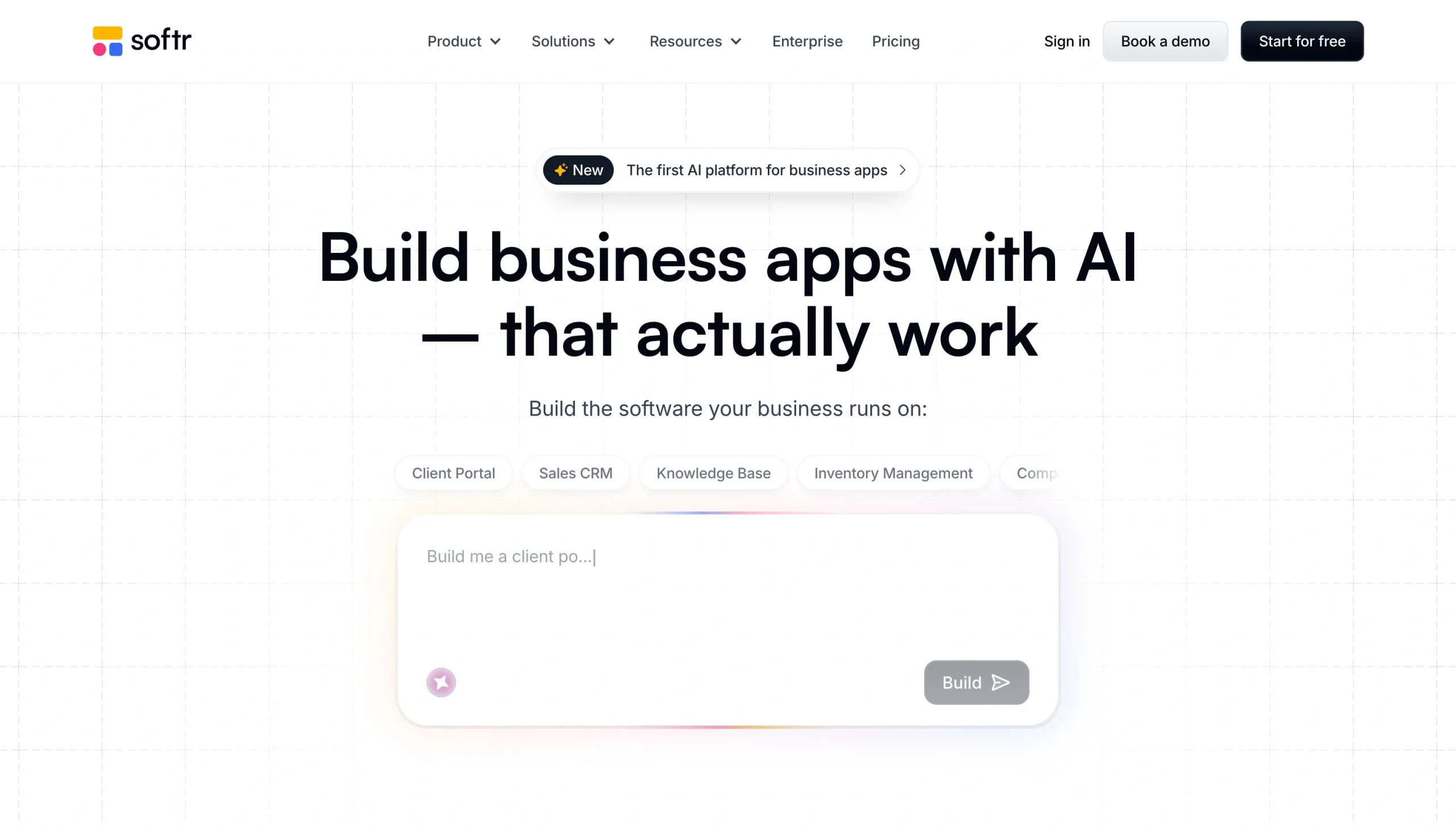
Softr is an AI-powered, no-code platform for building
- Business apps
- Client portals
- Internal tools
- CRM systems
- Inventory management systems
- Dashboards
The Softr platform helps you create apps that connect to data you already have on platforms such as Airtable, Google Sheets, and Notion. If you have more structured data needs and want to integrate your app with an SQL database, you’ll need a paid tier.
Instead of starting your app creation from a blank page, Softr builds an app based on your existing data. You can then customize your first app draft using Softr’s AI app builder or its visual editor. If you don’t have business data organized elsewhere, you can use Softr’s built-in database.
The platform also has automation workflows for tasks such as sending emails and updating records. You can use Softr’s Ask AI feature to build agents that run on your data. Overall, Softr is better for teams that need to build a working, data-connected business app in a few days.
Pros
- Its free plan allows app publishing, unlike Bubble’s free plan, which lets you build and test only.
- Apps connect directly to your existing data, so you don’t have to design a database schema or build workflows from nothing.
- Updates you make in your data show up in the app without any importing or migration.
Cons
- Design flexibility is limited because you make apps from preset blocks.
- It has no real custom logic engine, which makes it challenging to build rules for workflows from scratch.
Pricing and plans
Softr has five plans and a series of add-on options.
| – | Free plan | Basic plan | Professional plan | Business plan | Enterprise plan |
|---|---|---|---|---|---|
|
Price/month |
$0 |
$49 |
$139 |
$269 |
Custom |
|
App users |
10 |
20 |
100 |
500 |
Custom |
|
Database records per workspace |
5,000 |
50,000 |
500,000 |
1 million |
Custom |
|
Workflow actions/month |
500 |
2,500 |
10,000 |
25,000 |
Custom |
|
AI credits/month |
5 |
10 |
50 |
100 |
Custom |
|
Key additions |
Unlimited apps and collaborators, custom domain, default user group |
All Free features |
All Basic features, custom user group, advanced visibility settings, API access, integrations for monday.com, Supabase, and ClickUp |
All Professional features, unlimited user group, SQL database connections (PostgreSQL, MySQL, SQL Server, MariaDB, BigQuery), HubSpot |
All Business features, single sign-on, audit logging, SOC 2 reporting, dedicated success manager, priority support |
What is Bubble?
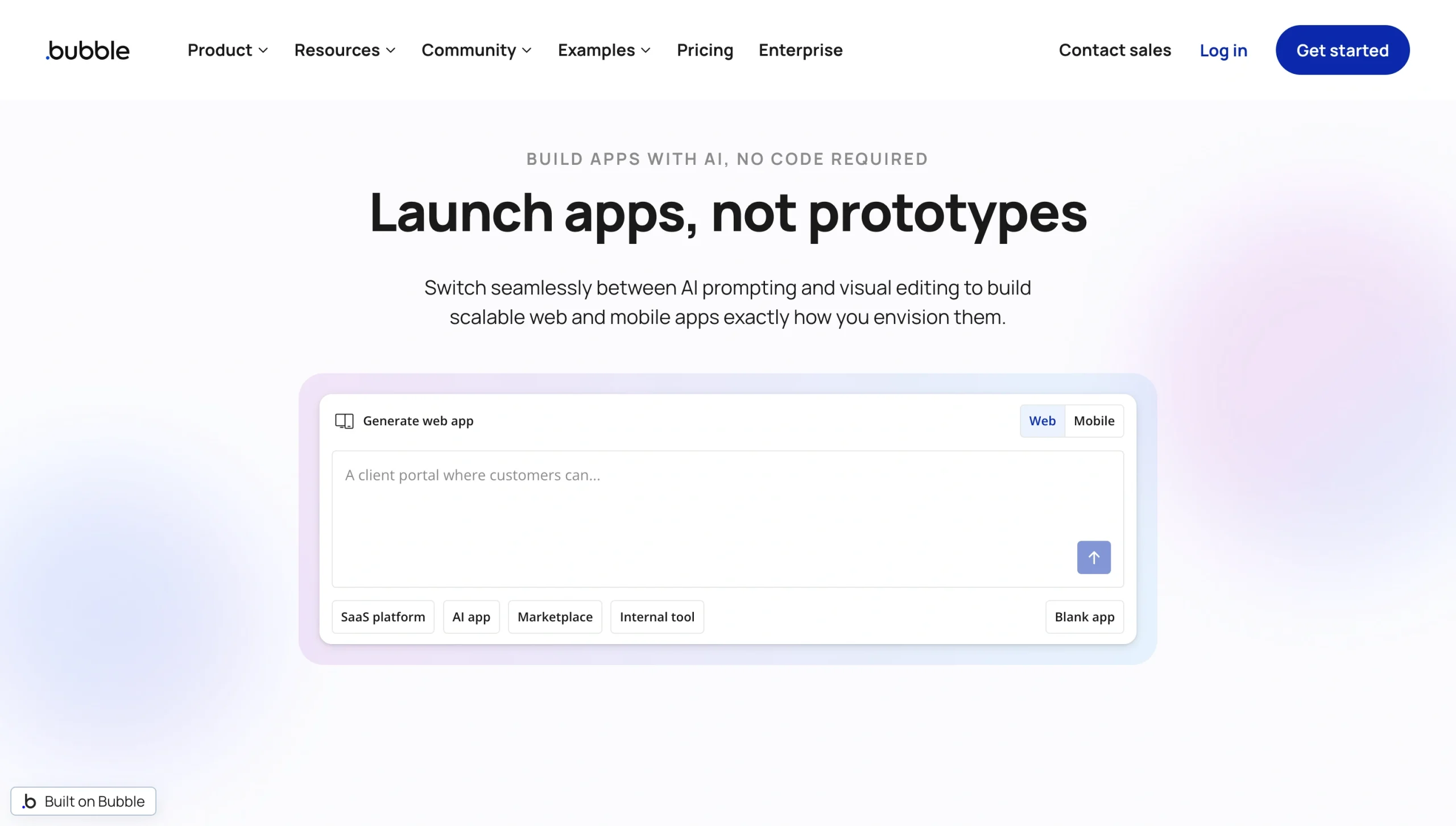
Bubble is a no-code AI platform that builds fully customized web and native mobile apps, with a built-in database and visual workflow logic. You can describe your app in plain language and let Bubble AI generate the app for you, or you can use the drag-and-drop editor to create each function of your app, giving you deeper control over
- Design
- Data
- Workflow logic
- User interface
- Integrations
Bubble is one of the few no-code platforms that lets you build web and native iOS and Android apps from a single editor. From one project, you can publish apps that share the same database and backend workflows, eliminating the need to rebuild your app for each platform.
Bubble also has a built-in database, so you can manage data directly within the platform. If you already have a database, you can connect to it instead, avoiding the need to rebuild your data layer from scratch. You can connect to other third-party services, so you don’t have to build payment processing, authentication, messaging, or social media features yourself.
Pros
- Full visual control allows you to build business logic with no template constraints.
- A native mobile app builder publishes your app to the App Store and Google Play from the same project as your web app.
- Pixel-level control over all elements lets you customize each detail.
Cons
- Unlike Softr, Bubble’s Free plan doesn’t allow you to publish a live version of your app.
- Bubble requires you to design a database schema and workflow logic from scratch before your app is usable.
Pricing and plans
Bubble has different pricing tiers for web and mobile, web-only, and mobile-only development. To keep the comparison relevant when weighing Bubble against Softr, we grouped web and mobile plans together.
| – | Free plan | Starter plan | Growth plan | Team plan | Enterprise plan |
|---|---|---|---|---|---|
|
Price (billed annually) |
$0/month |
$59/month |
$209/month |
$549/month |
Custom |
|
Live app |
No |
Yes |
Yes |
Yes |
Yes |
|
Web app |
Complete library, web debugger |
Live website, custom domain |
Live website, custom domain |
Live website, custom domain |
Live website, custom domain |
|
Mobile app |
Native mobile editor, mobile debugger, on-device testing |
5 build submissions/month, 3 live app versions, unlimited over-the-air updates (OTAs) |
10 build submissions/month, 5 live app versions, unlimited OTAs |
20 build submissions/month, 8 live app versions, unlimited OTAs |
Custom builds/month, custom live app versions, unlimited OTAs |
|
Server log retention |
6 hours |
2 days |
14 days |
20 days |
Custom |
|
Key additions |
Visual editor, database, workflow engine, API connectors |
Everything in Free plan, recurring workflows, basic version control |
Everything in Starter plan, premium version control, two-factor authentication, 10 custom branches |
Everything in Growth plan, sub-apps, 25 custom branches |
Everything in Team plan, custom infrastructure, advanced security, and service-level agreements |
Softr vs Bubble: Head-to-head comparison
On the surface, comparing Softr vs Bubble can feel like a close call. Both tools are reputable no-code app builders with drag-and-drop functions, built-in workflow automation, and free plans. That said, they are optimized for entirely different workflows, user bases, and operational goals. The better choice isn’t one-size-fits-all but rather depends on what you’re building.
App building logic: How does Softr compare with Bubble?
On the Softr platform, you build apps around the data you already have by connecting your app to sources such as Airtable and Google Sheets. The platform then generates pages, forms, and permissions from the existing structures. Bubble, on the other hand, lets you build apps around logic you design from scratch using its own database and a visual workflow editor for custom rules. If your app needs business logic beyond basic data display, Bubble gives you the flexibility to build it.
App design and customization: How do the two platforms stack up against each other?
To build a Softr app, you assemble pre-built blocks such as grids, lists, tables, and item detail pages, which keeps builds fast but limits how far you can push a custom design. Bubble gives you pixel-level control over elements in your app, which takes longer to build but lets you match your design specs. While Softr lets you use CSS and JavaScript on its paid plans, you’ll appreciate Bubble’s customization capabilities if you have a designer on your team or a specific brand experience to protect.
Collaboration and workflow integration: How does each tool work with your existing tools?
Softr integrates directly with the tools most teams use to manage data, as well as with automation platforms such as Zapier for multistep processes. Bubble’s built-in database means most workflows live inside Bubble itself, though you can use its API connector and Marketplace to connect with external tools such as Stripe or Slack.
If you’re already managing data in a spreadsheet or database tool, you’ll love that Softr connects more quickly to the tools you’re already using. If you’re building a standalone product, you’ll find Bubble’s built-in database a better fit because it keeps your data and application logic on a single platform.
When it comes to teamwork, both platforms support multiple collaborators working on the same app. However, Softr’s custom user groups and granular visibility settings in Professional and higher tiers give you more control over what team members can see and edit.
Softr vs Bubble pricing: How does Softr compare with Bubble?
Cost is an important factor, but it’s crucial to look beyond the base plan price. How the two no-code app builders price their plans determines when you’ll need to upgrade to accommodate more app users, database records, automation runs, and AI usage limits.
Softr paid plans start at $49 per month (billed annually), with usage caps that scale directly with the plan tier, so it’s straightforward to estimate your monthly bill in advance. Bubble’s workload-unit model bills for the actual server resources your app consumes. Paid plans start at $59 per month and include 175,000 workload units. However, a high-traffic or logic-heavy app often requires additional workload units, which can cost more than the listed price, even before adding plug-in subscriptions or choosing extra workload tiers. You cannot effectively predict how many resources your app will need and plan for it in advance.
Softr vs Bubble: Which one should you choose?
The right choice in the Softr vs Bubble AI comparison depends on your priorities and needs. As early in the process as possible, you have to understand what you want to build and how much control you need over the details. Neither tool is objectively better than the other because each one is built for different starting points and different destinations. If you’re migrating from an existing spreadsheet-based process to a portal, you’ll have very different development needs from a founder building a two-sided marketplace from scratch.
Choose Softr if
- You already manage data in a platform such as Airtable, Google Sheets, or Notion and want an app layered on top of it.
- You need a client portal, CRM system, inventory management app, knowledge management system, or an internal tool to be built and go live in a few days’ time.
- Your team doesn’t have a developer to build or maintain custom logic.
- Predictable, plan-based pricing matters more to you than maximum flexibility.
Choose Bubble if
- You’re building a product with custom business logic, such as marketplaces, booking systems, SaaS applications, or customer portals, that will need rules Softr’s block-based developer can’t express.
- You need native iOS and Android apps that share a database and workflows with your web app, all managed from a single project.
- Your team has the time or expertise to build and maintain a fully custom app while monitoring workload costs as usage grows.
Pro Tip
Jotform AI App Builder lets you create apps that people can use on any device and download directly to their phone, tablet, or desktop, without going through the App Store or Google Play. Sharing and using your app is much faster and simpler than it is for platforms that require a formal app store listing.
Turn ideas into working apps with Jotform
Softr and Bubble do their job well, but each app builder comes with a trade-off. Softr’s ability to power simple, data-based apps through its block system stands out, but its customization limits become noticeable as your app requirements grow. In contrast, Bubble’s deep customization abilities come with a steeper learning curve and workload-based pricing that scales with traffic. Jotform Apps is a practical middle ground that lets you turn your ideas into a working app.
As a drag-and-drop app builder, Jotform Apps lets you create highly customizable, workflow-integrated apps and systems for your business ideas. To put everything into perspective, consider the following scenarios.
Scenario 1: Making a clinic booking idea into an app
Let’s say you run a small clinic that wants an app that lets patients book appointments, complete intake forms, and receive reminder notifications before their visits. If you were to build this app on Bubble, you’d need to
- Design a database schema for patients’ appointments and intake responses
- Build the booking, intake, and confirmation screens in the visual editor
- Set up workflows for booking logic, form submissions, and reminder timing
- Test the logic across different appointment types and edge cases
- Publish the app and connect it to a custom domain before your patients can use it
If you use Softr as an alternative to Bubble, your app’s development would be possible only if your clinic already has scheduling data. If your app would need a feature outside the Softr block, you’d have to find a workaround.
On Jotform Apps, you don’t need to build a database schema or write custom logic. Instead, you build the app draft using an AI Agent, a drag-and-drop interface, or one of Jotform’s 3,200-plus ready-to-use app templates. You can add an intake form and a booking form from one of over 20,000 form templates and use conditional logic to create a branded reminder your patients can open through a link. Your app will then grow with your workflow.
Scenario 2: Turning a real estate listing lookup into a client portal
If you own a real estate agency, you might want to build a portal that lets clients view your active listings, request showings, and get status updates on their offers. If you were to build this portal on Softr, you’d need a preexisting listing to generate the app. You’d then need to customize branding and set visibility rules for different client groups. Then, if a client needs to submit paperwork for their home loan process, you’d have to find a Softr block to collect data or else consider a workaround.
On Bubble, you’d need to design a database schema for listings, build the listing gallery, and set up a workflow for showing requests and status update notifications. You’d then have to test the logic across different listing types and offer stages before you could publish your app to your custom domain.
With Jotform Apps, even if you don’t have existing data sources, you can build your app using an AI Agent, the drag-and-drop editor, or templates. You can then add a showing request form and an offer status form within the app, with push notifications for updates, before bundling all the functions into one branded app that clients can open from a link.
What can you do with Jotform Apps?
Jotform Apps lets you quickly turn any business idea (beyond a clinic booking app or a real estate listing portal) into a working app, but the simplified and workflow-driven development process is only half of the picture. Once your app is live, you can reach your target audience and collect payment without writing a line of code, thanks to Jotform.
With Jotform Apps, you can
- Send push notifications to reach users across devices with real-time updates, offers, and announcements that drive engagement and conversions.
- Sell products and collect payments through 40-plus payment gateways worldwide, with built-in secure data collection.
- Add forms, visuals, videos, links, and more to your app, then customize them to match your branding, including your logo, brand colors, brand fonts, and splash screen.
- Share your app via link, email, or QR code, and let users download it directly to any device, no app store access needed.
You don’t need to wait for app stores to review your app or approve your updates before users receive them. Jotform lets you turn ideas into apps you can roll out and update instantly, so you can iterate on feedback and keep your app up-to-date without delaying its release.
Idea to app in minutes
While Softr can help you turn your ideas into apps quickly, its software can be rigid, requiring you to rely on preset blocks and data sources you connect to it. The moment your app needs a form or workflow that your source doesn’t have, you’ll have to find a workaround instead of building it directly. On Jotform, the form, payment collection, notifications, and approval workflows are native to the platform, so you can build business workflows without relying on external services for core functionality.
Bubble addresses Softr’s rigidity issue, but its deep level of control comes with a trade-off of weeks of building before you have something to show for it. Jotform bridges this gap by letting you turn your business ideas into real-world apps using an AI Agent, a drag-and-drop interface, or thousands of templates. Add the workflows, forms, and logic you need to have a usable app the same day.
Use Jotform Apps today to efficiently turn your idea into a real-life app without writing any code.
This article is for founders, product managers, small business owners, non-technical teams, and SaaS builders comparing Softr and Bubble for building apps without (or with minimal) coding.





























































































Send Comment: