



Construction Forms
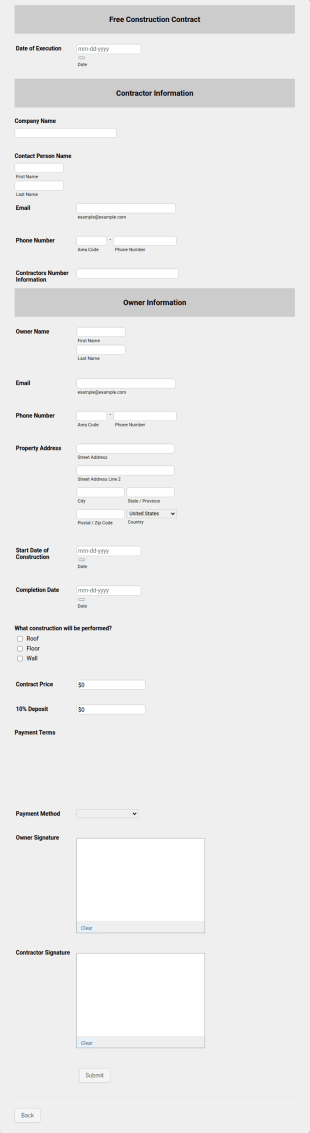
Free Construction Contract
Create your own Construction Contract using this form. This Free Construction Contract form contains all the necessary information you need in order to make a contract. You can edit, remove or add information if you like using the editing tool feature.
Go to Category:Services Forms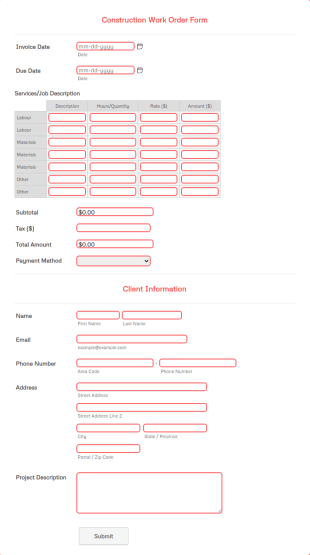
Construction Work Order Form
Construction Work Order Form is a form template that allows construction companies to systematically capture and manage work order requests, conveniently available on Jotform for seamless integration into your workflow.
Go to Category:Order Forms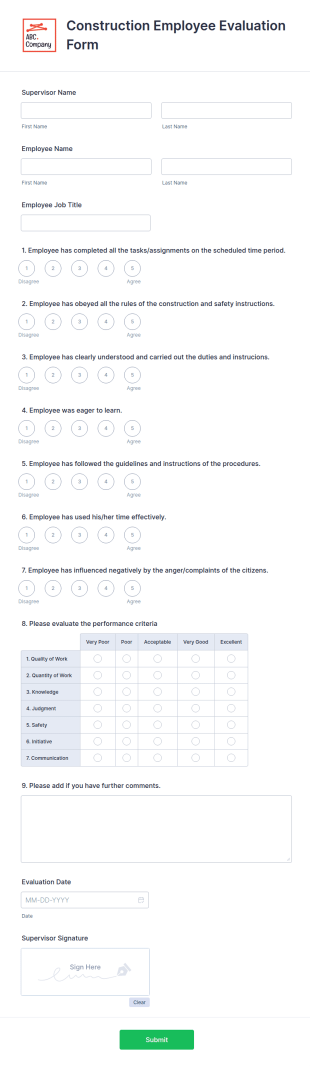
Construction Employee Evaluation Form
Monitor construction workers with this free, online evaluation form. Easy to customize and complete on any device. Download, print, and share reviews. No coding.
Go to Category:Human Resources Forms
Site Safety Inspection Report
A site safety inspection report is a document or report detailing the safety conditions of a building or site, such as a construction site or building, office space, or building site.
Go to Category:Business FormsConstruction Project Request Form
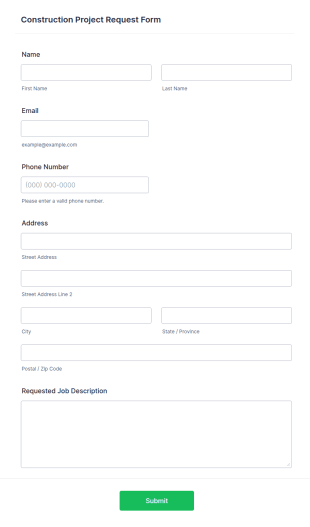
Collect construction project requests from clients online. Easy-to-customize online form. Embed in your website or share with a link. Sync with 100+ popular apps.
Go to Category:Request Forms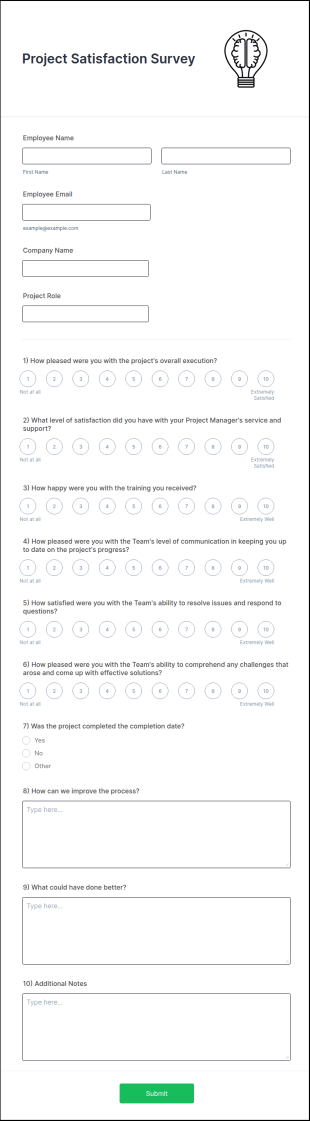
Project Satisfaction Survey
A project satisfaction survey is a questionnaire used by employers to collect feedback on project developments.
Go to Category:Business Forms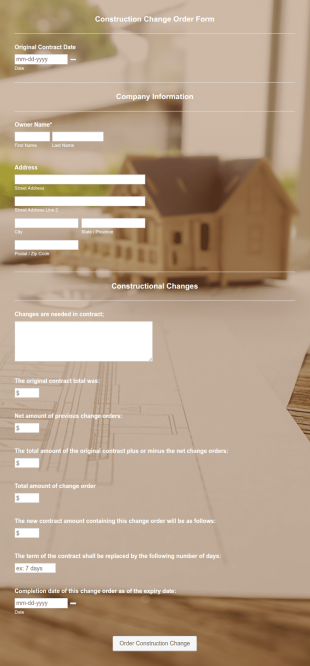
Construction Change Order Form
Collect information online for construction project changes. Customize this free Construction Change Order Form for your contracting business.
Go to Category:Order FormsHeavy Equipment Checklist
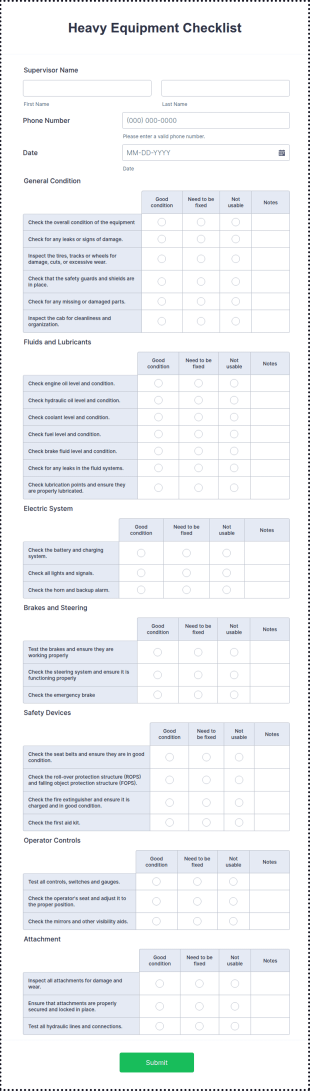
A heavy equipment checklist is used to determine the condition of a machine used in construction.
Go to Category:Checklist FormsDaily Construction Report
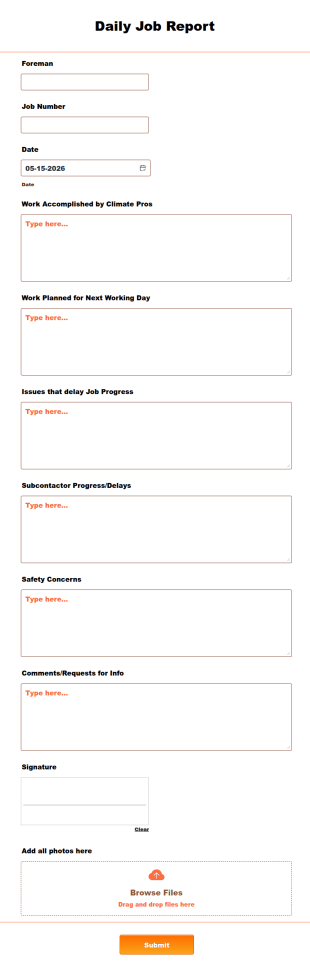
A daily construction report form is a document used by those in the construction business to record the progress of a project. Create your own daily construction report with Jotform!
Go to Category:Employee Information Forms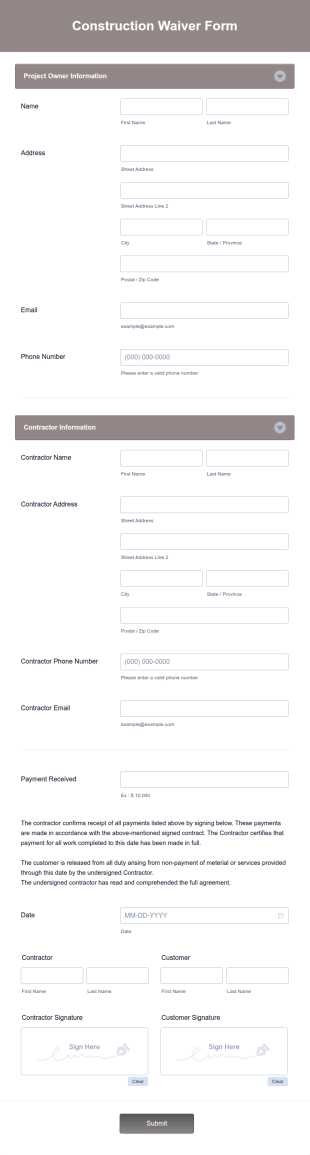
Construction Waiver Form
A Construction Waiver Form is a legally binding agreement which releases a party from liability for injury or damage that may occur during a construction project. Customize this template without coding!
Go to Category:Real Estate FormsExcavation Safety Checklist
An excavation safety checklist is a list of safety concerns and precautions required by contractors when working on a construction site.
Go to Category:Checklist Forms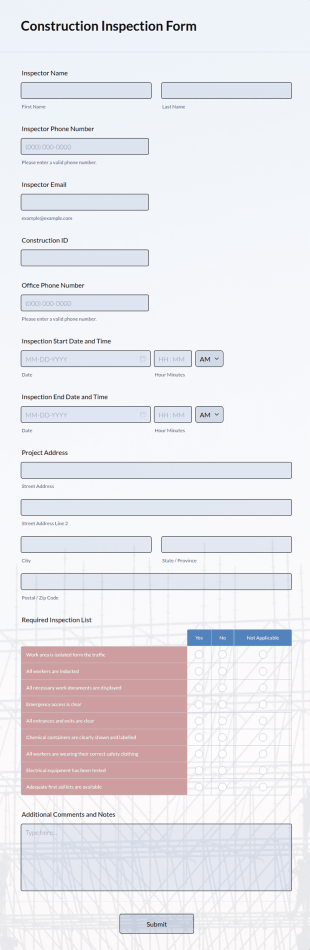
Construction Inspection Form
A construction inspection form is a type of check-list used by construction workers to check their work to see that it meets all the specifications before being accepted by the owners. No coding!
Go to Category:Checklist FormsConstruction Lead Generation Form
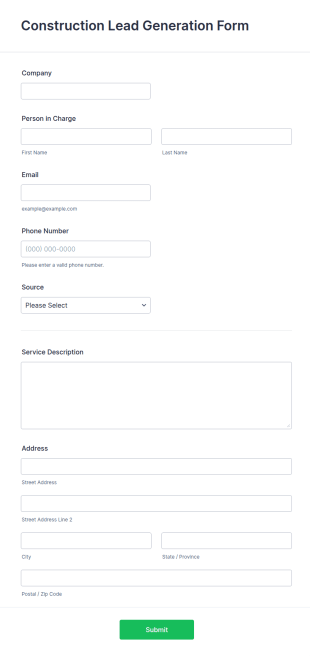
Construction Lead Generation Form Template helps construction companies collect project inquiries and contact details online to grow their lead pipeline.
Go to Category:Business Forms
Construction Job Application Form
A Construction Job Application Form is a form template designed to streamline the hiring process for construction companies and HR departments
Go to Category:Construction Forms
Construction Phase Planning Form
A Construction Phase Planning Form is a pre-designed template tailored to address the complex needs of project managers and contractors during the planning phase of their construction projects.
Go to Category:Construction Forms
Framing Punch Checklist
A framing punch checklist is a document that lists the tasks, requirements, tools and equipment used when framing a house.
Go to Category:Business Forms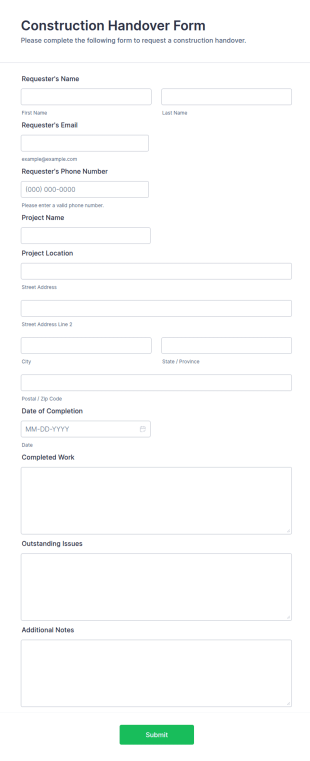
Construction Handover Form
A Construction Handover Form is a form template designed to document the completion of a construction project and transfer responsibility to the client or owner.
Go to Category:Business Forms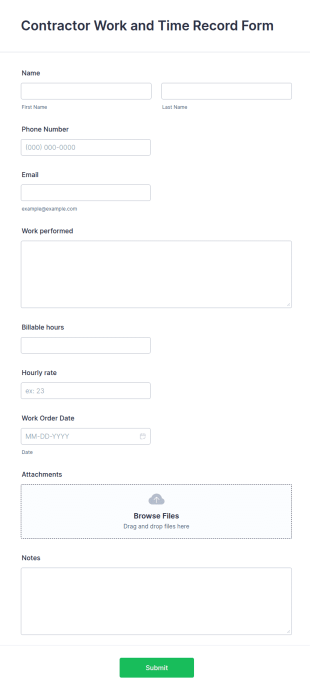
Contractor Work And Time Record Form
A contractor work and time record form is filled out by construction and city workers and given to their employer in order to record the progress and time they have spent on a project.
Go to Category:Business Forms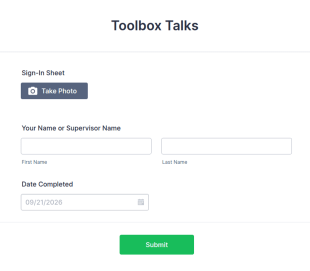
Toolbox Talks Sign In Form
A Toolbox Talks Sign In Form is an efficient solution created to streamline the process of logging attendance at safety meetings in construction and other industries.
Go to Category:Signup Forms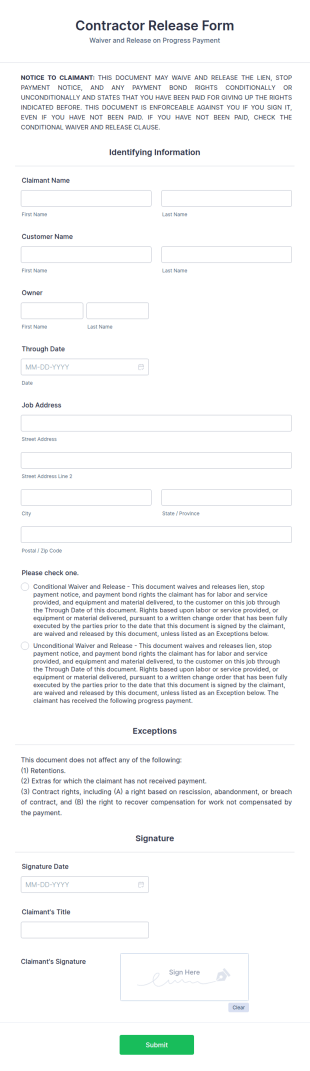
Contractor Release Form
A Contractor Release Form is a contract between a service provider and a customer that allows for the cancellation of a service.
Go to Category:Consent Forms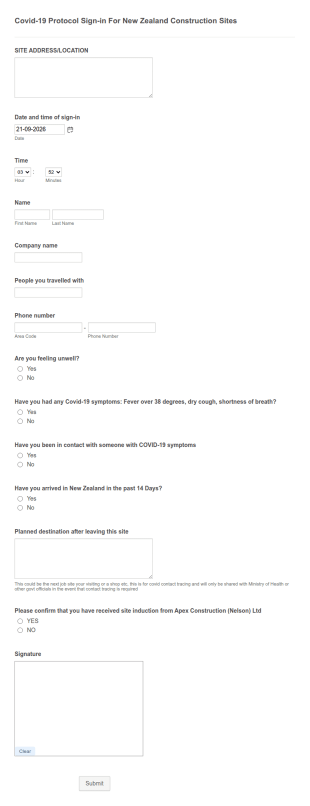
Construction Site Covid 19 Protocol Form
Covid Contact Tracing and site sign-in form for Residential Construction sites for recording all site visits/workers on site. Includes fields for contact name/phone number, site address, health questionnaire and confirmation of site induction as well as planned destination after leaving site (For contact tracing if required)
Go to Category:Business Forms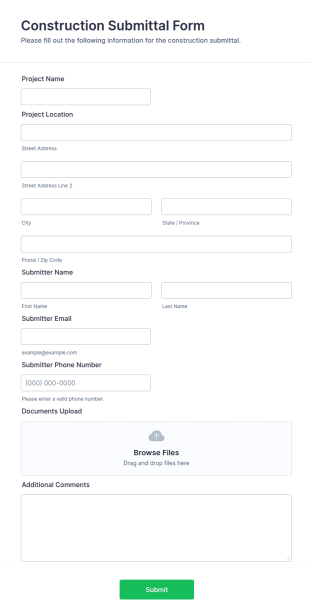
Construction Submittal Form
A construction submittal form is a document submitted to clients for approval of proposed construction work.
Go to Category:Information Request FormsConstruction Lien Form
The Construction Lien Claim Form is used to authorize a construction company to file a lien against a property if the owner or contractor does not pay for the services or products provided.
Go to Category:Informed Consent Forms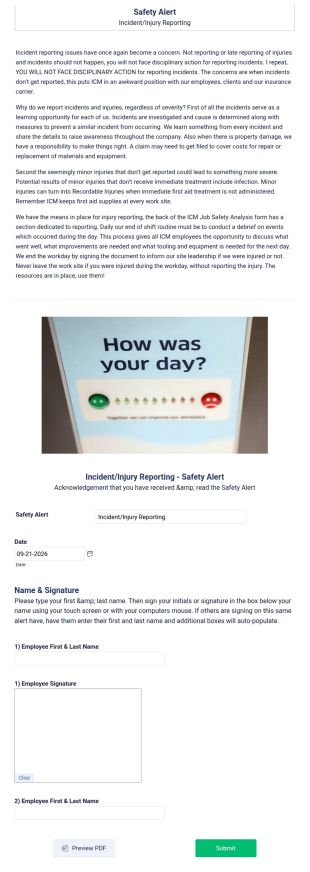
Incident Injury Reporting Form Template
Incident Injury Reporting Form Template helps employers and safety officers document workplace accidents, improve risk management, and ensure accurate reporting
Go to Category:Employee Incident Report FormsAbout Construction Forms
Construction Forms are specialized online forms designed to efficiently manage and streamline various operational tasks within the construction industry. These forms are utilized for a myriad of purposes, including project documentation, safety inspections, equipment checklists, and client feedback collection. In real-world workflows, construction teams often rely on these forms to ensure seamless communication and coordination among project managers, site supervisors, and field workers. By digitizing the traditional paperwork processes, Construction Forms help in reducing errors, accelerating data processing, and enhancing overall project management efficiency.
Jotform stands out as the premier online form builder for creating and managing Construction Forms. Known for its user-friendly interface, Jotform allows construction professionals to easily customize forms to suit specific project requirements, thus automating the tedious task of data collection. With Jotform, teams can benefit from centralized data management through Jotform Tables, facilitating secure storage, immediate access, and effective data analysis. This capability empowers construction businesses to maintain accurate records, improve decision-making, and optimize their workflow operations.
Why Use Construction Forms?
- Construction Forms significantly enhance accuracy in data collection by eliminating manual entry errors, ensuring that the information collected is precise and reliable. This precision is crucial for documentation that influences project outcomes and safety compliance.
- The speed at which data can be collected and shared using Construction Forms helps streamline project timelines. Quick data transmission reduces delays, enabling faster decision-making and action implementation, which is vital in the fast-paced construction environment.
- Professional data handling is a core benefit of using Construction Forms. With features such as electronic signatures, forms ensure that all collected data is verified and authenticated, which is essential for maintaining legal and regulatory compliance.
- The ability to customize forms according to specific project needs allows for a personalized approach to data collection. This customization ensures that each form captures all necessary information without unnecessary clutter, enhancing both usability and data relevance.
- By integrating with over 100 third-party applications, Jotform's Construction Forms facilitate seamless data flow across different platforms, ensuring that information gathered is easily accessible and utilized in other business processes.
Common Problems Solved by Construction Forms
- One major pain point in the construction industry is the overwhelming amount of paperwork, which often leads to inefficiencies and human errors. Construction Forms digitize these processes, providing a more organized and manageable approach to handling documentation.
- Manual data entry is not only time-consuming but also prone to errors that can have significant repercussions on project outcomes. Construction Forms automate data entry, reducing the likelihood of mistakes and freeing up valuable time for more strategic tasks.
- Lost data is a common issue due to the reliance on physical documents, which can be easily misplaced or damaged. By using Construction Forms, data is securely stored and backed up in the cloud, ensuring that it is never lost and can be retrieved whenever needed.
- Communication gaps often occur due to delayed information sharing among teams, leading to project delays. Construction Forms facilitate real-time data sharing, ensuring that all stakeholders are kept informed and aligned with project developments.
- Outdated information can lead to poor decision-making and project setbacks. Construction Forms provide up-to-date, accurate data that is essential for making informed decisions and maintaining project momentum.
Matching Use Cases to Features
- Using the Drag-and-Drop Form Builder, construction managers can tailor forms to meet specific project needs, allowing for precise data collection and improved project tracking.
- Conditional Logic can be employed to create dynamic forms that adapt to user inputs, ensuring that only relevant information is gathered, thus enhancing form efficiency and user experience.
- With 30+ Payment Gateways like Stripe and PayPal, companies can collect payments directly through their forms, streamlining the billing process and improving cash flow management.
- Jotform Sign enables the collection of electronic signatures, ensuring that all agreements and approvals are legally binding and securely stored, which is critical for compliance and record-keeping.
- Through the PDF Editor, automated PDF generation transforms form submissions into professionally formatted documents, which can be easily shared and archived, maintaining a polished and organized documentation process.
- The Report Builder helps analyze the data collected from forms, providing valuable insights and visualizations that aid in project assessment and strategic planning.
- Integration with third-party platforms like Google Sheets and Salesforce allows for seamless data synchronization across different business systems, enhancing operational efficiency and data utilization.
How to Create a Construction Form
- Browse the Template List for a Constructions template or start from a blank form.
- Customize the design and fields using the Drag-and-Drop Form Builder.
- Publish and share via Direct Link, Email, or Website Embed.
Top Use Cases for Construction Forms
- For Managers: Construction managers can leverage Construction Forms to maintain oversight of project progress and employee performance. These forms allow managers to efficiently track project milestones, manage resources, and ensure compliance with safety regulations. By centralizing all project-related data, managers can make informed decisions quickly and effectively, which is critical for maintaining project timelines and budgets.
- For Teams: Construction teams benefit from the collaborative features of Construction Forms, which facilitate seamless communication and task coordination. Field workers can easily submit real-time updates and reports, ensuring that all team members are informed of the latest developments. This real-time data exchange helps in resolving issues promptly and keeping the project on track, fostering a more productive and cohesive work environment.
- For Customers: Customers can use Construction Forms to provide feedback and report issues, ensuring that their voices are heard and their concerns are addressed promptly. These forms can also be used to manage client approvals and document communications, providing a clear record of interactions and agreements. By streamlining customer communication, businesses can enhance client satisfaction and build stronger, more trusting relationships.
Summarizing Construction Forms
Construction Forms offer a robust solution for managing the complexities of construction projects, from data collection to project management. By leveraging the capabilities of Jotform, businesses can significantly enhance their operational efficiency, reduce errors, and improve data accuracy. These forms facilitate seamless communication and coordination among all stakeholders, ensuring that projects are completed on time and within budget. In an industry where precision and timeliness are paramount, Construction Forms provide the essential infrastructure for success.
Frequently Asked Questions
1) Is it free to create Construction Forms on Jotform?
Yes, Jotform offers a free plan that allows users to create and manage Construction Forms, though there are limitations on submission counts and storage.
2) Are the forms and submitted data secure?
Jotform ensures the security of forms and data through advanced encryption protocols and compliance with industry standards like GDPR and CCPA.
3) Do I need coding knowledge to build a Construction Form?
No, Jotform's Drag-and-Drop Form Builder allows users to create forms without any coding knowledge, making it accessible for all skill levels.
4) Can I collect payments directly through my forms?
Yes, Jotform supports integrations with over 30 payment gateways, allowing you to collect payments directly through your forms.
5) Can these forms be used on mobile devices?
Yes, Jotform forms are mobile-responsive and can be accessed and submitted from any device, ensuring flexibility and convenience for users.
6) Can I turn form submissions into professional PDF documents?
Yes, with Jotform's PDF Editor, you can automatically generate professional PDF documents from form submissions.
7) How can Construction Forms help with project management?
Construction Forms facilitate project management by providing real-time data collection, progress tracking, and centralized documentation, which are essential for maintaining project timelines and efficiency.
8) Can Construction Forms integrate with other software used in the construction industry?
Yes, Jotform offers integrations with various third-party platforms, allowing you to seamlessly connect your forms with other software tools used in the construction industry.